
Why Pay per Lead Costs Vary So Much by Industry
Pay per lead by industry is one of the most searched topics among business owners trying to figure out what they should actually be paying for new customers — and whether they’re getting ripped off.
Here’s a quick snapshot of average lead costs across major industries in 2026:
| Industry | Paid CPL | Organic CPL | Blended CPL |
|---|---|---|---|
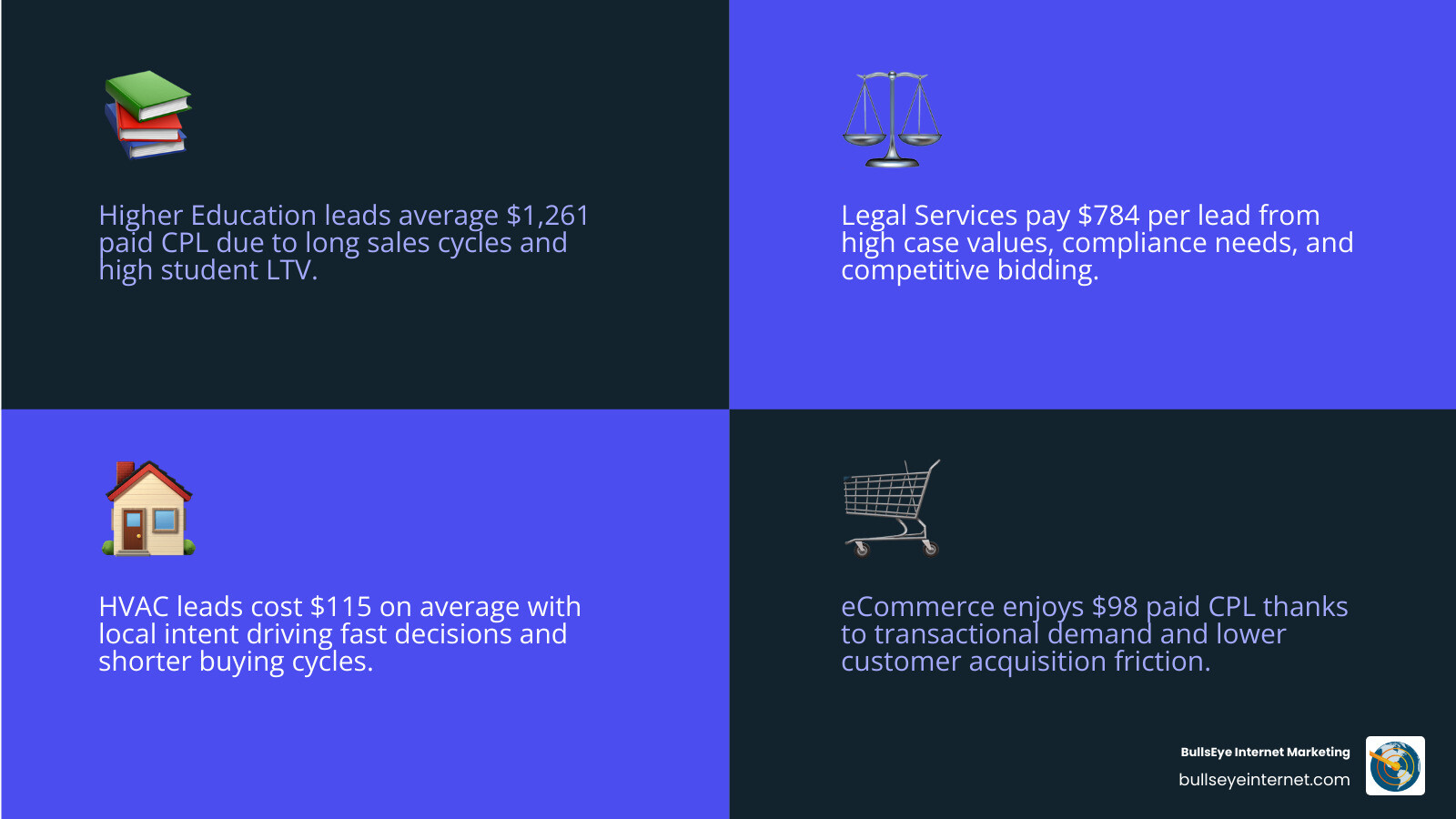
| Higher Education | $1,261 | $705 | $982 |
| Financial Services | $761 | $555 | $653 |
| Legal Services | $784 | $516 | $649 |
| Manufacturing | ~$600 | ~$400 | $553 |
| B2B SaaS | ~$310 | ~$164 | $237 |
| HVAC | $115 | $69 | $92 |
| eCommerce | $98 | $83 | $91 |
The global average across all industries sits around $198 per lead — but that number alone tells you almost nothing useful.
A $50 lead can be a money-loser in one industry and a $500 lead can be a bargain in another. It all depends on your close rate, customer lifetime value, and whether the lead is exclusive to you or shared with five competitors.
That’s exactly why understanding lead costs by industry matters so much before you spend a single dollar.
I’m Ronnie Katz, founder of BullsEye Internet Marketing, and I’ve spent over 20 years helping businesses across competitive industries navigate pay per lead by industry pricing — from home services and legal to healthcare and real estate. Below, I’ll walk you through the 10 most common questions I hear from business owners so you can make smarter, more profitable lead generation decisions.
Terms related to Pay per Lead by Industry:
What Does Pay per Lead by Industry Actually Mean?
When we talk about Pay per Lead by Industry, we are looking at the specific costs and mechanics of acquiring a prospective customer who has shown direct interest in a service or product. In simple terms, a “lead” is a direct connection — an email, a phone call, or a form submission — from someone ready to talk shop.
However, there is a big difference between a generic “Cost Per Lead” (CPL) and a “Pay Per Lead” (PPL) model. CPL is a metric: you take your total marketing spend and divide it by the number of leads generated. If you spend $1,000 on ads and get 10 leads, your CPL is $100. PPL, on the other hand, is a pricing model where you only pay for the actual leads delivered, shifting the risk from you to the lead generation provider.
Understanding this distinction is vital because it impacts your Customer Acquisition Cost (CAC). While CPL only measures the lead, CAC measures the total cost to get a paying customer. In high-stakes industries, the quality and intent of that lead determine whether your CAC stays healthy or skyrockets.
What counts as a lead in different industries?
Not all leads are created equal. Depending on what you do, a lead might look like:
- Home Services: A phone call from a homeowner with a leaking pipe or a broken HVAC unit.
- Legal & Insurance: A detailed case evaluation form or an inquiry about policy rates.
- B2B & SaaS: A request for a product demo, a whitepaper download, or a booked consultation.
- Real Estate: A request for a home valuation or a tour of a specific property.
Pay per Lead by Industry vs cost per lead benchmarks
Benchmarks often distinguish between “Paid CPL” (leads from Google Ads or Social Media) and “Organic CPL” (leads from SEO and content). In 2026, we see a massive gap between these two. For example, in Legal Services, a paid lead might cost $784, while an organic lead costs around $516. When you work with a vendor, you aren’t just paying for the media spend; you’re often paying for their expertise, lead qualification, and the exclusivity of that lead.
Why the same lead can be cheap in one niche and expensive in another
The price of a lead is driven by three things: competition, Lifetime Value (LTV), and urgency. In a niche like “Water Damage Restoration,” the urgency is extreme, and the job value is high, which drives up keyword costs. In “eCommerce,” the barrier to entry is lower, and the sales cycle is shorter, keeping lead costs in the double digits. Geography also plays a role; a lead in a major metro like Miami or Fort Lauderdale will naturally cost 30-60% more than one in a rural area due to higher competition.
What Are the Average Pay per Lead Costs by Industry in 2026?
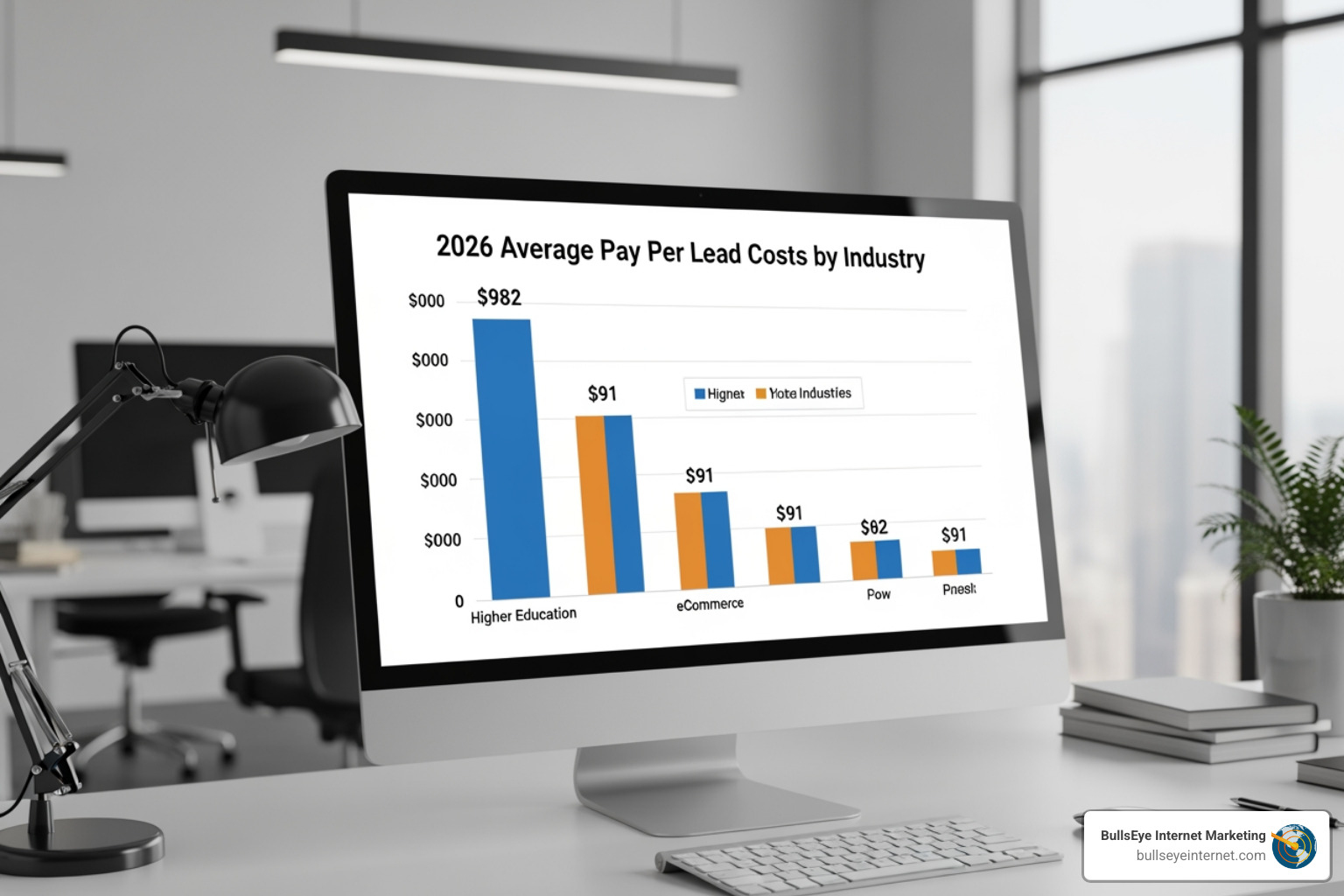
As we move through 2026, lead costs have continued to rise, largely driven by inflation and increased competition in digital ad auctions. While the global average is roughly $198, the “blended” CPL (the average of paid and organic) varies wildly.
| High-Cost Industries | Blended CPL (2026) | Low-Cost Industries | Blended CPL (2026) |
|---|---|---|---|
| Higher Education | $982 | eCommerce | $91 |
| Financial Services | $653 | HVAC | $92 |
| Legal Services | $649 | Auto Repair | ~$30 |
| Manufacturing | $553 | Local Services | $25-$100 |
Pay per Lead by Industry for high-cost sectors
High-cost sectors like higher education and financial services often deal with very long sales cycles and high-ticket values. When a single student represents tens of thousands in tuition, or a legal case is worth $50,000, paying $600+ for a qualified lead is actually a great deal. These industries require high trust and often involve complex buying committees.
Pay per Lead by Industry for lower-cost sectors
On the flip side, lower-cost sectors like HVAC, roofing, and eCommerce benefit from transactional demand. People searching for “AC repair near me” in South Florida have an immediate need. This high intent, combined with shorter buying cycles, allows for more efficient lead generation.
Typical price ranges for major categories
- Legal: $100–$600 (Mass tort can reach $2,000+)
- Finance: $50–$300
- Healthcare: $30–$150
- Home Services: $25–$100
- SaaS: $200–$800 (depending on enterprise vs. SMB focus)
- Real Estate: $20–$100 (for general inquiries)
Which Industries Pay the Most Per Lead and Why?

It’s no surprise that Legal, Finance, and Enterprise Software top the charts. But why?
Why legal and financial leads are so expensive
In the legal world, keywords like “personal injury lawyer” or “car accident attorney” are among the most expensive in Google Ads, often costing hundreds of dollars per click. This is because the potential settlement value is massive. Similarly, financial services are heavily regulated (TCPA compliance), requiring sophisticated lead capture methods that ensure prospects are truly interested and have opted in.
Why education, manufacturing, and B2B tech often see high PPL
These industries don’t just want a name and email; they want a “Sales Qualified Lead” (SQL). In B2B tech, a lead often has to go through a “BANT” (Budget, Authority, Need, Timeline) qualification process. Because the average contract value (ACV) can be $500,000 or more, companies are willing to pay $1,000+ for a lead that has been human-verified.
Why home services and eCommerce are usually cheaper
These industries rely on local intent and high volume. Most people don’t spend six months researching who will fix their toilet; they pick one of the first three results on Google. This lower friction and recurring demand keep the costs manageable, especially when using Pay Per Lead Real Estate or home service strategies that target specific neighborhoods.
Which Channels Produce the Best Lead Costs and Best Lead Quality?
Choosing the right channel is just as important as knowing your industry benchmark.
Organic vs paid: which is cheaper over time?
According to 2026 lead generation pricing data, organic SEO consistently delivers the lowest CPL—often 2x to 4x cheaper than paid ads—once it scales. While paid channels like Google Ads provide immediate volume, organic channels build long-term equity.
- Paid: Great for short-term scale and immediate “hot” leads.
- Organic: Best for lower-funnel leads and long-term ROI (usually takes 12-24 months to fully mature).
Why exclusive leads usually outperform shared leads
This is a huge point of contention in the pay per lead by industry world. Shared leads (sold to 3-5 pros) are cheaper upfront but often have abysmal close rates. Exclusive leads might cost 3x more, but they typically convert at a 5x higher rate because you aren’t racing four other people to the phone. For more on this, check out our guide on Pay Per Lead Generation Companies.
Best-fit channels by industry
- Home Services: Google Local Services Ads (LSAs) and Hvac Pay Per Lead Guide tactics.
- Legal: Google Search and specialized directories.
- B2B/SaaS: LinkedIn Ads and high-value content marketing.
- Medical: Local SEO and Google Business Profile optimization.
How Can You Tell if a Pay per Lead Price Is Actually Profitable?
A lead is only “too expensive” if it doesn’t make you money. To find your “sweet spot,” you need to look at your Lifetime Value (LTV).
The simple formulas every business should use
- CPL: Total Spend / Total Leads.
- CPA (Cost Per Acquisition): CPL / Close Rate.
- ROI: (Revenue from Leads – Cost) / Cost.
A healthy benchmark is the 3:1 LTV to CAC ratio. If a customer is worth $3,000 to you over their lifetime, you should be comfortable spending up to $1,000 to acquire them. In many service industries, we aim for a target CPA that is 20-30% of the initial job value.
Why a low lead price can still lose money
Cheap leads from “lead aggregators” are often recycled or low-intent. If you pay $15 for a lead but only close 1% of them, your CPA is $1,500. If you pay $100 for an exclusive lead and close 25%, your CPA is $400. The “expensive” lead is actually the better deal.
How geography and exclusivity change profitability
In South Florida—places like Miami, Fort Lauderdale, and West Palm Beach—the market is saturated. You will pay a premium to appear at the top of search results. However, because the population density is high, the volume is there to justify the cost if you are working with Pay Per Lead Marketing Agency that understands these local nuances.
How Should Businesses Budget and Choose a Pay Per Lead Partner?
Most established businesses should budget 5-12% of their gross revenue for marketing. If you are in a high-growth phase, that might jump to 15-20%.
When choosing a partner for Pay per Lead by Industry, look for these “red flags” and “green flags”:
- Green Flag: No long-term contracts. If the leads are good, you’ll stay.
- Green Flag: One client per area. You shouldn’t be competing with your own agency’s other clients.
- Red Flag: Shared leads. If they sell the same name to five people, your ROI will suffer.
- Red Flag: Lack of transparency. You should be able to hear call recordings or see exactly where the leads are coming from.
Questions to ask before buying leads in any industry
- Are these leads exclusive to my business?
- How do you qualify the leads before sending them?
- What is your refund policy for “bad” leads (wrong numbers, out of service area)?
- Can I see a real-time dashboard of my lead flow?
Industry-specific examples and next steps
Whether you are looking for Roofing Pay Per Lead 101 tips or need PPL For Weight Loss, the strategy remains the same: focus on quality over quantity.
- Lawyers: Focus on high-intent search terms. Pay Per Lead For Lawyers
- Water Damage: Focus on speed and 24/7 availability. Water Damage Pay Per Lead
- Pest Control: Focus on recurring service contracts. Pest Control Pay Per Lead
Frequently Asked Questions About Pay per Lead by Industry
What is a good pay per lead cost for my industry?
A “good” cost is relative to your profit margin. For home services, $50-$120 is standard. For legal or financial services, $200-$600 is common. The key is ensuring your CPA (Cost Per Acquisition) allows for a healthy profit margin after all overhead is paid.
Which channel usually delivers the lowest long-term lead cost?
Organic SEO and local map optimization (Google Business Profile) consistently deliver the lowest long-term costs. While it takes time to build authority, the “cost per click” eventually drops to zero, leaving you only with the cost of maintaining your rankings.
Are exclusive leads worth paying more for?
Absolutely. Exclusive leads typically close at a rate 3-5x higher than shared leads. When you are the only one calling the prospect, you aren’t fighting a price war, and you have a much better chance of building a relationship.
Conclusion
Navigating pay per lead by industry doesn’t have to be a guessing game. By understanding the 2026 benchmarks and focusing on lead quality rather than just lead volume, you can build a predictable, profitable growth engine for your business.
At BullsEye Internet Marketing, we believe in a different approach. We don’t believe in long-term contracts because we believe our results should keep you coming back. We also work with only one client per industry per geographic area — whether you’re in Miami, Fort Lauderdale, or Palm Beach — giving you a distinct competitive advantage.
Ready to stop guessing and start growing? Learn more about our Pay Per Lead services and see how we can help you dominate your local market.
