
Why Startup Growth Hacking Is the Smartest Move You Can Make Right Now
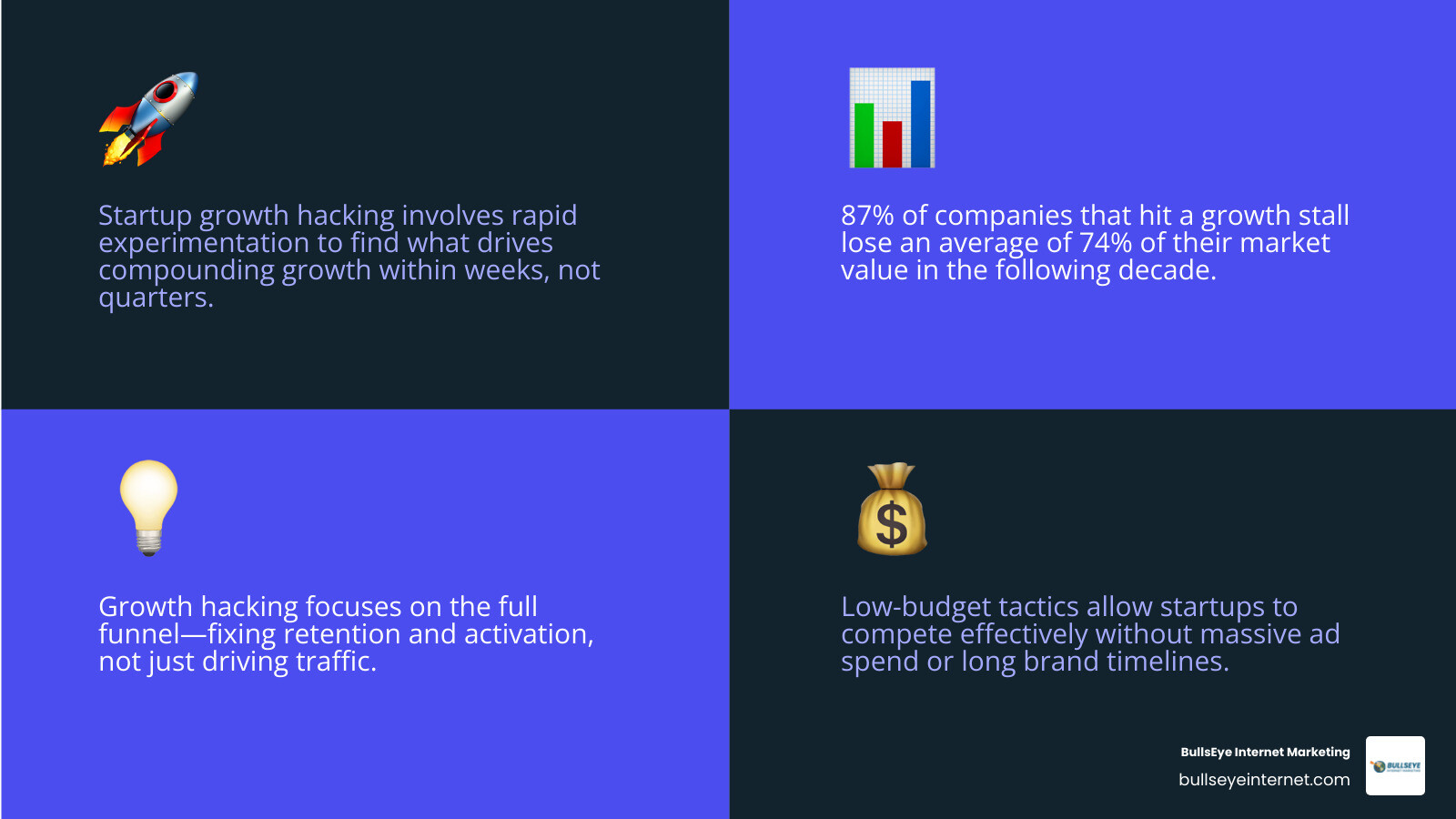
Startup growth hacking is the practice of running fast, low-cost experiments across your product, marketing, and distribution to find what actually drives compounding growth — before your runway runs out.
Here’s a quick snapshot of what it covers:
| What | Why It Matters |
|---|---|
| Rapid experimentation | Find what works in weeks, not quarters |
| Full-funnel focus | Fix retention and activation, not just traffic |
| Low-budget tactics | Compete without a massive ad spend |
| Data-driven decisions | Replace gut feelings with real behavioral signals |
| Compounding loops | Build growth that feeds itself over time |
Back in 2010, the term “growth hacker” didn’t even exist. A small group of startup advisors, frustrated by watching expensive marketing executives burn through limited budgets on billboards and PR agencies, needed a new word for something different — someone obsessively focused on moving the needle, using whatever combination of product, data, and creativity it took.
That frustration is still relevant today. Most early-stage businesses can’t afford to wait for a slow-burn brand strategy to kick in. You need users. You need revenue. And you need them now.
The good news? 87% of companies that hit a growth stall lose an average of 74% of their market value in the decade that follows — which means the startups that build a real growth system early hold an enormous competitive advantage over those that don’t.
This guide gives you 15 scrappy, proven strategies you can start using today — no bloated budget required.
I’m Ronnie Katz, founder of BullsEye Internet Marketing, and I’ve spent over 20 years helping businesses grow their online visibility, traffic, and conversions — including advising early-stage companies on exactly the kind of startup growth hacking strategies covered in this guide. Everything in this article comes from real-world experience, not theory, so you can trust that what follows is built to work.
Startup growth hacking helpful reading:
The Evolution of Startup Growth Hacking vs. Traditional Marketing
To understand how we get users today in July 2026, we have to look back at how this whole movement started. The term “growth hacker” was coined in 2010 by Sean Ellis at a Southern California bar over a mint julep and two cold beers with Hiten Shah and Patrick Vlaskovits. They were looking for a way to describe a new breed of marketer.
At the time, early-stage startups were making the fatal mistake of hiring expensive, traditional marketing executives. These executives, trained in corporate environments, would immediately spend hundreds of thousands of dollars on billboards, PR agencies, and slow-moving brand campaigns. The result? They burned through precious seed capital without moving a single key metric.
Traditional marketing is fundamentally about brand awareness, top-of-funnel reach, and slow quarterly campaign cycles. It relies heavily on creative intuition and massive budgets.
In contrast, startup growth hacking is a highly disciplined, cross-functional system. It is a hybrid of marketing, engineering, product design, and data analytics. Instead of focusing solely on getting people to the front door, a growth hacker looks at the entire customer journey. They ask: How do we optimize rapid customer flow? How do we build viral loops directly into the software?
When you are a new business, you do not have the luxury of waiting six months for a brand campaign to deliver results. By focusing on rapid, weekly iteration cycles, your team can test ten small product tweaks or distribution channels in the time it takes a traditional agency to draft a single creative brief. For more tips on how to bootstrap your early visibility without burning cash, check out our guide on How to Market Your New Business Without Selling Your Kidney.
The AARRR Framework: Building a Repeatable Growth Flywheel
If you want to build a sustainable business, you must stop treating growth as a series of random, one-off “hacks.” Instead, you need a repeatable system. The foundation of this system is the AARRR framework, affectionately called “Pirate Metrics” because of its acronym:
- Acquisition: How do users find you?
- Activation: Do they have a great first experience?
- Retention: Do they come back over time?
- Referral: Do they tell others about your product?
- Revenue: How do you make money?
Most founders obsess over Acquisition. They think, “If I just get more traffic, my startup will grow.” But if your activation and retention are broken, pouring traffic into your product is like pouring water into a leaky bucket.
In fact, a 10% improvement in Activation often delivers more active users than a 50% increase in Acquisition spend. Why? Because it plugs the leak at the very top of your product experience.
To build a true growth engine, we must shift our mental model from linear funnels to compounding growth flywheels.
| Feature | Linear Funnels | Compounding Growth Flywheels |
|---|---|---|
| Core Concept | Users go in the top; customer comes out the bottom. | The output of one cycle becomes the input of the next. |
| Sustainability | Requires constant paid marketing spend to keep running. | Growth naturally compounds and lowers effective CAC. |
| Primary Metric | Total traffic, page views, and raw signups. | Cohort retention and viral coefficient. |
| Product Role | Separate from marketing; product is just what is sold. | The product itself acts as the primary distribution channel. |
When you document and measure your growth loops, the results are staggering. Startups with a documented, measurable value loop achieve 3.2x higher Day-7 retention than those using traditional linear funnel models. Furthermore, startups with documented, measured flywheels grow 4.7x faster in ARR over 24 months.
If your week-4 user retention rate is under 20%, you do not have a growth problem — you have a fundamental product-market fit problem. We always advise our clients to fix retention first. Once your cohort curves flatten out (meaning a stable percentage of users stay active indefinitely), you are ready to scale.
To see how to apply these metrics to your paid acquisition, check out our insights on Why Your Startup Needs a Digital Ad Strategy Yesterday.
15 Scrappy Growth Hacking Strategies for 2026
Forget bloated budgets and slow-burn corporate strategies. Today’s most explosive startups engineer their traction. Here are 15 highly effective, scrappy strategies designed to build self-reinforcing growth loops.
1. Zero-Click Conversions (Pre-Solved States)
Instead of forcing new signups to start with a blank canvas, pre-load your product with pre-solved states. This could mean auto-generating sample data, pre-loading industry-standard templates, or using AI to draft their first project within seconds of registration. Removing the blank-canvas anxiety drastically reduces friction and immediately demonstrates product value.
2. Network Hijacking (Workflow Integration)
Do not try to build a brand-new destination from scratch if you can embed your product into already-active networks. Build deep integrations, browser extensions, or plugins for platforms where your target users already spend their workdays (like Slack, Figma, GitHub, or Salesforce). This allows users to experience your product’s core value without switching contexts, achieving 5.7x faster time-to-10k users than relying on owned channels alone.
3. Co-Development Programs
Turn your earliest users into active co-developers. Launch with a structured program where users submit templates, vote on the feature roadmap, or build integrations in exchange for early access or platform credits. Startups with active co-development programs see 4.1x higher NPS and 68% lower churn because their community feels a deep sense of ownership.
4. Community Seeding & Reddit Arbitrage
Find 5 to 10 highly active niche communities on platforms like Reddit, Discord, or specialized forums. Spend 4 to 6 weeks contributing genuine value — answering questions, sharing free resources, and writing detailed guides without promoting your business. When you finally share your product, frame it as a free tool built specifically to solve a problem the community has been complaining about. Community word-of-mouth has 3-5x higher conversion than paid ads because the trust is built-in.
5. Referral Re-Triggers
Most referral programs fail because they ask users to invite friends at checkout or immediately after signing up. Instead, trigger your referral prompt exactly when the user experiences a major success event (their first “aha” moment). Swapping your referral ask to post-success can increase conversion from a baseline of 2.1% to 19%.
6. Dynamic Landing Page Personalization by Source
Stop sending all your referral, social, and search traffic to a single, static landing page. Use lightweight scripts to dynamically swap out headlines, hero images, and call-to-action buttons based on where the visitor came from. Personalizing the page to match the visitor’s referral source can lift conversion rates from 3.4% to 7.1%.
7. High-Intent Free Tool Lead Magnets
Build a simple, highly useful single-purpose utility (like a calculator, grader, or converter tool) and host it on a free subdomain. A free tool that solves a specific pain point captures high-intent search traffic and acts as a massive lead magnet, funneling qualified prospects directly into your primary product ecosystem.
8. Anti-SEO Technical Campaigns
Instead of writing broad, boring listicles that compete with massive media sites, publish highly technical “anti-SEO” guides. Write about ultra-niche, painful engineering or workflow problems, complete with real terminal outputs, bug logs, and code snippets. These deeply technical resources earn 3.8x more referring domains and 5.1x more organic signups than generic content because they solve real, immediate problems for professionals.
9. Citation Bait via Original Research
Conduct a proprietary survey of your industry or release a unique dataset gathered from public APIs. Package these insights into a clean, beautifully formatted report. Journalists, bloggers, and AI search engines are constantly looking for data to back up their claims, making original research an incredible natural backlink generator.
10. Product-Led Virality (Branded Outputs)
If your product produces any public-facing output (like shared reports, embedded widgets, or PDF exports), add a small, elegant brand mark that links back to your site (e.g., “Powered by [Your Brand]”). Turning normal product usage into a continuous, zero-cost distribution channel allows you to acquire new users passively.
11. Personalized Cold Outreach at Human Scale
Bulk email spam is dead. Instead, use AI to conduct deep research on a highly targeted list of 50 prospects per day. Spend at least 60 seconds of research per prospect to customize the opener, mention a specific problem they are facing, and offer a free, no-strings-attached resource. Personalized cold outreach at human scale converts at 8-15%, compared to just 0.5-1% for generic bulk campaigns.
12. Drastically Reducing Time-to-First-Value (TTFV)
Analyze your onboarding flow and ruthlessly cut every unnecessary step. Startups that reduce their median Time-to-First-Value (TTFV) from 42 seconds to 7 seconds see a 214% lift in Day-1 activation and a 39% increase in paid conversion within 30 days.
13. Real-Time Behavioral Triggers
Set up real-time event tracking to monitor user behavior. If a user gets stuck on a specific feature or abandons their workspace halfway through, trigger an automated, personalized in-app prompt or email offering help. Companies using real-time behavioral triggers see a 29% lift in feature adoption and 22% higher LTV.
14. Optimized 7-Day Onboarding Sequences
Do not ignore users after they sign up. Design a highly structured, 7-day onboarding email sequence that focuses entirely on guiding them to their first meaningful product outcome. A well-designed onboarding sequence can improve week-2 retention by 20-40%.
15. Annual Plan Conversion Triggers
Identify users who have been active on your monthly plan for 30 days and offer them a clear incentive (like 1 or 2 months free) to upgrade to an annual subscription. Converting monthly subscribers to annual plans reduces customer churn by 30-40% on average, instantly stabilizing your cash flow.
For B2B-specific strategies, read our guide on B2B Startup Marketing and see how to budget your early experiments in Advertising for Startups.
The AI-Driven Tech Stack and Experimentation Process
In 2026, growth hacking is no longer about manual labor or slow, custom development cycles. It is a highly automated engineering discipline. The barrier to entry has collapsed because small teams can now use AI to build, test, and deploy growth ideas in hours instead of weeks.
Accelerating Startup Growth Hacking with Generative AI and Agents
Generative AI and autonomous AI agents have completely rewritten the growth playbook. Previously, growth hacking was a “search” problem — founders spent hours looking for platform loopholes or manual workarounds. Today, it is a “construction” problem. If you notice a gap in your marketing or product flow, you can describe it to an AI agent and have a custom micro-tool hosted on Cloudflare Pages by the afternoon.
Startups are leveraging large language models (LLMs) across three core growth pillars:
- Product-Led Growth: AI agents facilitate both technical and non-technical content creation, allowing non-technical founders to build functional calculators, custom scrapers, or interactive widgets that serve as powerful free lead magnets.
- Sales-Led Growth: LLMs automate the deep research required for personalized cold outreach. They can scan a prospect’s LinkedIn, read their recent articles, identify their business pain points, and draft a hyper-targeted message in seconds.
- Operational Efficiency: AI lifecycle orchestration tools monitor user behavior and dynamically generate personalized onboarding steps, automated help guides, and custom email sequences to combat customer churn.
Furthermore, AI enables highly efficient programmatic SEO. Instead of writing individual blog posts, startups can use AI to build databases of thousands of high-quality, long-tail landing pages that target ultra-specific user queries, capturing organic search traffic at an unprecedented scale.
To learn more about how AI is changing the landscape, read Growth Hacking with AI in 2026: The Playbook Actually Changed | FindClout.
The Modern Tech Stack and Experimentation Process for Startup Growth Hacking
To run a successful growth system, we recommend keeping your tool stack thin and highly integrated. You do not need to spend thousands of dollars on enterprise software. Instead, focus on wiring lightweight tools together using automation.
Here is the recommended stack for 2026:
- Automation Layers: Make.com or n8n to connect your tools without writing custom backend code.
- AI Engine: Claude for writing copy, analyzing data, and generating code.
- Hosting: Cloudflare Pages for lightning-fast, free hosting of landing pages and micro-tools.
- Analytics & Event Tracking: Privacy-friendly event tracking pipelines to monitor user behavior in real-time.
- Session Recordings: Lightweight tools to watch how users interact with your onboarding flow and identify where they get stuck.
To run this stack effectively, you must adopt a scientific, weekly experimentation process. Do not build features based on gut feelings. Instead, run every idea through the ICE Framework:
$$\text{ICE Score} = \frac{\text{Impact} + \text{Confidence} + \text{Ease}}{3}$$
Every Monday, score your backlog of growth ideas from 1 to 10 on these three metrics:
- Impact: How much will this project move our primary metric?
- Confidence: How sure are we that this will actually work?
- Ease: How simple is this to build and launch?
Run your weekly sprints in a structured sequence: prioritize your highest-scoring ICE experiments on Monday, build and launch them by Wednesday, monitor early data on Friday, and analyze the final results the following week.
For more ideas on how to build a clean, high-converting digital presence, read our guide on Figma Builders and Chaos: A Startup Guide to Web Design. If you are just starting out with organic search, don’t miss The Ultimate SEO Starter Guide for New Businesses and explore a vast database of tactical plays in Startup Growth Hacks — 548 growth plays for 2026.
Common Pitfalls to Avoid in Early-Stage Growth
Even with the best strategies, many startups fail because they fall into common growth traps.
- Premature Scaling: This is the number one startup killer. 62% of failed startups misallocated growth resources by prioritizing scaling and paid acquisition before proving systemic leverage. If your product does not have a stable, flat cohort retention curve, spending money on ads is just burning cash.
- Optimizing for Vanity Metrics: Do not focus on traffic, social media followers, or unactivated signups. These numbers make you feel good, but they do not pay the bills. Focus on behavioral cohorts, Day-7 retention, and paid conversion rates.
- Copying Tactics Blindly: Just because a referral program worked for a cloud storage giant in 2010 does not mean it will work for your B2B developer tool today. Always analyze the underlying psychology of a tactic before adapting it to your audience.
- Ignoring Customer Feedback: Data tells you what is happening, but talking to your customers tells you why. If your activation rate drops, do not just run more tests — get on a call with five users who dropped off and ask them where they got confused.
To keep your brand safe as you scale, read our comprehensive guide on Brand Reputation Management for Startups: A Complete Guide.
Frequently Asked Questions about Startup Growth
Is startup growth hacking ethical?
Yes, absolutely. True growth hacking is about removing friction, improving onboarding, and helping users find your product’s core value as quickly as possible. It relies on customer empathy and value delivery. Ethical growth hacking avoids manipulative dark patterns (like hidden subscription fees or tricking users into inviting contacts) because we know that burning user trust completely ruins long-term retention.
How long does it take to see results from startup growth hacking?
You can often see a significant lift in activation or onboarding metrics within 2 to 4 weeks of focusing on a single high-leverage intervention (like reducing form fields or adding a progress bar). However, building compounding growth loops, organic search authority, and a fully functional referral flywheel typically takes 3 to 6 months of consistent, disciplined experimentation.
Can B2B startups use growth hacking?
Yes, B2B startups can achieve massive success with growth hacking, but the tactics are different from B2C. Instead of chasing quick, viral consumer loops, B2B growth focuses on product-qualified leads (PQLs), champion-driven internal expansion (helping an individual employee love your tool so much they pitch it to their boss), account-based experimentation, and long-tail programmatic SEO.
Conclusion
Building a successful startup in 2026 does not require a multi-million dollar marketing budget. It requires a disciplined, scientific approach to growth. By mapping your core value loops, focusing on user activation, and leveraging modern AI tools, you can build a repeatable growth flywheel that outruns your competitors.
If you are looking to accelerate your growth without signing long-term contracts, we can help. At BullsEye Internet Marketing, we specialize in generating high-quality calls and sales through Pay Per Lead campaigns, Google Business Profile Optimization, professional SEO, local search visibility, PPC, and conversion optimization.
We provide a massive competitive advantage by working with only one client per industry per geographic area. Whether you are based in Miami, Fort Lauderdale, West Palm Beach, or anywhere across the United States, we are dedicated to helping you dominate your local market.
Stop waiting for traction to happen. Let’s engineer it together. More info about digital marketing services.
