
How to Choose Digital Advertising Companies That Deliver Results
The right digital advertising companies do more than buy clicks. They connect your business goals to the right channels, build campaigns that can be measured, and show whether ads are producing calls, leads, sales, or profitable revenue.
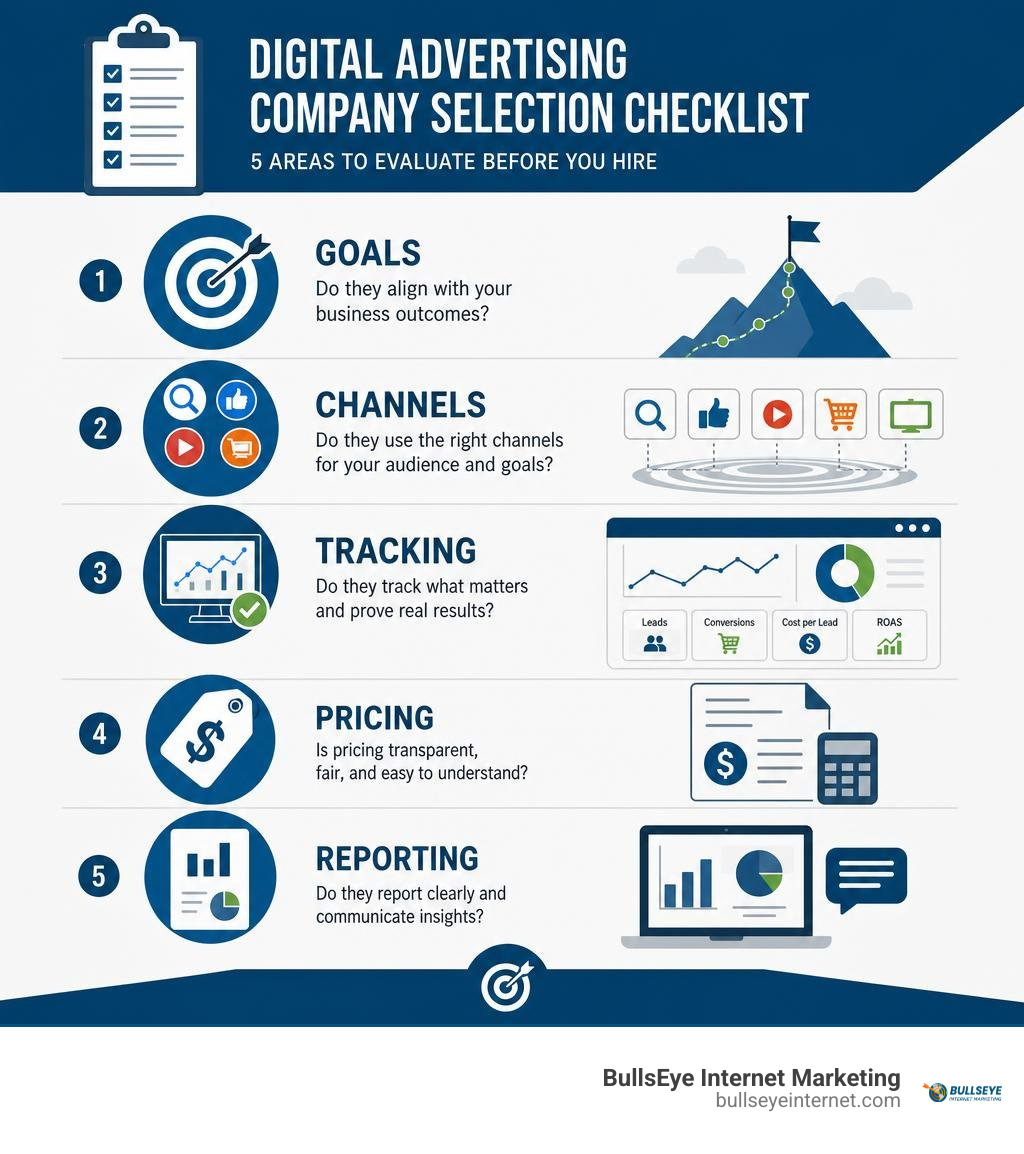
Before hiring an agency, look for three things:
- Clear outcome tracking: Ask how it measures qualified leads, conversion rates, cost per lead, and return on ad spend.
- Channel expertise that fits your buyer: Search can capture active demand, while social, commerce media, programmatic, and connected TV can create or expand it.
- Transparent service and pricing: You should know who manages the account, what work is included, how results are reported, and whether you can leave without a long contract.
This matters because the U.S. digital advertising agency market is worth an estimated $70.3 billion in 2026, across roughly 119,000 businesses. AI is also changing the work: less time is spent on manual bids and routine campaign setup, while more value comes from strategy, creative testing, first-party data, landing-page conversion, and proving business outcomes.
I am Ronnie Katz, founder and Principal CEO of BullsEye Internet Marketing since 2006, with more than 20 years of experience helping businesses evaluate and use digital advertising companies for stronger visibility, leads, and conversions. In the comparisons ahead, I will focus on the agency types, capabilities, and reporting standards that matter when every marketing dollar must earn its place.
Market Dynamics Reshaping Digital Advertising Companies in 2026
The digital advertising ecosystem has undergone a massive shift. The agency sector in the United States expanded at a compound annual growth rate (CAGR) of 9.8% between 2021 and 2026, while the number of registered agency businesses surged at an 18.1% CAGR. This rapid proliferation of service providers has made agency selection more complex for businesses seeking measurable returns.
At the platform level, power remains heavily concentrated. In 2026, the triopoly of Meta, Google, and Amazon commands an overwhelming 62.3% of total worldwide digital ad spending.
For the first time in digital marketing history, forecasts on ad revenue shifts indicate that Meta is projected to surpass Google in global net digital ad revenues. Meta is on track to reach $243.46 billion in 2026 (representing 26.8% market share), powered by an accelerating worldwide growth rate of 24.1%. In contrast, Google is projected to generate $239.54 billion (a 26.4% market share) on a steady growth rate of 11.9%. Meanwhile, Amazon continues its steep ascent as a retail media juggernaut, climbing from $68.64 billion in 2025 to $82.07 billion in 2026, on its way toward an estimated $97.07 billion in 2027.
Beyond raw market share, regulatory scrutiny is transforming media delivery. Antitrust rulings and tightening consumer data privacy standards across the United States have accelerated the deprecation of third-party tracking cookies. Advertisers can no longer rely on legacy retargeting methods. Modern agencies must deploy sophisticated first-party data architectures, server-side tracking, and conversion APIs to maintain campaign attribution.
The Shift Toward Agentic Media Buying and Autonomous Systems
Manual campaign configuration is giving way to autonomous execution. Modern ad tech platforms have transitioned from simple machine learning algorithms to fully agentic systems capable of planning, bidding, and optimizing media in real time.
Supply-side platforms and demand-side systems are pioneering AI-powered ad tech architectures that interpret natural-language media briefs and execute continuous, multi-variable yield optimization. For example, PubMatic’s AgenticOS platform demonstrated a 25.7% uplift in video completion rates and a 31% video-through rate improvement in head-to-head testing. In connected TV (CTV) environments, agentic programmatic deployment has driven an 18% lower cost per mille (CPM) against target baselines while increasing delivered impressions by 23%.

This evolution means agencies no longer deliver value simply by manually tweaking keyword bids or adjusting daily budget caps. The competitive advantage belongs to agencies that design the strategic frameworks, creative assets, and conversion infrastructure that guide these autonomous systems.
Why Leading Digital Advertising Companies Prioritize Outcome-Based Models
With automated bidding accessible across standard ad dashboards, leading agencies differentiate themselves by tying media spend directly to commercial outcomes. This shift has elevated the importance of commerce media, retail media networks (RMNs), and closed-loop measurement systems.
Platforms utilizing first-party conversion engines analyze SKU-level shopping intent across more than 30 billion monthly retail events. By integrating live search, cart additions, and transactional signals across the open internet, these engines identify high-intent buyers and optimize bidding within a latency window of just 14 milliseconds.
Similarly, agencies leverage compound AI machine learning systems like Moloco’s CARA architecture, which updates predictive model versions as frequently as every two hours. These systems delivered a 27% increase in return on ad spend (ROAS) and a 30% increase in display ad click-through rates across mobile and retail media by analyzing continuous user interaction loops. By integrating these systems, high-performing agencies build defensible data moats for their clients.
Comparative Review of the 7 Leading Digital Advertising Agency Archetypes
To help you navigate the 119,000 agencies operating across the United States, we have categorized the industry into seven core archetypes. Each serves distinct business sizes, growth goals, and tech requirements.
| Agency Archetype | Primary Core Services | Best Fit Business Profile | Typical Pricing Model | Target Performance Metric |
|---|---|---|---|---|
| 1. Enterprise Consultancies | Omnichannel transformation, custom IT/CRM stack integration | Multinational brands ($50M+ revenue) | High-tier monthly retainer ($20k–$100k+) | Brand equity lift, blended ROAS |
| 2. Paid Search Specialists | High-intent Google/Bing Ads, Smart Bidding, Shopping | Growth-stage to enterprise lead-gen & e-commerce | % of ad spend (10–20%) or flat management fee | Cost Per Acquisition (CPA), Search Impression Share |
| 3. Social & Commerce Accelerators | Meta Advantage+, TikTok Shop, SKU-level RMNs | Direct-to-consumer (DTC) brands, consumer products | Base fee + % of tracked revenue | ROAS, Incremental Gross Merchandise Value (GMV) |
| 4. Programmatic & CTV Networks | Connected TV, digital out-of-home (DOOH), real-time DSP/SSP | Mid-market to enterprise consumer brands | Dynamic CPM markup / managed spend fee | Cost Per Completed View (CPCV), Brand Lift |
| 5. Local Lead Gen Specialists | Pay-Per-Lead, Google Business Profile, Local Services Ads | Local service businesses, contractors, regional practices | Fixed Pay-Per-Qualified-Lead or performance fee | Cost Per Inbound Call, Qualified Lead Volume |
| 6. AI-Driven Dynamic Creative Studios | Automated multivariate copy/video generation, asset scaling | High-velocity digital advertisers, mobile app publishers | Project-based tier or monthly creative retainer | Click-Through Rate (CTR), Creative Conversion Rate Lift |
| 7. Full-Funnel Hybrid Agencies | Paid search, conversion optimization, paid social, SEO | Small-to-midsize businesses (SMBs), growing firms | Performance-tiered retainers with no-contract flexibility | Net Customer Acquisition Cost (CAC), Pipeline ROI |
1. Enterprise Omnichannel Consultancies
Enterprise consultancies serve global brands that require coordinated marketing deployments across dozens of regional markets. These firms combine traditional corporate consulting with full-service creative, media planning, and systems integration.

Capabilities and Media Buying Execution
Enterprise consultancies manage tens of millions of dollars in annual media spend. Their core strength lies in unifying enterprise data warehouses (such as Snowflake or BigQuery), customer relationship management (CRM) software (Salesforce, Adobe Experience Cloud), and marketing automation platforms into a single media buying ecosystem. They deploy advanced multi-touch attribution (MTA) and media mix modeling (MMM) to determine how television, print, search, and social media investments interact over multi-year buying cycles.
Strengths and Trade-Offs
- Strengths: Unrivaled enterprise resource access, international market scale, unified tech stack deployments, and boardroom-level strategic alignment.
- Trade-Offs: Extremely high overhead, slower campaign deployment cycles, and long-term locked contracts. For small to mid-sized businesses, these firms represent significant cost inefficiency, as smaller ad budgets rarely receive senior-level attention.
2. High-Performance Paid Search Specialists
Paid search specialists focus exclusively on capturing active, high-intent commercial demand on platforms like Google Search and Microsoft Advertising.
To master active demand capture, companies often consult a pay per click management complete guide to establish clear performance baselines before selecting an agency partner.
Advanced Optimization Strategies
Top search specialists focus on high-intent keyword discovery, comprehensive negative keyword governance, and advanced Smart Bidding management (such as Target CPA and Target ROAS). Rather than letting automated systems bid indiscriminately, these agencies structure accounts to train machine learning models using verified first-party conversion data. They optimize Google Performance Max campaigns by supplying tightly controlled audience signals, structured asset groups, and custom conversion values.
Measurable Performance Metrics
These agencies are judged on bottom-of-the-funnel conversion efficiency:
- Impression Share in Top Absolute Positions: Ensuring ads appear above competitors for critical commercial searches.
- Conversion Rate (CVR): Maximizing the percentage of paid clicks that convert into phone inquiries or completed transactions.
- Cost Per Acquisition (CPA): Continuously driving down the cost required to generate a paying customer.
3. Dedicated Social and Commerce Media Accelerators
Social and commerce media accelerators specialize in paid social networks and fast-growing retail media ecosystems.
Platform Mastery: Meta Advantage+ and Retail Networks
With Meta’s global advertising revenue accelerating to $243.46 billion in 2026, these agencies focus heavily on Meta Advantage+ shopping and lead campaigns. They leverage Meta’s deep neural networks, feeding the algorithm large volumes of structured creative variations to let the platform identify optimal user-product pairings across Facebook and Instagram feeds, Stories, and Reels.
In the retail space, these accelerators manage product visibility across marketplace ad networks, deploying real-time bidding strategies on platforms like Amazon Advertising to capture shoppers right at the digital point of sale.
Dynamic Creative Testing
Because social ad performance degrades quickly due to audience creative fatigue, social accelerators operate rapid creative iteration pipelines:
- Iterative Hooks: Testing 5 to 10 distinct visual or conceptual opening hooks per creative asset.
- Dynamic Product Ads (DPA): Syncing catalog feeds to automatically display products based on past user browsing history.
- Format Diversification: Deploying a continuous mix of user-generated content (UGC) styles, high-production video, and interactive carousel formats.
4. Programmatic and Connected TV Networks
Programmatic and CTV specialists operate in the automated media buying space outside walled-garden search and social environments.
Supply-Side Precision and Audience Curation
These agencies utilize advanced Demand-Side Platforms (DSPs) to access premium inventory across major streaming networks, digital out-of-home (DOOH) screens, and top-tier web publishers. By partnering with modern Supply-Side Platforms (SSPs), they curate customized audience marketplaces based on Automatic Content Recognition (ACR) data from smart televisions, household demographic data, and offline purchase behavior.
Attribution Beyond Clicks
Because television and programmatic display ads rarely result in an immediate link click, these specialists rely on advanced attribution models:
- Cost Per Completed View (CPCV): Verifying efficient spend delivery for fully viewed non-skippable assets.
- Cross-Device Household Matching: Tracking whether a household exposed to a CTV commercial subsequently visited the brand’s website or physical storefront on a mobile device or laptop.
- View-Through Conversion (VTC) Measurement: Evaluating the indirect lift programmatic impressions provide across paid search and direct channels.
5. Local Lead Generation Specialists
Local lead generation agencies specialize in capturing local commercial intent for regional and service-based businesses.
For local businesses seeking to dominate their geographic service zones, reviewing a local marketing agency complete guide provides essential criteria for evaluating local optimization capabilities.
Geotargeted Search and Map Pack Optimization
These agencies coordinate high-intent Google Search campaigns with systematic Google Business Profile (GBP) optimization and Local Services Ads (LSAs). By deploying precise geofencing, location-specific bidding adjustments, and targeted local citations, they ensure local service providers dominate the coveted Google “Map Pack” and local search results.
The Pay-Per-Lead and Exclusivity Advantage
The top local lead generation specialists move entirely away from abstract metrics like impressions or clicks. Instead, they structure programs around transparent, tangible outcomes:
- Pay-Per-Qualified-Lead Models: Advertisers pay strictly for verified inbound phone calls, form completions, or appointment bookings.
- Strict Market Exclusivity: Premier local agencies work with only one client per industry within a specific geographic territory. This protects businesses from paying an agency that is simultaneously bidding against them on behalf of a direct local competitor.
6. AI-Driven Creative and Dynamic Asset Studios
AI-driven creative studios operate at the intersection of generative technology and behavioral psychology, focusing on solving ad fatigue through rapid asset production.
High-Velocity Creative Iteration
These agencies deploy generative AI pipelines to produce, test, and refine thousands of visual and copy variations in fractions of the time required by traditional creative agencies:
- Automated Multivariate Copywriting: Generating real-time ad copy variations tailored to specific buyer pain points, emotional triggers, and seasonal events.
- Dynamic Background and Visual Swapping: Testing product imagery against dozens of lifestyle contexts, color palettes, and typographic layouts.
- Predictive Engagement Modeling: Using computer vision algorithms to score ad creative elements (such as logo placement, human facial expressions, and text density) against historic conversion databases prior to launch.
Conversion Rate Lift
By identifying winning creative combinations faster, dynamic asset studios help businesses significantly decrease their Cost Per Click (CPC) and improve ad relevance scores across major media platforms.
7. Full-Funnel Hybrid Performance Agencies
Full-funnel hybrid performance agencies integrate brand discovery, intent capture, and post-click conversion optimization into a unified service framework.
Businesses looking for an agency that seamlessly blends top-of-funnel reach with bottom-of-funnel conversion often turn to the best adwords agency to ensure search ads convert efficiently alongside other channels.
Blended Search, Social, and Demand Generation
Rather than isolating channels into separate silos, hybrid agencies coordinate campaigns across the entire customer journey:
- Top of Funnel (Awareness & Consideration): Deploying Meta Advantage+, YouTube video, and Demand Gen campaigns to introduce solutions to target audiences.
- Bottom of Funnel (Intent Capture): Running tightly structured Google and Bing search campaigns to capture high-intent buyers ready to purchase.
- Conversion Rate Optimization (CRO): Designing custom, dedicated landing pages that maximize the percentage of paid traffic that turns into revenue.
Unified Attribution
Hybrid performance agencies utilize server-side tracking, closed-loop CRM connections, and unified data dashboards to prove exactly how each marketing dollar contributes to top-line business growth.
How to Select and Evaluate the Right Digital Advertising Partner
Selecting an advertising agency requires careful evaluation of technical capabilities, transparency, and operational standards. Reviewing modern marketing mastery finding the right digital ads agency for you can help you audit an agency’s strategic process before signing an agreement.
Use this four-point framework to vet potential partners:
- Audit First-Party Conversion Infrastructure: Verify that the agency implements server-side tracking (such as Google Tag Manager Server Container or Meta Conversions API) rather than relying exclusively on vulnerable browser-based tracking pixels.
- Review Client Exclusivity Policies: Confirm whether the agency represents your direct competitors in your local market or vertical. Agencies that take on multiple direct competitors in the same market face a fundamental conflict of interest, driving up CPCs for both clients.
- Examine Contract Terms: Be cautious of agencies requiring mandatory 6-month or 12-month lock-in contracts. High-performing agencies earn client retention every month based on verified results, offering flexible, no-contract agreements.
- Demand Direct Attribution Access: Ensure that your business maintains full administrative ownership of your Google Ads, Meta Business Manager, and analytics accounts. Never partner with an agency that withholds access to your campaign data or historical performance metrics.
Key Tech Stacks Used by Premier Digital Advertising Companies
Premier digital advertising companies utilize a modern ad tech stack designed to optimize performance across every stage of the funnel:
- Compound AI Optimization Engines: Leveraging tools like Moloco CARA or proprietary machine learning algorithms to continuously adjust bids based on live conversion probabilities.
- Server-Side Tracking & CAPI Solutions: Implementing server-to-server data pipelines that preserve conversion tracking accuracy against ad blockers and privacy restrictions.
- Conversion Rate Optimization Platforms: Deploying tools like Unbounce, VWO, or custom headless landing pages for continuous A/B split testing.
- Real-Time Attribution & BI Dashboards: Unifying Google BigQuery, Looker Studio, and CRM integrations (HubSpot, Salesforce) to report revenue, pipeline value, and true ROAS.
Pricing Structures and Industry Exclusivity Standards
Agency pricing structures generally fall into three standard models:
- Percentage of Ad Spend: The agency charges a variable fee (typically 10% to 20%) based on total monthly media investment. While standard, this model can create a misalignment of incentives if an agency encourages higher ad spend without improving conversion efficiency.
- Flat Monthly Management Retainers: A fixed monthly management fee based on campaign scope, channels managed, and reporting frequency. This provides cost predictability for the advertiser.
- Pay-Per-Lead / Performance-Based Pricing: The agency charges strictly based on delivered business outcomes (such as verified, exclusive inbound phone calls or qualified lead submissions).
At BullsEye Internet Marketing, we operate with a clear philosophy: we work on a no long-term contract basis, and we maintain strict geographic and industry exclusivity. We work with only one client per industry per geographic area, ensuring that our strategic efforts, keyword targeting, and bidding strategies are 100% dedicated to giving your business a decisive market advantage.
Frequently Asked Questions About Digital Advertising Agencies
How are AI and agentic systems changing digital ad campaign management?
AI and agentic systems (such as PubMatic’s AgenticOS) are shifting campaign management from manual bid adjustments to autonomous orchestration. These platforms process natural-language campaign briefs, optimize yield across SSPs and DSPs in real time, and dynamically assemble creative assets to maximize engagement. Agencies now focus on providing high-quality creative inputs, setting strategic constraints, establishing first-party data connections, and managing post-click conversion rates.
Why is Meta surpassing Google in total digital advertising revenue?
Meta’s projected milestone of reaching $243.46 billion in worldwide net ad revenue in 2026—surpassing Google’s $239.54 billion—is driven by rapid AI integration across its advertising stack. Meta’s Advantage+ automated campaign engine, combined with powerful discovery algorithms across Instagram Reels, Facebook feeds, and messaging apps, has significantly improved ad relevance and advertiser ROAS, accelerating Meta’s growth rate to 24.1%.
What service model delivers the highest return on ad spend for growing businesses?
For growing businesses and local service providers, full-funnel performance models that combine paid search intent capture, Google Business Profile optimization, and Pay-Per-Lead structures consistently deliver the highest ROAS. Prioritizing agencies that offer single-client industry exclusivity and no long-term contractual lock-in ensures that marketing investments are directly aligned with verified revenue generation.
Conclusion
Choosing among digital advertising companies in 2026 comes down to one fundamental principle: measurable business outcomes over vanity metrics. As artificial intelligence, agentic media buying platforms, and retail media networks reshape the advertising landscape, the value of an agency no longer lies in manual campaign mechanics, but in strategic execution, conversion optimization, and proven lead generation.
At BullsEye Internet Marketing, we have helped businesses across the United States grow their bottom line since 2006. We specialize in driving qualified calls and profitable sales through Google Ads, Google Business Profile optimization, Pay Per Lead programs, SEO, and dedicated conversion optimization. We operate without long-term contracts and uphold a strict one client per industry per geographic market standard to ensure your business maintains a dominant competitive edge.
Explore our comprehensive digital advertising services today to secure exclusive market representation and transform your digital media investments into predictable, profitable growth.
