
How Is AI Changing the Search Landscape in 2026?
The way consumers find products, service providers, and expert answers has fundamentally shifted. For over two decades, search engine optimization meant fighting for position among Google’s top ten blue links. Today, millions of potential buyers skip search engine result pages (SERPs) entirely. Instead, they turn to generative conversational platforms—including ChatGPT, Perplexity, Claude, Gemini, and Google AI Overviews—to ask full, natural-language questions and receive synthesized, direct recommendations.
The statistics surrounding this migration paint a clear picture:
- Massive Adoption: ChatGPT alone handles over 2.5 billion prompts daily and serves hundreds of millions of active users weekly. Over 45% of consumers interact with generative AI weekly for personal research and product recommendations.
- Shift in User Behavior: 58% of consumers rely on AI platforms for product and service recommendations (up from 25% in 2023), while 20% of all global search queries are now natural-language questions averaging nearly 11 words.
- Erosion of Traditional Organic Clicks: Google’s worldwide search market share dropped below 90% for the first time in over a decade. Furthermore, 69% of traditional Google searches end without a user clicking through to any website (zero-click searches).
- The Commercial Opportunity: AI search referrals to retail sites surged 1,300% during recent holiday shopping seasons. Industry analysts at IDC forecast that corporate spending on LLM optimization will be five times greater than traditional SEO by 2029.
When a prospective customer asks an AI engine, “What is the best commercial property management firm near me with transparent reporting?” the model does not present a list of 10 links for the user to browse. It reads, evaluates, and synthesizes top online sources to produce a concise response highlighting three or four recommended options.
If your company is not cited inside that synthesized answer, you do not exist in that buyer’s decision matrix.
At BullsEye Internet Marketing, we help businesses adapt to this reality. By deploying targeted generative engine optimization strategies, we ensure our clients are actively recommended when potential customers consult conversational AI platforms.

What Is LLM SEO and How Does It Differ From Traditional SEO?
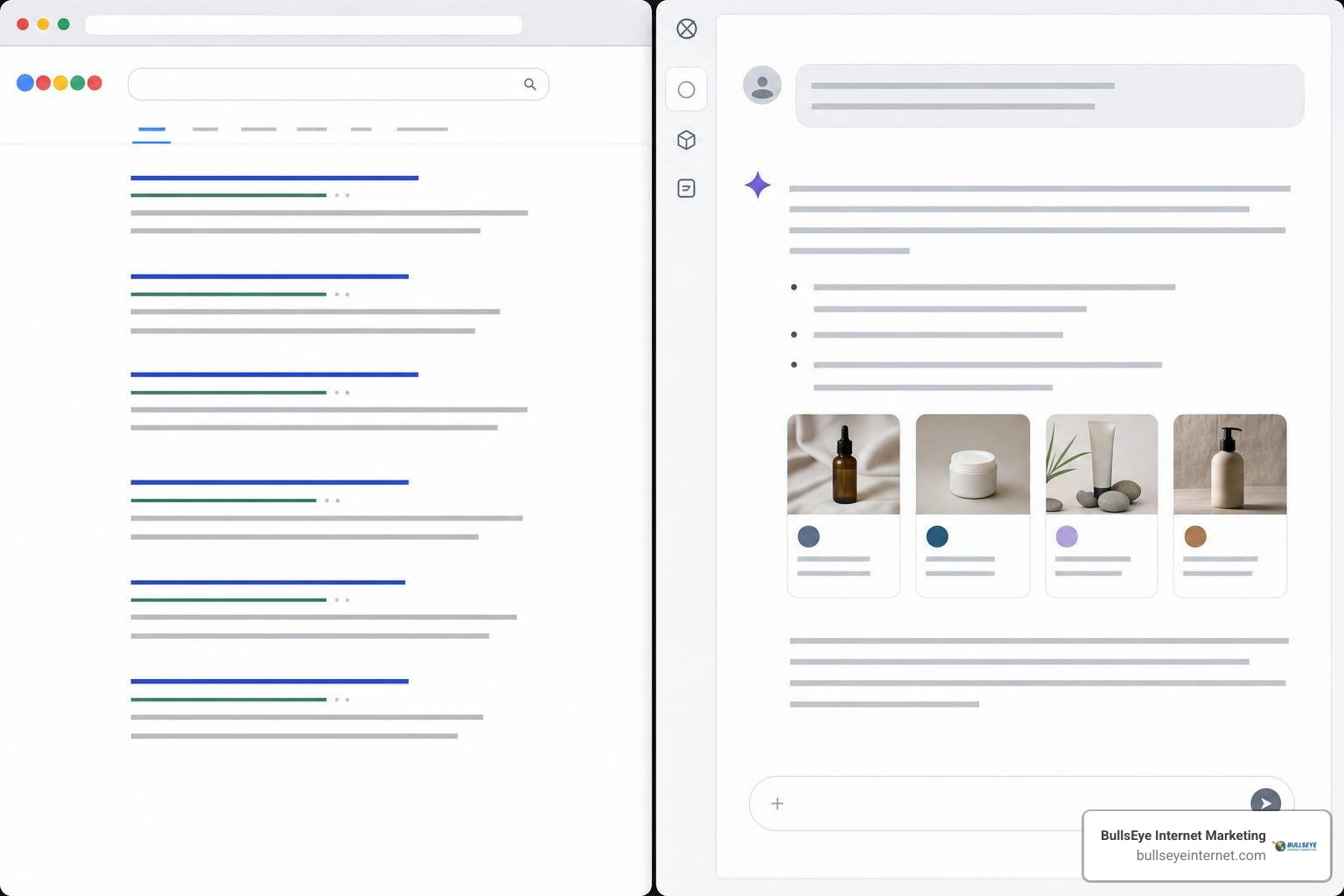
To navigate this landscape, it is helpful to clarify three overlapping terms that define modern AI search visibility:
- Large Language Model SEO (LLM SEO or LLMO): The practice of optimizing web content and overall digital brand footprint so that large language models discover, accurately comprehend, trust, and cite your brand within AI-generated responses.
- Generative Engine Optimization (GEO): On-page formatting, factual densification, and entity structuring designed to make your web pages easy for generative models to parse and extract.
- Answer Engine Optimization (AEO): Strategies focused on winning direct answer boxes, featured snippets, and immediate conversational responses across search engines and voice assistants.
For a deeper dive into these frameworks, review our guide on AEO, GEO, and LLM SEO.
While traditional SEO focuses on ranking web pages higher on SERPs to earn clicks, LLM SEO focuses on earning inclusion within the top ~5 citation slots inside synthesized AI answers.
| Optimization Dimension | Traditional SEO | LLM SEO & GEO |
|---|---|---|
| Primary Goal | Secure top rank in blue links; maximize CTR | Secure brand inclusion and direct citation in AI answers |
| Target Audience | Search crawlers + human click-through visitors | Generative AI models + high-intent conversational buyers |
| Primary Ranking Drivers | Keywords, title tags, backlink volume, domain rank | Entity authority, factual density, RAG retrievability |
| Content Formatting | Keyword-targeted landing pages, long-form content | BLUF blocks, structured tables, standalone FAQ chunks |
| User Intent & Queries | Short-tail & exact-match keywords (2–4 words) | Conversational, preference-heavy prompts (~10.9 words) |
| Traffic Characteristics | Higher overall traffic volume; variable intent | Lower referral volume; 4.4x higher conversion value |
What makes conversational AI traffic fundamentally higher converting?
While AI-referred web traffic typically represents a smaller raw volume compared to peak Google organic traffic, the conversion quality of these visitors is vastly superior. Industry studies show that AI search visitors are 4.4x more valuable than traditional organic search visitors.
Why does this happen? Conversational AI acts as a pre-qualification filter. When a user asks an AI engine a detailed, preference-driven question—such as “Find me a digital marketing agency in South Florida that specializes in pay-per-lead, offers no long-term contracts, and provides exclusive market protection”—the AI resolves multiple comparison steps on-screen.
By the time the user clicks a cited source link inside the AI answer, they have already evaluated the options and confirmed fit. They are not entering the top of your funnel; they are arriving ready to convert.
Why is link building still the most critical lever for AI visibility?
A common misconception is that LLM optimization renders backlinks obsolete. In practice, the opposite is true. High-quality backlinks remain the single most influential driver for securing AI citations.
Modern language models rely heavily on domain trust and entity authority signals when selecting which sources to trust during real-time retrieval. When an AI engine queries a live web index to formulate an answer, it prioritizes pages hosted on domains with strong backlink profiles and high topical authority.
In fact, research confirms that sites ranking on the first page of traditional search engines are cited by AI engines nearly 77% of the time, while top-three ranking positions are cited roughly 82% of the time.
Earning backlinks and authoritative mentions from widely trusted industry journals, news sites, and niche platforms builds the foundational domain trust that LLMs require before recommending your business. To explore this core lever further, watch these expert insights on AI SEO link building strategies.
How Do Large Language Models Find, Process, and Retrieve Content?
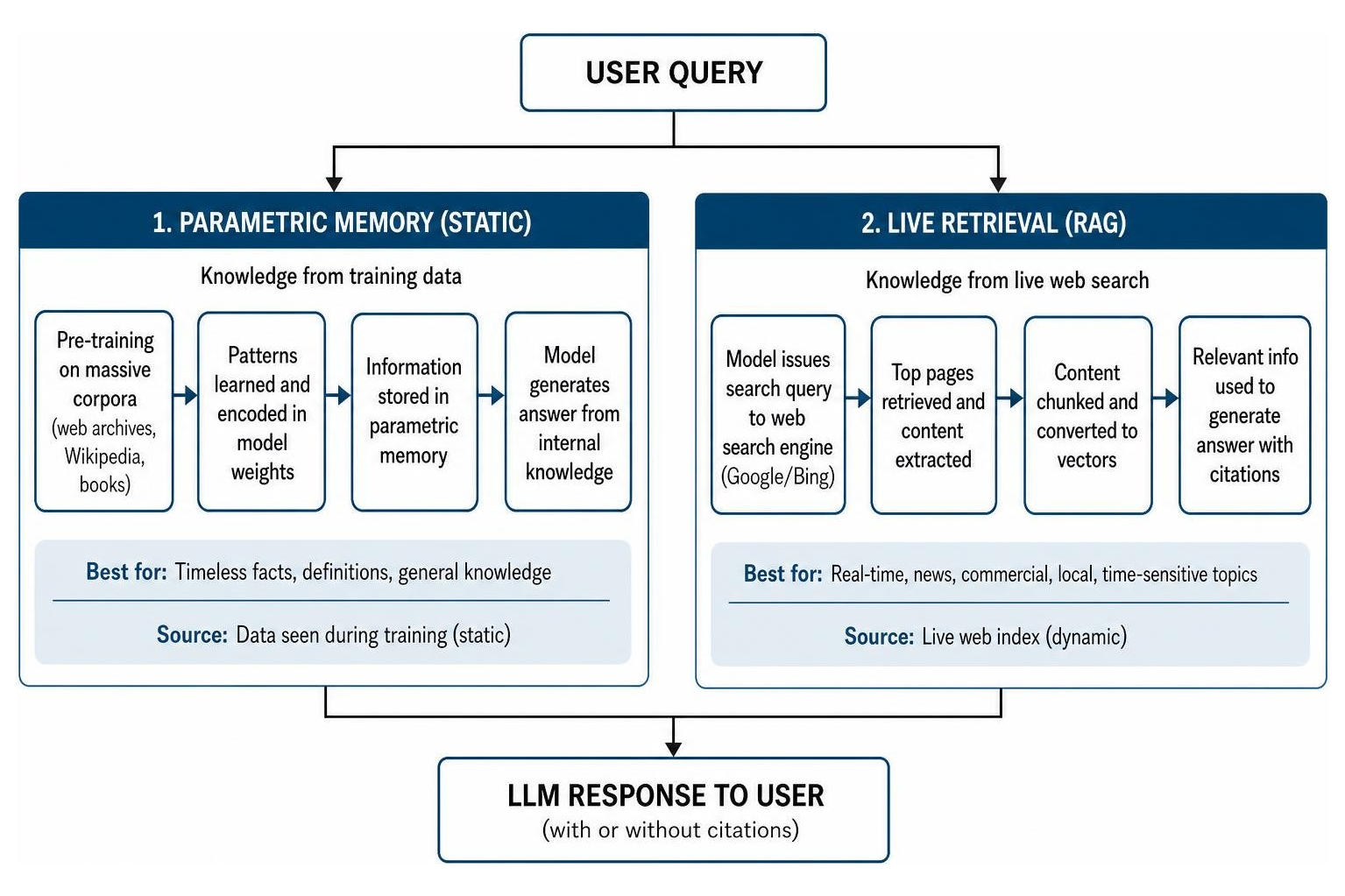
To optimize your web presence effectively, you must understand the two distinct pathways through which large language models access information:
- Parametric Memory (Static Training Data): This represents the knowledge baked directly into model weights during training phases. Models ingest massive public web archives (such as Common Crawl, Wikipedia, and digitised books). If your brand narrative is consistently cited across hundreds of authoritative web pages, the AI “knows” who you are even without searching the web.
- Non-Parametric Live Retrieval (RAG): When users ask real-time, commercial, or news-sensitive questions, models deploy Retrieval-Augmented Generation (RAG). The model queries live search engines (primarily Google or Bing), scrapes top candidate web pages, breaks them into text vectors, and synthesizes a direct answer using fresh source citations.
Because AI models combine both pathways, achieving maximum visibility requires establishing strong parametric entity authority while simultaneously optimizing on-page structure for live RAG retrieval. Learn more about balancing these elements in our complete guide to large language model SEO.
How does the live retrieval pathway (RAG) execute fan-out sub-queries?
When a user submits a complex prompt to an AI platform like ChatGPT Search or Perplexity, the system does not submit just one search query. Instead, it executes fan-out sub-queries—breaking the original prompt down into multiple search requests to gather a complete dataset.
For example, a prompt like “Compare the top local SEO agencies in South Florida for HVAC companies based on client reviews and contract terms” might trigger three separate automated search queries behind the scenes:
- Sub-query 1:
top local SEO agencies South Florida HVAC - Sub-query 2:
South Florida digital marketing agencies client reviews ratings - Sub-query 3:
SEO agencies no long term contracts South Florida
During live retrieval, RAG algorithms parse candidate web pages by dividing text into vector chunks of 200 to 500 words. If your page features long, rambling preamble paragraphs, the RAG chunking process may fragment your main value proposition, rendering it unusable for the AI response.
To survive vector chunking intact, your page content must be organized into standalone 40-to-150-word passages that answer direct questions clearly up front—a technique known as Bottom Line Up Front (BLUF) formatting.
How does Bing optimization directly impact ChatGPT citations?
Many marketers focus exclusively on Google, neglecting Microsoft’s Bing. This is a critical strategic mistake for LLM SEO.
ChatGPT Search relies directly on Bing’s search index to perform live web retrieval. If your website is indexed poorly or ranks low on Bing, ChatGPT will struggle to discover your content during real-time user prompts.
To maximize your inclusion in ChatGPT and Meta AI responses, setting up and optimizing Bing Webmaster Tools is mandatory. Ensuring clean indexing, submitting sitemaps, and monitoring crawler health on Bing directly translates into higher citation frequency within ChatGPT search outputs.
What Are the Essential Technical and Structural Optimizations for AI Crawlers?
Before an AI model can evaluate or cite your content, its web crawler must be able to access and read your underlying code. Technical accessibility operates as a strict binary pass/fail gate for AI search visibility.
First, you must manage crawler access through your site’s robots.txt file. It is vital to differentiate between AI training crawlers (which scrape content to train foundational models) and AI search/retrieval crawlers (which fetch real-time web pages to answer live user queries).
Second, you must address dynamic code execution. Most AI crawlers do not execute client-side JavaScript. They fetch the raw HTML file returned directly by your server.
If your website relies heavily on client-side JavaScript frameworks (such as React or Angular) to render body text, headings, or comparison tables on the browser, an AI crawler will see a blank page. Implementing Server-Side Rendering (SSR) or Static Site Generation (SSG) ensures that 100% of your content resides in the raw static HTML payload.
To review techniques for aligning your site structure with model requirements, read our guide on how to speak the AI’s language with content optimization.
How do you implement JSON-LD Schema markup for entity clarity?
Schema markup provides machine-readable metadata that explicitly defines entities, relationships, and concepts for AI parsers. By deploying structured data via JSON-LD, you eliminate ambiguity regarding your brand identity, services, key personnel, and core offerings.
Key schema types to deploy across your site include:
OrganizationSchema: Defines your official brand name, address, phone number (NAP), logo, social profiles, and service geographic boundaries.FAQPageSchema: Pairs precise questions with concise direct answers for instant answer extraction.Article/WebPageSchema: Defines publication dates, content authors, and primary entity subjects.Product/ServiceSchema: Explicitly outlines pricing models, target industries, and product features.
Connecting these schemas together using @graph arrays creates an interconnected knowledge graph on your domain, making it simple for language models to verify your business credentials.
Is creating an llms.txt file worth it for AI search optimization?
An emerging web standard gaining adoption across the developer community is the llms.txt file—a plain Markdown text file placed in your website’s root directory (yourdomain.com/llms.txt).
Much like robots.txt guides search crawlers, an llms.txt file serves as a curated, machine-readable directory specifically tailored for AI agents and language models. It provides a concise summary of your business alongside markdown links to your most critical landing pages, documentation, and product specs.
Optimizing AI Crawler Technical Accessibility: BullsEye Internet
- Generative Engine Optimization Services: AI search visibility strategies for commercial brands.
- AI Search Optimization Guide: Comprehensive insights into ranking across ChatGPT, Perplexity, and Google AI Overviews.
Business Policies
- No long-term contracts required.
- Exclusive protection: working with only one client per industry per geographic area.
What Are the 12 Proven Optimization Tactics for Maximum LLM Visibility?

Achieving broad visibility across AI search platforms requires combining on-page formatting precision with aggressive off-page authority building. For further official guidelines, refer to the Google Generative AI Optimization Guide as well as our practical guide to LLM SEO strategies.
Below are the 12 battle-tested tactics we deploy to maximize client inclusion in conversational AI search results.
What on-page and formatting tactics drive immediate AI citation?
- Format Direct BLUF Answer Blocks: Place a concise 40-to-60-word summary direct answer immediately beneath H2 or H3 question subheadings. AI search engines heavily prioritize these self-contained passages for verbatim extraction into response boxes.
- Publish Direct FAQ Structures: Feature 8 to 10 fully answered questions directly within key pages. Keep answers complete and accessible in the standard HTML body rather than concealing text inside interactive accordion elements that AI bots may ignore.
- Map Pages to Granular Audience Sub-Segments: Create distinct, dedicated landing pages for specific industries, use cases, and service tiers. Language models look for exact contextual alignment when resolving multi-variable user prompts.
- Anchor Entity Signals in Footers & Homepages: Explicitly state your core brand offering, physical service regions, and company USP in high-visibility areas like site footers and primary landing pages to establish clear entity signals.
- Maintain a Standing 2-Month Refresh Cadence: Content freshness carries immense weight in AI retrieval models. Industry benchmarks indicate that pages updated within the last 60 days earn ~28% more citations, whereas citations drop sharply for content older than 3 months.
- Apply Factual Densification & Original Data: Incorporate concrete statistics, named source attributions, comparison tables, and proprietary insights. A landmark Princeton study on GEO demonstrated that adding verifiable citations and statistics increases a brand’s visibility in AI answers by 30% to 40%.
What off-page and entity authority tactics build brand presence in LLMs?
- Build Topical Content Clusters: Develop hub-and-spoke content structures with at least three interlinked supporting articles around core commercial landing pages. Demonstrating comprehensive depth across a topic builds strong topical domain authority.
- Repurpose Content Across Multimodal Formats: Convert core written guides into short-form videos, infographics, audio podcasts, and downloadable slides. AI engines parse diverse media types, expanding your brand footprint across multiple indices.
- Build Presence on Third-Party Citation Hubs: Earn unlinked brand mentions, reviews, and detailed discussions on platforms that LLMs consistently pull from during retrieval—notably Reddit, Quora, YouTube, G2, and niche industry forums.
- Execute Targeted Digital PR & Syndication: Secure editorial features and press placements on authoritative news outlets and industry trade publications. AI scraping bots do not distinguish between paid advertorials and organic news features when gathering source data.
- Expand Indexable Brand Footprint: Research indicates it requires roughly 250 indexable online documents mentioning a brand across trusted web properties for an LLM to accurately master and articulate that brand’s narrative in parametric memory.
- Publish on Fast-Indexing Channels: Publish core company announcements and whitepapers on high-authority, fast-indexing channels like LinkedIn Pulse and Reddit. These channels are often indexed and retrieved by AI engines within minutes of publication.
How Do You Audit and Measure Your Performance Across AI Search Platforms?
Transitioning from traditional SEO to LLM SEO requires shifting your primary performance key performance indicators (KPIs). Tracking keyword rankings alone is no longer sufficient; you must track your LLM Share of Voice (SoV), citation frequency, and referral conversion rates.
To learn more about tracking metrics, explore our breakdown of AI search ranking factors.
How do you perform a baseline AI presence and sentiment audit?
To measure where your business stands in conversational AI responses today, execute a baseline audit using a standardized set of buyer prompts across ChatGPT, Perplexity, Gemini, and Claude:
- Category Prompts: “What are the top-rated [industry] service providers in [location]?”
- Feature Prompts: “Which [industry] companies offer [specific service/feature] without long-term contracts?”
- Comparison Prompts: “Compare [Company A] vs [Your Company] for commercial service quality.”
Document the following outcomes:
- Direct URL Citation Rate: How often does the AI link directly to your website in source citations?
- Implicit Brand Mention Rate: How often is your brand name mentioned in the generated text without an explicit hyperlinked citation?
- Brand Sentiment Alignment: Does the AI describe your core USP, offerings, and value proposition accurately, or is it citing outdated or incorrect factual details?
How do you track AI search performance and referral conversions in GA4?
Tracking AI-referred visitors in Google Analytics 4 requires tailored tracking rules. While GA4 introduced native AI Assistant referral channels, a significant portion of AI traffic arrives tagged as generic direct traffic or standard referral traffic (“dark AI traffic”).
To track this accurately:
- Build custom Channel Groups in GA4 targeting referral sources containing domains such as
chatgpt.com,perplexity.ai,claude.ai,gemini.google.com, andcopilot.microsoft.com. - Monitor user engagement metrics for these channels—specifically Session Conversion Rates, Time on Site, and Event Completions—to measure the high-intent value multiplier of AI visitors.
What common technical mistakes block brands from appearing in AI responses?
When auditing low-performing sites, we consistently uncover four recurring technical errors that prevent brands from winning AI citations:
- Blocking Live Search Bots in Robots.txt: Accidentally blocking web crawlers like
OAI-SearchBotorPerplexityBotwhile attempting to block training bots likeGPTBot. - Client-Side Rendering Dependencies: Hiding body text, service descriptions, or comparison charts behind client-side JavaScript that AI raw HTML crawlers cannot execute.
- Concealing Content Behind Interactive Accordions: Hiding essential FAQ text behind user-activated click tabs, preventing retrieval parsers from extracting passage text cleanly.
- Publishing Low-Quality, Generic AI Text: Over-relying on unedited AI-generated content. Modern LLMs prioritize original human insights, unique statistics, and verifiable credentials to prevent model collapse and authoritative bias.
What Is the 30-Day Action Plan for Starting LLM Optimization?
Transforming your online footprint to capture conversational AI traffic does not require years of theoretical planning. Below is our structured, 4-week execution roadmap designed to refactor your site’s technical foundation and build immediate AI visibility.
If you prefer to have expert execution handled for you, our team at BullsEye Internet Marketing delivers full-service Generative Engine Optimization. We back our services with no long-term contracts and offer exclusive market protection—working with only one client per industry per geographic area.
Week 1: Technical Accessibility & AI Crawler Audit
- Review your site’s
robots.txtfile to ensure search crawlers (OAI-SearchBot,PerplexityBot,Claude-SearchBot) are explicitly allowed. - Audit critical landing pages to verify that primary content is served via raw static HTML (Server-Side Rendering) rather than client-side JavaScript.
- Set up and verify your domain inside Bing Webmaster Tools, submitting XML sitemaps to accelerate indexing for Bing-powered AI models like ChatGPT Search.
- Create and publish a root-level
llms.txtfile summarizing your core services, target location, and primary URL links. - Run a 10-prompt baseline audit across ChatGPT, Perplexity, Gemini, and Claude to record your starting Share of Voice.
Week 2: Schema Deployment & Structural Refactoring
- Deploy comprehensive JSON-LD schema markup across all primary pages, focusing on
Organization,FAQPage,Article, andServicetypes. - Reformat the top section of your primary commercial landing pages using the Bottom Line Up Front (BLUF) style—placing clear 40-to-60-word answers directly beneath H2 headings.
- Remove interactive accordions or JavaScript hides from key FAQ sections so all text remains visible in the raw source code.
- Update site footers and primary landing pages to explicitly list your entity details, service locations, and core USP signals.
Week 3: Content Freshness, Factual Densification & Clustering
- Identify core evergreen pages that have not been updated in over 60 days. Refactor headings, refresh stats, and update schema
dateModifiedtimestamps. - Enhance key service guides with factual densification—adding specific numbers, authoritative citations, comparison tables, and named expert attributions.
- Build out a topical cluster around your top commercial page by publishing at least 3 supporting hub articles linked with contextual, descriptive anchor text.
Week 4: Brand Footprint Expansion & Analytics Tracking
- Claim, update, and optimize third-party review profiles (Google Business Profile, G2, Trustpilot) and directory listings to align entity data across the web.
- Publish an authoritative, research-backed summary article on high-trust, fast-indexing channels like LinkedIn Pulse and Reddit.
- Configure custom Channel Groups in Google Analytics 4 (GA4) to isolate and track AI chatbot referral sources.
- Re-run your 10-prompt audit to measure preliminary improvements in brand citation frequency, sentiment accuracy, and referral traffic quality.
Frequently Asked Questions About AI Search & LLM Optimization?
Is LLM SEO completely replacing traditional SEO?
No. LLM SEO does not replace traditional SEO; it operates as an essential strategy layered directly on top of it. Because modern AI platforms rely on live search engine indices (like Google and Bing) during Retrieval-Augmented Generation (RAG), achieving high organic rankings in standard search remains one of the strongest prerequisites for earning AI citations.
How fast can a website start getting cited by AI search engines?
Initial citations via live retrieval (RAG) can occur within days or weeks once you unblock AI crawlers, reformat pages with BLUF answers, and ensure content is indexable on Bing and Google. However, shaping an LLM’s parametric memory (static knowledge) typically requires 3 to 6 months of continuous content publishing, schema maintenance, and off-page digital PR.
Does adding an llms.txt file guarantee inclusion in ChatGPT?
No. Publishing an llms.txt file acts as an accessible, machine-readable directory map for AI agents, but it does not guarantee automatic inclusion in generated responses. Major AI platforms still evaluate domain trust, backlink authority, content freshness, and search index rankings before selecting source citations.
How Can Your Brand Lead the AI Search Revolution?
The transition from ten blue links to conversational AI answer synthesis represents the largest change in digital marketing in two decades. As zero-click searches rise and more consumers depend on AI platforms for direct recommendations, remaining invisible within AI responses presents a serious business risk.
Winning in this new era does not require secret hacks or shortcuts. It requires a disciplined, entity-first strategy focused on technical crawler accessibility, clear BLUF content formatting, rich schema implementation, and aggressive authority building across trusted web platforms.
At BullsEye Internet Marketing, we specialize in helping businesses navigate this transition smoothly. By combining our proven Generative Engine Optimization (GEO) framework with traditional SEO, pay-per-click management, and conversion rate optimization, we ensure your brand dominates both traditional search engines and AI answer engines.
We believe in earning our clients’ business every single month. That is why we operate with no long-term contracts and offer a powerful competitive advantage: we work with only one client per industry per geographic area.
Ready to capture high-intent buyers who are searching for your services on ChatGPT, Perplexity, and Google AI Overviews? Contact our team today to request your AI search visibility audit and take the lead in conversational search.
