
Why Optimizing for AI Overviews Matters Now
Optimizing for AI Overviews means making your pages easy for Google to crawl, trust, extract, and cite. Start by answering the searcher’s question near the top of the page, support that answer with real evidence, use clear headings and lists, keep pages technically healthy, and build authority through expert content and reputable mentions.
Google’s AI Overviews can answer a search before someone reaches the usual organic listings. That changes the value of visibility. Research cited in this guide shows users click traditional results 8% of the time when an AI Overview appears, compared with 15% when one does not. The links inside the Overview receive only about 1% of clicks, so a citation is not a traffic guarantee – but it can still put your brand in front of a highly relevant searcher.
The smart goal is not to chase a new SEO trick. It is to publish useful, specific content that Google can confidently use as a source. Strong rankings still help, but clear passages, current facts, real expertise, and a fast site give your content a better chance to be included.
I am Ronnie Katz, founder and Principal CEO of BullsEye Internet Marketing, with more than 20 years of experience helping businesses improve online visibility, traffic, and conversions. My work in Optimizing for AI Overviews builds on practical SEO, local search, AEO, and conversion-focused marketing strategies designed to generate measurable business results.
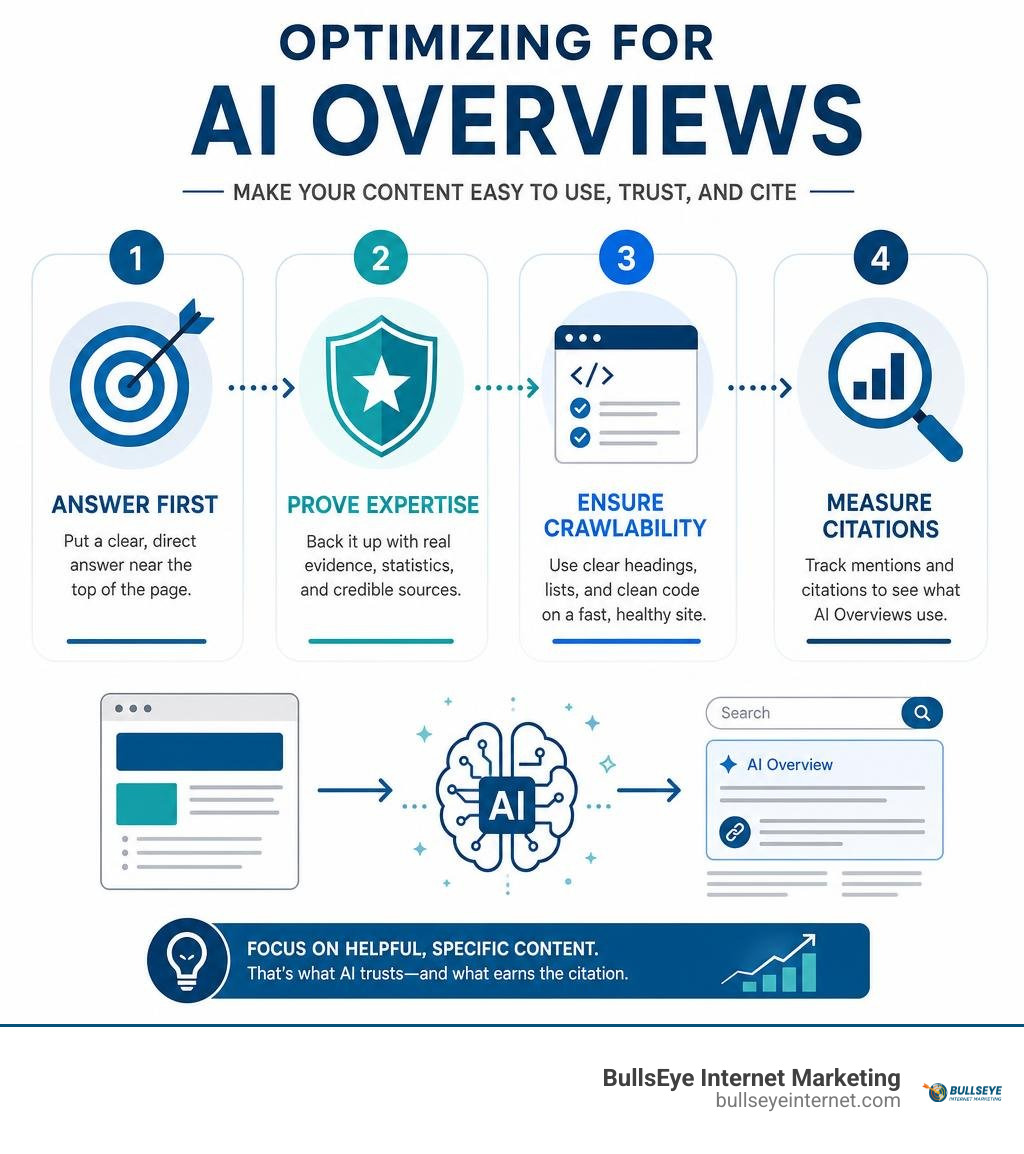
Optimizing for AI Overviews terminology:
Understanding Google AI Overviews and Search Mechanics
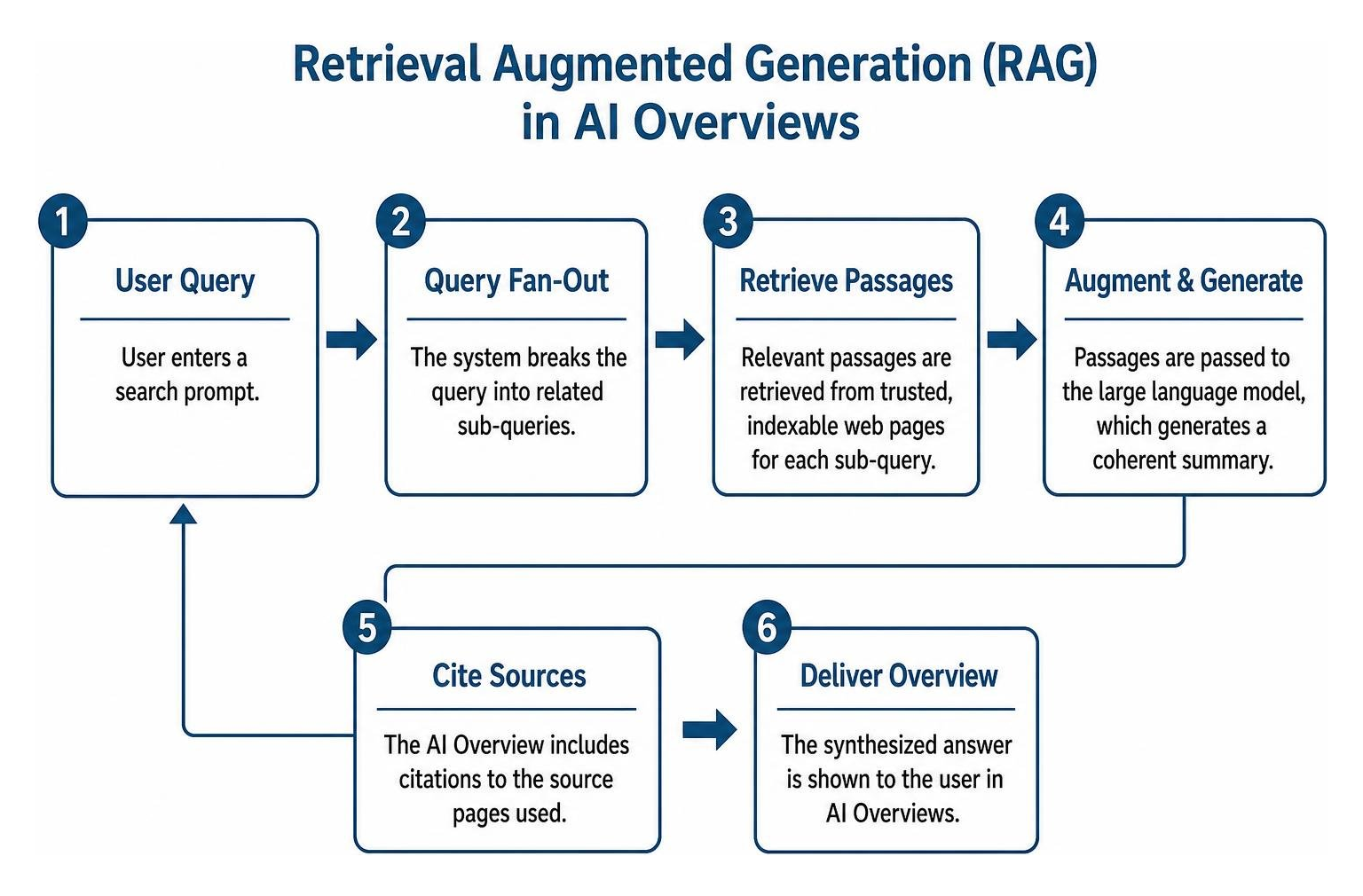
Search architecture has undergone a massive evolution. Today, Google relies heavily on Retrieval-Augmented Generation (RAG) to power its generative summaries. Instead of merely matching keywords to indexed documents, Google’s systems retrieve relevant passages from verified web pages, pass them into large language models, and synthesize a single, coherent response.
Implementing modern Generative SEO Techniques allows businesses to align their digital assets with this RAG architecture. When an AI Overview is generated, the underlying algorithm evaluates passage extractability, entity clarity, and source trust before attributing credit. Public research initiatives, including the comprehensive insights found in the [PDF] Artificial Intelligence Report 2025 – Miami-Dade County, emphasize how machine learning models prioritize structured, verified data across public and enterprise environments.
What AI Overviews Are and How Query Fan-Out Works
Google’s Gemini models utilize a process known as “query fan-out.” When a user types a prompt into Google, the search engine does not evaluate just that solitary phrase. Instead, natural language processing breaks down the core prompt into several related sub-queries.
For instance, if a user asks about the best commercial roofing maintenance schedules, Google fans out the search into sub-queries regarding inspection frequency, material lifespans, preventative costs, and regional weather impacts. Google then retrieves indexable passages across the web for each sub-topic, synthesizing them into a multi-faceted overview. Gaining visibility in this environment requires understanding What is AEO? to ensure your content answers not just the head term, but the surrounding contextual questions as well.
Impact on Search Visibility, Organic Traffic, and Click-Through Rates
The rise of generative summaries has fundamentally reshaped user interaction patterns on search engine results pages. Across broad search monitoring, organic web traffic has experienced declines between 15% and 25%, with the clickthrough rate for purely informational queries projected to decrease by over 50%.
| Metric Dimension | Traditional SERP Snippets | Google AI Overviews |
|---|---|---|
| Average User CTR | ~15% on standard organic links | ~8% on standard links when AIO is present |
| Citation Click Share | N/A (Standard blue link clicks) | ~1% direct click rate on internal citation cards |
| Zero-Click Behavior | ~40% across general searches | >80% of users rely on zero-click answers regularly |
| Informational Query Share | Stable across informational intent | Dropped from 89.03% (Oct 2024) to 57.16% (Oct 2025) |
| Average Sources Cited | 1 featured source per snippet | 5 to 8 sources synthesized per response |
Understanding these shifts is central to Mastering Google SGE: Your Path to AI Search Visibility, allowing brands to target commercial and high-intent informational spaces where citations still yield valuable, qualified engagement.
Core Ranking Factors When Optimizing for AI Overviews
Earning inclusion in AI Overviews requires satisfying core algorithmic criteria. The foundational AI Search Ranking Factors center on three primary pillars: technical crawlability, passage extractability, and authoritative trust signals.
Google’s models look for concise, self-contained factual statements that directly address query intent without unnecessary padding. Furthermore, freshness acts as a decisive tiebreaker: studies indicate that approximately 85% of citations originate from content published or refreshed within the last 2 to 3 years.
The Critical Influence of E-E-A-T and Brand Authority
Experience, Expertise, Authoritativeness, and Trustworthiness (E-E-A-T) serve as the foundation of AI source selection. Because generative models must avoid delivering hallucinations or harmful information, they disproportionately cite domains with established industry reputations and transparent authorship.

Industry discussions on Why Old-School SEO Copywriting Still Works in AI Era highlight that genuine editorial standards remain irreplaceable. Citations in AI Overviews are earned when content incorporates first-party data, verifiable author credentials, and brand mentions across authoritative third-party publications.
Why Traditional Organic Rankings Drive AI Overview Citations
While an AI Overview evaluates passages dynamically, traditional organic rankings remain an essential retrieval filter. Empirical data reveals that links in the 1st organic position have a 53% chance of appearing within an AI Overview, whereas pages in the 10th position drop to a 36.9% probability. Overall, roughly 52% of all AI Overview citations originate from URLs that already sit within the top 10 organic results.
Securing strong baseline organic rankings ensures your content enters the candidate pool for generative summaries. Techniques established in Get Featured: Mastering Google Answer Box Optimization continue to reinforce overall search authority, ensuring your pages are crawled and indexed with high priority.
Content Structuring and Technical SEO for AI Overviews
Extractability dictates whether Google’s language models can easily parse your content. Following proven AI Search Best Practices means engineering pages so that key information can be extracted without parsing complex narrative fluff.
Content Architecture and Formatting for Optimizing for AI Overviews
To make content citation-ready, structure your web pages into distinct, scannable modules:
- Direct Answer Blocks: Place a concise 35-to-50-word answer directly beneath your H2 or H3 heading.
- Self-Contained Passages: Write supporting sections ranging between 134 and 167 words that fully explain a single concept or claim.
- Mixed Content Textures: Incorporate ordered lists, bulleted key takeaways, and comparative data tables. Approximately 78% of AI Overviews feature list elements.
- Visible Attribution: State facts, dates, and supporting figures explicitly alongside claims rather than hiding them in vague statements.
Technical SEO Prerequisites: Core Web Vitals, Schema, and Crawlability
Technical openness ensures that search bots can retrieve your content without friction. Applying Large Language Model SEO standards involves:
- Core Web Vitals: Maintaining Largest Contentful Paint (LCP) under 2.5 seconds, Cumulative Layout Shift (CLS) under 0.1, and Interaction to Next Paint (INP) under 200 milliseconds. Notably, even a 0.1-second improvement in site speed can boost customer spending by 10%.
- Structured Data Markup: Implement valid JSON-LD schemas such as
FAQPage,HowTo,Article, andOrganizationto provide clear semantic context. - Indexability & Rendering: Ensure robots.txt files, canonical tags, and JavaScript rendering directives allow unrestricted access to your text.
Strategic Execution: Long-Tail Targeting, Passage Placement, and Optimization Cadence
A comprehensive execution plan requires aligning content production with generative search intent. Utilizing frameworks outlined in How to GEO enables marketing teams to target conversational queries and maintain topic authority systematically.
Key Long-Tail Keyword Strategies for Optimizing for AI Overviews
AI Overviews appear most frequently for specific, multi-word search queries. The average keyword length triggering generative summaries sits between 3 and 5 words (under 30 characters), often accompanied by low CPCs ($0.10 or less) and non-branded informational intent.
Targeting long-tail, question-based modifiers (such as “how to compare,” “what is the process for,” and “why does”) aligns your content directly with natural user prompts. Group these long-tail queries into semantic topic clusters to build comprehensive coverage across entire subject areas.
The 44-Percent Rule: Formatting Intros and Self-Contained Passages
Recent search studies identify what is known as the 44-Percent Rule: approximately 44.2% of LLM citations are extracted from the first 30% of a webpage.
To capitalize on this pattern:
- Front-load your core definitions, key statistics, and primary takeaways in the introductory sections.
- Ensure high-salience entities (key subjects, brand names, technical terminology) are introduced early in the text.
- Maintain a disciplined freshness cadence by conducting micro-refreshes every 90 to 120 days to update data points, case examples, and timestamps.
Performance Tracking and Debunking Common AI Search Myths
Measuring success in an era of generative search requires looking beyond basic organic click numbers to assess brand exposure and contextual citations.

Tracking Share of Answer and Generative AI Performance
Effective generative search tracking involves:
- Google Search Console Performance Reports: Monitor impression spikes alongside CTR trends to identify pages triggering zero-click AI summaries.
- Share of Answer Audits: Track prompt-level visibility across target keyword clusters to measure how often your brand is cited compared to industry peers.
- Assisted and Post-Click Conversions: Analyze referral paths and conversion behavior. While AI citations may generate lower overall click volume, visitors arriving via generative references often exhibit significantly higher commercial intent and conversion rates.
Debunking Persistent Myths About AI Search Optimization
Several misconceptions have emerged regarding AI search optimization:
- Myth 1: You must create an
llms.txtfile. Fact: Google’s search bots rely on standard web indexing and robots.txt protocols; proprietary LLM text files do not influence AI Overview inclusion. - Myth 2: You need to rewrite all content exclusively for AI. Fact: Foundational SEO, helpful human-first writing, and high E-E-A-T signals remain the primary ranking drivers.
- Myth 3: Using
nosnippettags is an effective optimization strategy. Fact: Addingnosnippetor restrictive tags blocks Google from generating text snippets, effectively disqualifying your page from appearing in AI Overviews entirely.
Frequently Asked Questions About AI Overviews
Can you optimize for AI Overviews without ranking on page one?
While pages ranking outside the top 10 can occasionally be cited if they provide uniquely structured data or direct answers to niche sub-queries, over 52% of citations come from pages already holding top-10 organic positions. Strong foundational SEO remains the most dependable path to AI visibility.
Do AI Overviews decrease overall website conversion rates?
Although AI Overviews can reduce top-of-funnel informational clicks, traffic originating from AI Overview citations often demonstrates higher conversion rates. Because the generative summary pre-qualifies the user, visitors who click through are typically further along in their decision-making process.
How do long-tail queries and question-based headings trigger AI Overviews?
Google’s Gemini models use conversational natural language processing to break queries down via query fan-out. Question-based H2 and H3 headings directly match these generated sub-queries, allowing the search engine to extract direct answers quickly and accurately.
Conclusion
Adapting to search engine evolution requires moving from basic keyword insertion toward comprehensive, structured, and authoritative content engineering. By focusing on direct answer blocks, maintaining robust technical health, leveraging structured schema, and demonstrating undeniable E-E-A-T, businesses can secure prominent citations across modern generative search results.
At BullsEye Internet Marketing, we help businesses establish industry authority and capture high-value leads without locking them into long-term contracts. To ensure your company maintains search visibility across emerging AI search environments, explore our specialized strategies for Answer Engine Optimization (AEO, GEO, LLM SEO) today.
