
SEO for Criminal Defense Starts With Being Visible at the Moment of Need
To improve SEO for criminal defense, focus first on the searches that lead to immediate calls: build a strong page for every major charge, optimize your Google Business Profile for local and 24/7 intent, prove attorney credentials clearly, and make the site fast and easy to use on a phone.
- Create detailed pages for DUI, drug crimes, assault, domestic violence, and other core charges.
- Target local terms that include your city, county, and courthouse area.
- Add clear calls, intake options, credentials, reviews, and answers to urgent questions.
- Earn credible legal and local links while keeping business listings accurate.
Criminal defense search is different because the prospect is often under pressure. Someone may search for a DUI lawyer late at night, from a phone, after an arrest or traffic stop. They are unlikely to compare ten firms. Visibility in organic results, the local map pack, and AI-generated answers can determine which firm gets the call.
This guide explains how to build that visibility without sacrificing client privacy or relying only on costly ads. You will learn how to turn legal experience, local relevance, helpful content, trusted reviews, and technical SEO into a durable source of qualified criminal defense leads.
I am Ronnie Katz, founder and Principal CEO of BullsEye Internet Marketing. With more than 20 years in digital marketing, I help firms use SEO for criminal defense to improve visibility, traffic, conversions, and the calls that matter most.
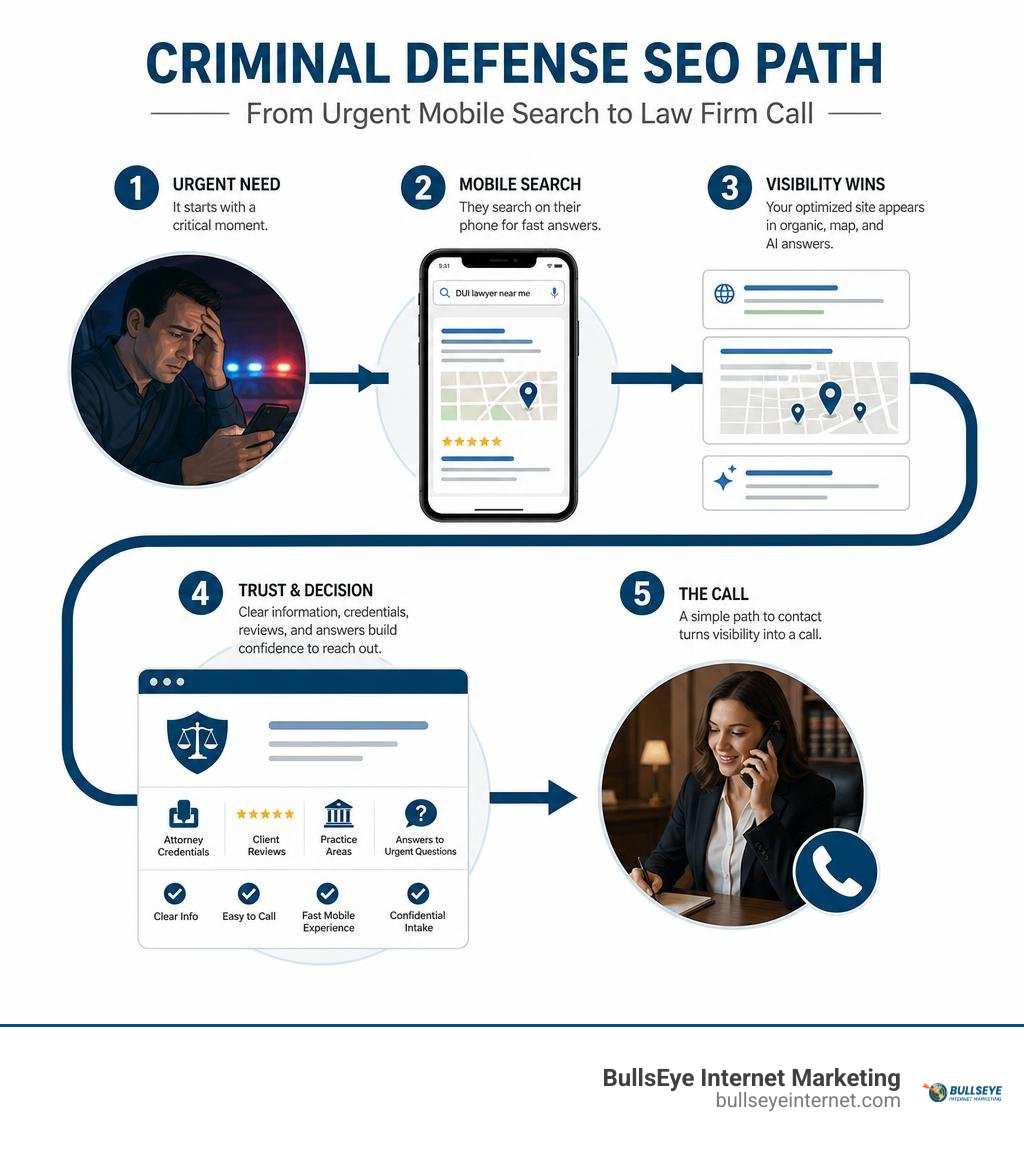
Key terms for SEO for criminal defense:
Why Criminal Defense SEO Differs from Other Practice Areas
Legal marketing is rarely one-size-fits-all. When evaluating search engine optimization across practice areas, criminal defense stands apart due to extreme search urgency, strict Your Money or Your Life (YMYL) content standards, and high mobile intent.
When an individual faces potential jail time, asset forfeiture, or criminal prosecution, they do not casually read informational blog posts over several weeks. A spouse searching from a police precinct or an individual stopped on the roadside requires immediate legal intervention. Searchers rarely navigate past page one of Google; they select an attorney from the top organic positions, the local map pack, or responsive AI summaries.
Google subjects criminal defense sites to rigorous YMYL evaluations. Because legal outcomes directly impact personal freedom, algorithms demand unambiguous proof of expertise, authority, and trustworthiness. Content must reflect statutory accuracy, jurisdictional relevance, and ethical legal marketing compliance.
Because of this condensed decision window, standard lead capture strategies often fail. Firms executing the criminal defense marketing playbook for modern law firms configure their digital presence for 24/7 intake readiness, high mobile site speed, and clear emergency contact options.
The Strategic Pillars of SEO for Criminal Defense Law Firms
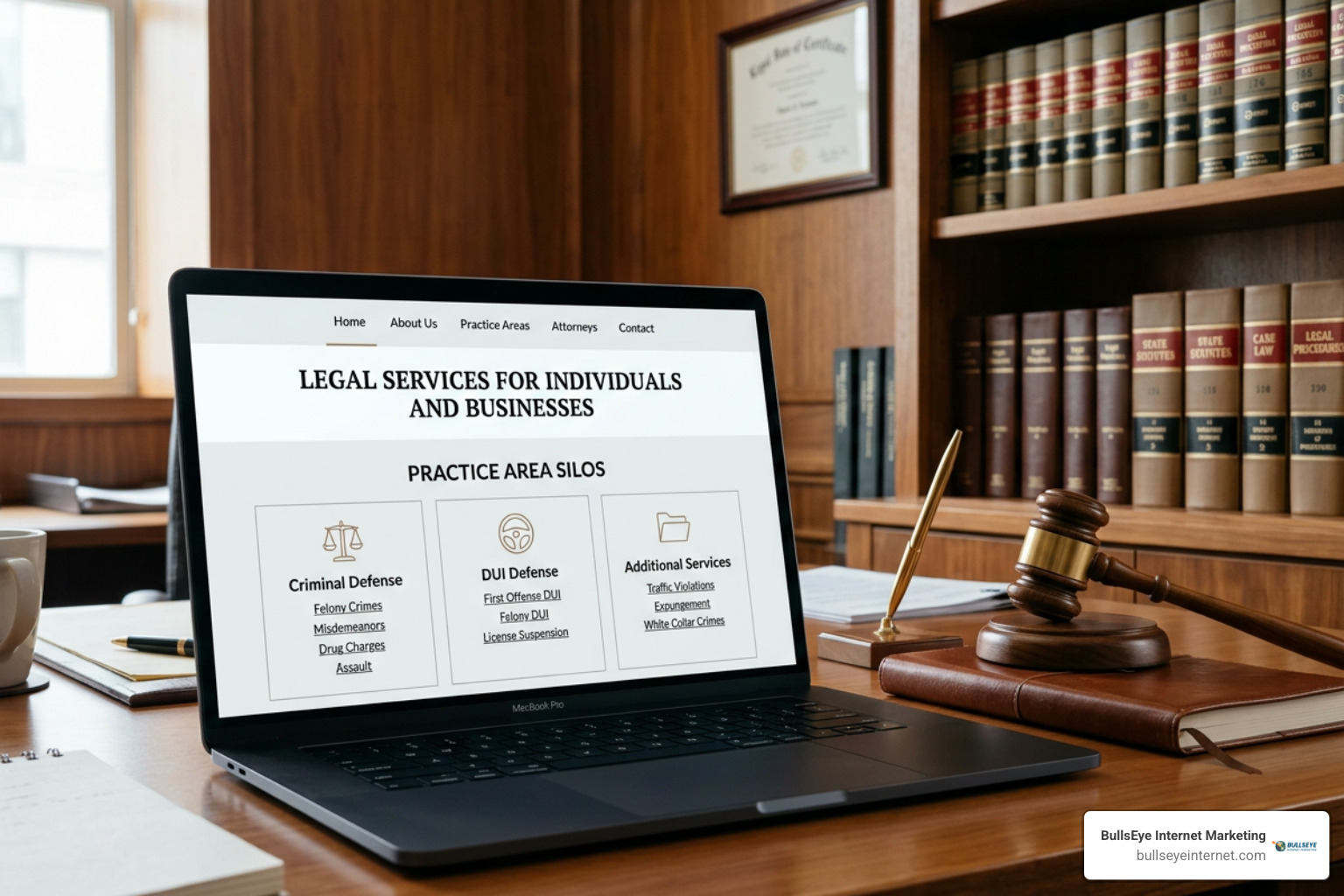
Sustainable organic performance requires a structured architecture combining technical execution, content authority, and algorithmic trust signals. Understanding why hiring a legal SEO specialist is your best growth strategy helps law firms establish topical dominance across competitive practice areas.
On-Page and Technical SEO for Criminal Defense Websites
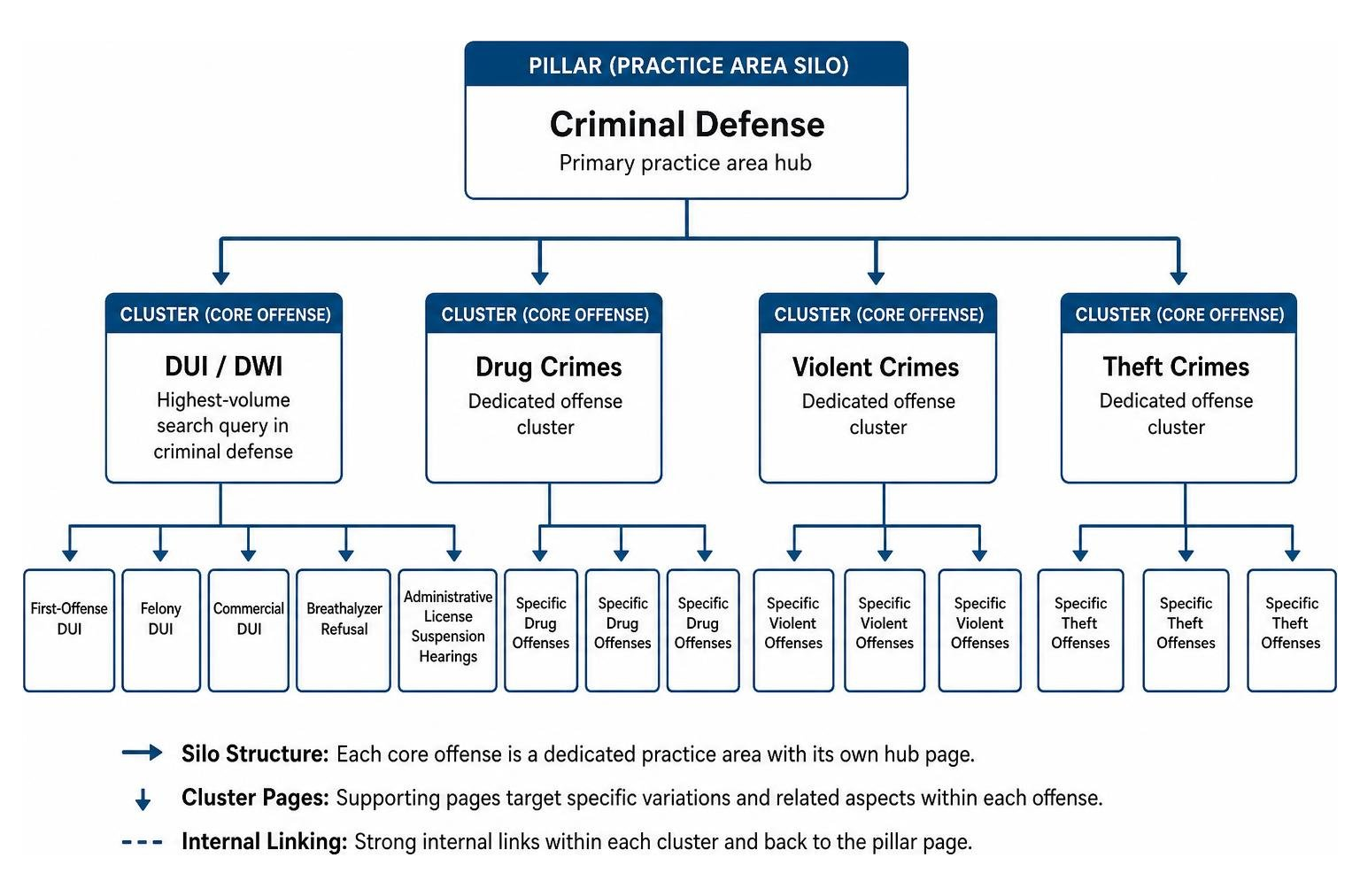
On-page SEO requires creating dedicated practice area silos for every specific charge rather than clustering distinct offenses under a broad criminal defense header.
DUI/DWI represents the highest-volume search query in criminal defense across metropolitan markets. An effective DUI practice area architecture must expand into dedicated URLs targeting first-offense DUI, felony DUI, commercial DUI, breathalyzer refusal, and administrative license suspension hearings.
For each charge-specific page, we incorporate:
- Clear statutory definitions and grading (misdemeanors vs. first-degree felonies).
- Mandatory minimum penalties, fines, license revocations, and statutory incarceration periods.
- Procedural stages: arrest, arraignment, preliminary hearing, pre-trial motions, and trial.
- Common defense strategies, such as challenging probable cause or unlawful search and seizure.
- Structured question-and-answer modules answering immediate user concerns.
Technical SEO must support this content with sub-two-second mobile load times, clean URL taxonomy (/practice-areas/dui/first-offense/), and prominent click-to-call headers sticky on mobile screens.
E-E-A-T and Confidentiality in Practice Area Content
Google demands verified Experience, Expertise, Authoritativeness, and Trustworthiness (E-E-A-T) on legal websites. However, criminal defense lawyers face unique ethical challenges due to attorney-client privilege. Unlike civil litigators who publicize massive monetary settlements, defense attorneys represent clients who expect strict confidentiality.
Firms can build verifiable E-E-A-T while observing lawyer advertising rules by focusing on public, verifiable milestones:
- Board certifications in criminal trial law.
- State bar admissions, standing, and disciplinary clearance.
- Trial leadership roles, past prosecutorial experience, or judicial clerkships.
- Published legal commentary, media appearances, and legal education faculty appointments.
- Redacted aggregate outcomes (e.g., “Over 500 felony dismissals achieved”) accompanied by required statutory disclaimers.
Attorney biography pages must link to reputable third-party verification profiles, confirming that content is authored and reviewed by licensed practitioners.
Authority Link Building and Legal Directory Citations
Search engines evaluate backlink profiles to determine site authority. In legal SEO, relevance and quality outweigh raw link quantity.
Key off-page link categories include:
- Tier-One Legal Directories: Complete profiles on authoritative platforms, including top criminal defense profiles on Justia, establish core entity trust.
- Professional Legal Associations: Links from organizations such as the National Association of Criminal Defense Lawyers (NACDL) and state bar associations provide high-relevance domain signals.
- Digital PR and Legal Commentary: Providing expert analysis on recent criminal appellate decisions or local legal statutes earns editorial backlinks from news outlets and law journals.
- Local Citations: Consistent business citations on local business directories validate geographic presence.
Dominating Local Search and County Courthouse Queries

Most criminal defense clients retain counsel within their immediate municipal jurisdiction or where their case will be tried. Ranking in Google’s Local Map Pack alongside organic results is essential for driving immediate inquiries. Implementing our step-by-step guide to local attorney SEO positions your firm directly in front of local searchers.
Google Business Profile Optimization for 24/7 Intake
Your Google Business Profile (GBP) serves as the primary gateway for mobile crisis searches. An incomplete profile reduces visibility in local 3-pack results.
To optimize GBP performance:
- Set Criminal Justice Attorney or Criminal Defense Attorney as the primary business category, with secondary categories like DUI Attorney and Trial Attorney.
- Ensure Name, Address, and Phone number (NAP) data matches your website footer and directory profiles precisely.
- Explicitly list 24/7 emergency availability if your firm maintains round-the-clock intake.
- Build localized landing pages mapped to regional county courthouses and municipal courts, complete with parking details, courthouse addresses, and jurisdictional procedural guides.
- Implement call tracking and analyze client actions; discovering how law firms can use behavioral data to win more clients helps refine your intake messaging for higher conversion rates.
Ethical Review Acquisition and Client Privacy
Client reviews significantly impact both local map rankings and conversion rates. However, asking an acquitted defendant or someone who resolved a sensitive domestic dispute to post a public Google review requires discretion.
To collect client feedback ethically:
- Focus on the Professional Experience: Instruct clients to review communication, courtroom preparedness, responsiveness, and peace of mind rather than specific criminal allegations.
- Automate Post-Resolution Outreach: Send review invitations via SMS or email immediately following a favorable case disposition.
- Maintain Multi-Platform Profiles: Distribute reviews across Google, Avvo, and legal review sites.
- Respond Professionally to All Reviews: Never confirm or disclose attorney-client details in a public response. A standard reply such as “Thank you for your feedback; our firm is dedicated to protecting our clients’ rights and providing responsive counsel” maintains confidentiality while demonstrating active engagement.
Optimizing for AI Overviews and Modern Search Engines
Search engines now utilize generative AI to answer user queries directly at the top of search engine results pages. AI Overviews synthesize answers to legal questions before standard organic links appear.
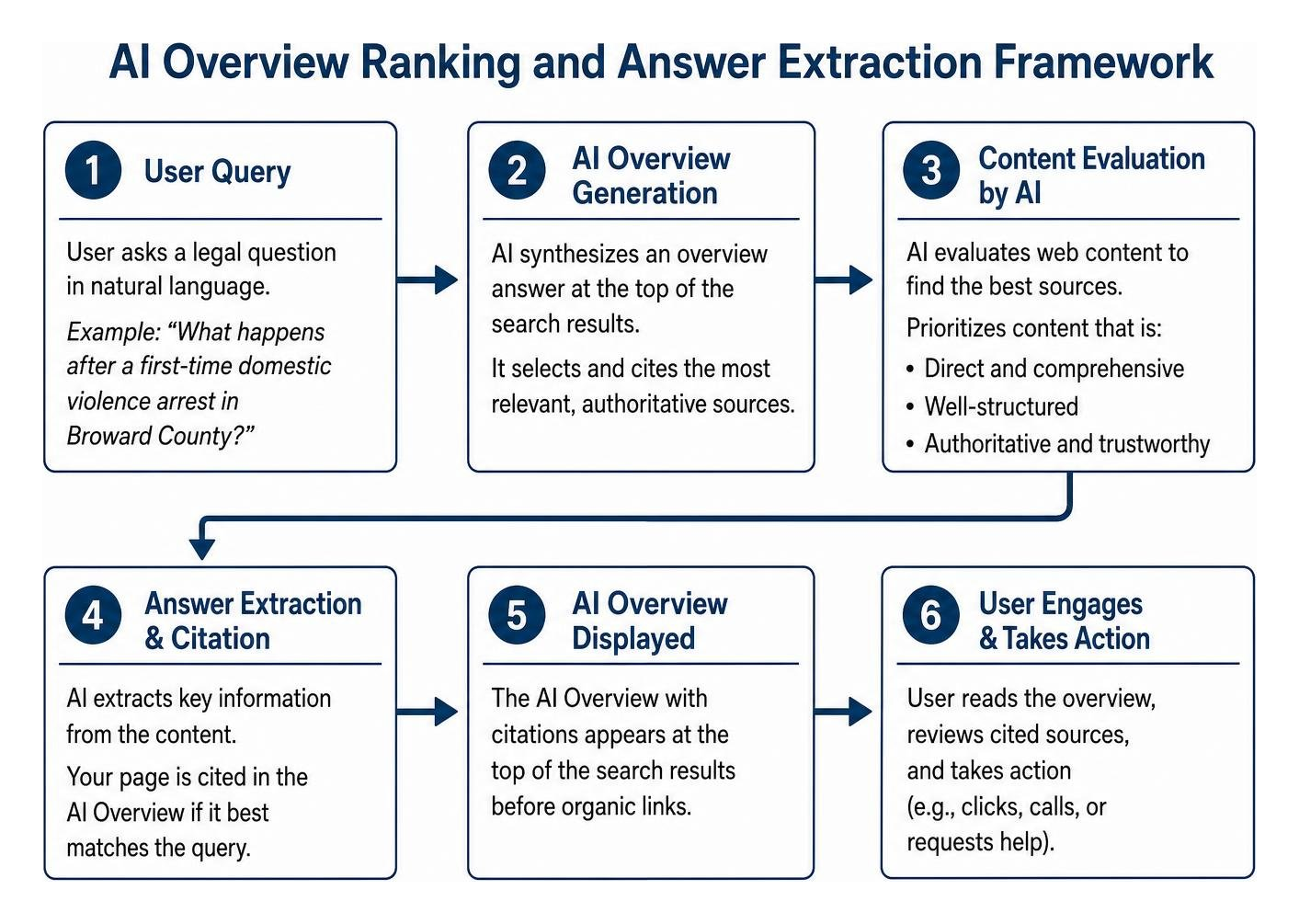
To capture AI citations, defense firms must structure their content for machine readability. Applying specialized AI search optimization strategies for defense lawyers allows your firm to be referenced as an authoritative source when users query legal penalties, court procedures, and statutory defenses.
AI models prioritize content that directly answers conversational prompts (e.g., “What happens after a first-time domestic violence arrest in Broward County?”). Clear definitions, bulleted penalty lists, and explicit statutory references enhance citation frequency.
Structured Schema Markup for Legal Entities
Schema markup translates your website’s content into structured JSON-LD code that search engine crawlers and AI answer engines can interpret without ambiguity.
Essential schema types for criminal defense law firms include:
AttorneyandLegalService: Defines your core entity, physical address, business hours, geo-coordinates, and accepted payment methods.Person: Applied to individual partner pages to map bar credentials, education, and professional associations using thehasCredentialproperty.FAQPage: Wraps common legal questions on practice area pages, increasing the likelihood of rich snippet capture and AI Overviews integration.LocalBusiness: Connects parent and satellite office locations to the firm’s central Knowledge Graph entity.
Projecting Timelines and Measurable ROI with SEO for Criminal Defense
SEO is an asset-building strategy that compounds over time. While paid advertising stops generating inquiries the moment ad spend halts, structured organic optimization yields durable visibility.
- Long-tail, charge-specific queries (such as “probation violation attorney Palm Beach County”): Typically reach page one within 6 to 10 weeks.
- AI Overview citations: Well-structured, authoritative FAQ content often secures AI citations within 8 to 14 weeks.
- High-volume competitive keywords (such as “DUI attorney Miami”): Generally require 6 to 18 months of sustained content development, technical refinement, and link acquisition.
A fully mature search strategy delivers measurable returns, helping defense firms scale their caseloads sustainably while lowering their blended cost per client acquisition.
Frequently Asked Questions About Criminal Defense Search Rankings
How quickly can a criminal defense law firm rank on page one?
Ranking speed depends on geographic competition, domain history, and query intent. Highly specific, long-tail queries (such as specialized weapons charges or municipal court defense pages) can rank within six to ten weeks. Highly competitive keywords in major metropolitan markets—such as broad DUI or federal criminal defense terms—typically take six to eighteen months of sustained optimization and authority building.
Can criminal defense attorneys publish case results without ethics violations?
Yes, provided the content complies with your state bar’s advertising and ethics regulations. Most state bars permit aggregate case outcomes (e.g., “Over 200 cases dismissed” or “Not Guilty jury verdicts secured”), provided you include clear, prominent disclaimers stating that prior results do not guarantee a similar outcome. Individual case summaries must omit identifying personal details unless explicit, informed written consent is provided by the client.
What is the most effective schema markup for criminal defense websites?
The most effective configuration uses nested JSON-LD schema combining Attorney or LegalService markup for the firm entity, Person markup with hasCredential for attorney biographies, and FAQPage schema on practice area pages. This structured code provides search engines and AI models with explicit data about your practice areas, attorneys, locations, and judicial jurisdictions.
Conclusion
Building dominant search visibility for a criminal defense practice requires a strategic balance of technical precision, local authority, structured charge-specific content, and strict adherence to legal ethics. When prospective clients face their most critical legal moments, your firm must be visible across local map listings, AI Overviews, and organic search results.
At BullsEye Internet Marketing, we help law firms establish digital authority and scale their practices. We operate with a clear competitive advantage: we offer no long-term contracts and work with only one client per industry per geographic area, ensuring our complete focus is on winning your market.
To explore our broader legal marketing frameworks, explore our essential guide to advertising for lawyers and schedule your strategic consultation with our team today.
