
Get More Qualified Legal Calls With Google Local Services Ads
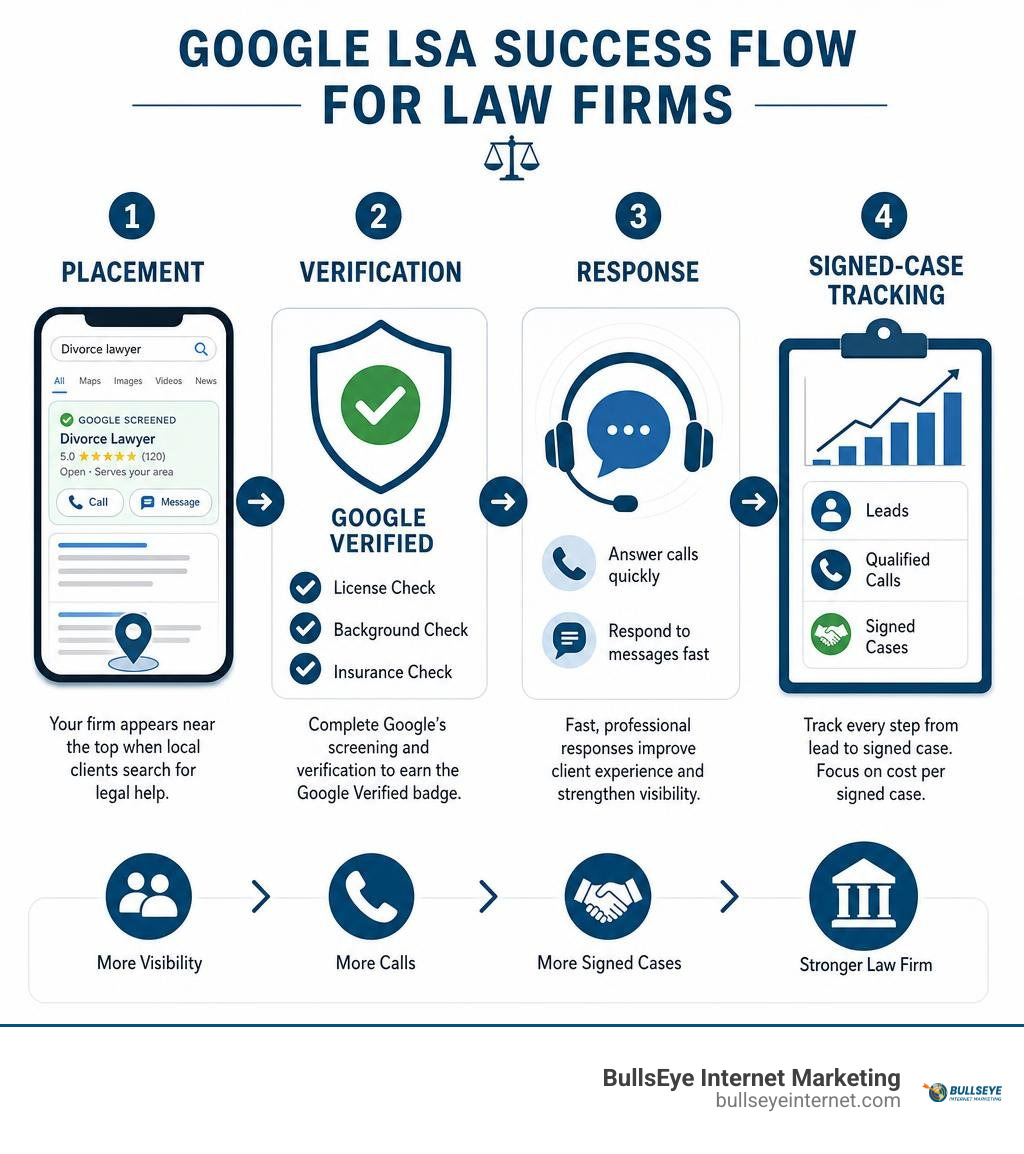
Google Local Services Ads for lawyers put eligible law firms near the top of Google results when local people need legal help now. Unlike standard Google Search Ads, LSAs charge when a prospective client calls or messages your firm, not every time someone clicks.
To make LSAs work, focus on three things first:
- Choose only the practice areas and locations your firm actually serves.
- Complete Google’s screening and verification requirements to earn the Google Verified badge.
- Answer every call and message quickly. A missed lead wastes more than the lead fee – it can also weaken future visibility.
For lawyers, this is not just another advertising channel. It is an intake test. Your reviews, proximity to the searcher, profile quality, and responsiveness all help determine whether Google shows your firm. In a competitive city, a smaller firm with strong reviews and fast call handling can earn meaningful visibility against firms with much larger budgets.
The payoff can be substantial when intake is prepared. Legal LSA leads commonly run about $195 to $250 in 2026, while personal injury firms that retain roughly 34% of leads may see a cost per signed case of about $630 to $735. The key metric is not simply cost per lead. It is cost per signed case.
I am Ronnie Katz, founder and Principal CEO of BullsEye Internet Marketing. For more than 20 years, I have helped businesses improve visibility, calls, and conversions, including through Google Local Services Ads for lawyers and local search strategies built around measurable ROI.
Easy google local services ads for lawyers glossary:
Understanding Google Local Services Ads for Lawyers and How They Work
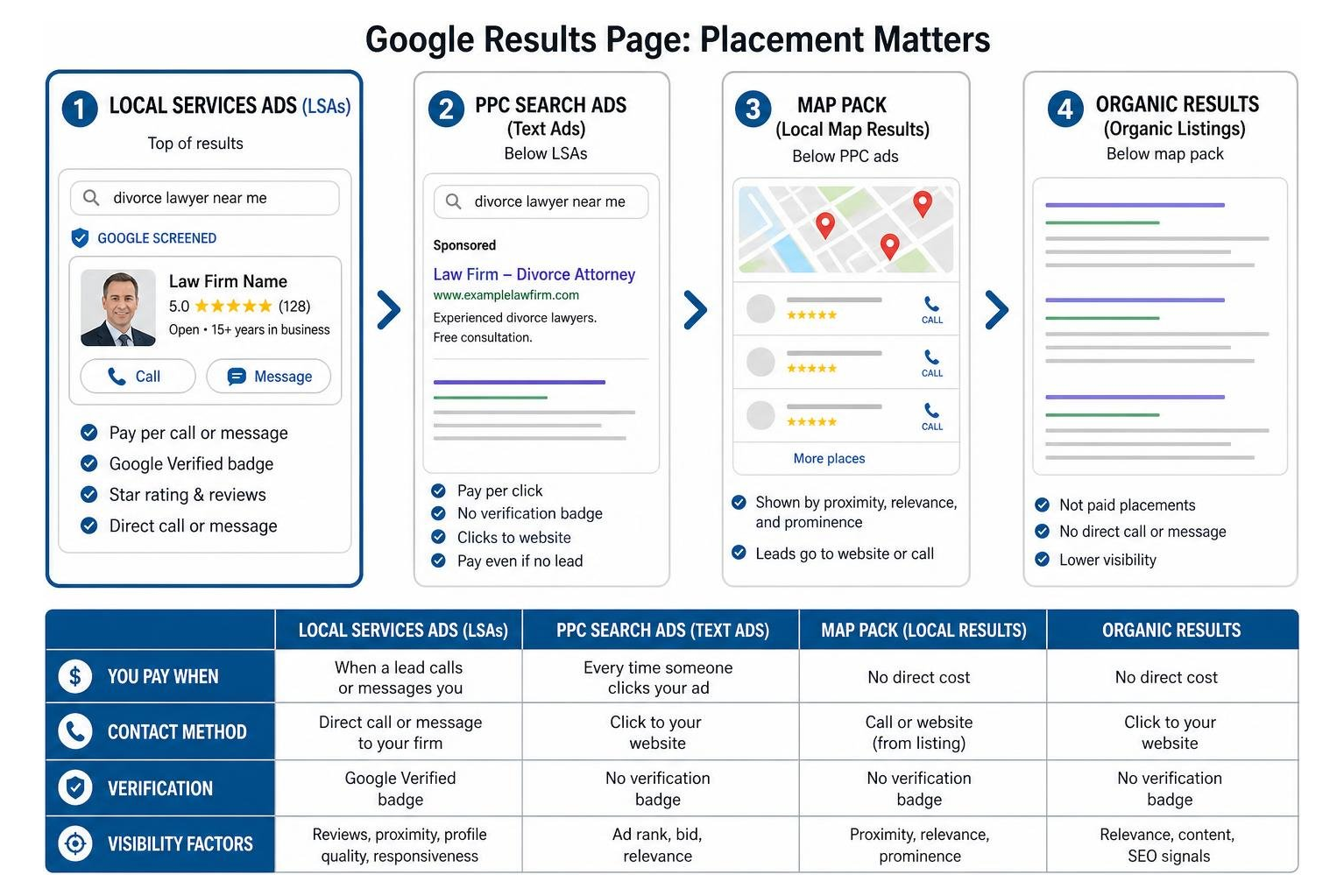
Google Local Services Ads (LSAs) represent a fundamental shift in how law practices generate business online. When local prospects experience an urgent legal issue, they turn to search engines on their mobile devices. LSAs occupy the absolute prime real estate on the Search Engine Results Page (SERP)—sitting above traditional pay-per-click (PPC) text ads, above the local map pack, and well above organic search results.
When you learn how lawyers lead the way how to master google local service ads, you realize the format is tailored specifically for immediate consumer action. The ad unit features your firm name, average star rating, total review count, operating hours, years in business, a direct headshot or firm image, and a prominent badge. Crucially, the ad unit incorporates a direct tap-to-call button.
Unlike traditional advertising formats where prospective clients navigate to a website landing page and browse through legal articles, LSAs eliminate friction. When users click to Reach Local Customers with Local Service Ads, they are connected straight to your intake line via phone call or direct message. You are not buying impressions or clicks; you are paying only when a prospective client initiates a direct conversation.
Pay-Per-Lead vs. Traditional PPC Search Ads
In traditional Google Search Ads, legal keywords represent some of the most expensive terms across digital marketing. Clicks for competitive practice areas can routinely cost $50 to over $300 each—regardless of whether that click turns into a consultation or bounces in three seconds. Furthermore, standard PPC exposes law firms to click fraud, accidental clicks, and window shoppers who never intend to retain legal counsel. If you want to know how law firms can stop wasting money on google ads, shifting budget into pay-per-lead (PPL) models is often the most straightforward solution.
With the PPL model of Local Services Ads:
- Predictable Billing: You only pay when a consumer calls your tracking number or sends an inquiry through the ad unit.
- Immediate Intent: Callers are reaching out in real time with an active legal problem, drastically reducing the sales cycle.
- High Conversion Efficiency: A multi-year analysis showed that legal LSAs yielded a blended cost per lead roughly 14% lower than traditional Google Search Ads, while delivering 50% of signed cases on only 40% of ad spend.
The Evolution to the Unified Google Verified Badge
Historically, Google distinguished service providers using different designations: the “Google Screened” badge (for professional services like attorneys and financial planners) and the “Google Guaranteed” badge (for home services). However, Google consolidated these programs into a single, universal Google Verified badge.
Understanding this change is critical when passing the test a guide to getting google screened. The unified Google Verified checkmark confirms to potential clients that your law practice has successfully cleared Google’s rigorous credential validation standards. This includes active state bar license verifications, appropriate malpractice/liability insurance validation, and comprehensive background screenings. The badge acts as an immediate trust anchor at the top of the search results, validating your firm’s credibility before the prospect even places the call.
Practice Area Eligibility and 2026 Cost Benchmarks
Before launching a campaign, firms must understand which practice areas Google supports. Google designs LSAs around local consumer intent; therefore, consumer-facing legal specialties thrive, whereas corporate or non-local specialties are excluded.
Consumer Practice Areas vs. Excluded Specialties
Google currently supports a wide array of consumer-focused legal practice areas:
- Personal Injury Law (auto accidents, slip and fall, wrongful death)
- Criminal Defense & DUI / Traffic Law
- Family Law & Divorce
- Estate Planning, Probate, & Elder Law
- Bankruptcy Law
- Immigration Law
- Labor & Employment Law
- Real Estate Law & Contract Disputes
- Medical Malpractice & Disability Law
Conversely, non-consumer, national, or strictly business-to-business verticals—such as mass torts, corporate mergers and acquisitions, tax shelter structuring, and patent prosecution—are not eligible for LSA placement.
Cost Per Lead and Cost Per Signed Case Analysis
In 2026, legal LSA leads typically average between $195 and $250 per lead, though individual practice areas display unique cost dynamics. Smart managing partners evaluate LSAs based on client retention rather than lead volume alone. Because these prospects call directly with active matters, they retain at significantly higher rates than general website visitors.
The table below outlines current cost-per-lead benchmarks, estimated retention conversion rates, and expected acquisition costs:
| Practice Area | Average Cost Per Lead (CPL) | Retained Client Conversion Rate | Estimated Cost Per Signed Case |
|---|---|---|---|
| Personal Injury | $195 – $250+ | ~34% | $630 – $735 |
| Family Law | $75 – $200 | ~25% – 30% | $300 – $665 |
| Criminal Defense & DUI | $50 – $175 | ~30% – 35% | $165 – $500 |
| Estate Planning | $40 – $100 | ~35% – 40% | $115 – $285 |
| Immigration Law | $50 – $125 | ~25% – 30% | $200 – $415 |
| Bankruptcy Law | $60 – $140 | ~30% – 35% | $200 – $400 |
Capturing exclusive attorney leads that actually convert requires understanding this financial equation. When a personal injury firm can sign a viable contingency case for under $750, or an estate planning firm can secure a $3,500 trust client for under $300, the return on investment becomes self-evident.
Step-by-Step Setup and Screening Verification
Launching an LSA campaign requires proper administrative setup and identity verification to earn full visibility.

Setting Up Google Local Services Ads for Lawyers Step by Step
Following the step by step google lsa setup guide for local businesses ensures your firm avoids common onboarding delays:
- Confirm Geographic Eligibility: Visit the official portal for Getting started with Local Services Ads – United States and enter your firm’s primary practice address and postal code.
- Select Practice Subcategories: Select only the specific legal case types your firm handles on a daily basis.
- Set Service Areas: Define your exact operational footprint by county, city, or radius around your physical office where your attorneys are licensed to practice.
- Establish Weekly Budgets: Set an initial weekly budget that accommodates at least 5 to 10 leads per week (typically $1,500 to $3,000 per month as a baseline) to give Google’s delivery algorithm enough data.
- Connect Your Google Business Profile: Linking your verified profile pulls in your review history, star rating, and office location signals.
Screening Verification, Licensing, and Pre-Badge Ads
To earn the Google Verified checkmark, you must complete the screening process through Google’s designated background check partners:
- State Bar Verification: Submit active state bar licenses for every practicing attorney who will be featured in the ad unit or taking inbound inquiries.
- Proof of Insurance: Provide a current certificate of insurance demonstrating adequate legal malpractice and general commercial liability coverage.
- Background Checks: Complete business entity registration checks and background checks for business principals.
If there are administrative processing delays, Google permits professional legal verticals to run pre-badge ads in certain markets once preliminary registration, billing, and review requirements are met. Pre-badge ads display below fully verified listings, providing an early bridge to lead generation while your final verification is finalized.
Algorithmic Ranking Factors and the Responsiveness Imperative
Securing top-three placement in the LSA ad block is not simply a matter of having the highest bid. Google’s auction algorithm relies heavily on operational and trust signals to decide which law firm to show.

Answer Rates and Intake Call Performance
The single most critical ranking signal that many law firms fail to manage is responsiveness. According to legal industry benchmarks, only about 40% of law firms answer their incoming phone calls live, dropping steadily over recent years.
Google actively tracks whether your firm answers incoming LSA phone calls or allows them to ring out to voicemail.
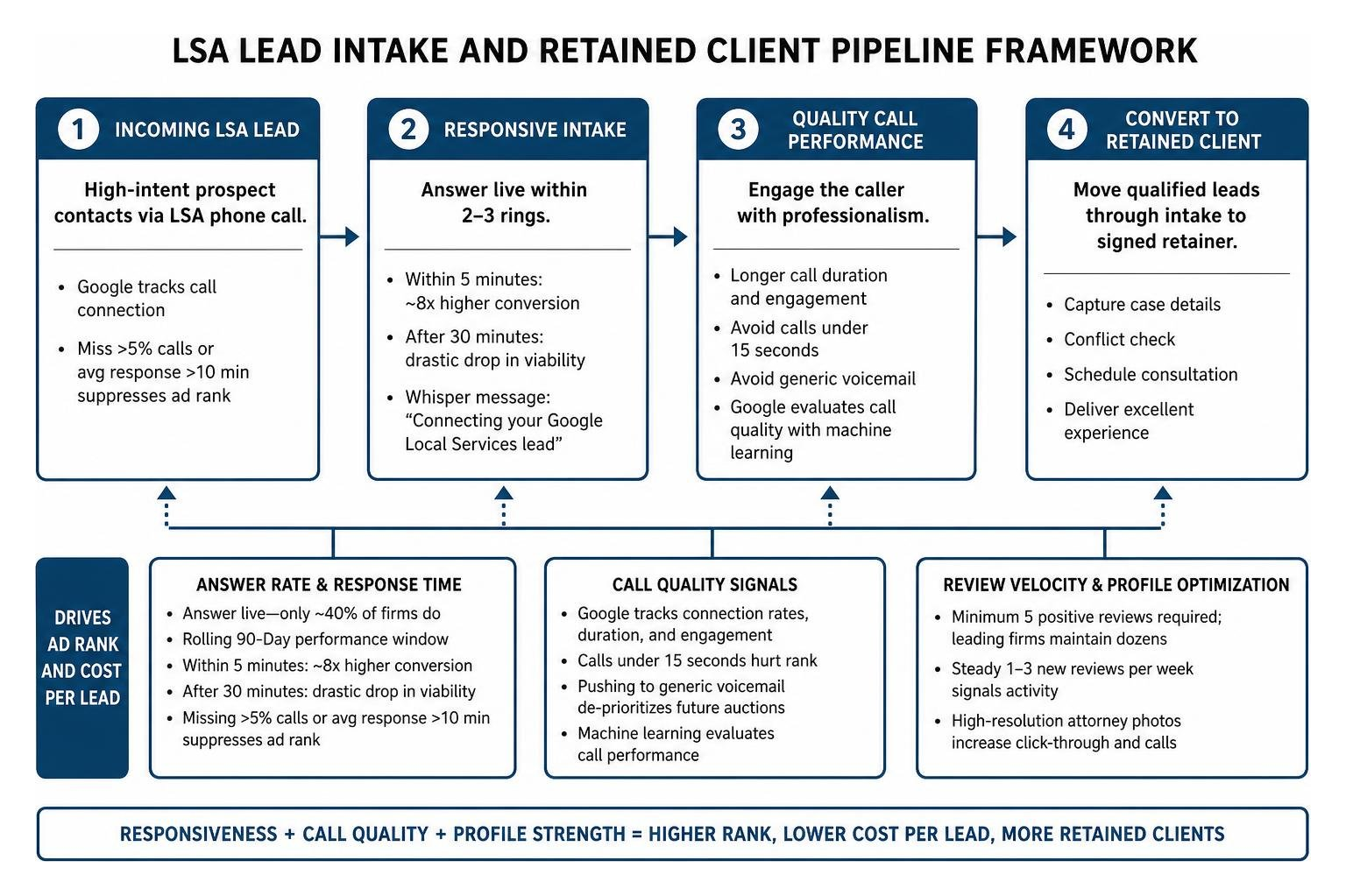
- Rolling 90-Day Performance Window: Google calculates your answer rate over an approximate 90-day rolling window. Missing more than 5% of incoming LSA calls or averaging response times over 10 minutes is the single fastest way to suppress your ad rank and increase your cost per lead.
- Call Audio and Machine Learning Evaluation: Google’s system evaluates call connection rates, duration, and caller engagement. If a firm routinely drops calls in under 15 seconds or pushes prospects to a generic voicemail, the algorithm automatically de-prioritizes the firm in future auctions.
- Intake Whisper Messages: Utilizing a whisper message (“Connecting your Google Local Services lead“) prepares your intake team to handle the call with immediate urgency and professionalism.
Review Velocity and Profile Optimization Signals
Reviews act as the primary algorithmic fuel for your ad placement:
- Review Count & Star Rating: Google prioritizes firms with a strong baseline of authentic client reviews (a minimum of 5 positive reviews is required, but leading firms maintain dozens).
- Review Velocity: A steady, consistent trickle of 1 to 3 new client reviews per week sends strong activity signals to the algorithm, outranking firms with stale review profiles.
- High-Resolution Photography: Profile listings featuring professional, well-lit attorney headshots generate significantly higher click-through and call rates than generic logos or stock courthouse images.
Lead Conversion and Campaign Optimization Strategies
Treating LSAs solely as a digital marketing campaign will lead to disappointing results. Local Services Ads function as an operational intake pipeline. To maximize your return, your firm must build robust systems for handling, tracking, and converting inbound inquiries.
Scaling Google Local Services Ads for Lawyers with High-Intent Intake
To turn high-intent phone calls into signed retainer agreements:
- Deploy 24/7 Live Intake: Legal emergencies do not adhere to business hours. Whether an arrest occurs at midnight or a motor vehicle accident happens on Sunday afternoon, law firms must utilize responsive intake systems, professional rollover answering services, or legal-trained virtual receptionists to answer calls within 2 to 3 rings.
- Integrate Practice Management Software: Leading firms connect their LSA flow directly into legal CRMs. When you Grow your law firm with Google’s Local Service Ads – Clio, intake forms and contact records sync automatically, enabling instant conflict checks, digital retainer execution, and automated follow-up sequences.
- Standardize Practice-Specific Intake Scripts: Equip intake specialists with clear qualifying criteria. For personal injury, capture liability, injury severity, and insurance details immediately. For family law or criminal defense, perform immediate conflict checks and schedule consultations before the prospect contacts a competitor.
Avoiding the General Law Firm Leads Trap and Policy Updates
A widespread and costly mistake attorneys make in the LSA dashboard is enabling the broad “General Law Firm Leads” category. This setting opens your ad spend to ambiguous legal inquiries—such as pro bono requests, small claims disputes, or out-of-jurisdiction issues—that waste your budget. Uncheck general categories and target only precise case types (e.g., “Motorcycle Accidents” or “Contested Divorce”).
Additionally, law firms must remain compliant with recent policy adjustments:
- Automated Lead Crediting: Manual dispute tickets have been phased out. Google utilizes automated machine-learning systems that review lead recordings and transcripts within 72 hours, automatically issuing credits for spam, robocalls, and wrong numbers. However, leads matching your selected service categories that you simply decline do not qualify for credits.
- Attorney-Client Privilege Safeguards: Because Google monitors call recordings for quality and automated credit evaluations, instruct your intake staff to handle initial qualification on the tracking line, but transition sensitive, confidential legal consultations off the LSA recording line once the lead is established.
Frequently Asked Questions About Legal LSAs
What happens if our law firm misses an LSA phone call?
When an incoming LSA call goes unanswered or rolls to a generic voicemail, your firm suffers a dual penalty. First, you lose a high-intent prospect who will immediately click and call the next attorney listed on the SERP. Second, Google logs the unanswered call against your responsiveness score. Because responsiveness is measured over a rolling 90-day average, missing more than 5% of calls will actively depress your ad placement and inflate your cost per lead for weeks.
How does Google handle invalid lead disputes in 2026?
Google utilizes an automated machine-learning evaluation process that assesses inbound calls within 72 hours of receipt. The system automatically credits your account for invalid inquiries such as automated telemarketers, wrong numbers, and spam calls. Manual dispute ticket submissions have been retired, meaning firms can no longer dispute legitimate callers who simply were not a good fit or cases that were declined.
Can solo attorneys compete against large law firms on LSAs?
Yes. The LSA platform provides equal footing for solo practitioners and boutique law firms. Because Google’s ranking algorithm places heavy emphasis on geographic proximity, star rating, review recency, and phone responsiveness, a responsive solo attorney with a 4.9-star rating and a 98% call answer rate can regularly outrank large institutional firms with massive advertising budgets.
Conclusion
Google Local Services Ads offer law firms an unmatched opportunity to capture prospective clients at the precise moment they require legal representation. By securing the Google Verified badge, narrowing your practice categories, optimizing review velocity, and maintaining exceptional phone responsiveness, your firm can build a predictable client acquisition machine.
At BullsEye Internet Marketing, we specialize in helping attorneys dominate their local markets through targeted Pay Per Lead strategies, SEO, and complete campaign management. We operate with a strict one client per industry per geographic area policy—giving your firm an uncompromising competitive advantage with no long-term contracts.
Ready to scale your case volume? Contact us today to launch and optimize your google local services ads campaign.
