
How Local Marketing SEO Drives Real Business Growth in 2026
Local marketing SEO is the process of optimizing your online presence to capture nearby customers searching on Google Search, Google Maps, and AI-powered engines.
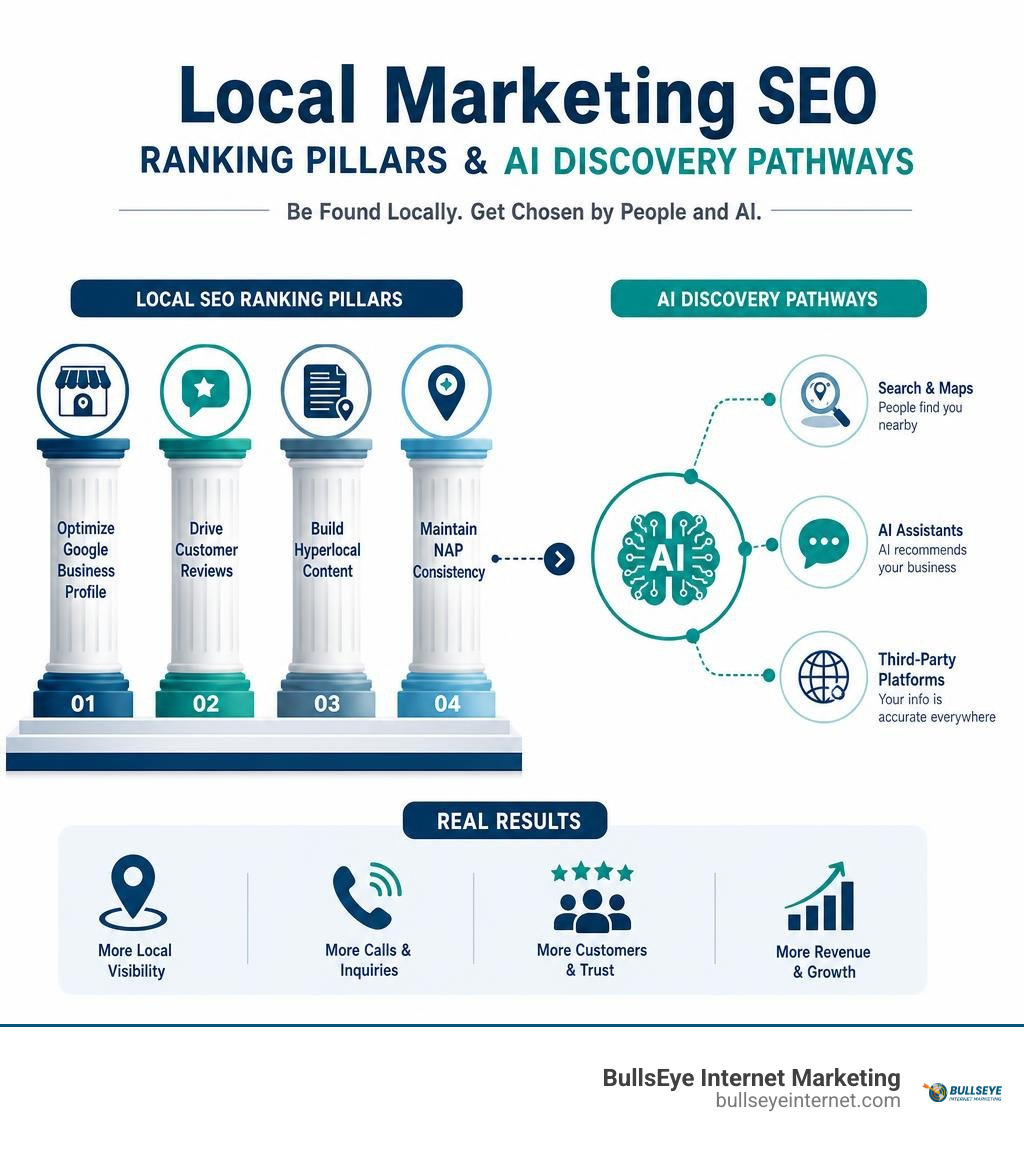
To turn local searches into direct phone calls and revenue, execute these four foundational tactics:
- Fully Optimize Google Business Profile: Choose the exact primary category, publish weekly updates, and complete every service description.
- Drive Systematic Customer Reviews: Gather steady, detailed reviews where customers mention specific services and locations.
- Structure Hyperlocal Content: Build dedicated service-area pages featuring clear 50-word direct answers and LocalBusiness schema markup.
- Maintain Exact NAP Consistency: Keep your business Name, Address, and Phone number identical across core directories and map providers.
Nearly 46% of all Google searches carry local intent, and over 40% of service discovery now flows through AI platforms like ChatGPT and Gemini. Dominating local search requires feeding accurate, structured data to both traditional map algorithms and AI discovery models.
I’m Ronnie Katz, founder and Principal CEO of BullsEye Internet Marketing, where I’ve spent over 20 years helping service brands turn Local marketing SEO into predictable, measurable revenue. Let’s break down the exact strategies you need to build local authority and win more customers in your market.
Essential Local marketing SEO terms:
- search engine optimisation companies
- search engine optimization company
- search engine optimization consultants
Core Pillars of Modern Local Marketing SEO
Local search connects immediate commercial intent with geographic proximity. When a consumer’s pipe bursts in Fort Lauderdale or someone needs commercial air conditioning repair in West Palm Beach, they are not casually browsing; they need an immediate solution. Understanding the benefits of local SEO for your business begins with recognizing how search engines evaluate three foundational ranking pillars:
- Relevance: How well your business profile, service categories, and on-page content match the explicit or implicit intent of the search query.
- Distance (Proximity): How close your verified business location or established service area is to the user making the query or the geographic boundary defined in the search.
- Prominence: How established and trustworthy your business appears across the web, measured through review volume, customer sentiment, local citations, high-quality backlinks, and directory verification.
The #1 page in organic search results captures approximately 32% of total clicks, and conversion rates for high-intent local queries are 15% to 30% higher than generic informational terms. For businesses operating across Florida markets—from Miami-Dade and Broward County up through Palm Beach County—dominating both the map pack and standard organic listings doubles your real estate on the search engine results page (SERP).
| Ranking Factor / Signal | Traditional Organic SEO | Modern Local Marketing SEO |
|---|---|---|
| Primary Goal | Global / National SERP rankings | Local 3-Pack, Google Maps, AI engine answers |
| Location Signals | Broad domain authority, topic depth | Physical address, NAP consistency, service radiuses |
| Key Assets | Blog posts, whitepapers, site architecture | Google Business Profile, Apple Business Connect, local pages |
| User Reviews | Trustpilot, site testimonials (social proof) | Direct Google reviews, localized sentiment, recency |
| Backlink Profile | High-authority global and niche websites | Hyperlocal links (Chambers of Commerce, local sponsorships) |
| AI Overviews | Large-scale informational entity graphs | Localized business entities, local schema, structured NAP |
Conducting Keyword Research for Local Marketing SEO Campaigns
Keyword research for local campaigns is fundamentally different from national content marketing. Instead of targeting broad terms with high volume but low commercial intent (such as “types of water heaters”), we target high-converting, geo-modified terms (such as “tankless water heater installation Coral Springs”).
Modern local keyword discovery revolves around three main buckets:
- Explicit Geo-Targeted Keywords: Queries combining a core commercial service with a city, county, or neighborhood modifier (e.g., “emergency electrician Boca Raton” or “commercial roofing Miami”).
- Implicit “Near Me” Searches: Mobile and desktop queries where Google determines the location automatically using the searcher’s IP address and GPS coordinates (e.g., “AC repair near me”). Over 1.5 billion “near me” searches occur every month.
- Conversational Intent Queries: Natural-language questions used in voice search and generative AI tools like ChatGPT and Gemini (e.g., “Who can fix my HVAC unit today in Delray Beach?”).
To uncover hidden local search volume, analyze competitor keyword gaps and use Google Autocomplete suggestions for your primary service lines across adjacent cities like Hollywood, Boynton Beach, and Pompano Beach. If you want a proven framework for discovering these high-intent local phrases, review our local SEO strategies for small business success.
Technical Web Foundations Supporting Local Marketing SEO
You cannot build lasting local rankings on a broken technical foundation. Local search engines prioritize websites that load instantly, display clean structural code, and provide direct actions for mobile users.
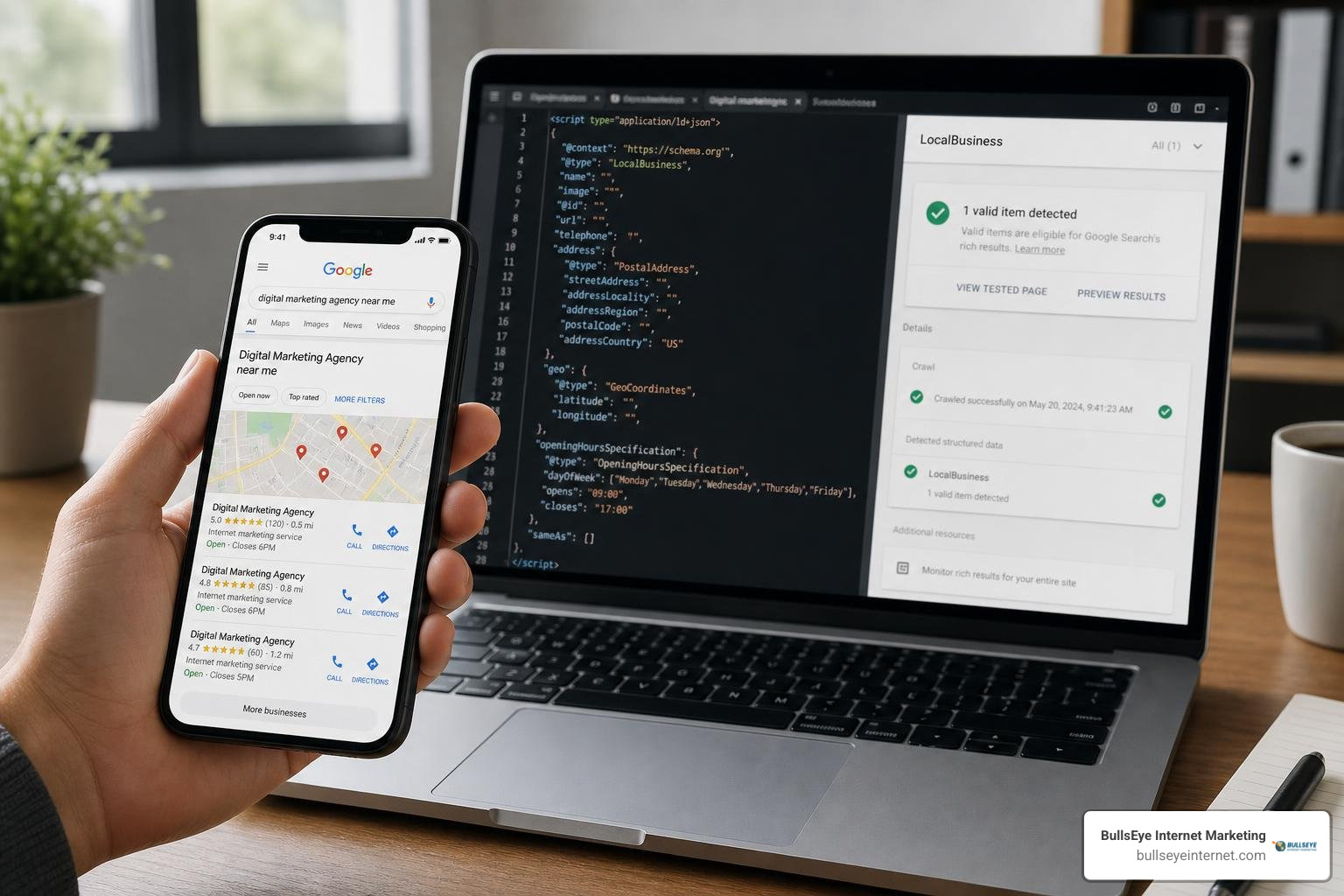
To support your local marketing campaigns, your website must satisfy these core technical standards:
- Structured Data (Schema Markup): Implement robust JSON-LD markup, specifically
LocalBusiness(or granular sub-types likePlumbingContractororLegalService),Service,AggregateRating, andFAQPageschema. Validated structured data helps search crawlers and AI answer engines ingest your operating hours, service area coordinates, and pricing tiers directly. - Core Web Vitals & Speed: Over 84% of local searches originate on mobile devices. Your website must load under 2.5 seconds (Largest Contentful Paint), maintain an Interaction to Next Paint (INP) under 200ms, and keep Cumulative Layout Shift (CLS) below 0.1.
- Mobile-First Conversions: Implement sticky tap-to-call buttons (
tel:links) with tap targets of at least 48px, clear quote request forms, and rapid mobile navigation.
For a detailed walkthrough on setting up technical site architectures for multi-city coverage, follow our local SEO strategy template guide.
Optimizing Google Business Profile and Reputation for Search Visibility
Your Google Business Profile (GBP) is the single most important asset in local search marketing, accounting for roughly 32% of local pack ranking factors. Businesses with fully optimized, actively managed profiles capture 2.7 times more visibility and 70% more direction requests than neglected listings.
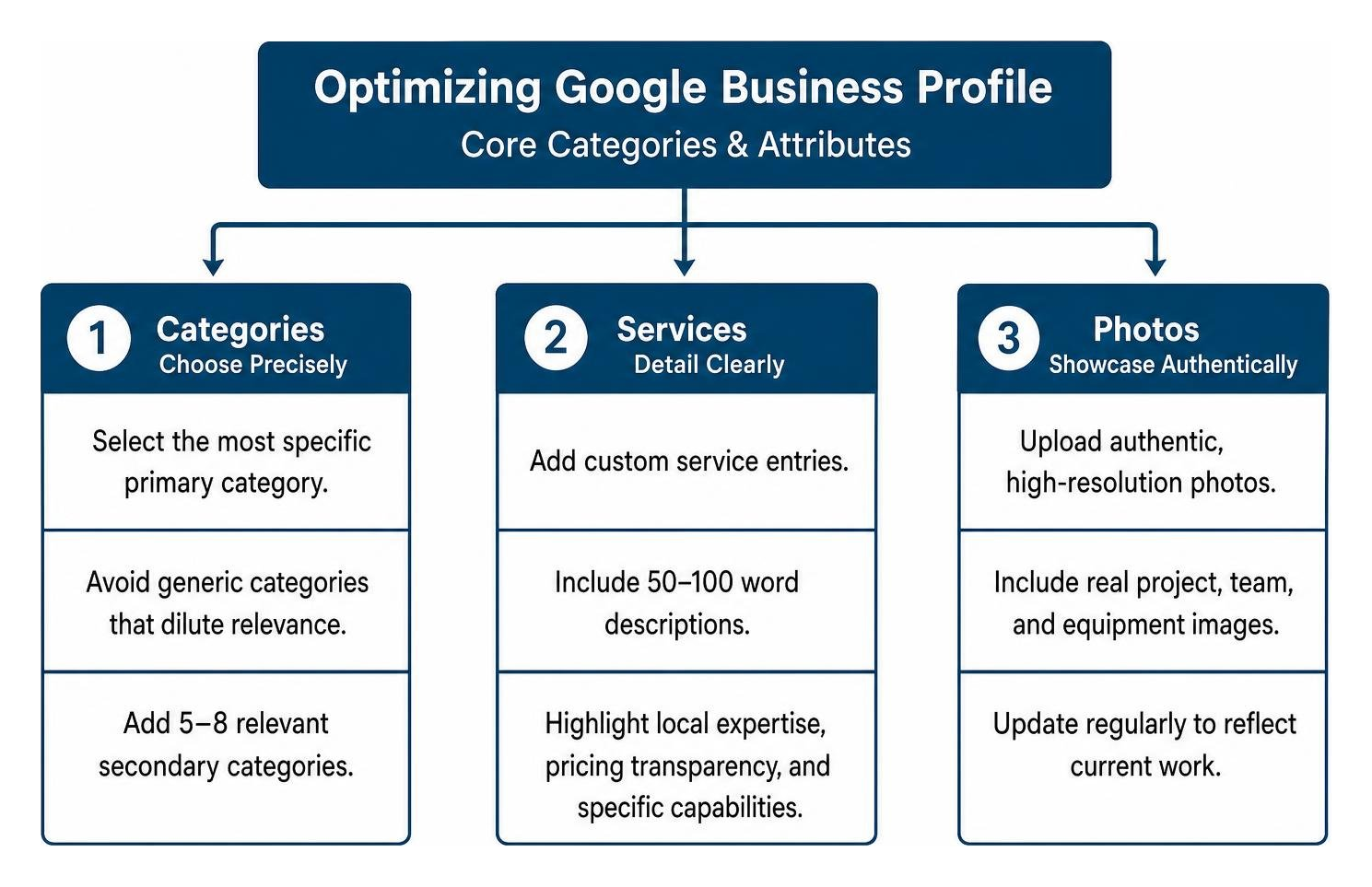
To maximize your Google Maps and local 3-pack visibility:
- Select the Most Specific Primary Category: Choosing the wrong primary category is the single most damaging local ranking mistake. If you specialize in bathroom renovations, choose “Bathroom Remodeler” rather than the generic “Contractor.” Add 5 to 8 relevant secondary categories to capture related service lines.
- Populate Granular Service Menus: Add custom service entries complete with 50-to-100-word descriptions that naturally highlight your local expertise, pricing transparency, and specific capabilities.
- Upload Authentic High-Resolution Photos: Listings with comprehensive photo libraries receive 42% more direction requests and 35% more clicks to their websites. Upload real project photos, team images, and equipment shots regularly; top-ranking local businesses maintain 200+ authentic images over time.
- Publish Weekly Updates and Offers: Use Google Posts to announce seasonal promotions, highlight recent local jobs, and share company news to keep your profile active.
Systematic Review Generation and Reputation Management
Online reviews directly influence both search engine algorithms and prospective customer conversions. In fact, 98% of consumers read reviews of local businesses at least occasionally, and 76% do so regularly. Furthermore, 73% of consumers only trust reviews written in the last 30 days, making review freshness critical.
To build a steady stream of authentic reviews without violating platform policies:
- Automate Post-Service Requests: Send an automated SMS and email review request within 2 to 24 hours of completing a job, including a direct shortlink to your GBP review form.
- Encourage Specific Customer Details: Ask customers to mention the specific service performed and their neighborhood or city (e.g., “installing a new breaker panel in Coral Gables”). Detailed reviews supply rich contextual entities that Google’s algorithm uses to validate your relevance.
- Maintain a Rapid Response Velocity: Respond to 100% of reviews—both positive and negative—within 24 to 48 hours. Businesses that respond quickly generate up to 38% more customer engagement. Always address negative feedback with professionalism and an offer to resolve the issue offline.
To explore deeper reputation workflows and automated customer feedback loops, explore our local search marketing expert guide.
Maintaining Directory Hygiene and Citation Accuracy
Local citations are online mentions of your business Name, Address, and Phone number (NAP). While mass directory spamming with hundreds of low-tier links is obsolete, maintaining exact NAP consistency across core authoritative data aggregators remains a fundamental hygiene requirement.
- Structured Citations: Standardize your business data across top-tier platforms: Google Business Profile, Apple Business Connect, Bing Places, Yelp, Facebook, YellowPages, Data Axle, and Localeze.
- Unstructured Citations: Earn natural mentions of your business NAP details in local digital newspapers, regional lifestyle blogs, and community event listings.
- Duplicate Suppression: Routinely audit platforms to detect and merge duplicate listings, mismatched phone numbers, or outdated suite numbers that create conflicting signals for search crawlers.
Navigating the AI Shift: From Map Packs to Generative Search Discovery
Local search is experiencing its most dramatic evolution since the introduction of the smartphone. Today, 30% to 40% of local service queries occur inside AI-driven discovery engines like ChatGPT, Perplexity, and Gemini, while Google’s AI Overviews appear on roughly 48% of tracked search queries.

Generative Engine Optimization (GEO) requires a dual-track strategy. While traditional Google Maps relies heavily on geographic proximity and core GBP signals, AI search agents pull information across a broader spectrum of web data. ChatGPT recommends only 1.2% of local business locations, Gemini 11%, and Perplexity 7.4% (compared to 35.9% visibility in Google’s traditional 3-pack). To win these highly competitive AI recommendations—which deliver 4 to 23 times higher call conversion rates—you must adapt your web properties for AI synthesis.
For a deeper dive into adapting your digital assets for AI retrieval engines, consult our local SEO services complete guide and explore the latest industry research on local SEO in the AI era.
Crafting High-Authority Local Content and Answer Capsules
AI engines do not read web pages the way humans do; they parse semantic entities, structured data, and concise factual statements. To win citations in AI Overviews and chat-based searches:
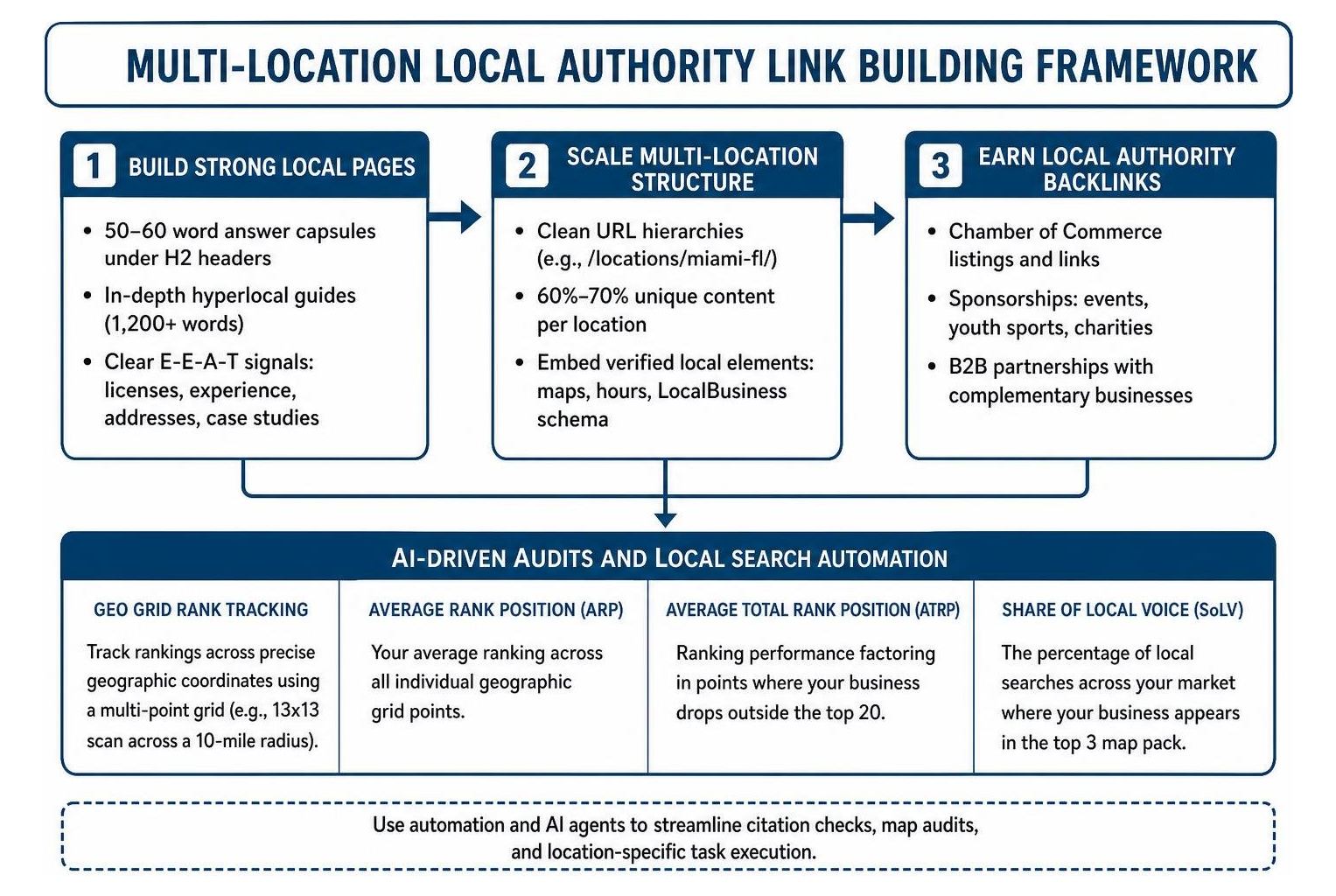
- Deploy 50-to-60 Word “Answer Capsules”: Place direct, factual summaries immediately below H2 headers on service and location pages. An answer capsule answering “How much does AC repair cost in South Florida?” gives LLMs an easily extractable quote block, boosting citation rates by up to 40%.
- Build Hyperlocal Authority Hubs: Replace thin, templated pages with in-depth guides (1,200+ words) addressing local conditions. For instance, a roofing contractor in South Florida should publish detailed guides on local building codes, hurricane wind-mitigation standards, and tile roofing durability in coastal salt-air environments.
- Demonstrate Clear E-E-A-T Signals: Detail your team’s state licenses, years of local operation, physical office addresses, and verified local project case studies to prove real-world Experience, Expertise, Authoritativeness, and Trustworthiness.
AI-Driven Audits and Local Search Automation
Managing multi-city visibility requires advanced monitoring tools to track rankings across precise geographic coordinates. Because map pack rankings change within micro-distances, standard citywide tracking no longer tells the whole story.
Modern local tracking relies on geogrid rank tracking, which maps your visibility across an interactive multi-point grid (such as a 13×13 scan across a 10-mile radius). This calculates critical metrics:
- Average Rank Position (ARP): Your average ranking across all individual geographic grid points.
- Average Total Rank Position (ATRP): Ranking performance factoring in points where your business drops outside the top 20.
- Share of Local Voice (SoLV): The percentage of local searches across your market where your business appears in the coveted top 3 map pack positions.
Practitioners looking to streamline automated citation checks and map audits can review open-source local SEO automation tools to understand how AI agents are deployed for location-specific task execution.
Scaling Multi-Location Strategies and Authority Link Building
Expanding your footprint across multiple cities—such as operating branches across Miami, Fort Lauderdale, and West Palm Beach—requires a disciplined structural approach. Attempting to scale by creating duplicate landing pages with swapped city names triggers doorway page filters and destroys search performance.
To scale multi-location SEO effectively:
- Use Clean URL Hierarchies: Organize locations logically (e.g.,
/locations/miami-fl/and/locations/fort-lauderdale-fl/or/services/plumbing-boca-raton/). - Ensure 60% to 70% Unique Content: Every location landing page must feature authentic local team bios, distinct customer reviews from that municipality, unique project descriptions, and custom local FAQs.
- Embed Verified Local Elements: Include custom Google Maps embeds pointing directly to the specific location’s GBP listing, verified local business hours, and location-specific
LocalBusinessschema.
To understand how enterprise and regional brands expand their geographic reach without triggering algorithmic penalties, study these real-world multi-location expansion strategies.
High-authority local backlinks signal community trust and prominence to search engines. Rather than pursuing irrelevant national links, focus on local link building:
- Chambers of Commerce: Secure listings and links from municipal chambers across your target service counties.
- Local Event & Youth Sports Sponsorships: Sponsor youth athletic leagues, charitable 5K runs, and community festivals to earn authoritative
.organd regional business page mentions. - B2B Community Partnerships: Partner with non-competing, complementary service providers (e.g., an HVAC contractor partnering with a local general contractor or property management firm) to exchange resource links and customer recommendations.
Frequently Asked Questions About Local Search Performance
How long does it take to see measurable results from local SEO?
Local search campaigns typically show initial ranking movements and increased profile impressions within 60 to 90 days. Significant call volume increases and dominant top-3 map pack rankings generally solidify between months 4 and 9 as citation authority, structured schema, and review velocity compound. Generative AI visibility often updates faster (within 2 to 6 weeks) when structured data and answer capsules are published on authoritative domains.
How does traditional local SEO differ from AI search optimization?
Traditional local SEO focuses on optimizing for Google’s local 3-pack algorithm, which prioritizes proximity, primary GBP categories, and local citation volume. AI search optimization (Generative Engine Optimization) focuses on getting cited in conversational models like ChatGPT, Gemini, and Perplexity. These AI models synthesize data across multiple web sources (including Bing indexes, structured web page schema, and third-party entity mentions), placing greater emphasis on comprehensive topical authority, fresh content, and extractable answer formats.
How can growing businesses scale local SEO across multiple locations without duplicate content penalties?
Avoid mass-producing identical doorway pages. Each location page must contain 60% to 70% unique content, including neighborhood-specific customer testimonials, local job case studies, localized FAQs, unique staff photos, and verified local addresses or service radiuses. Centralize your technical SEO, schema templates, and branding guidelines, but localize the on-page content and community link-building efforts for each market.
Conclusion
Local marketing SEO is no longer just about filling out a business directory; it is a comprehensive growth engine that bridges technical web architecture, active Google Business Profile management, customer sentiment, and AI-driven answer engine optimization.
At BullsEye Internet Marketing, we help local and multi-location service brands dominate their service territories and turn search intent into measurable, high-value leads. We operate with complete transparency: we require no long-term contracts, and we work with only one client per industry per geographic market, ensuring our full strategic focus is dedicated to keeping your business ahead of the competition.
Ready to dominate local map packs and AI search engines across your target cities? Partner with our team for professional search engine optimization services and build your market advantage today.
