
Hire a Generative Engine Optimization Agency That Can Earn AI Visibility
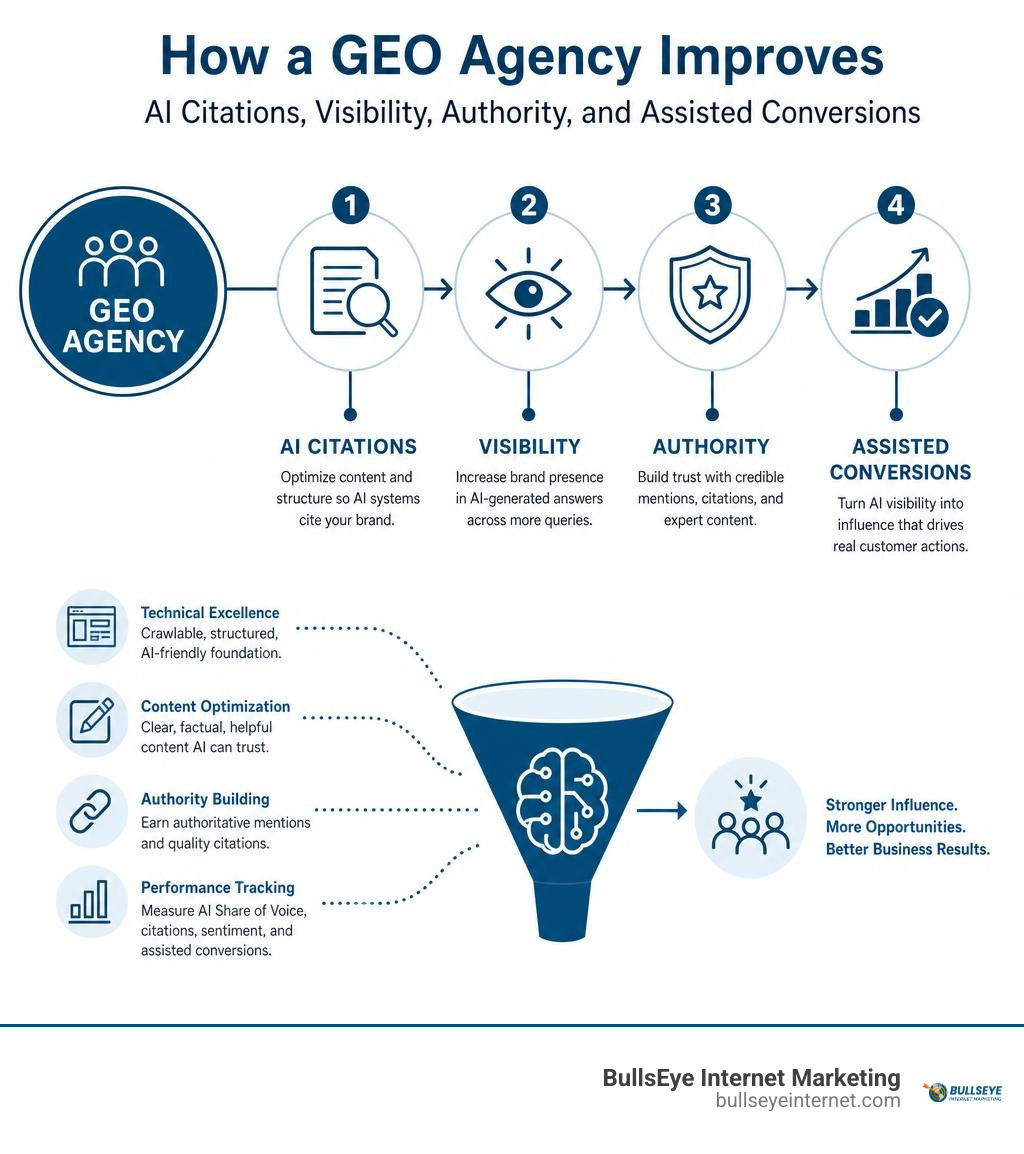
A Generative Engine Optimization (GEO) agency helps your business appear as a trusted source in AI-generated answers from platforms such as ChatGPT, Google Gemini, Perplexity, and Microsoft Copilot. Unlike a traditional SEO agency that focuses mainly on rankings and clicks, a GEO partner works to improve your chances of being mentioned, cited, and recommended when buyers ask AI tools for solutions.
Before hiring one, look for an agency that can:
- Audit how often AI systems currently mention your brand and competitors.
- Improve your website’s facts, content structure, schema, and technical crawlability.
- Build credible third-party mentions through digital PR, citations, and authority content.
- Track AI Share of Voice, citation quality, sentiment, and assisted conversions – not just traffic.
This matters because many AI searches end with an answer, not a click. If your company is absent from that answer, a strong traditional ranking may not be enough to win the customer. The right GEO strategy adds a citability layer to SEO: it helps AI systems understand who you are, what you offer, and why your business is a credible recommendation.
I’m Ronnie Katz, founder and Principal CEO of BullsEye Internet Marketing. Since 2006, I have helped businesses improve online visibility, leads, and conversions through SEO, local search, AEO, and Generative Engine Optimization agency services that prioritize clear reporting and measurable business outcomes.
Essential generative engine optimization agency terms:
What Is a Generative Engine Optimization Agency and How Does It Work?
As search moves from indexed lists of blue links to synthesized, conversational answers, search discovery has transformed. A specialized agency focuses on getting your business cited, referenced, and highlighted inside conversational models and generative search results.
Instead of only targeting a static keyword list, these firms optimize for how large language models understand context, extract entity relationships, and compile real-time summaries. Understanding the ultimate guide to generative engine optimization and ai search visibility begins with recognizing that AI engines do not merely match strings of text—they evaluate source credibility, extract verified facts, and generate conversational recommendations.
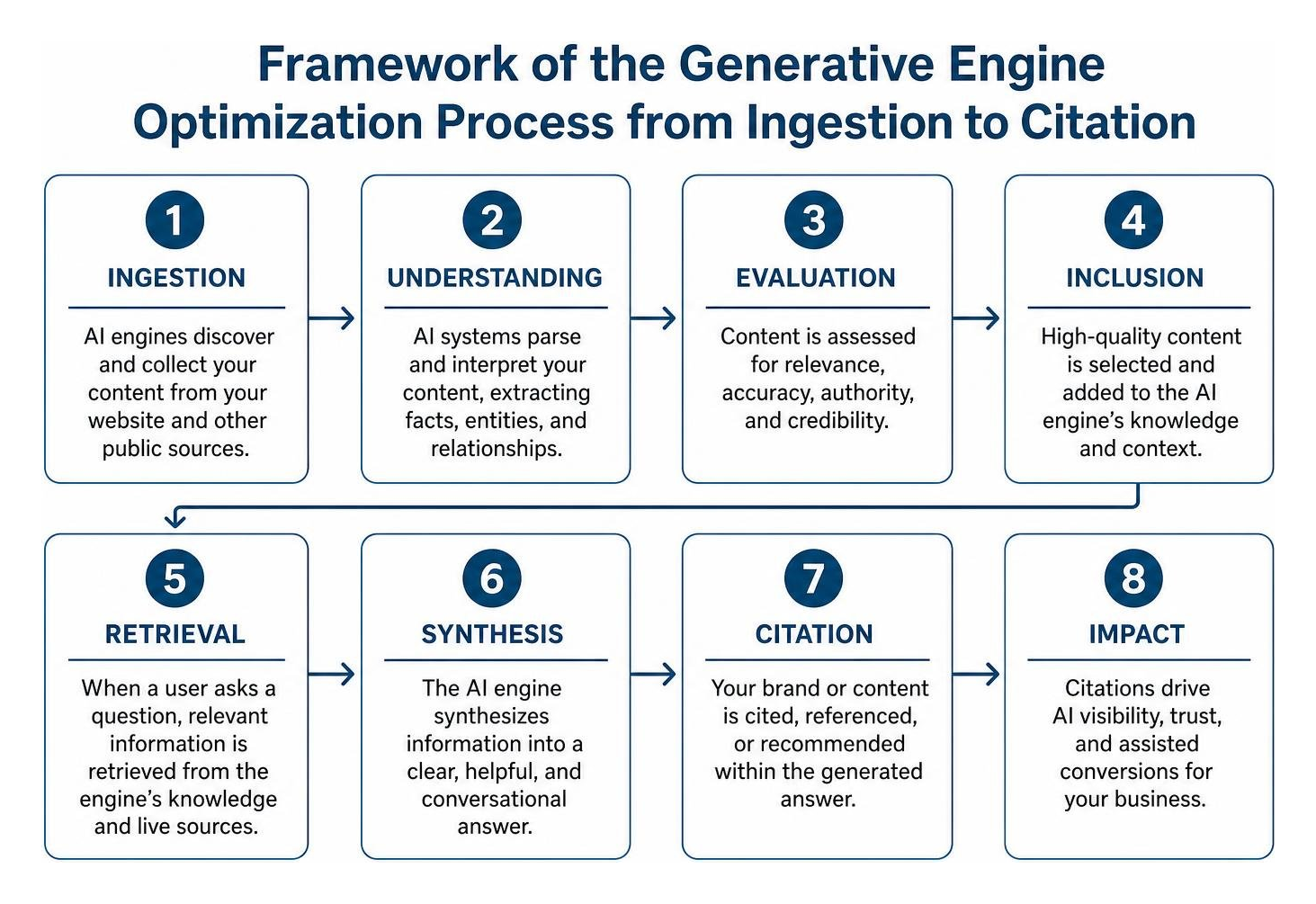
When an AI engine processes a query, it pulls together information from its training weights, real-time web retrieval (RAG), structured data, and high-authority third-party platforms. An expert firm coordinates entity mapping, content structuring, and external citation building so your brand is the obvious, verified choice to answer the user’s prompt.
Why Partner With a Specialized Generative Engine Optimization Agency Instead of Traditional SEO?
Traditional search engine optimization remains critical, but its primary objective is ranking individual web pages for specific queries. In contrast, hiring a dedicated firm offering an advanced generative engine optimization service ensures your brand is optimized for the mechanics of generative AI engines.
- Targeting Answers Instead of Just Clicks: Generative answers often provide direct summaries that fulfill user intent on the spot. Optimization focuses on brand inclusion and positive sentiment within those direct summaries.
- Optimizing for Multi-Turn Conversations: Traditional SEO focuses on isolated single-query searches. Generative discovery adapts to conversational threads, follow-up questions, and prompt expansions.
- Evaluating Dynamic Retrieval Pipelines: AI platforms evaluate data freshness, entity consensus across the web, and clear structural context rather than relying solely on standard backlink counts.
- Securing High-Intent Assisted Conversions: Even when users do not click a traditional link immediately, being cited in an AI overview establishes authority, leading directly to high-intent branded searches, phone calls, and direct consultations.
GEO vs AEO vs LLMO: Understanding the Nuances
As AI search terminology evolves, it helps to distinguish between the closely related optimization disciplines:
| Optimization Discipline | Target Platforms | Primary Output | Core Strategy |
|---|---|---|---|
| GEO (Generative Engine Optimization) | Google AI Overviews, Perplexity, ChatGPT Search, Gemini | Synthesized narratives, multi-source citations, comparison tables | Entity mapping, citable formatting, structured data, topical authority |
| AEO (Answer Engine Optimization) | Voice assistants (Siri, Alexa), Google Featured Snippets, direct answer widgets | Direct single answers, voice readouts, snippet boxes | Q&A formatting, schema markup, concise direct factual summaries |
| LLMO (Large Language Model Optimization) | Base LLMs, conversational agents, custom enterprise copilots | Model training data representation, contextual brand recall | Digital PR, knowledge graph inclusion, cross-web entity consensus |
To explore how these disciplines align, review our detailed guide on answer engine optimization aeo geo llm seo.
Core Services Delivered by Leading AI Optimization Firms

A comprehensive agency does not just rewrite blog posts with buzzwords. Instead, it deploys a systematic strategy that transforms your digital footprint into machine-readable, authoritative information. Mastering how to geo requires combining technical architecture with off-page digital authority.
Entity Mapping, Schema, and Citable Content Structuring
AI engines rely on clear knowledge representations to understand who you are, what services you provide, and where you operate. Leading firms utilize advanced semantic seo services complete guide techniques to build robust semantic clarity:
- Entity Definition & Knowledge Graph Alignment: Defining your business entity unambiguously using Organization, LocalBusiness, and Service schema markups to connect with external knowledge bases.
- Citable Content Formatting: Structuring information with direct, factual “lead-with-the-answer” paragraphs, digestible lists, and clear definitions that LLMs can extract easily without summarization loss.
- Structured Q&A Integration: Building comprehensive FAQ architectures and technical schema that directly address bottom-of-the-funnel buyer questions and conversational prompts.
Brand Authority Building Across ChatGPT, Gemini, and Perplexity
Large language models determine source trust by examining web-wide consensus. They cross-reference your claims against reputable third-party publications, industry portals, and community platforms. Specialized agencies earn third-party mentions on high-authority websites, maintain consistent profile citations across respected digital platforms, and optimize presence on community discussions where real-world users discuss service providers.
Top agencies also utilize specialized off-page authority strategies aligned with best practices from platforms like Google Search Central to ensure models pull verified data about your business from trusted sources.
Proprietary AI Tracking Tools and Visibility Scoring
Because traditional ranking dashboards cannot capture conversational responses, top firms use specialized tracking frameworks. Through active ai visibility optimization, agencies monitor critical generative metrics:
- AI Share of Voice (SoV): The percentage of relevant industry prompts in which your brand is cited compared to competitors.
- Citation Frequency and Position: How often and how prominently your domain or brand name appears within synthesized answers.
- Sentiment and Context Tracking: Evaluating whether the generative engine presents your business favorably, neutrally, or with outdated information.
- Prompt Coverage Mapping: Monitoring hundreds of prompt variations to ensure visibility across diverse user phrasing.
How to Evaluate and Choose the Right Generative Engine Optimization Agency

Selecting an agency requires vetting their technical capabilities, operational transparency, and experience with AI retrieval systems. Navigating our comprehensive ai search marketing agency guide will help your leadership team ask the right questions during consultations.
Key Criteria for Selecting a Generative Engine Optimization Agency for Startups and Enterprises
Whether you are a growing local business or an established enterprise, evaluate providers based on these standards outlined in our generative engine optimization services 101 breakdown:
- Demonstrated Technical Competence: Can the agency explain JSON-LD nested schemas, crawl budget optimization for AI bots, and RAG retrieval mechanisms in plain, straightforward language?
- Real-World Case Studies: Look for documented evidence of growth in AI citations, visibility scores, or lead generation.
- Human-Led Content Production: AI models value deep experience and original insights (E-E-A-T). Avoid agencies that rely on cheap, fully automated AI copy generation.
- Geographic Market Exclusivity: Ensure your agency does not represent direct competitors in your local market. At BullsEye Internet Marketing, we work with only one client per industry per geographic area, giving our partners a true competitive edge without conflicting interests.
- Flexible Engagement Terms: Trustworthy agencies stand behind their work without locking you into rigid multi-year agreements. We offer no long-term contracts, ensuring our performance earns your business every month.
Unique Requirements for B2B SaaS and Technical Brands
For specialized B2B brands, standard surface-level content will not convince decision-makers or AI algorithms. Buyers prompt AI engines with specific comparison queries, integration requirements, and security concerns. Effective generative ai lead generation requires content that directly addresses feature comparisons, clear technical documentation, and authoritative third-party reviews that generative models aggregate when recommending enterprise software.
Measuring ROI, Pricing Models, and Red Flags to Avoid
Transitioning to AI-assisted search requires modern attribution models that measure impact across the entire customer journey.
Pricing Ranges, Minimum Retainers, and Project Scopes
Pricing models for professional generative engine optimization services typically reflect the scope of optimization and technical complexity required. As detailed in our ai marketing agency complete guide, common pricing tiers include:
- Initial Audits and Entity Mapping ($1,500 – $5,000): Comprehensive evaluations of your current AI visibility, schema health, and competitor Share of Voice.
- Monthly Retainers for Small-to-Midsize Businesses ($2,000 – $6,000/month): Ongoing content structuring, digital PR, citation management, technical optimization, and monthly prompt tracking.
- Enterprise or Multi-Location Programs ($7,500 – $15,000+/month): Large-scale entity architecture, continuous multi-model monitoring, custom prompt engineering, and extensive cross-channel authority campaigns.
Critical Red Flags and Pitfalls When Hiring
Be alert to questionable practices that indicate an agency lacks true technical depth:
- Guaranteed #1 Citations on AI Platforms: Generative algorithms are dynamic and probabilistic. No agency can guarantee a permanent top citation on ChatGPT or Perplexity.
- Fully Automated Content Farms: Flooding your domain with unedited, low-quality AI-generated articles dilutes your authority and risks algorithmic devaluation.
- Lack of Attribution Reporting: If an agency cannot show how AI citations correlate with qualified calls, form fills, or branded search lifts, their strategy is incomplete.
- Opaque Link Networks: Using spammy link schemes to manipulate AI engines can result in search penalties and brand exclusion.
Frequently Asked Questions About Generative Engine Optimization
How long does it take to see results from generative engine optimization?
Most businesses begin seeing their brand included in real-time generative search answers (such as Google AI Overviews and Perplexity) within 4 to 6 weeks as search bots recrawl structured pages and updated entity profiles. Broader citation growth across foundational LLM models typically matures over 3 to 6 months as platforms update their retrieval indexes and training datasets.
Can a brand measure traffic when generative engines answer queries directly?
Yes, although the measurement framework differs from classic rank tracking. While zero-click summaries answer basic queries immediately, buyers ready to make purchasing decisions look for cited sources, check phone numbers, or visit domains directly. ROI is tracked through assisted conversions, referral traffic from AI platforms, branded organic search spikes, and direct calls generated from local entity visibility.
Does GEO replace existing technical and content SEO strategies?
No. Generative optimization builds upon traditional organic search foundations rather than replacing them. High-performing campaigns implement a hybrid discovery framework that combines technical crawlability, on-page keyword relevance, and local optimization with an advanced citability layer. Review our insights on next gen seo to see how modern brands blend traditional and AI-driven methodologies into a single cohesive system.
Conclusion
The search landscape has entered a new era where generative engines serve as direct gatekeepers between businesses and buying decisions. Staying visible requires partnering with a forward-thinking firm that understands how language models digest, evaluate, and recommend brands.
At BullsEye Internet Marketing, we combine over two decades of search expertise with cutting-edge AI visibility strategies. Our focus is simple: generating qualified calls, high-intent leads, and measurable sales. We provide a distinct competitive advantage through our strict policy of working with only one client per industry per geographic area, backed by flexible agreements with no long-term contracts.
Ready to dominate AI search and secure your position as the default recommendation in your market? Explore our comprehensive approach to answer engine optimization aeo geo llm seo and contact our team today to future-proof your digital presence.
