
Why Google Ads for Chiropractors Can Drive More Local Appointments
Google Ads for chiropractors can put your clinic in front of local people who are actively looking for care, often at the exact moment they are ready to call or book. Unlike marketing that waits for attention, search ads respond to existing demand for terms such as “chiropractor near me,” “back pain treatment,” or “same-day chiropractor.”
For a quick answer, an effective chiropractic Google Ads campaign should:
- Target high-intent local and symptom-based searches.
- Limit ads to the areas your clinic can realistically serve.
- Send visitors to a focused booking page, not a general homepage.
- Track calls, forms, and scheduled appointments – not just clicks.
- Remove irrelevant searches so budget goes toward prospective patients.
Results depend on local competition, the offer, and the patient experience after the click. Still, case-study data in this market has shown that well-targeted campaigns can maintain 3-5% click-through rates, generate 100-150 monthly clicks, and improve efficiency over time when search terms, ads, and landing pages stay aligned.
I am Ronnie Katz, founder and Principal CEO of BullsEye Internet Marketing, with more than 20 years of experience helping businesses improve visibility, traffic, calls, and conversions. I use that hands-on PPC, local SEO, and landing-page experience to help practices make Google Ads for chiropractors more measurable and more focused on real patient leads.
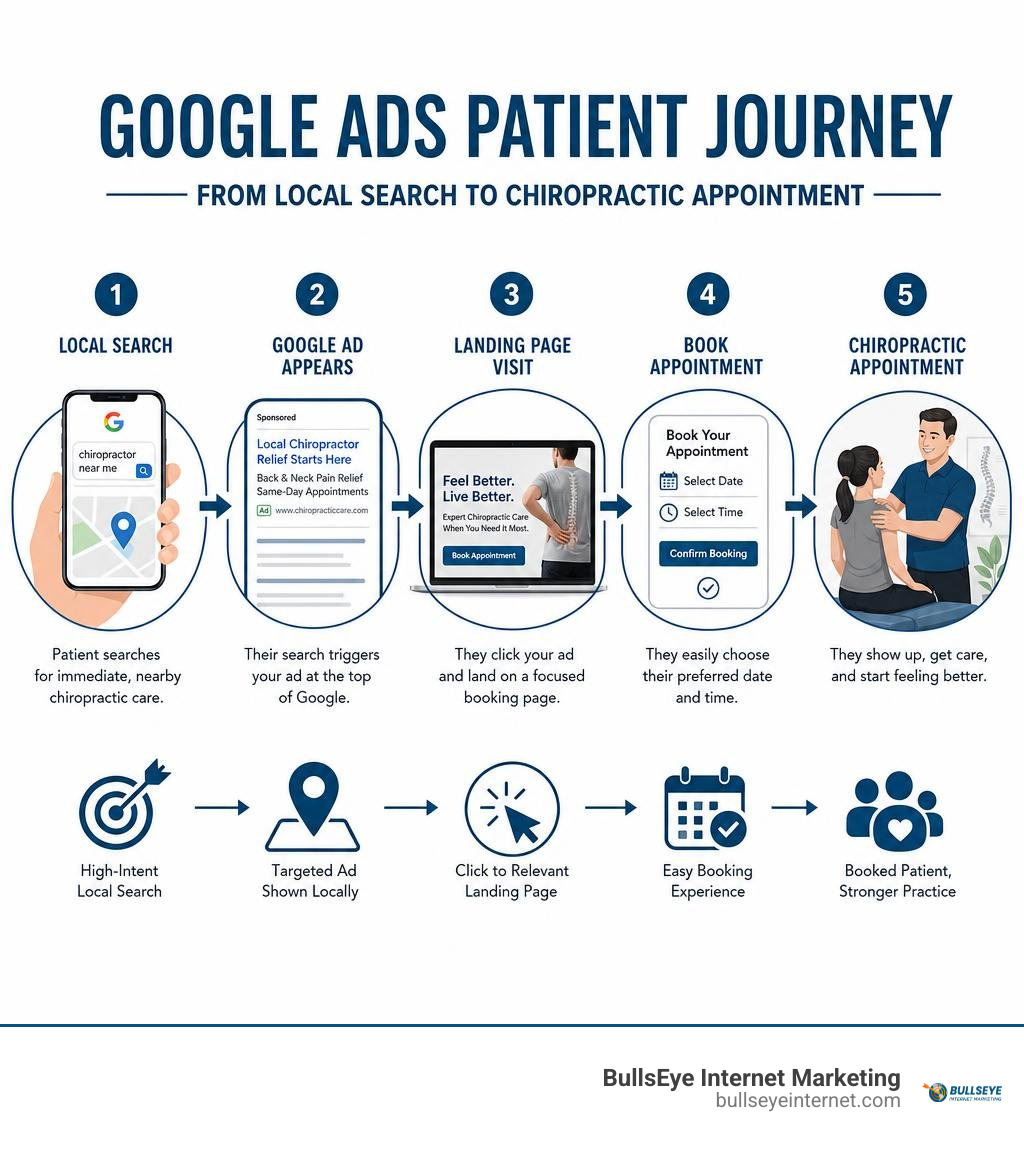
How Google Ads for Chiropractors Captures High-Intent Local Patients
When someone wakes up with acute lower back pain or severe neck stiffness, they rarely spend hours browsing social media feeds looking for passive inspiration. They pick up their smartphone and search for immediate, nearby care. This active intent is what makes pay-per-click (PPC) advertising uniquely powerful for chiropractic practices.
By deploying google ads for chiropractors, our campaigns meet local prospective patients at their moment of peak need. A person searching for “emergency chiropractor near me” or “sciatica pain relief fast” is not merely casually researching; they are actively seeking a professional solution to resolve immediate physical discomfort.
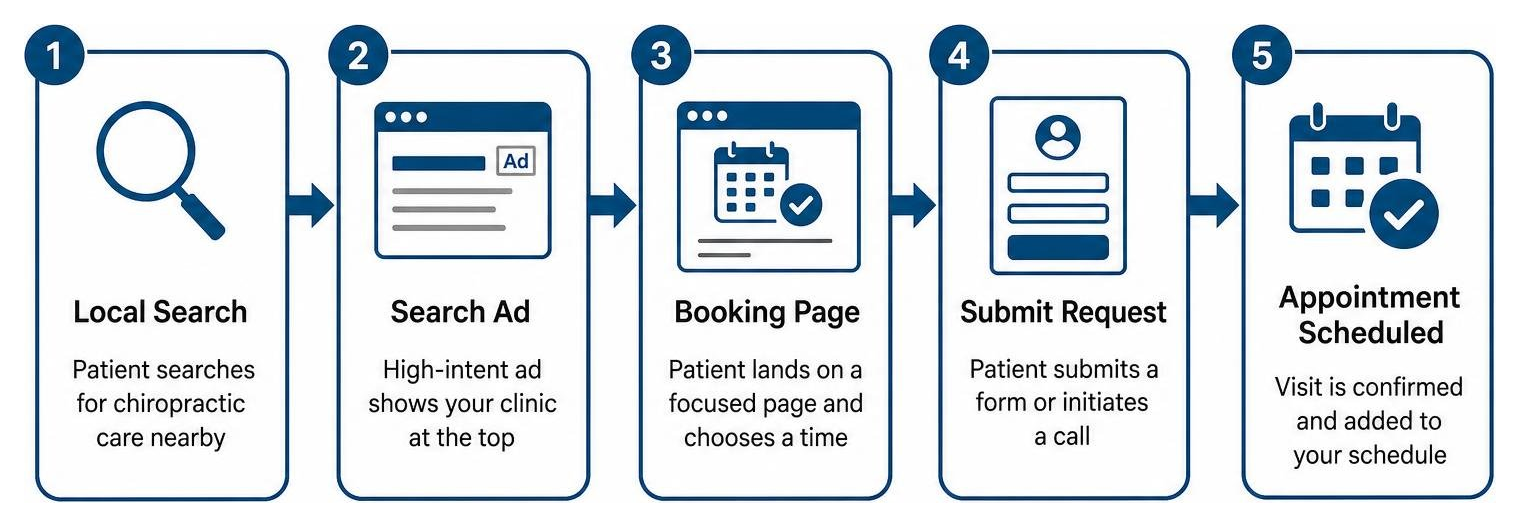
Mobile search plays a decisive role in this local ecosystem. Most urgent medical and chiropractic searches happen on mobile devices while people are at home, at work, or even sitting in their cars trying to find relief. If your clinic appears at the absolute top of the Google search results page, complete with a clickable phone number and direct directions, you capture those high-converting leads long before a competitor even comes to mind. To learn more about structuring successful healthcare search campaigns, check out The Ultimate Guide to Medical Practice Advertising and PPC.
When we align paid search ads with a strong local organic footprint (such as an optimized Google Business Profile), your clinic dominates the search engine results page (SERP). This dual dominance builds immediate trust with searchers who need treatment today.
Structuring Your Keyword and Bidding Strategy
A high-performing Google Ads campaign requires deliberate structure. Throwing a broad list of keywords into a single ad group with automated default settings is a fast track to draining your marketing budget. To maintain maximum cost-per-click efficiency, campaigns must be segmented into tightly themed ad groups based on patient intent and specific chiropractic conditions.
For example, a prospective patient searching for “prenatal chiropractic adjustments” should see ad copy tailored specifically to gentle, safe pregnancy care—leading to a landing page highlighting your certified prenatal techniques. On the other hand, someone searching for “car accident injury chiropractor” needs ad copy emphasizing personal injury care, same-day evaluations, and insurance claim support.
When managing keyword match types:
- Exact Match (
[chiropractor near me]): Captures high-intent searches with tight control, minimizing irrelevant clicks. - Phrase Match (
"sciatica chiropractor"): Allows for slight variations while keeping search intent locked onto relevant terms. - Broad Match: Use with extreme caution. While Broad Match can uncover new search terms, it often triggers ads for non-converting queries unless paired with robust automated smart bidding algorithms and extensive negative keyword lists.
Mastering Keyword Intent and Negative Keyword Lists in Google Ads for Chiropractors
Understanding symptom-based language versus general informational queries is vital. Prospective patients rarely type complex medical terminology into search engines when they are hurting. Instead, they use direct, problem-focused search terms like “sharp lower back pain when sitting,” “pinched nerve in neck,” or “best rated chiropractor for migraines.”
However, bringing in traffic is only half the battle—keeping unwanted traffic out is equally critical. Implementing robust negative keyword lists ensures your ad spend is protected against irrelevant queries that waste clicks.
Here are essential negative keyword categories every chiropractic practice should implement:
- Job and Career Terms:
jobs,careers,salary,schooling,degree,requirements,hiring,internship. - DIY & Home Remedies:
stretches,exercises,foam roller,self crack back,massage tool,at home treatment. - Low Intent / Free Services:
free,cheap,pro bono,DIY,forum,reddit. - Unrelated Professions:
physical therapy school,orthopedic surgeon jobs,massage therapy licensing.
By filtering out non-patient searches from day one, every dollar spent goes directly toward acquiring local patients seeking professional care.
Location Targeting and Ad Extensions That Drive Calls
Chiropractic care is fundamentally a proximity-based decision. Patients rarely want to drive 45 minutes across town while dealing with severe back spasms. Therefore, setting precise location targeting parameters is vital.
We recommend setting location boundaries based on realistic drive times rather than arbitrary administrative boundaries:
- Radius Targeting: Setting a 5-to-10-mile radius around your physical practice address works exceptionally well in dense suburban or urban settings like Miami, Fort Lauderdale, or West Palm Beach.
- ZIP Code Targeting: Selecting specific zip codes allows practices to target surrounding affluent neighborhoods or skip areas outside their typical patient demographic.
- “Presence” vs. “Interest”: Always select “Presence: People in or regularly in your targeted locations” in your Google Ads location settings. By default, Google targets people “in, or who’ve shown interest in” your locations, which can lead to tourists or out-of-state searchers wasting your budget.
In addition to traditional Search Ads, clinics can leverage Google Local Services Ads for Health Care Services to earn the Google Screened badge and appear at the absolute top of local search listings. Discover how these local ads transform clinic growth by reviewing Why Healthcare Google Local Ads Are a Game-Changer for Clinics.
To further expand your search visibility and click-through rates, configure all available ad extensions (now called assets):
- Call Extensions: Displays your practice phone number directly on the ad with a clickable call button for mobile searchers.
- Location Extensions: Connects your Google Business Profile, displaying your practice address, distance, and direct navigation routes.
- Sitelink Extensions: Directs users to specialized subpages like “Pediatric Chiropractic,” “Meet Dr. Smith,” or “New Patient Specials.”
- Callout Extensions: Highlights practice benefits such as “Same-Day Appointments,” “In-Network Insurance,” or “20+ Years Experience.”
Landing Page Optimization and Quality Score Dynamics
Winning the click on Google Search is only the first step. Where you direct that prospective patient determines whether that paid click turns into a scheduled appointment or a wasted opportunity.
Converting Local Searchers with High-Impact Landing Pages
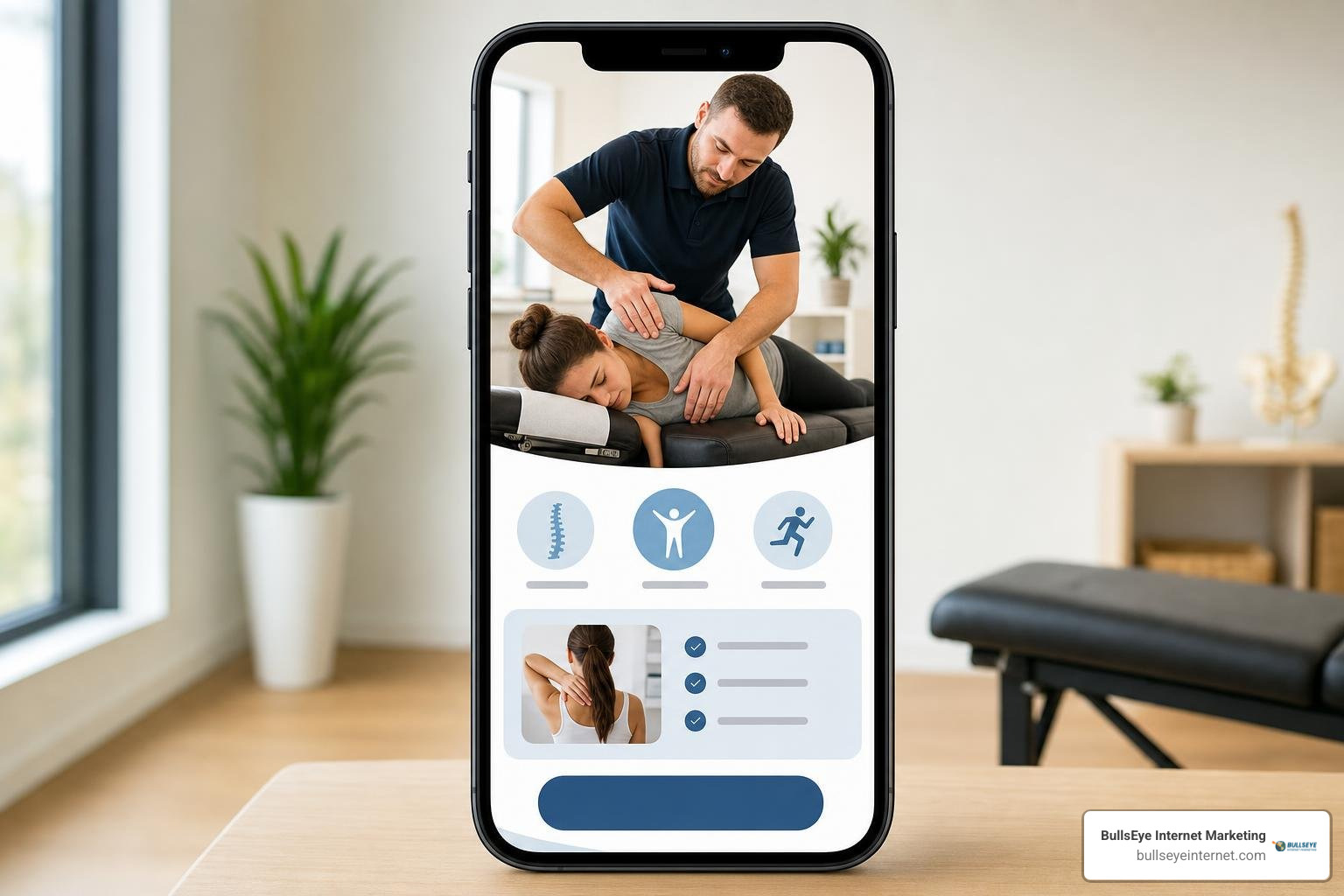
Sending paid Google Ads traffic to your practice homepage is one of the most common and costly marketing mistakes. Homepages are designed to serve every potential website visitor, offering general background information, multiple navigation links, staff bios, and blog articles. For a prospective patient searching for quick relief, those extra options create unnecessary distraction and friction.
Instead, google ads for chiropractors should always point to dedicated landing pages built specifically around the target campaign search term.
Key elements of a high-converting local chiropractic landing page include:
- Above-the-Fold Direct CTA: Clear, bold headline matching the ad copy, accompanied by an unmistakable call-to-action button (e.g., “Schedule Your $49 New Patient Consultation Today”).
- Click-to-Call Buttons: Prominent phone numbers that mobile visitors can tap to call your front desk instantly.
- Online Scheduling Integration: An embedded calendar system enabling visitors to select an appointment slot without waiting for a callback.
- Social Proof and Trust Badges: Patient reviews, star ratings, video testimonials, and professional certifications reassuring visitors of your expertise.
- Short Contact Form: A clean contact form asking for essential details only (Name, Phone, Email, Primary Symptom).
Maximizing Quality Score to Reduce Cost-Per-Click
Google uses a metric called Quality Score (rated from 1 to 10) to determine how relevant and useful your ad is to searchers compared to competing advertisers. Quality Score directly impacts your ad rank and determines how much you pay for every single click.
Quality Score is calculated based on three primary pillars:
- Expected Click-Through Rate (eCTR): How likely searchers are to click your ad when displayed.
- Ad Relevance: How closely your ad text matches the user’s search query.
- Landing Page Experience: How relevant, fast, clear, and mobile-friendly your landing page is to someone who clicked your ad.
When your keywords, ad copy, and landing page content are tightly aligned, Google rewards your campaign with higher Quality Scores, resulting in lower Cost-Per-Click (CPC) rates and higher ad placements.
| Quality Score Factor | Low Quality Score (1–4) Impact | High Quality Score (8–10) Impact |
|---|---|---|
| Average Cost-Per-Click (CPC) | Increased by up to 400% | Reduced by up to 50% |
| Ad Position | Lower positions or bottom of page | Top of SERP premium placements |
| Impression Share | Severely suppressed visibility | Maximum local exposure |
| Conversion Efficiency | Higher Cost-Per-Acquisition (CPA) | Lower overall acquisition costs |
By systematically improving account organization, aligning search terms with landing page headlines, and speeding up landing page load times, our optimizations have helped clinics reduce CPC by up to 24% month-over-month while scaling total conversion volumes.
Comparing Search Intent: Google Ads vs Facebook Ads
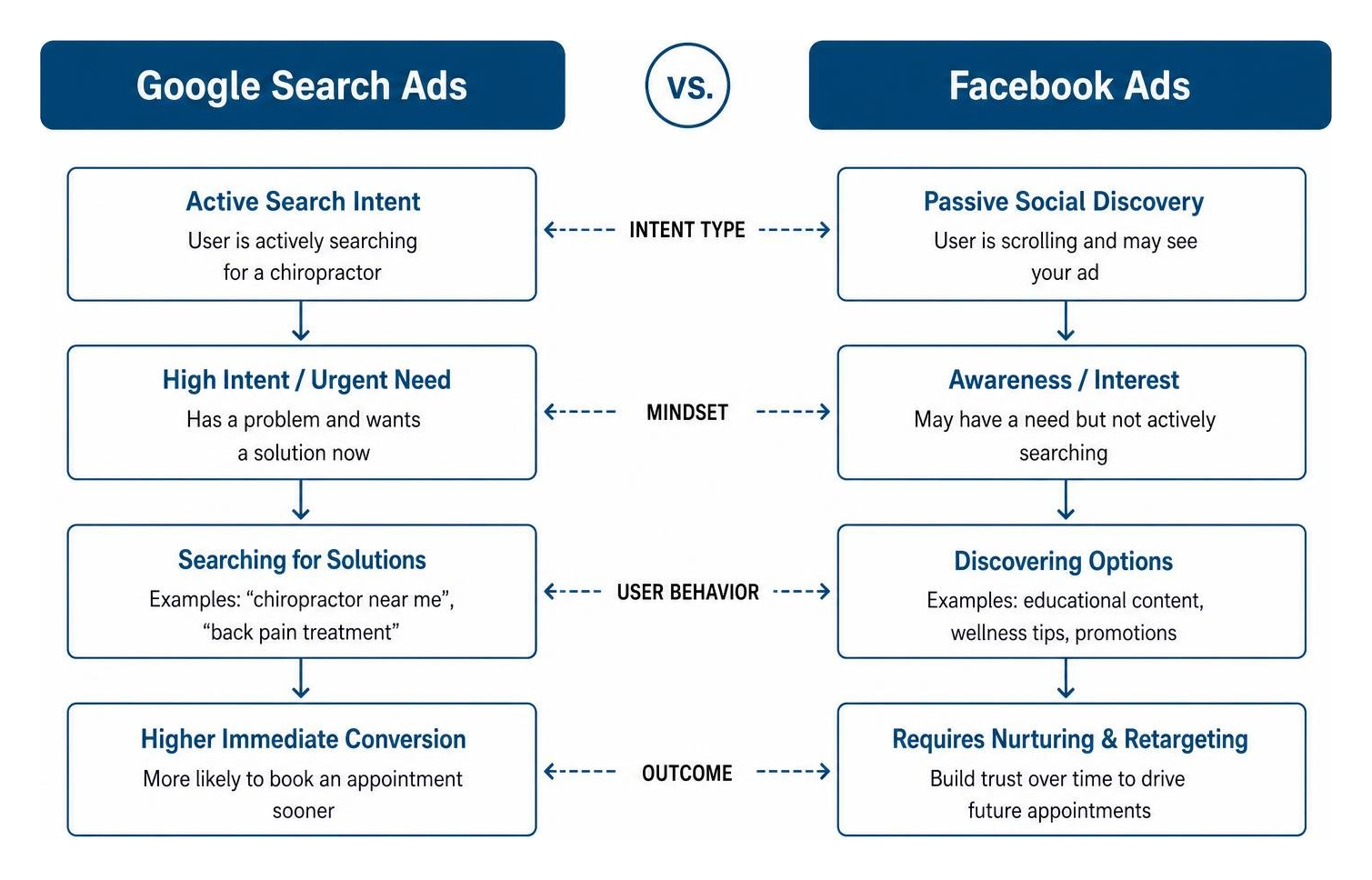
A frequent debate among practice managers is whether to focus marketing budgets on Google Search Ads or Facebook Social Ads. Both platforms offer strong patient acquisition capabilities, but they capture prospective patients at fundamentally different stages of decision-making.
Strategic Setup: When to Deploy Google Ads for Chiropractors
Google Search Ads represent active search intent. When someone searches for a chiropractor, they already know they have a problem and are actively seeking a solution. This makes Google Ads the premier choice for driving rapid conversion velocity and filling open appointment slots with motivated local patients. You can learn more about search advertising features and campaign structures through Google Ads Help.
Deploy Google Ads as your primary channel when:
- You need immediate new patient appointments and quick booking turns.
- You are targeting high-intent, symptom-driven queries (“sciatica specialist”).
- You want to dominate search listings in your local geographic area.
Integrating Social Retargeting for Full-Funnel Patient Acquisition
While Google Search captures immediate demand, social media channels excel at building brand awareness and nurturing prospective patients over time. Many searchers click a Google Ad, read through your landing page, but get distracted before booking an appointment.
By placing a Facebook retargeting pixel on your Google Ads landing page, you can create a seamless multi-touchpoint funnel:
- Capture Searcher: A patient clicks your Google Search Ad for “sciatica treatment.”
- Trigger Pixel: They browse your landing page but don’t finish booking.
- Deploy Social Retargeting: Over the next 14 days, they see warm, engaging video testimonials on Facebook and Instagram featuring real local patients sharing how your clinic relieved their sciatica pain.
- Re-engage & Convert: The prospective patient clicks the social ad and completes their online appointment booking.
Combining targeted search capture with strategic social retargeting creates a full-funnel patient acquisition strategy that maximizes ROI across both platforms. To explore additional strategies for keeping your appointment calendar full, read How to Fill Your Waiting Room Using Modern Lead Generation.
Measuring Performance, Budgets, and Avoiding PPC Mistakes
To run a sustainable Google Ads campaign, practice owners need realistic performance expectations and clear, data-driven key performance indicators (KPIs).

In typical competitive chiropractic markets across Florida and nationwide, baseline performance standards frequently reflect the following ranges:
- Average Cost-Per-Click (CPC): $1.36 to $2.79 for competitive local terms.
- Average Click-Through Rate (CTR): 3% to 5% on active search campaigns.
- Monthly Clicks: 100 to 150 highly qualified visitors per targeted campaign budget.
- Monthly Appointment Conversions: Up to 39 direct appointment requests per month from dedicated local campaigns.
To track success accurately, clinics must implement proper conversion tracking tools, including call tracking software (to record calls coming directly from ad interactions) and web form goal tracking.
Common PPC mistakes that ruin performance include:
- Failing to set up call conversion tracking: Missing phone call data makes it impossible to know which keywords drive actual bookings.
- Ignoring regular negative keyword updates: Unmonitored campaigns end up paying for non-converting, off-target search terms.
- Setting geographic targeting too broad: Displaying ads outside your practice’s realistic driving radius burns ad spend on leads unlikely to show up.
- Setting up campaigns and forgetting them: PPC campaigns require ongoing bid adjustments, ad copy A/B testing, and landing page optimization to maintain low acquisition costs.
Frequently Asked Questions About Google Ads for Chiropractors
How long does it take to see results from chiropractic Google Ads?
Unlike search engine optimization (SEO), which can take several months to build momentum, Google Ads generates immediate visibility. Your ads can appear at the top of local search results within 24 to 48 hours of launch, driving phone calls and form submissions within the very first week. However, peak campaign efficiency and lowest cost-per-lead are achieved after an initial 4-to-6-week optimization window, as conversion data helps refine keywords and bidding strategies.
What is the average cost-per-click and monthly budget for chiropractic PPC?
Average cost-per-click typically ranges between $1.36 and $2.79 for standard chiropractic terms, though highly competitive personal injury or accident-related search terms can command higher rates. Most single-doctor chiropractic clinics begin with a starter ad spend budget between $1,000 and $2,500 per month. This allows the campaign to generate enough clicks and conversion data to optimize performance and scale spend profitably.
Why shouldn’t chiropractors send Google Ads traffic to their homepage?
Homepages contain too much general information, navigation menus, and links to secondary content, which creates friction for someone looking for immediate care. This leads to higher bounce rates, lower Quality Scores, higher CPCs, and lost revenue. Dedicated landing pages streamline the experience with focused messaging and a clear path to book an appointment immediately.
Scale Your Practice with High-Converting Search Campaigns
Running successful google ads for chiropractors requires an ongoing commitment to keyword research, technical tracking, ad copy creation, landing page design, and negative keyword optimization. When managed correctly, search advertising becomes a predictable lead engine that brings a steady stream of new patients into your clinic.
At BullsEye Internet Marketing, we deliver results through specialized digital strategies:
- Pay-Per-Lead and PPC Optimization: Direct, transparent campaigns engineered around booked calls and patient requests.
- Geographic Exclusivity: We work with only one client per industry per geographic area, giving your practice a distinct competitive advantage in your local market.
- No Long-Term Contracts: We earn your business every month through clear performance metrics and real ROI.
- Complete Local Visibility: Integrating paid search with Google Business Profile optimization, local SEO, and landing page conversion optimization.
Whether your clinic is based in Miami, Fort Lauderdale, West Palm Beach, or surrounding areas across Florida and the USA, our expert team can help you build and manage high-performing local ad campaigns. Explore our comprehensive Google Ads Services or discover how to Transform Your Practice Growth with Custom Google Ads Management today. Ready to fill your appointment schedule with qualified local patients? Contact us to get started!
