
Why Advertising for Startups Can Make or Break Your Business
Advertising for Startups is the strategic use of marketing channels to build brand awareness, attract customers, and drive revenue growth when resources are limited. Here’s what you need to know:
- The stakes are high: 22% of startups fail specifically because of marketing problems
- Speed matters: 80% of entrepreneurs watch their businesses fail within the first 18 months
- ROI is everything: Email marketing drives $36 for every $1 spent, making channel selection critical
- Strategy beats budget: Successful startup advertising requires clear goals and measurable results—not just a big budget
Every startup begins with a great idea, but a great product isn’t enough. Without effective advertising, even the best solutions fail to reach their audience. The challenge is building a sustainable customer acquisition engine that drives growth without draining your limited budget.
This guide covers everything from pre-launch marketing to choosing channels, implementing growth tactics, and measuring what matters. You’ll learn which strategies deliver real ROI, which pitfalls to avoid, and how to align your teams for scalable success.
I’m Ronnie Katz, and since 2006, I’ve helped hundreds of businesses—including early-stage startups—steer the complexities of Advertising for Startups through data-driven SEO, PPC, and lead generation strategies. My mission is to cut through the noise and show you what actually works when every marketing dollar counts.
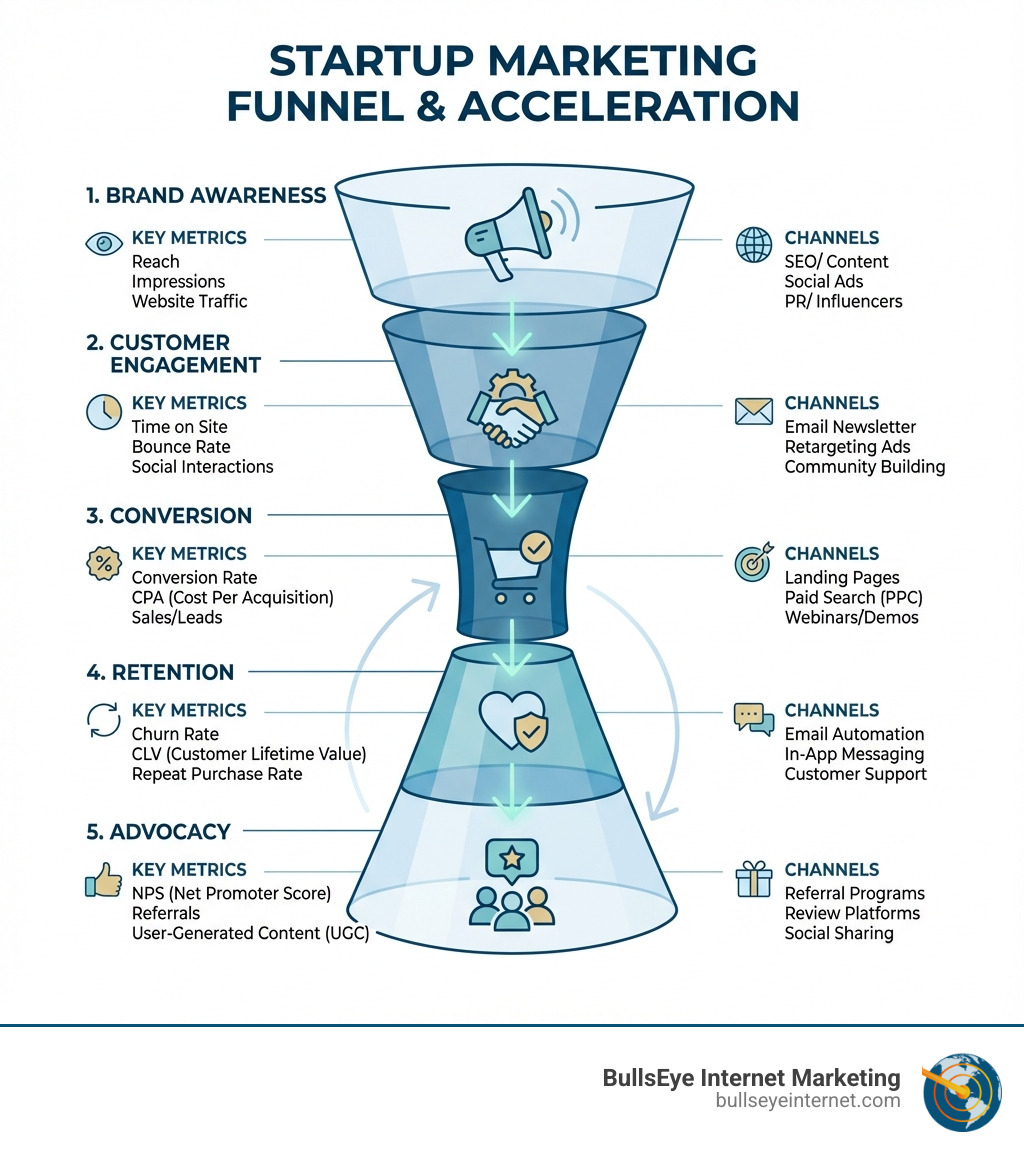
Laying the Groundwork: Your Pre-Launch Marketing Blueprint
Before diving into specific tactics for Advertising for Startups, understand that effective marketing isn’t just about ads; it’s about building a solid foundation. Many of the 80% of businesses that fail within 18 months do so because they market prematurely. A strategic approach ensures every dollar contributes to sustainable growth.

Defining Your “Why”: Goals and Brand Identity
The first step is to define your “why.” For a startup, the primary goals are typically:
- Brand Awareness: Ensuring potential customers know you exist.
- Lead Generation: Capturing contact information from interested prospects.
- Customer Acquisition: Converting leads into paying customers.
- Customer Loyalty and Trust: Fostering relationships that lead to repeat business and advocacy.
- Strong Reputation: Positioning your brand as a credible industry leader.
Beyond these goals, build a compelling brand identity. This isn’t just a logo; it’s your company’s personality, values, and voice. A strong identity helps you stand out and build relationships. Consistency across all touchpoints—from your website to customer service—is paramount. Managing your Brand Reputation Management from day one is critical.
Finally, you must identify your Unique Value Proposition (UVP). What makes your product or service different and better? What specific problem do you solve? Clearly articulating your UVP is the cornerstone of all your marketing messages.
The Right Time and the Right Research
When should a startup begin marketing? Not the moment you have an idea. Marketing too early wastes resources and can create a bad first impression. The ideal time is after achieving product-market fit—when you have data-backed proof that a specific customer group wants your product. Ensure a smooth user experience and exhaustive testing before launching any campaigns.
Market research is pivotal. It’s about understanding your customers and your brand’s standing with them. This involves:
- Audience Segmentation: Dividing your market into smaller groups to tailor messaging.
- SWOT Analysis: Evaluating internal Strengths/Weaknesses and external Opportunities/Threats.
- Competitor Analysis: Studying competitors to find market gaps and effective strategies.
- Identifying Your Target Market: Creating buyer personas—detailed profiles of your ideal customers, including their pain points and online habits.
Since 97% of consumers use search engines to find businesses, understanding how your audience searches is vital. A robust SEO Strategy begins with this research.
Crafting Your Startup Marketing Plan
With your goals, UVP, and research complete, it’s time to build your marketing plan. This roadmap will guide all your advertising efforts with these foundational elements:
- Establish a Business Brand: Define your brand voice, values, and visual identity.
- Create a Professional Digital Presence: Start with a high-quality, mobile-responsive website. It’s the cornerstone of digital marketing and a key lead generation tool. Our Website Design Services ensure your site is functional and optimized for conversions.
- Perform Market Research: This is ongoing and informs every other step.
- Create Buyer Personas: Detailed profiles of your ideal customers.
- Set SMART Marketing Goals: Your goals must be Specific, Measurable, Attainable, Relevant, and Time-bound (e.g., “Increase website traffic by 20% next quarter”).
- Identify Your Marketing Strategy: Decide which channels and tactics you’ll employ.
- Create Your Marketing Budget: Allocate funds strategically, prioritizing high-ROI channels.
- Set Metrics and Key Performance Indicators (KPIs): Use measurable values like conversion rates, customer acquisition cost (CAC), and return on ad spend (ROAS) to track progress.
- Monitor Your Progress: Regularly track your KPIs and adjust your strategy as needed.
Since most founders aren’t sole marketers, they must learn on the job or seek expert help. Using Web Analytics Services from the start provides crucial data for informed decisions and continuous refinement.
Choosing Your Channels: Digital and Offline Advertising for Startups
Once the groundwork is laid, the next question is: where do you advertise? Advertising for Startups involves a mix of digital and offline channels, chosen based on your target audience and goals.

Startups must weigh inbound vs. outbound marketing. Inbound (e.g., SEO, content) earns attention by attracting customers with valuable content. Outbound (e.g., ads, cold calls) buys attention by pushing messages out. While inbound often has higher conversion rates for startups, an integrated marketing approach that blends both typically yields the best results.
While digital channels dominate, don’t discount traditional methods. Email marketing drove an incredible $36 for every $1 spent in 2022, but traditional marketing also ranked in the top three for ROI. A thoughtful mix is effective. Our Digital Marketing strategies create holistic campaigns by considering both.
Dominating the Digital Landscape
Digital marketing channels offer unparalleled targeting and measurability, making them indispensable for Advertising for Startups.
- SEO (Search Engine Optimization): SEO makes your website visible in search results. As a top priority for marketers, it’s a long-term strategy that builds organic traffic and authority. We focus on keyword optimization, technical SEO (like mobile responsiveness), and semantic search.
- Content Marketing: This involves creating valuable content (blogs, videos, guides) to attract and retain your target audience. For example, tech startup LiberEat grew organic traffic by 1000% in three months with content marketing.
- Social Media Marketing: Engage with your audience on platforms like Facebook, Instagram, and LinkedIn. With 74% of consumers trusting opinions on social media, authentic engagement and influencer marketing are powerful.
- Email Marketing: Nurture customer relationships with email campaigns, which drive an ROI of $36 for every $1 spent. We optimize campaigns with personalization, automation, and segmentation while adhering to privacy regulations like GDPR and the CAN-SPAM Act.
- Paid Advertising: Paid ads on platforms like Google and social media provide an immediate boost in leads and revenue. We start with small test budgets to identify effective strategies before scaling. Our PPC Advertising expertise helps startups steer these platforms.
- Influencer Marketing: Collaborate with individuals who have credibility in your niche to leverage their audience’s trust.
Making an Impact with Offline and Unconventional Tactics
Offline and unconventional tactics create memorable experiences and strong local connections, which is key in areas like Florida, South Florida, and Miami Dade County.
- Networking Events: Attend industry conferences and local meetups for face-to-face interaction and relationship building, which is especially effective for B2B Startup Marketing.
- Business Cards and Pamphlets: Traditional yet effective for sharing your UVP in person.
- Guerrilla Marketing: Low-cost, unconventional campaigns designed to grab attention and generate buzz.
- Experiential Marketing: Create immersive brand experiences that engage customers directly, like a pop-up shop or product demo.
- Strategic Partnerships and Collaborative Marketing: Team up with complementary businesses to cross-promote services and expand your reach, such as partnering with a co-working space in West Palm Beach.
Integrating offline efforts with your digital strategy is key. For example, promote a local event on social media to maximize attendance and create a seamless customer journey.
From Strategy to Growth: 11 Actionable Ideas and Measuring Success
Now that we’ve covered the foundations and channels, let’s get into specific, actionable ideas for Advertising for Startups and how to measure their impact.
11 Specific Advertising for Startups Ideas to Drive Growth
Here are 11 tried-and-true startup marketing ideas for competitive markets:
- Invest in Paid Ads to Supplement Your Community: Use paid ads on platforms like Google or social media to supplement organic growth and target customers in specific areas like Broward County or Palm Beach County.
- Engage Your Customers Through Social Media and Content: Don’t just broadcast; interact. Use social media and valuable content to build personality, foster conversations, and educate your audience.
- Leverage Digital PR and Influencer Marketing: Partner with relevant publications or influencers. Since 74% of consumers trust social media opinions, this is a powerful way to build credibility.
- Host Virtual Events or Webinars: Position your startup as a thought leader by hosting focused online events or webinars to generate leads and engagement.
- Master SEO Services: Optimize your site to rank high in search results. With 97% of consumers using search engines to find businesses, organic visibility is crucial, especially for local terms like “SEO Services Florida.”
- Create a Referral Program: Encourage word-of-mouth from happy customers. Dropbox famously grew its sign-ups by 60% with its referral program.
- Offer a Free Trial or Demo: Let customers experience your product firsthand. Freemium models, used by companies like Canva, reduce customer risk and showcase your value.
- Aim for Viral Marketing: Design campaigns and products that encourage sharing. Creating shareable content can lead to exponential growth.
- Send Personalized Emails: Segment your audience to send custom messages that address their needs. This tactic consistently delivers high ROI.
- Integrate with Popular Business Tools: If your product complements other platforms like Slack, explore integrations to expand your ecosystem and reach.
- Leverage User-Generated Content (UGC): Encourage customers to create content like reviews or photos. This provides authentic social proof and builds community.
Measuring What Matters: ROI and Data-Driven Decisions
For startups, every dollar counts, so rigorously measuring Return on Investment (ROI) is essential. The basic formula is:
ROI = (Sales Growth – Marketing Cost) / Marketing Cost
A good marketing ROI is at least 200%, with 500% or more being excellent. We aim for strategies that consistently deliver 200-500% ROI or more.
To measure effectively, we focus on Key Performance Indicators (KPIs) tied to your business goals:
- Customer Acquisition Cost (CAC): How much it costs to acquire a new customer.
- Customer Lifetime Value (CLTV): The total revenue a customer is expected to generate.
- Conversion Rate: The percentage of visitors who complete a desired action.
- Return on Ad Spend (ROAS): Revenue generated for every dollar spent on advertising.
We use data analytics tools to track performance, conduct A/B testing, and adjust strategies based on insights. Our Call Tracking Services, Google Analytics setup, and regular SEO Audit Service ensure we capture comprehensive data to make decisions that fuel growth.
Common Marketing Pitfalls for Startups to Avoid
Startups can fall into common marketing traps:
- Marketing Too Early: Launching before product-market fit wastes money and creates negative impressions.
- Neglecting Market Research: Failing to understand your audience is the number one reason startups fail.
- No Clear Plan or Budget: This leads to haphazard and inefficient marketing efforts.
- Spreading Resources Too Thin: Focus on a few channels that yield the best results.
- Ignoring Data and ROI: Running campaigns without tracking their effectiveness means you’re flying blind.
- Inconsistent Branding: A fragmented brand message confuses customers and erodes trust.
- Choosing the Wrong Channels: Forcing a fit where there isn’t one is costly, like using expensive, untrackable TV ads.
Scaling Up: Aligning Teams and GTM Strategy
As a startup grows, sales and marketing alignment becomes critical for converting leads into loyal customers. Misalignment is a key issue for 47% of teams. Our Pay Per Lead Marketing expertise helps bridge this gap by focusing on qualified leads ready for sales engagement.
Sales and Marketing: A Powerhouse Partnership
An integrated sales and marketing team is a powerhouse. Here’s how to foster this collaboration:
- Shared Goals and KPIs: Align both teams on revenue goals and key metrics like CAC and CLTV.
- Defining the Ideal Customer Profile (ICP): Sales and marketing must agree on who the perfect customer is to ensure marketing attracts the right leads.
- Lead Handoff Process (MQL, SQL): Establish clear definitions for Marketing Qualified Leads (MQLs) and Sales Qualified Leads (SQLs) and a smooth handoff process.
- Using a Shared CRM: A centralized CRM gives both teams access to the same customer data and lead status.
Our Lead Generation Services are designed to deliver high-quality leads that align with your sales team’s objectives.
Choosing Your Go-to-Market (GTM) Motion for Startups
Your Go-to-Market (GTM) strategy defines how you acquire customers. For SaaS startups, there are three common motions:
- Sales-Led Strategy: Common for high-value, complex B2B products, this involves a dedicated sales team actively engaging prospects.
- Self-Serve (Product-Led) Strategy: The product itself drives customer acquisition, often through freemium models or free trials.
- Hybrid Strategy: A combination where marketing drives self-serve adoption and a sales team engages high-value leads.
The right GTM motion depends on product complexity, average revenue per user (ARPU), and target market. A product-led approach is often an efficient start, with a sales layer added as the startup matures.
Leveraging Feedback and Automation for Growth
Sustainable growth relies on continuous improvement.
- Using Customer Feedback for Product Development: Sales and marketing gather invaluable customer feedback on the front lines. This feedback should flow to product development, creating a powerful loop that drives innovation and ensures your product evolves to meet market needs.
- Role of Marketing Automation Tools: Automation is a game-changer for resource-limited startups. These tools automate repetitive tasks like email sequences and lead nurturing, helping to:
- Lead Nurturing Workflows: Automatically send targeted information to leads based on their engagement.
- Lead Scoring Models: Prioritize leads based on their likelihood to convert, focusing sales efforts.
Marketing automation allows for personalized campaigns at scale, enhancing engagement and simplifying workflows while ensuring data privacy compliance.
Frequently Asked Questions about Advertising for Startups
How much should a startup spend on advertising?
There’s no magic number for a startup’s ad spend; it depends on your industry, growth stage, and budget. A common guideline is a percentage of projected revenue (e.g., 5-10%, but often higher for startups in aggressive growth phases).
However, our philosophy is to focus on ROI, not just spend. Start small, test channels, and scale what works. A small PPC campaign might start at $20-$50/day to gather data. Once it shows a positive ROI (200-500%+), you can confidently increase the budget. Our PPC Management Florida services maximize this efficiency.
What are the best free advertising methods for a startup?
For startups with tight budgets, several free or low-cost methods can be effective:
- Content Marketing (Blogging): Create valuable blog posts that address your audience’s pain points to attract organic traffic.
- SEO Services Florida: Optimize your website for search engines. Many foundational SEO practices can be done in-house.
- Organic Social Media: Build a presence on relevant platforms and engage with your community.
- Email List Building: Offer valuable content in exchange for email addresses to communicate directly with prospects.
- Networking: Attend industry events or online forums to build relationships that lead to referrals.
- Public Relations (PR): Reach out to journalists and bloggers with compelling stories to earn media exposure.
How do I create a strong digital presence for my startup?
A strong digital presence is non-negotiable. Here’s how to build one:
- Professional, Mobile-Responsive Website: Your site is your digital storefront. It must be fast, secure, easy to steer, and look great on all devices.
- Active Social Media Profiles: Be present and engaged on relevant platforms. Share valuable content and interact with followers to build a community.
- Optimized Google Business Profile (GBP): Crucial for local Florida businesses, an optimized GBP improves visibility in local search and Google Maps.
- Consistent Content Creation: Regularly publish high-quality content (blogs, videos) to provide value and establish expertise.
- Encouraging Online Reviews: Solicit reviews on platforms like Google. Positive reviews build trust and boost search rankings.
Since 97% of consumers use search engines to find businesses, a robust digital presence is foundational for any startup.
Conclusion: Turning Your Advertising into a Growth Engine
Advertising for Startups is a marathon, not a sprint. It’s a continuous process of planning, execution, measurement, and refinement. This guide covered the critical steps: laying the groundwork, choosing the right channels, implementing actionable strategies, and rigorously measuring ROI while aligning sales and marketing.
Successful startup advertising treats marketing not as an expense, but as a strategic investment in growth. It’s about being smart, agile, and data-driven, especially when resources are limited.
Navigating these complexities can be challenging, but you don’t have to do it alone. BullsEye Internet Marketing offers expert PPC, SEO, and lead generation services without long-term contracts. We guarantee a competitive advantage by working with only one client per industry per geographic area, from Miami to West Palm Beach.
Ready to accelerate your startup’s growth with a proven advertising strategy? Explore our Paid Ad Management services and get a competitive edge.
