
The Shift from Search Engines to Answer Engines
AEO best practices are essential for maintaining visibility as AI-powered answer engines like ChatGPT and Google’s AI Overviews transform how people find information. The old rules of SEO are no longer enough.
Quick Answer: Top AEO Best Practices for 2025
- Structure content with direct answers – Place a 40-60 word answer at the top of each section
- Use schema markup – Implement FAQPage, HowTo, and Article schema to help AI understand your content
- Optimize for featured snippets – Format content with bullet points, numbered lists, and tables
- Focus on user intent – Answer questions in conversational, natural language
- Build authority signals – Include citations, original data, and earn mentions on trusted sites
- Ensure technical health – Pass Core Web Vitals, maintain mobile-friendliness, and use semantic HTML
- Create FAQ sections – Address “People Also Ask” questions directly on your pages
- Optimize for voice search – Write in spoken-friendly language for local queries
The shift to an “answer economy” is a fundamental change in user behavior. The old goal was to rank high and get clicks; the new goal is to be the answer. This is critical for business survival and growth for several reasons:
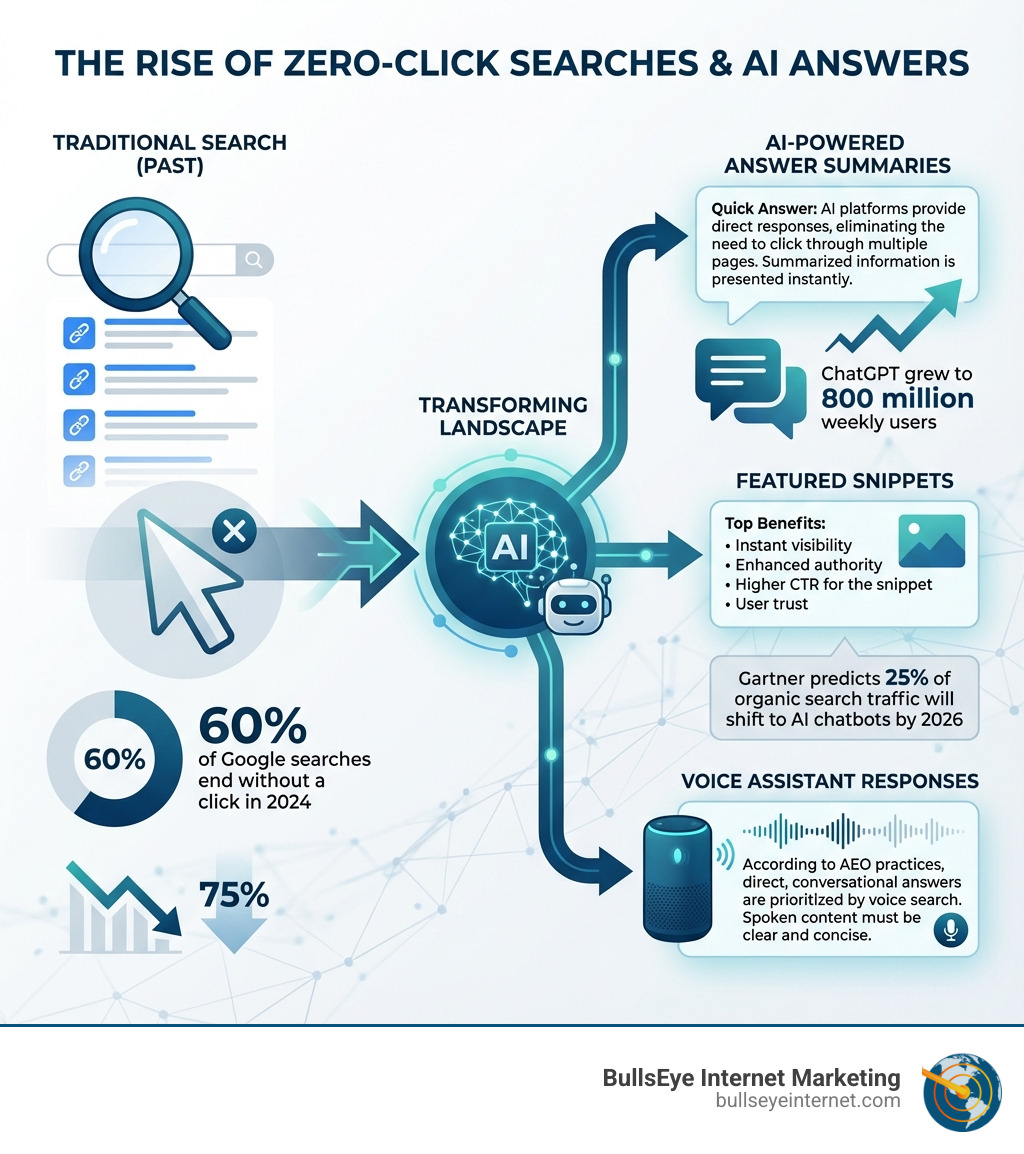
- Zero-Click Dominance: Nearly 60% of Google searches now end without a click. Users get answers directly from AI Overviews and featured snippets. If your content isn’t providing these answers, your brand is invisible to a large part of your audience.
- AI-Driven Search Explosion: AI tools are booming. ChatGPT nearly doubled its weekly users to 800 million, and Gartner predicts that by 2026, 25% of organic search traffic will shift to AI chatbots. Businesses must be present where customers get information.
- Brand Authority: Being cited by an AI engine builds immense credibility. NerdWallet, for example, grew revenue by 35% despite a 20% traffic drop because their expertise still reached consumers through snippets.
This doesn’t mean SEO is dead. AEO isn’t a replacement for SEO—it’s an evolution. Foundational SEO skills are still critical. AEO adds a new layer: making your content easily extractable, understandable, and citable by AI.
I’m Ronnie Katz, founder of BullsEye Internet Marketing. Since 2006, we’ve helped businesses adapt to search changes, and implementing AEO best practices has been essential for our clients’ visibility.
What is AEO and How Does It Differ from SEO?
Answer Engine Optimization (AEO) is the practice of structuring content so AI systems can easily extract, understand, and present it as authoritative answers. While traditional Search Engine Optimization (SEO) aims to drive clicks and traffic, AEO focuses on being the definitive answer AI delivers, even if it doesn’t result in a direct click. It’s about owning the answer, not just the ranking.
| Feature | Traditional SEO | Answer Engine Optimization (AEO) |
|---|---|---|
| Primary Goal | Improve rankings, drive clicks & website traffic | Be the direct answer, gain visibility & citations |
| Content Focus | Broad topics, keyword density, comprehensive guides | Precise, Q&A style, direct answers, structured for AI |
| Key Metrics | Keyword rankings, organic traffic, click-through rate | Featured snippet presence, PAA mentions, AI citations, branded search volume |
| How it Works | Optimizes for search engine algorithms to rank pages | Optimizes for AI systems to extract & synthesize answers |
Core AEO Best Practices: Optimizing Your Content for AI Extraction
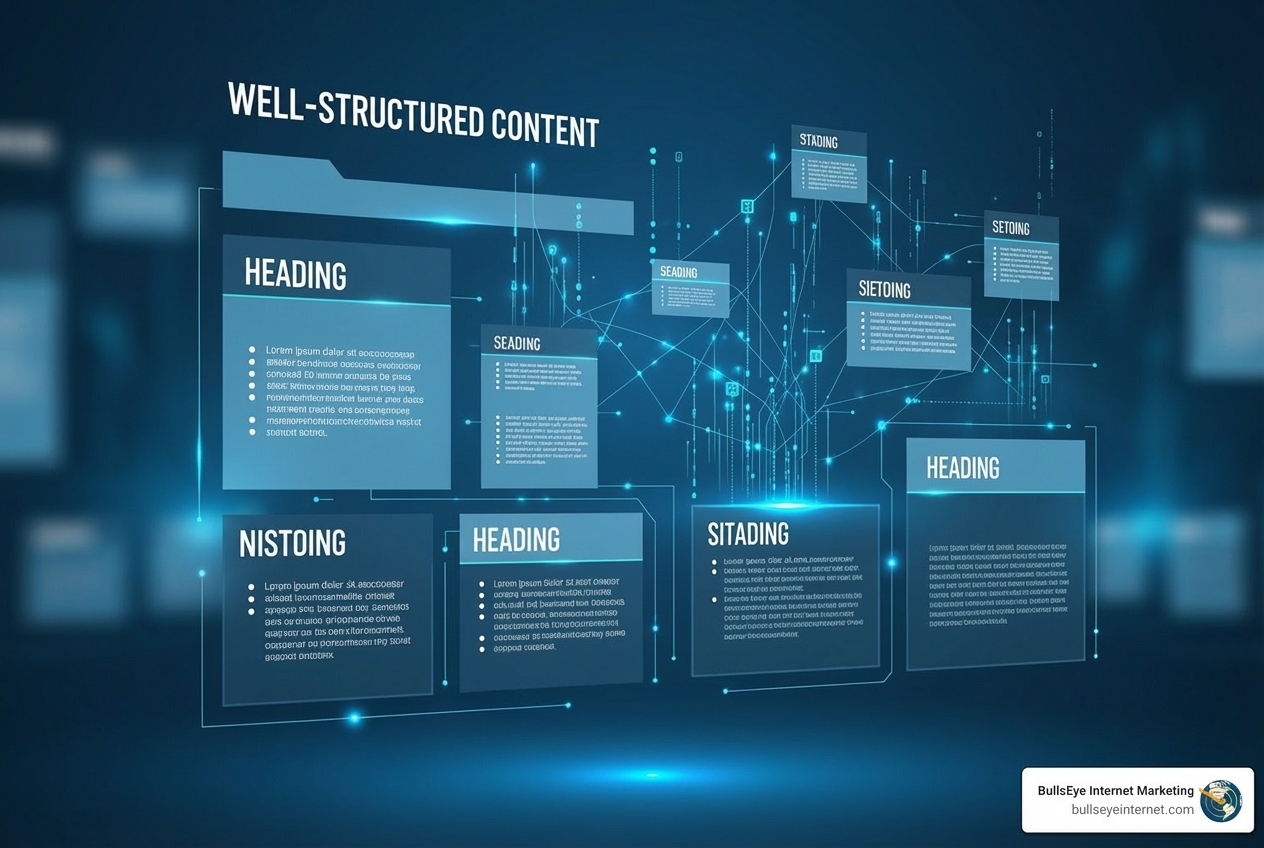
At the heart of AEO best practices is content optimized for AI extraction. AI engines move beyond keywords to understand user intent—what a user really wants. Your content must directly address their question in a conversational, natural tone that mirrors how people speak and search.
Structuring Content: Foundational AEO Best practices
For AI to extract your content effectively, it needs to be clear, concise, and logically organized. Here’s how to structure your content:
- Direct Answers (40-60 words): This is the most crucial AEO practice. Lead every key section with a direct, concise answer of 40-60 words. This length is optimal for featured snippets and AI summaries.
- Inverted Pyramid Style: Start with the most important information (your direct answer), then provide supporting details. This ensures AI gets the core message even if it only extracts the first few sentences.
- Scannable Formats: AI and human readers love structure. Use bullet points, numbered lists, short paragraphs (under four sentences), and Q&A sections.
- Reusable Content Blocks: Create standardized blocks for definitions or instructions. This consistency helps AI recognize and extract specific information types across your site.
Winning Snippets and “People Also Ask” (PAA)
Featured Snippets and PAA boxes are prime real estate in the answer economy, providing direct answers without a click. Optimizing for them is a cornerstone of AEO best practices.
- Featured Snippets: To win these top-of-page answer boxes, we focus on:
- Mirroring Question Wording: Use the exact phrasing of common questions (e.g., “What is AEO?”) in your H2 or H3 headers.
- Placing Answers High on the Page: Put your direct, concise answer immediately after the question.
- Matching Snippet Format: If a query yields a list, use a list. If it’s a definition, use a paragraph. For comparisons, use a table.
- “People Also Ask” (PAA) Boxes: These are invaluable for understanding user intent. To optimize for PAA:
- Harvest PAA Questions: Regularly check the PAA boxes for your target keywords to find real user questions.
- Create Dedicated Sections: Address these questions directly in your content, using the PAA phrasing as subheadings followed by a direct answer.
We use tools like AnswerThePublic and Google’s PAA feature to find user questions and tailor content for local queries like “best digital marketing agency Miami.”
Voice and Local Search: Applying AEO Best Practices for “Near Me” Queries
Voice and local search are intrinsically linked. Users expect immediate, location-specific answers from voice assistants for queries like “plumber near me.” Implementing AEO best practices for these scenarios is crucial for our clients across Florida.
- Conversational Tone: Voice queries are conversational, so your content should be too. Avoid jargon and write in a natural, spoken style.
- Google Business Profile Optimization: An optimized GBP is non-negotiable. Ensure all information is accurate and complete, including hours, services, photos, and a keyword-rich description.
- NAP Consistency: Your Name, Address, and Phone number must be identical across your GBP, website, and all online directories.
- Local Landing Pages: Create dedicated pages for each service area (e.g., “Plumber Miami,” “Plumber Fort Lauderdale”). These pages need unique, location-specific content.
- Encouraging Reviews: Reviews are powerful trust signals. Actively encourage customers to leave reviews on your GBP and respond to them to show engagement.
- Local Business Schema: Implement
LocalBusinessschema to explicitly tell AI your business’s name, address, phone number, and services, making it easier to provide direct answers to local queries.
Technical Foundations: Building Trust with Answer Engines
Even the best content won’t be extracted by AI if your site isn’t technically findable and trustworthy. Answer engines rely on structured data, robust technical SEO, and strong authority signals to confidently present your content.
Leveraging Schema Markup for Clarity
Schema markup is microdata added to your HTML that acts as a cheat sheet for AI, helping it understand your content’s context. Key schema types for AEO include:
- FAQPage schema: Essential for Q&A pages, this tells AI you’re providing answers, making it ideal for PAA boxes and AI summaries.
- HowTo schema: Use for step-by-step guides. It marks up each step, making it perfect for AI to extract for instructional queries.
- Article schema: For blog posts, this helps AI understand the headline, author, and publish date, boosting authority.
- Speakable schema: Highlights sections suitable for text-to-speech, making it invaluable for voice assistants.
- Organization schema: Helps AI understand your business’s identity (name, logo, contact info), strengthening brand authority.
- LocalBusiness Schema: Critical for providing precise location-specific information.
We validate schema using tools like Google’s Rich Results Test to ensure it’s correctly interpreted.
Essential Technical SEO Elements
Core technical SEO remains foundational for AEO. If AI can’t crawl or trust your site, it won’t use your content.
- Core Web Vitals: These metrics measure user experience. Fast-loading, stable pages are favored by users and AI. Pass Google’s thresholds (LCP < 2.5s, FID < 100ms, CLS < 0.1).
- Mobile-Friendliness: Your site must be responsive and provide an excellent mobile experience, as many searches happen on mobile.
- Crawlability and Indexability: Ensure AI crawlers can access your content. Check your
robots.txtandsitemap.xmlfiles. - Clean, Descriptive URLs: Use short, keyword-rich URLs that reflect the page content.
- Logical Heading Hierarchy (H1, H2, H3): Use headings semantically to help AI parse your content’s structure.
- Internal Linking Strategy: A strong internal linking structure establishes topical authority and guides crawlers.
- Server-Side Rendering (SSR): For JavaScript-heavy sites, SSR ensures crawlers see the fully rendered content, which is crucial for findability.
Building Off-Site Authority and Credibility
AI systems look at how the rest of the internet views your website. Off-site authority is paramount for AI to trust your content.
- Backlinks from Trusted Sources: Quality backlinks from relevant, authoritative sites still signal trust and expertise to AI.
- Brand Mentions: Even without a link, mentions on reputable sites, forums, and social media contribute to your authority.
- Original Research and Data: Publishing original research and data builds thought leadership. Content with citations is 30-40% more visible in AI search results because it demonstrates expertise.
- Loop Marketing Concept: Our approach involves a continuous engagement strategy across multiple channels (social media, forums, publications) to generate brand mentions and build authority. This creates a web of trust signals that AI systems use to gauge credibility.
Measuring Success and Overcoming AEO Challenges
One of the biggest shifts with AEO is in how we define and measure success. Traditional SEO metrics like clicks and traffic don’t tell the whole story in an answer-first world. Adopting AEO best practices also comes with unique challenges.
How to Measure AEO Performance
Since AEO’s goal is often “visibility without clicks,” measurement must adapt. Here’s how we track AEO success:
- Tracking Featured Snippet Share: We monitor the percentage of target queries for which our clients’ content appears in featured snippets using tools like Semrush or Ahrefs.
- Monitoring PAA Appearances: We track how often our content is used to answer questions in “People Also Ask” boxes.
- Branded Search Volume Growth: Increased AI visibility should lead to more people searching your brand name directly, indicating growing brand awareness.
- High-Impression, Low-Click Queries in Google Search Console: These can be a sign of success, indicating users got their answer from your brand without needing to click.
- Manual Testing on AI Platforms: We manually test key queries on platforms like ChatGPT, Gemini, and Perplexity to see if our clients’ content is cited.
Common AEO Problems and How to Overcome Them
Implementing AEO is a journey. Here are common challenges and our solutions:
- Challenge 1: Executives resist investing in “visibility without clicks.”
- Overcome: Frame AEO as a long-term investment in brand awareness and authority. Use success stories like NerdWallet to show how visibility translates to leads and sales.
- Challenge 2: Attribution and ROI measurement are unclear.
- Overcome: Use a hybrid measurement framework. Combine proxy metrics (snippet wins, branded search volume) with directional business indicators. The overall impact can be demonstrated even if direct attribution is hard.
- Challenge 3: Content teams lack capacity to retrofit content.
- Overcome: Prioritize strategically. Focus on retrofitting high-value, top-performing pages first. Integrate AEO principles into all new content creation from the start.
- Challenge 4: Teams are unfamiliar with schema and structured data.
- Overcome: Provide simple templates and training. Use CMS plugins to automate schema where possible and validate all new content with tools like Google’s Rich Results Test before publishing.
- Challenge 5: AI answers change rapidly.
- Overcome: Anchor your strategy in stable principles: direct answers, clear structure, authority, and semantic markup. These fundamentals remain constant even as AI evolves. Be precise to mitigate misinterpretation.
Frequently Asked Questions about AEO
As a new and evolving field, AEO naturally brings up many questions. Here are some of the most common ones we encounter from businesses looking to adapt their digital strategies.
Will AEO completely replace traditional SEO?
No, absolutely not! This is a common misconception, and frankly, a bit of marketer existential panic. AEO and SEO are complementary, not competitive. Think of AEO as the next evolution of SEO, not a replacement. Strong SEO fundamentals—a technically healthy website, a robust internal linking structure, quality content, and established domain authority—are actually prerequisites for AEO success. If AI systems can’t find and trust your content in the first place, they won’t cite it. We see AEO as building upon the solid foundation that SEO provides, adapting it to the AI-first world.
How long does it take to see results from AEO?
The timeline for AEO results can vary, but it’s generally not an overnight process. We’ve observed that:
- Early wins can often be seen within 4-8 weeks, particularly for winning new featured snippets or appearing in “People Also Ask” boxes. Pages with newly added structured data, for example, often start appearing in rich results within 6-8 weeks.
- Meaningful momentum and a more significant impact on brand visibility and authority typically build over 6-12 months of sustained effort. This is where the compounding effects of consistent AEO best practices start to really pay off.
Like traditional SEO, AEO is a long-term strategy that requires consistent effort and adaptation. But the early indicators of success can be quite motivating!
Do I need to add schema markup to every single page?
While schema markup is incredibly beneficial for AI understanding, you don’t necessarily need to add it to every single page on your website. The most impactful approach is to strategically prioritize where you apply schema.
Focus your efforts on:
- Key content pages: FAQs, how-to guides, product pages, and local business pages are prime candidates. These are the types of content where structured data provides the most context for answer engines and is most likely to be extracted for direct answers.
- High-value content: Pages that answer critical customer questions or provide essential business information.
- Content that could win rich results: If a page has the potential to appear as a featured snippet, in a PAA box, or as a rich result, applying the relevant schema will significantly increase its chances.
The goal is to provide AI with the clearest possible understanding of your most important content, not to over-engineer every minor page.
Conclusion: The Future of Search is an Answer
The digital landscape is in constant flux, and the rise of AI-powered answer engines marks one of the most significant shifts we’ve seen in years. As we look towards 2025 and beyond, the future of search is undeniably one where users expect direct, immediate answers, and AI plays an ever-increasing role in delivering them.
This change presents both challenges and immense opportunities. For businesses, especially those serving local communities across Florida, from the busy streets of Miami to the serene coasts of St. Lucie County, embracing AEO best practices is no longer a strategic choice—it’s a necessity. It’s about adapting our mindset from merely ranking in a list to becoming the definitive source of truth in an AI-driven conversation.
At BullsEye Internet Marketing, we believe that businesses that proactively implement AEO will not only maintain their visibility but also forge stronger connections with their audience, establishing themselves as trusted authorities in their respective fields. The companies that are willing to evolve, to provide clear, concise, and structured answers, will be the ones that thrive in this new era.
The future isn’t just about being found; it’s about being the answer. We’re here to help you steer this exciting new frontier.
