
Why AI Search Best Practices Matter for Your Business
AI search best practices are the new rules for getting your business found online. Here’s what you need to know:
Key AI Search Best Practices:
- Create concise, quotable answers (40-80 words) that AI can easily cite.
- Get mentioned in authoritative lists and third-party sources (41-64% impact on rankings).
- Use structured data (Schema markup) so AI understands your content.
- Optimize for conversational queries instead of just keywords.
- Publish original data and research to establish authority.
- Ensure AI crawlers can access your site (check robots.txt).
- Build topic clusters with clear page structure (H-tags, lists, tables).
- Embed your brand name in context-rich content.
The search landscape has fundamentally shifted. When potential customers ask ChatGPT, Google’s AI Overviews, or Perplexity for recommendations, they get direct answers with citations. If your business isn’t mentioned, you’re invisible.
The numbers are staggering: over 700 million people use ChatGPT weekly, and Google’s AI Mode has over 100 million monthly users. By 2028, AI tools are projected to surpass traditional search in traffic generation. Crucially, visitors from AI answers are 4.4 times more valuable than those from traditional search. Yet, most AI-cited sources don’t rank in Google’s top 20, proving the old rules no longer apply.
Traditional SEO focused on ranking your webpage. AI search focuses on being cited as a trustworthy source in a generated answer. It’s not about gaming algorithms—it’s about creating content that AI systems can understand, verify, and confidently reference.
This shift creates opportunities for startups to compete with established brands, as AI doesn’t prioritize domain authority in the same way. To succeed, you must know what AI looks for: authoritative mentions, clear structure, verifiable data, and content written for humans.
I’m Ronnie Katz, founder of BullsEye Internet Marketing. Since 2006, I’ve helped businesses adapt to online marketing shifts. Implementing AI search best practices is now critical for staying visible and competitive.
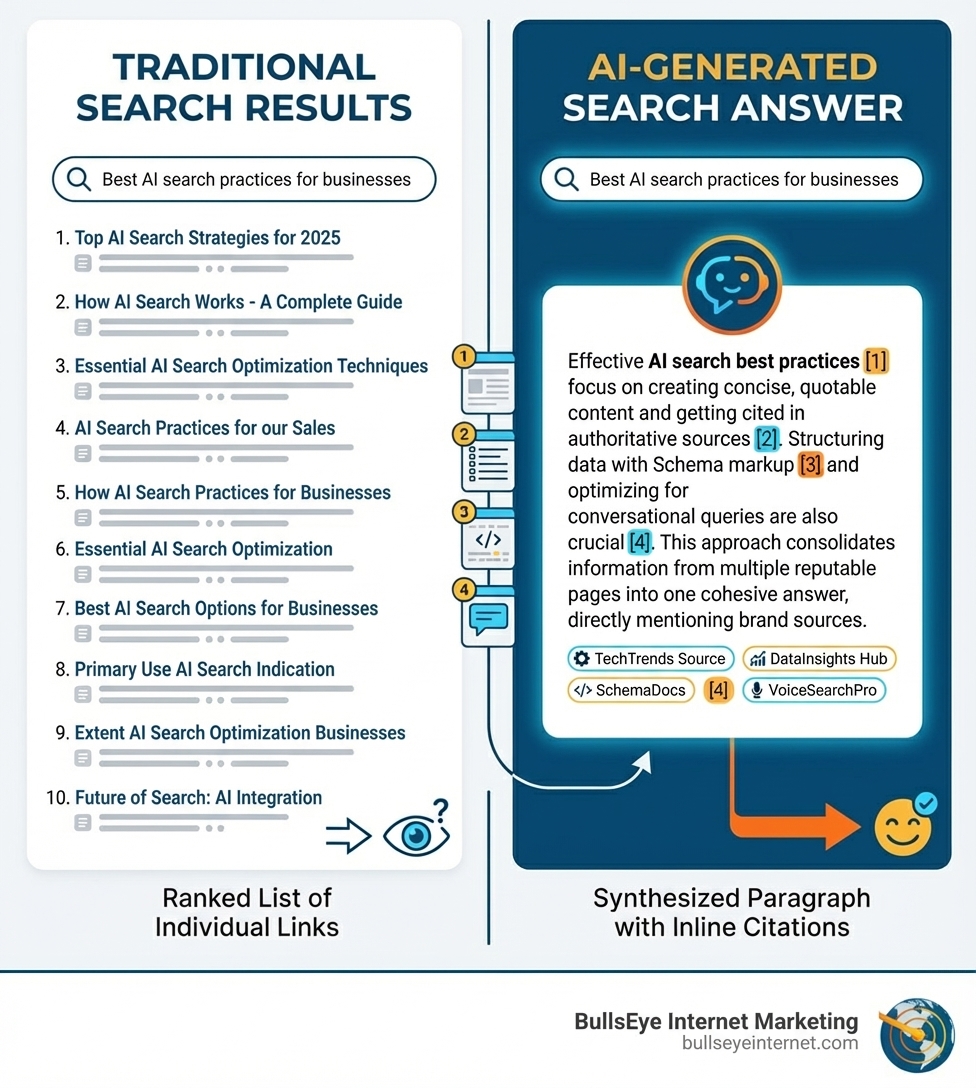
AI search best practices terms to know:
The New Search Paradigm: How AI Search Differs from Traditional SEO
The way people find information has shifted from lists of blue links to direct, synthesized answers. This fundamental change means our approach to online visibility must evolve.
Traditional SEO focuses on ranking high in search engine results pages (SERPs) by targeting keywords and building backlinks. It’s about getting your page in front of users.
AI search operates differently. Engines like Google’s AI Overviews, ChatGPT, and Perplexity read the web to generate direct, citation-driven answers. They understand conversational queries and synthesize information from multiple sources. The focus shifts from simply ranking a page to being cited as a trustworthy, authoritative source within these AI-generated answers.
Crucially, AI search doesn’t always prioritize website authority like traditional Google search. This creates opportunities for businesses of all sizes, including local businesses in Florida, to compete. In fact, most sources cited in AI responses don’t rank in Google’s top 20 for traditional searches, underscoring the need for a new strategy.
At its core, AI search uses a process called Retrieval-Augmented Generation (RAG):
- Understanding the query: AI interprets the user’s prompt, often in natural language, to grasp the true intent.
- Retrieval: The system scours its training data and the live web for relevant information, using a hybrid model that combines keyword and semantic matching at the passage level.
- Synthesis: The AI synthesizes the retrieved information, filters it for relevance and authority, and generates a coherent, direct answer with citations to the original sources.
Understanding AEO and ASO
As search evolves, so does the terminology:
- Answer Engine Optimization (AEO): Focuses on becoming the primary source AI assistants quote in direct answers, earning citations and ensuring brand accuracy.
- AI Search Optimization (ASO): A broader term for all strategies that make content findable, understandable, and citable by AI engines like ChatGPT and Google AI Overviews.
- Generative Engine Optimization (GEO): Specifically targets optimizing content (paragraphs, sentences) to be selected as input for LLM-generated responses.
These terms represent an evolution of traditional SEO, all aimed at adapting your online presence for AI-powered search.
How AI Search Engines Work: From Query to Citation
Understanding the mechanics of AI search is key to optimization:
- Query Intent Interpretation: The AI analyzes a user’s query, even if conversational, to understand the underlying intent. For example, “Who fixes leaky roofs fast in Lincoln Park Chicago?” is recognized as an urgent local service request.
- Hybrid Retrieval: It finds relevant information using a mix of keyword matching and semantic understanding (vector embeddings), pulling contextually relevant passages from pages.
- Scoring & Selection: Retrieved passages are scored on factors like relevance, E-E-A-T, and freshness. To ensure reliability, the AI selects evidence from multiple, diverse sources, seeking consensus and downranking promotional content.
- Answer Generation & Citation: The AI plans the answer’s structure (e.g., lists, narrative), synthesizes the selected information into a coherent response using an LLM, and assigns citations to the original sources.
This intricate process highlights why a holistic approach is essential for AI search visibility. To dive deeper, check out our guide on AI Optimization: How to Rank in AI Search (+ Checklist).
Core Ranking Factors for AI Search Engines
In AI search, visibility goes beyond traditional metrics. AI engines prioritize trustworthiness, authority, and consensus viewpoints to decide which sources to cite. The principle of E-E-A-T (Experience, Expertise, Authoritativeness, and Trustworthiness) is more critical than ever, as AI systems seek multiple independent sources to corroborate information, downranking single-source or overly promotional content.
The Power of Authoritative Mentions and Third-Party Validation
One of the most significant ranking factors is the presence of authoritative list mentions and third-party validation. This means being recognized by other credible sources, not just on your own website.
Our research highlights the immense weight of third-party validation:
- Authoritative List Mentions account for 41-49% of ranking impact for ChatGPT and Google AI Overviews, and a staggering 64% for Perplexity.
- Even Claude, which relies on traditional databases, gives these mentions a 38% weight.
This data proves that getting mentioned in industry publications, “best of” lists, and comparison articles is a critical AI search best practice. These mentions are powerful credibility signals. Online reviews and social sentiment also contribute, with Perplexity weighing reviews at 31%.
This creates a ‘citation core’ effect, where consistent references across diverse, trusted sources build undeniable authority. To achieve this, actively pursue guest posts, PR features, and inclusion in industry roundups. Substantive, consistent coverage is key.
The Importance of Verifiable Data and Original Research
AI search engines favor citing statistics and verifiable data. Backing up claims with numbers, facts, and concrete examples provides AI with the precise, quotable snippets it needs.
This means:
- Including relevant statistics: Always cite your sources, especially from authoritative domains (.edu, .gov), to provide clear provenance.
- Publishing original research: Conducting surveys or analyzing proprietary data positions you as a primary source, which AI systems value.
- Providing fresh, accurate data: Regularly update content with the latest statistics and trends, as AI prefers fresh information.
- Showcasing case studies and expert quotes: Detailed case studies and quotes from your team demonstrate practical experience and expertise (E-E-A-T).
This table shows how different AI platforms weigh these critical factors:
| Ranking Factor | ChatGPT | Google AI Overviews & Gemini | Perplexity | Claude |
|---|---|---|---|---|
| Authoritative List Mentions | 41% | 49% | 64% | 38% |
| Online Reviews | 16% | 13% | 31% | – |
| Social Sentiment | 11% | – | – | – |
| Google Website Authority | – | 23% | – | – |
| Customer Examples & Usage Data | 14% | – | – | 13% |
| Awards, Accreditations, & Affiliations | 18% | 15% | 5% | 19% |
| Traditional Databases & Directories | – | – | – | 68% |
A Practical Guide to AI Search Best Practices
Now that we understand the landscape and ranking factors, let’s cover the actionable steps for optimizing your content and website for AI search. This requires a coordinated effort across content, technical, and on-page optimization.
Content Optimization: Creating Quotable and Concise Content
For AI search, content must be informative, digestible, and easily quotable. Make it simple for AI to extract and cite your expertise.
Here are key AI search best practices for content:
- Concise Answers (40-80 words): Lead with a clear, direct answer of 40-80 words to increase the likelihood of being quoted.
- Clear, Definitive Language: Use precise, factual language and avoid jargon or promotional hype.
- Machine-Liftable Content: Structure content for easy extraction using:
- FAQ Format: Incorporate FAQ sections with
FAQPageschema. - Lists and Tables: Break down complex information into digestible chunks.
- “Definition → Example → Caveat” Structure: Provide comprehensive yet structured information.
- FAQ Format: Incorporate FAQ sections with
- Data and Examples: Back up claims with verifiable statistics, real-world examples, and case studies, citing sources.
- Embed Brand Name in Copy: To ensure your brand is mentioned, embed it directly into context-rich copy (e.g., “[BullsEye Internet Marketing’s] services helped…”).
- Create Specific Pages: Develop dedicated pages for each major service, feature, or use case to match specific user queries.
Technical Optimization: Ensuring AI Findability
Your content is invisible if AI crawlers can’t access and understand it. Technical optimization is the foundation of AI search visibility.
Our technical AI search best practices include:
- AI Crawler Accessibility: Ensure bots like GPTBot, Google-Extended, Claude-Web, and PerplexityBot can access your site. Explicitly allow them in your
robots.txtfile and whitelist them in firewall settings if needed. - Structured Data (Schema Markup): This is critical. Schema acts as a roadmap for AI, making your data machine-readable. Implement
FAQPage,HowTo,Product,Organization, andArticleschema and validate it using tools like validator.schema.org. - Page Structure & Semantic HTML: Use a clear heading hierarchy (H1, H2, H3) and semantic HTML tags (
<article>,<main>) so AI can parse your content. Avoid hiding content behind JavaScript. - Site Speed: Slow sites deter AI crawlers. Optimize server response time, enable caching, and compress images. Aim for a load speed of 3 seconds or less.
- Freshness Signals: Prominently display publication and last updated dates on pages and in schema markup.
- Remove Barriers: Avoid intrusive pop-ups, “Read More” clicks, or infinite scroll that can hide content from crawlers.
Local SEO: How Local Businesses Can Optimize for AI Search
For local businesses in Florida, from Miami-Dade to Martin County, AI search offers unique opportunities. The strategy must focus on hyperlocal, conversational queries customers use to find services.
Here are specific AI search best practices for local businesses:
- Target Local Conversational Queries: Create content that directly answers natural language questions like, “Can I get same-day roof repair in Fort Lauderdale?” or “Best PPC agency near West Palm Beach?”
- Hyperlocal Keywords and Landing Pages: Integrate hyperlocal keywords and create dedicated landing pages for specific services in specific locations (e.g., “Google Business Profile Optimization Miami”).
- Google Business Profile Optimization: Your GBP is more important than ever. Keep it fully optimized with accurate info, services, photos, and regular posts, as AI often pulls data from it.
- Local Citations and Reviews: Encourage reviews on Google, Yelp, and other local directories. Consistent citations build trust and authority.
- Local FAQs: Add FAQs to your site addressing questions specific to your service areas, like “What are common digital marketing challenges for businesses in Boca Raton?”
To learn more, explore our Need-To-Know Best Practices for AI Search Optimization (2025).
Advanced Strategies & Measuring Success
As you refine your AI search optimization, you can explore advanced strategies and establish robust methods for measuring success.
Preparing Your Website for Vector Indexing
Vector indexing is an advanced, long-term strategy that helps AI understand the semantic meaning of your content beyond keywords. It involves converting content into numerical “embeddings” that capture contextual meaning.
Here’s how to prepare your website for vector indexing:
- Clean Content: Start by removing boilerplate text, ads, and navigation from the main copy to ensure only relevant information is indexed.
- Content Chunking: Strategically break content into smaller, meaningful “chunks” (typically 200-500 words) to isolate specific concepts.
- Generate Embeddings: Use models from providers like OpenAI or Cohere to generate vector embeddings for each content chunk.
- Store in Vector Database: Store these embeddings in a specialized vector database (e.g., Pinecone, Weaviate) optimized for rapid semantic search.
- Retrieval Accuracy Testing: Rigorously test the system to ensure it correctly identifies the most semantically relevant content for a given query.
- Regular Updates: Re-index content regularly (e.g., quarterly for stable content, monthly for fast-moving topics) to keep the index fresh.
Implementing vector indexing can significantly improve how AI understands and cites your content. For a deeper dive, see this Case Study on Cognitive Search.
How to Measure the Success of Your AI Search Efforts
Measuring AI search success is crucial for understanding ROI and refining your strategy. While traditional SEO metrics remain important, add these AI-specific metrics to your dashboard:
- AI Citation Rate: Measure how often your brand is cited by AI engines like ChatGPT, Google AI Overviews, and Perplexity.
- AI Referral Traffic: Track traffic from AI answers in GA4 using tagged URLs. This traffic is highly valuable (visitors are 4.4x more valuable).
- AI Conversion Rate: Analyze the conversion rate of visitors from AI referrals to understand their impact on business goals.
- Brand Mention Tracking: Monitor brand mentions across the web, especially in authoritative lists and community platforms like Reddit and Quora.
- Google AI Overview Impressions: Track impressions in Google Search Console to see how often your content appears in Google’s AI summaries.
- Lift in Branded Searches: An increase in direct branded searches often indicates rising brand recognition from AI visibility.
- Schema Coverage: Monitor the percentage of your pages with relevant, machine-readable schema markup.
- Position in AI Overviews: Track if your content is selected as a primary source in Google AI Overviews.
Focusing on these metrics provides a clear picture of your AI search performance and enables data-driven decisions.
Frequently Asked Questions about AI Search
Let’s address some common questions about this new frontier of search.
What’s the difference between AEO, ASO, and traditional SEO?
It’s easy to mix these up. Here’s a quick breakdown:
- Traditional SEO: Focuses on ranking in traditional search results (the “10 blue links”) to drive organic traffic for specific keywords.
- AEO (Answer Engine Optimization): Aims to have your content cited directly in AI-generated answers.
- ASO (AI Search Optimization): The broad strategy of optimizing your entire online presence to be found, understood, and cited by AI search engines.
In short, traditional SEO is about getting found in a list, while AEO and ASO are about becoming the answer in the AI-driven search world.
Should I use AI to write content for AI search optimization?
Our advice is nuanced: use AI as a powerful assistant, not a replacement for human expertise.
- Google’s Stance: Google’s official guidance is to create helpful content for people, not just to rank. Its March 2024 Core Update targeted low-quality, mass-produced content, penalizing sites that relied on it.
- Originality and Trust: AI can lack a unique perspective and is prone to plagiarism or “hallucinations” (generating false information). Relying on it without human oversight can damage your brand’s trustworthiness.
How to leverage AI safely and effectively:
- Brainstorming and Outlines: Use AI to generate ideas and structure content.
- Research Assistance: Use AI to gather information, but always fact-check and verify details from primary sources.
- Editing and Readability: AI can help improve grammar, spelling, and phrasing.
- Add Human Expertise: The key is to infuse the content with your unique data, case studies, and proprietary insights. This is what creates value.
- Crucial Human Review: Every piece of content must undergo thorough human review, editing, and fact-checking before publication.
Our goal is to create valuable, original content that helps our audience, adhering to Google’s guidance on helpful content.
Does AI search mean traditional SEO is no longer important?
Absolutely not. AI search doesn’t replace traditional SEO; it builds upon it.
Here’s why both are crucial:
- Technical Foundation: AI engines need to find and understand your content first. This relies on traditional technical SEO for crawlability and indexability.
- Authority Signals: Traditional SEO helps build domain authority and trust through quality backlinks and a strong content profile—signals that AI systems still value.
- Source Material: Generative AI often processes top-ranking articles from traditional search to formulate answers. Ranking well in Google increases your chances of being cited.
- Hybrid User Behavior: Many users still use traditional search. A holistic strategy ensures you capture visibility across all touchpoints.
Ignoring either traditional SEO or AI search would be a mistake. Businesses that adapt their strategies for both will gain a significant competitive advantage.
Key Takeaways: AI Search Best Practices – BullsEye Internet Marketing
The future of search is conversational and AI-driven. The shift from links to direct, cited answers is a fundamental change in how businesses connect with customers. Implementing AI search best practices is now essential for visibility and growth.
At BullsEye Internet Marketing, we help businesses adapt and thrive amidst digital evolution. While creating valuable, authoritative content remains key, the methods for findy have expanded.
A holistic strategy integrating AI optimization with proven SEO fundamentals ensures your brand becomes a trusted, cited source. Continuous, data-driven optimization is the compass for navigating this new era.
To learn how your business can dominate this new landscape, explore our complete guide to Answer Engine Optimization (AEO), ASO, & LLM SEO. We’re here to help you turn these changes into opportunities for success.
