
Why Understanding AI Search is Critical for Your Business
An AI search expert is a professional who specializes in optimizing content and strategies for AI-powered search platforms like ChatGPT, Perplexity, Google AI Overviews, and other large language models. Here’s what they help you achieve:
What an AI Search Expert Does:
- Identifies AI-surfaceable keywords that your audience uses when researching solutions
- Optimizes for both AI and traditional search by improving structured data and topical authority
- Creates AI-optimized content that aligns with how AI systems extract and deliver answers
- Builds contextual backlinks to boost domain trust and relevance
- Ensures technical readiness for AI crawling and indexing
- Optimizes for conversion to turn AI traffic into real business outcomes
The world of search has fundamentally changed. Traditional search engines used to show you a list of blue links. You’d click through, scan multiple pages, and piece together your answer. That’s over.
Today, AI search systems understand what you’re actually asking for. They analyze context, synthesize information from multiple sources, and deliver direct answers. When someone searches for a solution you offer, they might get their answer without ever clicking a link to your website.
This is the new reality. Visibility is no longer about ranking #1 on Google. It’s about whether your content gets selected, cited, or mentioned inside AI-generated responses. If your business isn’t optimized for this shift, you’re becoming invisible to potential customers who are actively searching for what you offer.
The stakes are high. Companies that adapt are seeing up to 3x growth in organic traffic and a 90% increase in lead generation. Those that don’t risk being left behind as findy shifts from traditional search results to AI-powered answers.
I’m Ronnie Katz, founder and Principal CEO of BullsEye Internet Marketing, and I’ve been helping businesses steer online visibility since 2006. As an AI search expert with certifications from Google and Semrush, I’ve helped companies adapt their strategies to succeed in this new AI-driven landscape.
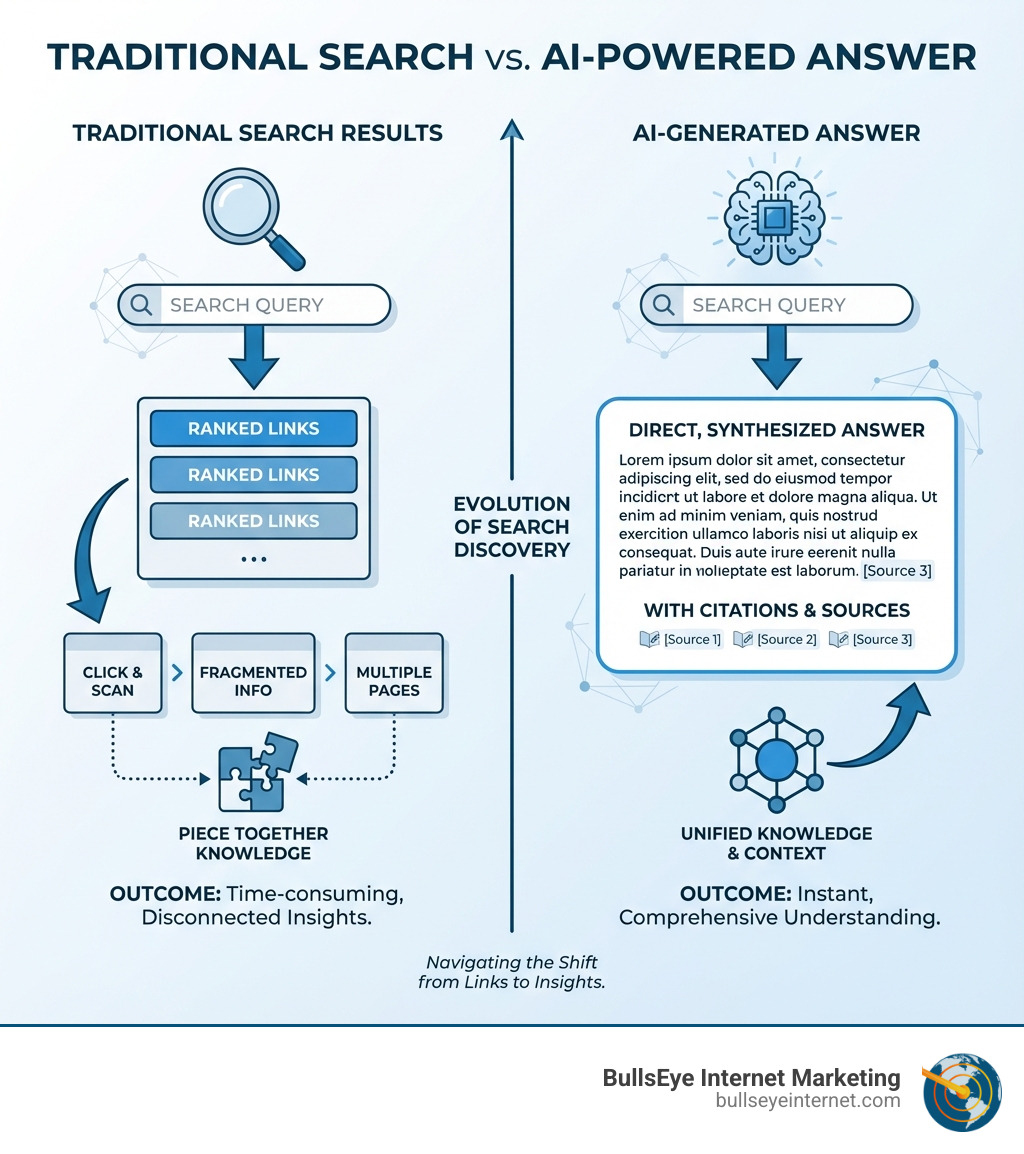
Simple guide to AI search expert:
Tip #1: Master the Fundamentals of How AI Search Works
To truly thrive in the age of AI search, we must first understand its inner workings. It’s not magic, it’s technology – complex, yes, but comprehensible. At its heart, AI search is a sophisticated approach powered by artificial intelligence, designed to interpret user intent, analyze context, and deliver direct, relevant answers or synthesized information from diverse data sources. Unlike traditional search, which relies heavily on keyword matching, AI systems dive deeper. They analyze meaning, deliver conversational responses, leverage advanced reasoning models, and offer interactive experiences.

The underlying technologies that make this possible are a fascinating blend of computational linguistics and data science:
- Natural Language Processing (NLP): This is the AI’s ability to understand, interpret, and generate human language. It allows AI search to grasp the nuances, synonyms, and context of your query, moving beyond mere word matching. For instance, if you search for “best spots for a quick bite in Miami,” NLP helps the AI understand “quick bite” as a casual meal, not necessarily a literal bite.
- Machine Learning (ML): ML algorithms are the learning engine of AI search. They continuously analyze vast amounts of data – user queries, content, engagement metrics – to improve the accuracy and relevance of results over time. This continuous learning is why AI search systems get better at predicting what we’re truly looking for, even when our queries are vague or new. Google’s own search systems, for example, leverage advanced ML to intuitively recognize when a word doesn’t look right and suggest corrections, or to understand entirely new searches, which make up 15% of daily queries.
- Large Language Models (LLMs): LLMs like those powering ChatGPT and Google’s Gemini are the generative powerhouse. They can synthesize information from various sources, summarize complex topics, and even generate conversational responses. These models are crucial for creating the direct, synthesized answers we see in AI Overviews and answer engines.
Together, these technologies allow AI search to move beyond simple keyword matching to genuinely understand our needs. As Google explains in How AI powers great search results, advancements in AI and machine learning allow search systems to understand human language better than ever, moving beyond simple word matching to more intuitive comprehension.
From Keywords to Concepts: The Core Technology
In the early days of search, if you typed “pziza,” you might not get results for “pizza” unless you corrected your spelling. That’s because traditional search was primarily about keyword matching. It looked for exact words or phrases on a page. While algorithms later evolved to handle misspellings, the fundamental approach was still rooted in matching text.
AI search flips this paradigm. It focuses on context analysis. When we ask a question, the AI doesn’t just look for keywords; it tries to understand the meaning and intent behind our query within its broader conversational context. It can then deliver synthesized responses – direct answers compiled from multiple sources, often with citations, rather than just a list of links. This ability to analyze meaning, deliver conversational responses, and leverage advanced reasoning models is a hallmark of the new search era.
This is where specialized types of AI search come into play:
- Semantic Search: This goes beyond keywords to understand the conceptual meaning of a query. If you search for “places to see marine life in Florida,” semantic search understands “marine life” to mean fish, dolphins, coral, etc., and will prioritize content about aquariums, snorkeling, or wildlife tours in our beautiful coastal state.
- Vector Search: This is a more advanced technique that represents queries and content as numerical vectors in a high-dimensional space. The closer the vectors, the more relevant the content. This allows for highly nuanced matching, even if exact keywords aren’t present.
- Conversational Search: Designed for natural language interactions, this type of search allows for follow-up questions and maintains context throughout a dialogue, much like talking to a knowledgeable person.
The Different Flavors of AI Search
AI search isn’t confined to a single platform; it’s permeating various aspects of our digital lives. Here are some of its different manifestations:
- Web Search & Answer Engines: Platforms like ChatGPT, Perplexity, Claude, and Google’s AI Overviews are prime examples. They don’t just give us links; they synthesize information and deliver direct, conversational, and citation-backed answers. This is where AI search expert guidance becomes invaluable for businesses in Florida and across the US.
- Enterprise Search & Document Search: Within organizations, AI-powered search tools are revolutionizing how employees find information. They index internal documents, emails, databases, and knowledge bases to surface insights faster, improving productivity for businesses in Miami, Fort Lauderdale, and beyond.
- AI-Powered SERPs (Search Engine Results Pages): Even traditional search engines are evolving. Google’s Search Labs experiment, “Web Guide,” uses AI to intelligently organize search results, grouping related links to make information findy easier. This means our content on the web still matters, but how it’s presented and finded is changing.
- Chatbots & Virtual Agents: From customer support to sales, AI-powered chatbots and virtual agents use LLMs and Retrieval-Augmented Generation (RAG) to provide instant, contextual assistance. Many businesses in South Florida are already leveraging these tools to improve customer service and lead generation.
Tip #2: Adapt Your Marketing for AI-Powered Visibility
The shift to AI search fundamentally redefines what “visibility” means for our marketing efforts. It’s no longer just about getting to the top of a ranked list of links. It’s about being recognized, cited, and mentioned within the AI-generated answers that users increasingly rely on.

This new landscape profoundly impacts organic marketing and brand visibility. As an AI search expert, we constantly emphasize that brands neglecting AI visibility risk becoming invisible. Our AI Search Optimization Complete Guide dives deep into this change.
The Shift from Ranking to Recognition
Traditional SEO focused on optimizing for ranked link lists. The goal was to appear as high as possible on the search results page, driving clicks to our website. However, AI search shifts visibility away from these lists and toward direct, AI-generated answers. This means fewer clicks from search results to websites, creating what’s known as “zero-click searches.” Findy increasingly happens inside AI summaries rather than on external sites.
So, how do we gain visibility?
- Citations as Authority Signals: When an AI-generated answer references our content, it’s a powerful signal of authority and credibility. These citations act like super-backlinks, reinforcing our brand’s trustworthiness with both algorithms and audiences. They signify that our content is reliable enough to be selected and synthesized by an AI.
- Brand Mentions: Beyond direct citations, simply being mentioned within an AI answer, even without a direct link, builds brand awareness and recognition. It’s like having a senior marketer in your pocket, validating your ideas and expertise, as one EMARKETER user described their AI search experience.
- Earning Trust: The AI itself acts as a filter, presenting what it deems most trustworthy and relevant. Therefore, creating content that is clear, factual, well-researched, and aligns with established expertise is paramount to earning the AI’s “trust.”
How to Optimize Your Content for AI Search
Optimizing for AI search requires a nuanced approach that goes beyond traditional keyword stuffing. Here’s how we guide businesses in Florida to prepare their content:
- AI-Surfaceable Keywords: We need to identify the questions and phrases our audience uses when they turn to AI for answers. These aren’t always the same as traditional search queries. AI-surfaceable keywords are often more conversational and intent-driven.
- Structured Data (Schema Markup): This is crucial. Structured data helps AI systems understand the context and meaning of our content. By providing clear signals about our business, products, services, and FAQs, we make it easier for AI to extract and present our information accurately. This is especially important for local businesses in Miami, Fort Lauderdale, and other Florida cities, helping AI understand location-specific services.
- Topical Authority: AI loves expertise. Building topical authority means creating comprehensive, in-depth content that covers a subject thoroughly. If AI sees us as the definitive source for a topic, it’s more likely to cite our content. Our LLM SEO Agency Ultimate Guide elaborates on building this authority.
- Content Freshness & Context-Rich Content: AI values up-to-date and relevant information. Regularly updating our content and ensuring it’s rich in context helps AI systems provide the most current and accurate answers. For example, if we’re detailing changes in local regulations for businesses in Broward County, ensuring that information is current is vital for AI selection.
Tip #3: Open up Business Growth with AI Search Insights
AI search isn’t just about how users find information; it’s also a powerful tool for businesses to gain unprecedented insights, fueling growth and enhancing decision-making. We’ve seen how it can transform operations for our clients in Florida.
Gaining a Competitive Edge
Businesses leveraging AI search for internal and market analysis are gaining a significant competitive edge:
- Faster Research: Companies like EMARKETER highlight the power of AI search for rapid research. Their PRO+ users reach insights 93% faster, saving an average of 6.8 hours per week. Imagine having a “senior marketer in your pocket” that can answer all your burning questions and validate ideas, whether tactical or strategic. This speed allows for quicker adaptation and response to market changes.
- Better Insights: AI search can connect disparate data points and turn complex information into actionable results. For example, it can identify new channels and strategic opportunities relevant to a company, explore market opportunities, or determine optimal ad spend allocation. This leads to more informed data-driven decisions.
- Improved ROI: The culmination of faster research and better insights is an improved return on investment. By quickly identifying what works and what doesn’t, businesses can optimize their marketing spend and strategies. We’ve seen clients achieve an average 90% increase in lead generation and a 60% boost in revenue year over year by effectively using AI SEO.
Here are some practical applications of AI search across various industries relevant to our Florida clients:
- E-commerce: Helping users find the right products instantly with optimized results, guiding shoppers to confident purchases faster with intent-aware retrieval.
- Healthcare: Quickly accessing vast medical literature for diagnostics, treatment protocols, and research.
- Financial Services: Analyzing market trends, compliance documents, and financial reports for faster decision-making. Snorkel, for instance, develops datasets and benchmarks for financial AI systems like SnorkelFinance, ensuring reliability.
- Customer Support: Reducing support load and speeding up problem-solving by quickly identifying the right content and delivering precise answers, often through AI-powered chatbots.
- Real Estate (Florida specific): Quickly identifying property trends, local market data, and neighborhood specifics for agents and buyers in Miami-Dade or Palm Beach County.
- Legal (Florida specific): Expediting legal research, case precedent analysis, and contract review for law firms in Broward County.
How AI Search Leverages Data for Better Results
The magic of AI search hinges on its ability to effectively process and learn from data. It transforms raw information into strategic assets:
- Data Analytics: AI search systems are constantly analyzing user behavior, query patterns, and content engagement. This continuous data analytics loop helps them refine their understanding of intent and improve result relevance.
- Predictive Analytics: By analyzing historical data, AI can predict future trends and user needs. This allows businesses to anticipate market shifts and proactively create content or develop services that meet emerging demand, staying ahead of competitors in the competitive Florida market.
- User Behavior Analysis: AI helps us understand not just what users search for, but how they search, what they click on (or don’t click on), and how they interact with AI-generated answers. This deepens our understanding of the customer journey.
- Performance Tracking: New metrics are emerging to track AI search visibility, moving beyond traditional SEO KPIs. We need to measure citations, brand mentions, and the impact of AI-driven answers on user engagement and conversions.
- Centralized Data: For enterprise AI search, integrating and centralizing marketing data from scattered platforms (like Google Ads, CRM, GA4, social media) provides a unified, real-time view of performance. This allows for comprehensive AI-powered insights and eliminates data silos.
Why Your Business Needs an AI Search Expert
The landscape of search is evolving at a breakneck pace, driven by AI. For businesses operating anywhere in the US, especially here in Florida, having an AI search expert isn’t a luxury; it’s a necessity. We provide the strategic guidance needed to steer this complex environment.
Navigating the Challenges and Limitations
While AI search offers immense potential, it’s not without its problems. An AI search expert helps you understand and mitigate these challenges:
- AI Hallucinations: Sometimes, AI models can generate plausible-sounding but incorrect information. We need strategies to ensure our content is accurate and robust enough to prevent misinterpretation by AI.
- Data Privacy: The increasing personalization of AI search, with features like “long-term memory” in systems like ChatGPT, raises important questions about data privacy. We must steer these ethical considerations carefully, ensuring compliance and building user trust.
- Ethical Considerations: Beyond privacy, there are broader ethical questions about algorithmic bias and the impact of AI on information consumption. An expert helps ensure our strategies are not only effective but also responsible.
- Algorithmic Bias: AI models can inadvertently pick up and amplify biases present in their training data. Understanding this helps us craft content that is inclusive and fair.
- Content Evaluation: With AI synthesizing information, the quality and trustworthiness of source content become paramount. We need rigorous processes for content creation and evaluation to ensure it stands up to AI scrutiny.
What Does an AI Search Expert Do?
An AI search expert bridges the gap between your business and the intricate world of AI algorithms. For our clients in Florida, this means:
- AI-driven Strategy: We design and execute strategies to ensure your business appears in AI-powered search platforms like ChatGPT, Perplexity, Google AI Overviews, and AI Mode. This includes identifying AI-surfaceable keywords that your audience uses when researching solutions.
- Technical SEO for AI: Ensuring your website is technically ready for AI crawlers is critical. This involves fixing indexing issues, improving site speed, and implementing schema markup to make your content digestible for AI.
- AI-Optimized Content Creation: We help you create content that aligns with how AI systems extract and deliver answers. This means clear, concise, and authoritative content that directly answers user questions, perfect for businesses from Palm Beach County to Martin County.
- Contextual Link Building: Building high-quality, contextual backlinks remains vital. These links boost your domain trust and signal relevance to both search engines and AI models, enhancing your overall authority.
- Performance Measurement: We track new metrics for AI visibility, focusing on citations, brand mentions, and the direct impact of AI-generated answers on lead generation and revenue. Our goal is to achieve measurable results, such as the 3x growth in organic traffic and traffic from AI platforms that many companies experience.
Preparing for the Future: An AI Search Expert Perspective
The future of AI search is dynamic and exciting, and an AI search expert keeps you ahead of the curve:
- Generative UI: Google Search is already enhancing its AI Mode with Gemini 3, featuring Generative UI. This means AI can dynamically create ideal visual layouts for responses, including interactive tools and simulations. Imagine searching for a complex topic and the AI generating a custom, interactive chart to explain it. We prepare our clients for content that can be dynamically adapted for such experiences.
- Agentic Systems: These are AI systems capable of planning, reasoning, and executing complex tasks. They will likely play a larger role in information retrieval and synthesis, acting as intelligent assistants that perform multiple searches to answer nuanced queries.
- Long-term Memory: Upcoming features, such as ChatGPT’s planned “long-term memory,” will allow AI search to provide far more personalized results based on persistent user information (e.g., “I’m a vegetarian”) or contextual details (e.g., “I’m going to Miami next week”). This will require a new level of personalization in content strategy.
- Hyper-personalization: As AI learns more about individual users, search results will become incredibly custom. This presents an opportunity for businesses to connect with users on a deeper, more relevant level if their content is optimized for such personalization.
- Multimodal Search: The ability to search using images, voice, and even video is expanding. AI will increasingly be able to understand and synthesize information across different modalities, offering richer and more intuitive search experiences. Google’s Gemini 3, with its advanced reasoning and multimodal understanding, is already paving the way for this.
Frequently Asked Questions about AI Search
How is AI search different from traditional search engines?
AI search fundamentally differs from traditional search engines in its approach to understanding and delivering information. Traditional search engines primarily rely on keyword matching and algorithmic interpretation of intent to provide a ranked list of links. You, the user, then click through these links to find your answer.
In contrast, AI search is powered by advanced technologies like Natural Language Processing (NLP), Machine Learning (ML), and Large Language Models (LLMs). It goes beyond keywords to interpret user intent, analyze context, and understand nuance in your query. Instead of just a list of links, AI search delivers direct, synthesized answers or comprehensive summaries, often drawn from multiple sources and presented in a conversational format. AI systems can analyze meaning, deliver conversational responses, leverage advanced reasoning models, and even offer interactive experiences, making the information findy process much more efficient and intuitive. This shift means visibility is less about a ranking on a SERP and more about whether your content is selected, cited, or mentioned within these AI-generated answers.
How do I optimize my content for AI search visibility?
Optimizing your content for AI search visibility requires a strategic shift from traditional SEO tactics. Here’s how we advise our clients in Florida:
- Focus on Clarity and Direct Answers: AI models excel at extracting factual information. Structure your content to directly answer common questions your audience might ask. Use clear headings, bullet points, and concise language.
- Build Topical Authority: Become the definitive source for topics relevant to your business. Create comprehensive, in-depth content that covers a subject thoroughly, signaling to AI that your site is an expert resource.
- Implement Structured Data (Schema Markup): This is crucial. Schema markup provides context to AI models about your content, products, services, and business information. For local businesses in our service areas like Fort Lauderdale or West Palm Beach, this helps AI understand your location-specific offerings.
- Create Context-Rich Content: Ensure your content provides ample context, definitions, and explanations. AI thrives on understanding relationships between concepts.
- Target AI-Surfaceable Keywords: Identify conversational, intent-driven questions and phrases that users are likely to type into AI answer engines. These may differ from traditional short-tail keywords.
- Ensure Technical Readiness: Your site must be easily crawlable and indexable by AI systems. This means a fast, mobile-friendly website with no broken links or indexing issues.
- Prioritize Freshness and Accuracy: AI values up-to-date and reliable information. Regularly review and update your content to ensure its accuracy and relevance.
- Earn Citations and Mentions: Focus on creating high-quality, authoritative content that AI models will want to cite or mention in their generated answers, building your brand’s credibility.
How much do AI SEO services cost?
The cost of AI SEO services can vary significantly based on the scope, complexity, and level of expertise involved. However, for businesses seeking high-quality, expert-led strategies to steer the evolving AI search landscape, AI SEO consulting typically starts at a premium.
While specific pricing can be customized to a company’s needs, most high-quality AI SEO services that include expert-led strategy, AI-powered content optimization, technical SEO, and hands-on performance tracking often start at around $3,500 per month. This investment reflects the specialized knowledge required to effectively optimize for AI-powered platforms and the potential for significant returns, such as up to 3x growth in organic traffic and a 90% increase in lead generation. Lower-cost options may exist, but they often rely too heavily on automation without proper oversight, which can lead to suboptimal results or even costly mistakes in the long run. An AI search expert ensures that AI tools are used strategically and effectively to achieve your business goals.
Conclusion: Your Next Move in the Age of AI Search
AI search is not a trend; it’s a fundamental evolution of information finding. Adapting your digital strategy is no longer optional. By understanding the technology, optimizing for visibility, and leveraging expert guidance, you can secure your brand’s place in this new era. The team at BullsEye Internet Marketing specializes in creating data-driven strategies that ensure you are found where your customers are searching now. Take the first step by exploring our comprehensive guide to Answer Engine Optimization.
