
Why AI Search Optimization Matters for Your Business
AI search optimization is the practice of making your content findable, understandable, and citable by AI-powered search engines like Google’s AI Overviews, ChatGPT, and Perplexity. Unlike traditional SEO that ranks web pages, AI search extracts and synthesizes information from multiple sources to generate direct answers—and your goal is to be cited within those answers.
Quick Answer: Core AI Search Optimization Strategies
- Structure content for direct answers – Lead with clear, concise responses to common questions
- Use semantic clarity – Write in natural language that AI can easily parse and understand
- Add structured data – Implement schema markup to help AI categorize your content
- Build authority signals – Establish expertise through credentials, citations, and consistent publishing
- Optimize for recency – Keep content updated as AI platforms prioritize fresh information
- Make content “snippable” – Format with clear headings, lists, and self-contained sections
Why This Shift Matters Now
The numbers tell a compelling story. AI referrals to top websites spiked 357% year-over-year, reaching 1.13 billion visits in June 2025. As of November 2025, 60% of all search results pages feature AI Overviews—and this happened in just months after their introduction in May 2024.
Here’s what really matters for your bottom line: AI search visitors convert 4.4 times better than traditional organic visitors. These numbers represent real customers asking complete questions and getting synthesized answers. If your business isn’t optimized for AI citation, you’re invisible to this growing, high-converting audience.
Traditional search volume is predicted to drop 25% by 2026, replaced by traffic from generative engines. Companies implementing AI search optimization strategies achieve 185% higher brand authority scores and a 240% improvement in pipeline quality within 8-12 months.
The search landscape has fundamentally changed. People no longer just type keywords—they ask AI platforms direct questions and expect complete answers. If your competitors are cited in AI answers for industry solutions and you’re not, you’ve lost that customer.
As Ronnie Katz, founder and Principal CEO of BullsEye Internet Marketing since 2006, I’ve helped businesses adapt to major shifts in online visibility for nearly two decades. AI search optimization is the most significant evolution in how customers find businesses since Google’s dominance, and I’ve developed proven strategies to ensure our clients are cited, trusted, and recommended by AI systems.
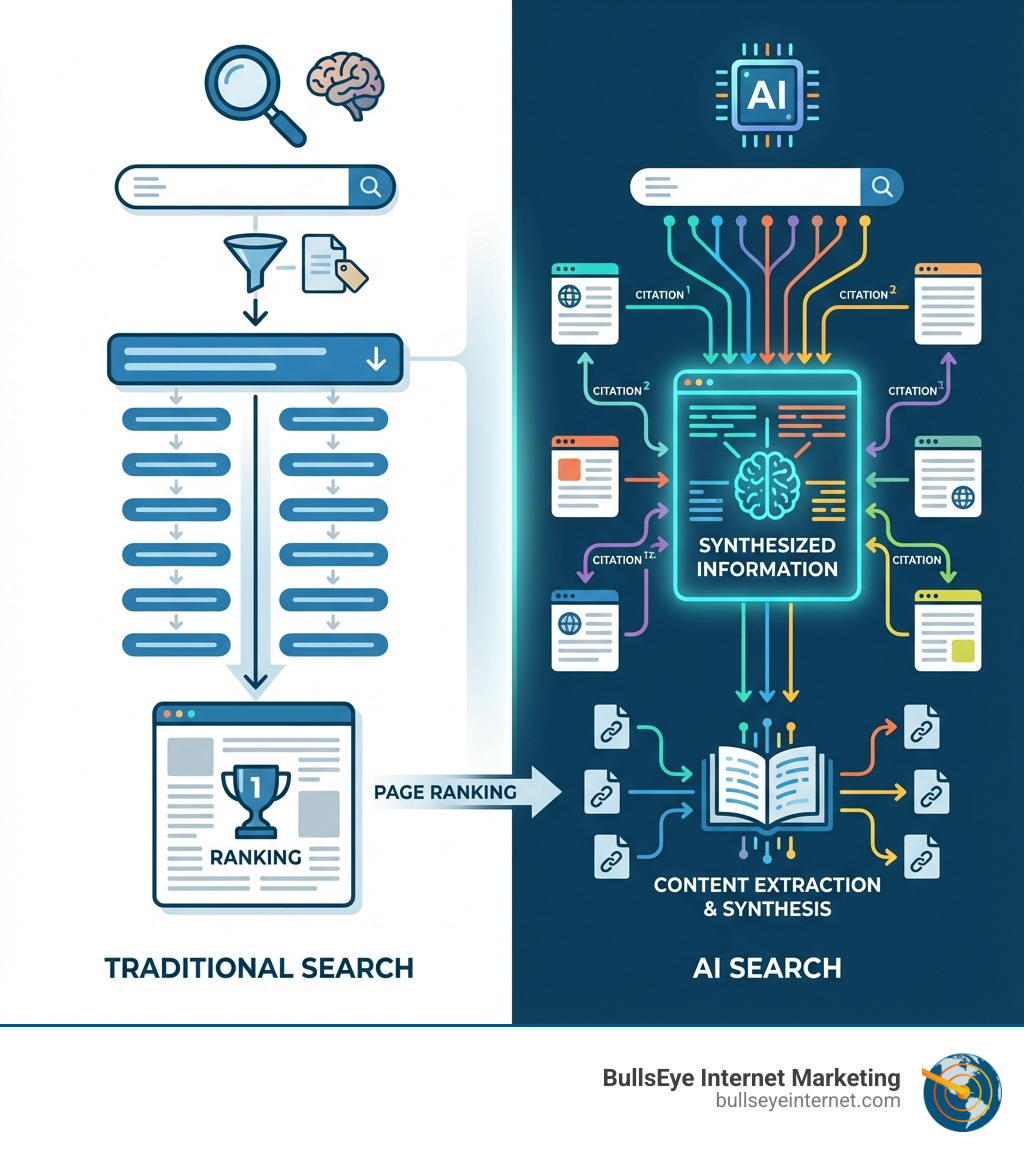
Basic AI search optimization terms:
Understanding Generative Engines: How AI Chooses What to Cite
AI search optimization hinges on understanding how AI algorithms function. They don’t just match keywords; they interpret the context, semantics, and intent of a user’s query to provide relevant and valuable information.
A key component of this is Retrieval-Augmented Generation (RAG). RAG systems first retrieve relevant information from a vast database of sources (which includes your website!) and then use a generative AI model to synthesize that information into a coherent answer. For RAG to find your content, it must be identifiable and extractable. This means structured, clear content that directly answers potential questions will be favored.
Semantic understanding is crucial here. AI engines leverage natural language processing to connect concepts and grasp the precise meaning of your content. They look beyond individual keywords to understand the relationships between words and phrases, providing more accurate answers. This semantic approach helps AI engines understand your content’s true meaning.
For content creators, this means embracing the principles of E-E-A-T: Experience, Expertise, Authoritativeness, and Trustworthiness. AI algorithms increasingly prioritize these factors when generating AI Overviews and search results. Building and demonstrating these qualities is paramount for your content to be recognized as valuable and trustworthy by AI systems.
Content recency also plays a significant role. AI systems, especially those providing real-time answers, prefer fresh, up-to-date information. Even for evergreen topics, AI Overviews often show recent content. This means regularly updating your existing content with the latest data, trends, and insights is a necessity for AI visibility.
Finally, the concept of a “first-mover advantage” can be profound. Just as Benford’s Law suggests that initial positions in rankings are disproportionately referenced, content that consistently ranks first or is frequently cited early on can create a snowball effect. This ensures your content is more frequently referenced by AI, leading to inclusion in AI summaries and voice search responses. Securing a top search position is crucial for visibility and long-term dominance in how often your content is referenced by AI. We have more insights into this on our AI Search Ranking Factors page.
How AI Search Differs from Traditional SEO
The shift from traditional SEO to AI search optimization represents a fundamental change in how content gains visibility.
Traditional SEO primarily focuses on getting your entire webpage to rank high in a list of blue links on a Search Engine Results Page (SERP). The user journey typically involves typing a query, seeing a list of results, clicking on a link, and then navigating that page to find their answer. Success is measured by page rankings and clicks.
In contrast, AI search operates differently. Instead of just ranking pages, AI systems extract and synthesize specific chunks of content from various sources to generate a direct, comprehensive answer. The user asks a full question, and the AI provides a synthesized response, often without the user needing to click through to any website. This means optimizing for mentions and citations within the AI’s answer, rather than just a high ranking in a list.
This distinction also changes the focus from keywords to user intent. While keywords are still important, AI systems are far more sophisticated at understanding the underlying needs and questions driving a search. Our content needs to address these needs head-on or risk being overlooked. We use tools to help us understand the underlying needs driving specific queries.
The metric of success also shifts from clicks to mentions. If your brand or content is cited within an AI-generated answer, that’s a powerful signal of authority and relevance, even if it doesn’t result in an immediate click. These AI systems act as intermediaries, filtering and synthesizing information, leading users to ask full questions, receive complete answers without clicking through, valuing brand awareness over direct traffic, and combining multiple sources.

The Importance of Recency and Authority
In the rapidly evolving landscape of AI search, two factors stand out as increasingly vital for content visibility: recency and authority.
AI’s preference for new information is undeniable. AI models have already consumed vast amounts of data from across the web, so they’re especially eager for new information that stands out from what they already “know.” This means if you have older content that doesn’t reflect the world we live in today, refreshing it to offer updated material is crucial. AI tools often prioritize recent content over even perfectly optimized older content, making regular updates a powerful strategy.
Building trust with AI systems is intrinsically linked to establishing authority. AI evaluates content not just on its immediate relevance but also on the credibility of its source. This means demonstrating E-E-A-T (Experience, Expertise, Authoritativeness, and Trustworthiness) is more important than ever. AI looks for signals that your content comes from a reliable, knowledgeable source.
Third-party validation significantly bolsters your authority in the eyes of AI. Backlinks from reputable sites, mentions across various platforms, and positive social proof all signal to AI that your content is valued and trustworthy. Backlinks and mentions act as votes of confidence, telling AI that others consider your content a valuable resource.
Furthermore, clear author credentials are no longer just a nice-to-have; they are essential. Including detailed author bios with relevant experience and expertise helps AI recognize the authority behind the content, increasing its likelihood of being cited.
The Content Blueprint for AI Search Optimization
To truly excel in AI search optimization, our content needs to be designed from the ground up to be both citable and snippable. Citable content provides direct, well-supported answers that AI can confidently extract and attribute. Snippable content is formatted in a way that allows AI to easily pull out key pieces of information for its synthesized answers. This all revolves around deeply understanding user intent—what questions are people truly asking, and what information do they need? We continually refine our approach to align with AI Search Best Practices.

Crafting Semantically Clear and Direct Answers
The way we structure our content is paramount for AI understanding. We should adopt an “inverted pyramid” structure, leading with clear, concise answers upfront, followed by supporting details. This makes it incredibly easy for AI to extract the core information it needs.
Accept a conversational tone. As voice search continues to grow, and people interact with AI in natural language, content that mirrors how people speak will be more findable. We incorporate conversational, long-tail keywords that reflect how people speak, and tools can help us understand common voice search queries and tailor our content accordingly.
Directly answering user questions upfront is a non-negotiable best practice. Structure your content around questions and answers, providing a concise response immediately after the question. Anticipate and address follow-up questions within your content, perhaps using subheadings or FAQ sections.
For content to be truly quotable, it must include specific statistics and data. Replacing vague statements with concrete, sourced numbers makes your content more credible and appealing to AI. Similarly, including expert quotes adds another layer of authority and makes your content more likely to be referenced. For AI to trust and cite your content, it needs to be confident in the factual accuracy and authority. We often leverage AI itself for content optimization and analysis, as detailed in our guide on Using AI for SEO and Content Marketing.
Formatting Content for AI Parsers
AI models don’t “read” a page top to bottom like a human; they break content into smaller, usable pieces through a process called parsing. These modular pieces are then ranked and assembled into answers. Therefore, content needs to be carefully formatted to aid this process.
Here’s a list of formatting best practices:
- Short paragraphs: Avoid long walls of text that blur ideas and make parsing difficult. Aim for clarity and conciseness.
- Bullet points and numbered lists: These are invaluable for breaking down complex information into easily digestible and extractable segments. AI can lift these verbatim.
- Q&A formats: Directly address common user questions with clear answers. This directly matches how AI often structures its responses.
- Clear headings (H2s, H3s): Use headings to define clear content slices and act as “chapter titles” for AI. This helps AI understand the hierarchical structure and main points of your content.
- Simple punctuation: Keep punctuation straightforward and consistent. Avoid decorative symbols or long strings of punctuation. Periods or semicolons are often clearer for AI parsing than overly complex em dashes.
- Clarity, Simplicity, and Readability: AI models prioritize content that is clear and easy to read at most reading levels. It’s important not to use overly complicated sentences. Tools can help improve clarity and readability, ensuring your content is easily digestible by both humans and AI.
The Crucial Role of Structured Data in AI Search Optimization
Structured data, specifically schema markup, is the unsung hero of AI search optimization. It’s not just about making your content look pretty; it’s about making it understandable to machines.
Schema is a type of code that helps search engines and AI systems understand your content. It’s usually added in JSON-LD format as a script in the backend of your site, often through your CMS or by a developer inserting it into the page code. This transforms plain text into structured data that machines can interpret with confidence. By explicitly labeling your content, you provide invaluable context to AI. For instance, schema can label your content as a product, a review, an FAQ, or an event.
This structured data helps AI systems categorize and process information much more efficiently. For example, FAQPage schema is particularly effective as it explicitly labels questions and answers, matching how AI often structures its responses. HowTo schema guides AI through step-by-step processes, and Product schema provides detailed information about offerings, making it easier for AI to present accurate product details.
We can use tools to verify that your structured data markup works properly. For a deeper dive into schema, visit Schema is a type of code that helps search engines and AI systems understand your content.
Technical SEO and Authority Building for AI Dominance
While content is king, technical SEO remains the backbone of visibility, especially for AI crawlers. These digital explorers need to access, understand, and process your site’s information efficiently. Coupled with this, building inherent authority signals your content’s trustworthiness to AI, making it more likely to be cited.
Key Technical SEO Factors for AI Search Optimization
For AI crawlers to do their job effectively, your website needs to be technically sound.
- Crawlability: This is fundamental. If AI crawlers can’t access your content, they can’t cite it. We need to ensure that your
robots.txtfile isn’t blocking important sections of your site from AI bots like GPTBot (OpenAI/ChatGPT) or CCBot. We can use arobots.txtchecker to ensure you’re not inadvertently blocking these crucial crawlers. - Page speed: AI search engines, like their traditional counterparts, favor fast-loading websites. A slow site frustrates users and signals a poor experience to AI. Optimizing page speed through caching, image compression, and using a Content Delivery Network (CDN) is essential.
- Mobile-friendliness: With the majority of searches now conducted on mobile devices, a mobile-friendly website with fast load times improves user experience and improves search rankings. AI chatbots rely on similar indicators, making mobile optimization crucial.
- HTTPS: A secure website (HTTPS) is a non-negotiable ranking factor. It protects user data and signals trust and reliability to both users and AI systems.
It’s a good idea to use a website audit tool to track your site’s health and identify steps to ensure your site is healthy, fast, and can rank in AI search results and chatbot citations. We can help you Check your site’s health with a website audit tool.
Optimizing for AI-Driven Search Experiences
The emergence of AI Overviews and the continued relevance of featured snippets demonstrate that search experiences are becoming increasingly AI-driven.
As of November 2025, a staggering 60% of Search Engine Results Pages (SERPs) feature AI Overviews. These expanded AI Overviews typically include around 8 links, offering significant opportunities for visibility. Optimizing for featured snippets can significantly boost your visibility; studies show that it can increase CTR by 42%. Content that appears in featured snippets often also appears in AI Overviews. To be eligible, content should be concise (one to two sentences), use structured formatting (lists, tables, Q&A), have strong headings, and be phrased in a self-contained manner. Using long-tail keywords within text fragments also improves snippet appearances by up to 55.5%.
Beyond text, video and image content are also critical. AI systems are increasingly multimodal, processing not just text but also visual information. Google Lens, for example, handles 20 billion visual searches monthly, requiring optimized media assets. Including unique images, charts, graphs, and diagrams makes complex data more accessible and increases the chances of your content being cited. Utilizing platforms like YouTube can also increase content visibility. For comprehensive guidance, refer to our LLM SEO Services Ultimate Guide.
Building Natural Human Authority to Earn Citations
In the AI era, building natural human authority is more critical than ever. AI algorithms increasingly prioritize E-E-A-T (Experience, Expertise, Authoritativeness, and Trustworthiness) when generating AI Overviews and search results.
- Consistent expert-level publishing: Regularly producing high-quality, in-depth content on your area of expertise signals to AI that you are a reliable source. AI will evaluate for authority at a granular level.
- Author bios and credentials: Clearly stating the qualifications and experience of your content creators in their author bios helps AI recognize the expertise behind the information. This builds confidence in your content’s accuracy.
- Social proof and engagement: Signals like mentions on social media, shares, and positive engagement metrics can signal authority to AI. These show that your content resonates with users and is considered valuable.
- Cross-platform presence: Being recognizable across multiple channels, including industry forums, social media, and other reputable websites, validates your authority. If AI cannot detect clear authority, your content may be overlooked.
Measuring ROI and Future-Proofing Your Strategy
In the dynamic world of AI search, measuring success requires a new set of metrics. We can no longer rely solely on traditional SEO KPIs. Our focus must shift to AI-centric metrics that reflect how generative engines interact with and cite our content. This involves continuous performance tracking and a commitment to adapting our strategies as trends evolve. For a holistic view of navigating this new landscape, we offer a comprehensive Digital Marketing AI Guide 2025.
How to Measure the Success of Your Efforts
To truly understand the impact of your AI search optimization efforts, we need to look at specific indicators:
- AI citation rate: This measures how often your brand or content is mentioned and linked within AI-generated answers. It’s a direct indicator of your content’s quotability and authority in the AI ecosystem.
- Share of AI voice: This metric assesses your brand’s presence in AI responses compared to your competitors. It helps us understand your relative visibility and influence in AI search.
- AI-attributed traffic and conversions: While AI often provides direct answers, some users will still click through for more detail or to engage with your brand. Tracking traffic and conversions that originate from AI sources (e.g., through specific tracking parameters or analytics segments) can demonstrate the direct business impact of your efforts. AI search visitors convert 4.4 times better than traditional organic visitors, making this a high-value segment.
- Tracking snippet performance: Monitoring how often your content appears in featured snippets is crucial. Tools like Google Search Console can help you track and optimize for these valuable search results, as content in featured snippets often appears in AI Overviews.
Implementing robust tracking through platforms like Google Analytics 4, including custom dimensions for AI traffic sources, allows us to monitor these key metrics and adjust strategies based on content type, topic performance, and update frequency.
Latest Trends in AI Search and How to Adapt
The AI search landscape is constantly evolving, and staying ahead means adapting to the latest trends:
- Multimodal search: AI is no longer limited to text. It processes text, images, video, and audio. This means optimizing all your media assets is crucial. Ensure your images have descriptive alt text, your videos are transcribed and have clear summaries, and all visual content is high-quality and relevant. Data visualizations and diverse visual content play a significant role in making content quotable for AI.
- Voice search optimization: As smart speaker usage continues to grow (experiencing a 2.5% growth from 2024), optimizing for natural language queries is more important than ever. Incorporate conversational, long-tail keywords that reflect how people speak. Tools can help you understand common voice search queries and tailor your content accordingly.
- Continuous content audits: The dynamic nature of AI search necessitates regular content audits. Review your existing content for accuracy, freshness, and AI-friendliness. Update old content, consolidate redundant pieces, and expand on high-performing topics.
- Experimentation and A/B testing: The best way to understand what works for AI search is to experiment. Test different content structures, formatting, and semantic approaches. Monitor the results and refine your strategies based on what drives better AI citation and visibility.
Frequently Asked Questions about AI Search Optimization
What is the main difference between AI search optimization and traditional SEO?
Traditional SEO focuses on ranking a webpage in a list of links for users to click. The goal is to get clicks to your website. AI search optimization, on the other hand, focuses on having your content’s information extracted, synthesized, and cited directly within an AI-generated answer. The primary aim is for your brand or content to be included in the AI’s response itself, rather than just appearing high in a list of links. While traditional SEO drives traffic through clicks, AI search optimization aims for brand mentions, authority, and direct answers.
How can I make my content more citable for AI?
To make your content more citable for AI, you should:
- Provide direct answers upfront: Use an inverted pyramid style where the most important information comes first.
- Use clear headings: Structure your content with H2s and H3s that clearly define each section.
- Incorporate specific data and statistics: Back up your claims with concrete, sourced numbers.
- Include expert quotes: Leverage credible voices to add authority to your content.
- Structure information with lists and tables: These formats are easy for AI to parse and extract.
- Ensure semantic clarity: Write in natural, unambiguous language that AI can easily understand.
- Maintain content recency: Regularly update your articles with the latest information.
- Build author authority: Ensure content creators have clear credentials and expertise.
Will using AI to write content hurt my rankings?
Using AI to generate content will not inherently hurt your rankings, as long as the final product is high-quality, original, helpful, and human-reviewed for accuracy and expertise. Google’s policy is to reward helpful content, regardless of how it’s produced, and penalize low-quality, spammy content. The key is to create content for people, not just algorithms. If you use AI to mass-produce shallow, unoriginal, or inaccurate content, it will likely be penalized. However, using AI as a tool to aid in research, outlining, drafting, or improving readability (with human oversight) can be highly effective. Google’s guideline is to create content for people, and helpful content is what AI systems also seek.
Conclusion: Partnering for Success in the AI Search Era
The world of search has irrevocably changed. The future is conversational, synthesized, and driven by sophisticated AI. For businesses in Florida, South Florida, Broward County, Miami Dade County, Palm Beach County, Martin County, St Lucie County, Indian River County, and across the United States, adapting to AI search optimization isn’t just an option—it’s a necessity for continued visibility and growth.
We’ve explored how generative engines choose what to cite, the stark differences from traditional SEO, and the critical importance of content recency and authority. We’ve laid out a content blueprint for creating semantically clear, direct, and well-formatted answers, underpinned by the crucial role of structured data. We also digd into the technical SEO factors that ensure AI crawlers can access your content and the strategies for building natural human authority to earn those coveted AI citations. Finally, we discussed how to measure your efforts with AI-centric metrics and adapt to the latest trends, from multimodal search to voice optimization.
The shift to AI-driven search presents both challenges and immense opportunities. Those who accept a proactive strategy, focusing on helpful, authoritative, and technically sound content, will be the ones who thrive. At BullsEye Internet Marketing, we are dedicated to helping our clients steer this new landscape. We understand the unique needs of businesses across all 50 USA States, including our local communities, and we’ve developed proven strategies to ensure your business is not just visible but authoritative, trusted, and recommended by AI systems.
To master this new landscape and ensure your business is not just visible but authoritative, explore our comprehensive guide on Answer Engine Optimization (AEO), GEO, & LLM SEO.
