
How AI is Reshaping the Rules of Search Visibility
AI search ranking factors are the signals that determine whether your business appears in AI-generated answers from Google’s AI Overviews, ChatGPT, Perplexity, and other AI-powered search tools. Here’s what you need to know:
| Key Factor | What It Means |
|---|---|
| Semantic Relevance | AI understands concepts and intent, not just keywords |
| E-E-A-T Signals | Experience, Expertise, Authoritativeness, and Trustworthiness matter more than ever |
| Source Credibility | Citations, author profiles, and verified information boost visibility |
| Content Structure | Answer-first formatting, tables, lists, and clear headings help AI extract information |
| User Engagement | Clicks, dwell time, return visits, and explicit feedback signal helpfulness |
| Technical Foundation | Page speed, mobile-friendliness, structured data, and Core Web Vitals remain critical |
| Freshness & Depth | Up-to-date, comprehensive content that demonstrates topical authority |
| Conversational Tone | Natural language that matches how people actually ask questions |
The landscape of search is changing fast.
A Gartner report predicts that by 2026, traditional search engine volume will drop by 25% as users shift to AI chatbots and virtual agents. Google’s Search Generative Experience (SGE) now provides AI-generated summaries directly in search results. ChatGPT can search the web. Perplexity cites sources in real-time.
This isn’t the death of SEO—it’s its evolution.
The old playbook of keyword stuffing, link schemes, and gaming the algorithm is completely obsolete. AI search rewards something different: genuinely helpful, credible, well-structured content that directly answers user questions.
But here’s the frustrating part for business owners: you can’t just throw money at this problem. You can’t buy your way to the top of an AI-generated answer the way you could with paid ads. And if your content isn’t already meeting these new standards, you’re becoming invisible to a growing share of your potential customers.
The rules have changed. Your goal is no longer to rank on page one—it’s to be the answer that AI systems trust and cite.
I’m Ronnie Katz, founder of BullsEye Internet Marketing, and I’ve been helping businesses steer online visibility since 2006. As AI reshapes search, understanding AI search ranking factors has become critical to staying competitive and getting your phone to ring.
#1: Traditional SEO is Evolving, Not Dying
For years, many of us in the SEO world focused on optimizing for specific keywords, building backlinks, and tweaking technical elements. While those factors still matter, the emergence of AI in search has ushered in a new era. Traditional SEO isn’t dying; it’s evolving into something more sophisticated and, frankly, more aligned with what users truly want.
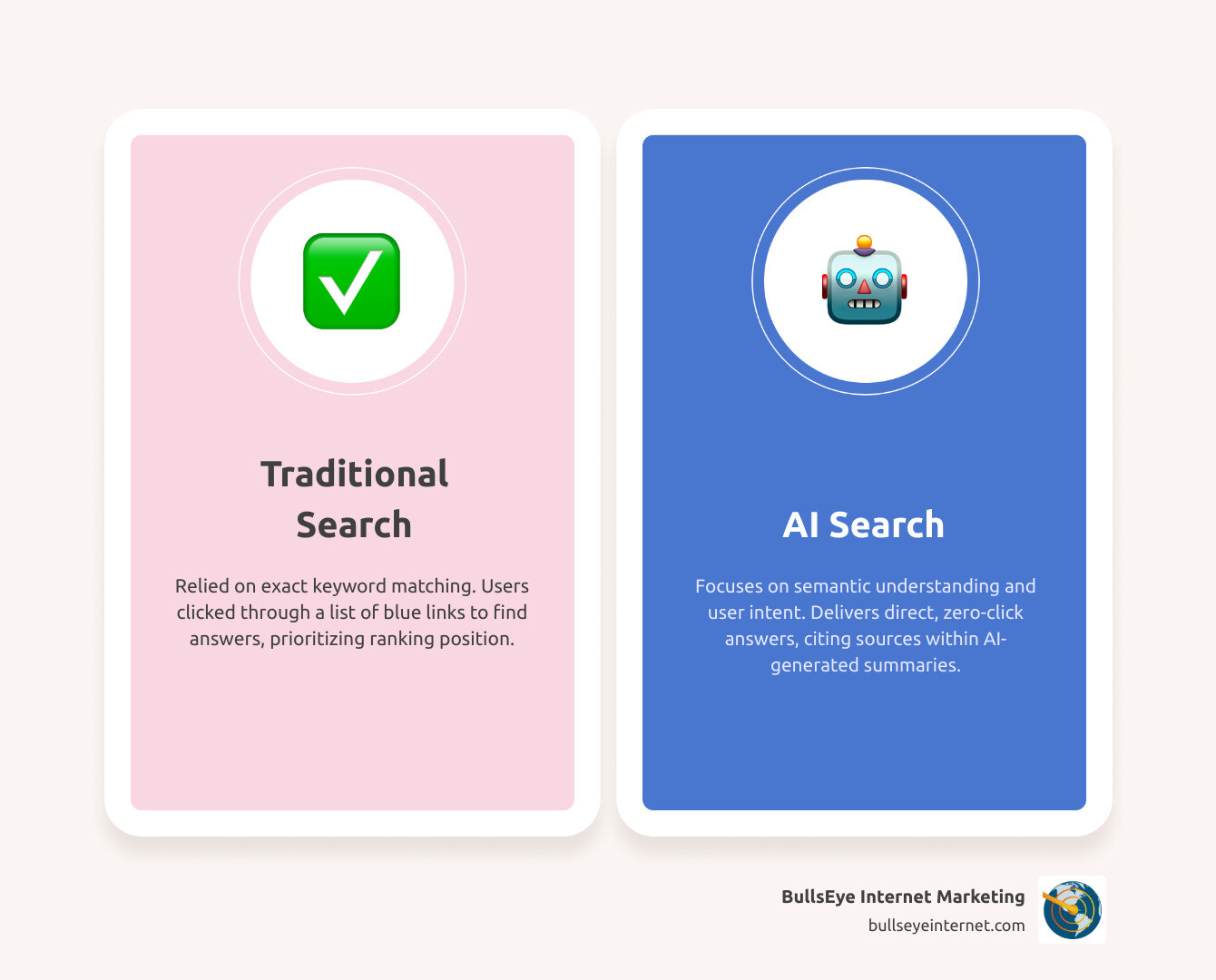
The primary difference between traditional SEO and AI search optimization lies in how search engines interpret queries and content. Traditional SEO often revolved around matching exact keywords. If someone searched for “best marketing agency Miami,” we’d optimize our content for that exact phrase. Now, AI search algorithms prioritize semantic relevance and contextual understanding. This means AI doesn’t just look for keywords; it strives to understand the concept behind the search and the intent of the user. It’s about understanding the ‘why’ behind a search, not just the ‘what.’
This shift is particularly evident with conversational queries. People are increasingly using natural language to ask questions, much like they would to another person. AI is designed to understand these nuances, analyze context, and provide precise results. This means our content needs to be written in a way that naturally answers these questions.
To thrive in this new environment, we need to accept two new concepts: Generative Engine Optimization (GEO) and Answer Engine Optimization (AEO). GEO focuses on gaining visibility within AI-generated experiences, like Google’s AI Overviews. AEO, on the other hand, concentrates on earning citations and inclusion in the machine-assembled summaries that AI provides. Our goal isn’t just to rank in a list of blue links; it’s to become the trusted source that AI systems reference when they generate an answer.
Even with this evolution, foundational elements of SEO remain crucial. Core Web Vitals, such as loading speed, interactivity, and visual stability, are still vital for user experience and, consequently, for AI’s evaluation of helpfulness. We’ll dig deeper into these later, but a slow website in Broward County, Florida, is still a slow website, and AI notices. Similarly, while the role of backlinks is evolving, quality links from authoritative sources continue to signal credibility, influencing how AI perceives your content’s authority. Technical SEO compatibility, ensuring our sites are crawlable, secure (HTTPS), and mobile-friendly, forms the bedrock upon which all other AI optimization efforts are built. Without a solid technical foundation, even the most brilliant content might remain hidden from AI’s discerning eyes.
#2: ‘Helpfulness’ is Now a Measurable Signal
In AI search, “helpfulness” isn’t just a warm, fuzzy concept; it’s a concrete, measurable signal that directly influences AI search ranking factors. Google’s AI Mode leverages its 25 years of search experience to determine what truly helps a user, and it uses this to control hallucinations and ensure quality.
How does Google evaluate helpfulness in AI Mode? It’s a multi-faceted approach that combines both explicit and implicit signals. On the explicit side, users can provide direct feedback through mechanisms like “thumbs up” or “thumbs down” buttons on AI-generated answers. This tells the system directly if a response was useful.
Implicitly, AI search algorithms closely monitor user engagement metrics. These include:
- Clicks: While a click is a basic signal, AI digs deeper.
- Dwell time: How long a user spends on your page after clicking from an AI-generated answer. Longer, engaged visits signal helpfulness.
- Return visits: If a user comes back to your site or references your content multiple times for related queries, it’s a strong indicator of value.
However, it’s crucial to differentiate success from failed attempts. Increased usage of an AI answer in a single session isn’t automatically a win. If a user has to make repeated attempts or rephrase the same query multiple times to get a satisfactory AI response, that actually signals a failure in helpfulness. Google’s AI models are smart enough to understand this nuance, aiming to provide a comprehensive answer the first time.
At the heart of this evaluation is Google’s Helpful content system, which focuses on delivering “original, helpful content written by people, for people…rather than content made primarily to gain search engine traffic.” The good news is that Google explicitly states it does not penalize AI-generated content as part of this system, as long as it meets the helpfulness criteria. This means the emphasis is squarely on the quality and utility of the content, regardless of how it was created.
For us, this translates into a clear directive: our content quality assessment must be rigorous. We need to ask ourselves:
- Does our content directly answer the user’s question?
- Is it comprehensive and easy to understand?
- Is it original and insightful?
- Does it load quickly and provide a good user experience?
- Does it cite credible sources?
The goal is always writing for humans. When we create content that genuinely serves our audience in Miami-Dade County, Florida, or any of our service areas, we’re also optimizing for AI search. AI is designed to reward content that humans find valuable.
#3: E-E-A-T and Credibility are Critical AI search ranking factors
Trust is the bedrock of information, and AI systems are built to prioritize it. This is where E-E-A-T (Experience, Expertise, Authoritativeness, and Trustworthiness) shines as one of the most critical AI search ranking factors. AI doesn’t want to recommend weak or unreliable sources, especially when it’s generating direct answers to complex or sensitive queries.
Let’s break down why E-E-A-T is so vital:
- Experience: This refers to having first-hand experience with the topic. For example, if you’re writing about the best places to fish in the Florida Keys, personal anecdotes and insights from someone who has actually fished there demonstrate experience.
- Expertise: This means having a high level of knowledge or skill in a particular field. A licensed financial advisor writing about investment strategies for residents of Palm Beach County demonstrates expertise.
- Authoritativeness: This is about being recognized as a go-to source for a topic. If other reputable sites, industry leaders, or news outlets frequently cite your content, it builds your authority.
- Trustworthiness: This encompasses the overall reliability and honesty of your website and content. Transparent contact information, a secure website (HTTPS), and accurate, unbiased information all contribute to trustworthiness.
For AI, these elements translate into concrete signals. Source credibility is paramount. AI models are trained to identify and prefer content that is backed by reliable data and cited sources. This means including references, studies, and expert opinions within our content. For instance, a recent study found that adding a statistic generated a 65% improvement in visibility, and citing trusted sources led to a 132% increase. These aren’t just vanity metrics; they are direct signals of credibility to AI.
Building strong author profiles is another key strategy. When content is attributed to real people with verifiable qualifications and experience, it boosts credibility. Imagine a local business in Fort Lauderdale, Florida, publishing an article on local tax regulations. If the author is a certified public accountant with a clear bio and professional links, AI is more likely to trust that information.
Google’s E-E-A-T guidelines provide a comprehensive framework for what constitutes high-quality, trustworthy content. While E-E-A-T isn’t a direct ranking factor in the traditional sense, it underpins the quality evaluation that AI systems use.
This is especially true for YMYL (Your Money or Your Life) topics. These are subjects that can significantly impact a person’s health, financial stability, or safety. Industries like finance, healthcare, legal services, and government information fall into this category. For YMYL content, Google applies greater scrutiny in AI Overviews. This means if you’re a financial planner in Miami, or a medical practice in Orlando, Florida, demonstrating impeccable E-E-A-T is non-negotiable for your content to appear in AI-generated answers. We need to use an authoritative (but not commanding) tone, share vetted data points, and cite trusted sources to demonstrate our expertise and trustworthiness.
#4: AI Thinks in Concepts, Not Just Keywords

One of the most profound shifts brought by AI into search is its ability to move beyond simple keyword matching to genuinely understand the meaning and relationships between ideas. This means AI “thinks” in concepts, not just isolated keywords, making semantic relevance and contextual understanding crucial AI search ranking factors.
AI algorithms analyze content to grasp the full meaning of a topic, the relationships between different terms, and the user’s underlying intent. For example, if someone searches for “apple,” AI can understand if they mean the fruit, the tech company, or a specific type of tree, based on the surrounding context of the query and the content it finds. This is a far cry from the old days where “apple” might just pull up anything with that word.
To cater to this, we need to create entity-rich content. An “entity” is a unique, distinguishable, and well-defined concept or thing – like a person, place, organization, product, or idea. For BullsEye Internet Marketing clients in Florida, this could mean ensuring that your content clearly defines and links to entities relevant to your business, such as “Miami Beach hotels,” “South Florida real estate market,” or “Broward County government services.” By structuring our content around these clear entities, we help AI systems make sense of our information.
This is where Knowledge Graph optimization becomes vital. Google’s Knowledge Graph is a vast database containing billions of facts about people, places, and things. AI Overviews and other AI models reference this database to generate responses. By optimizing our content to align with known entities in the Knowledge Graph, we can improve our visibility. For instance, if you’re a business, claiming and optimizing your Google Knowledge Panel, which summarizes information about your entity, can significantly help. This involves creating an entity page (like an ‘About Us’ or ‘Contact’ page), updating it with factual information, and including external links from reputable sources.
A powerful tool for this is structured data, specifically Schema markup. Structured data provides “explicit clues about the meaning of a page” to search engines and AI. While not a confirmed direct ranking factor, it’s invaluable in helping AI models and Google’s databases understand our content more thoroughly. Think of it as providing a cheat sheet to the AI, telling it exactly what each piece of information on your page represents.
We can use various types of Schema markup relevant to our clients:
- Product markup: For e-commerce businesses, this provides explicit details about offerings like price, rating, and inventory, feeding into databases like Google Shopping Graph.
- LocalBusiness markup: Essential for businesses in specific Florida locations (e.g., a restaurant in Coral Gables or a law firm in Delray Beach), this provides explicit information about your company’s name, address, and phone number.
- Organization markup: This helps establish essential business information, like your company’s name, phone number, and website URL, reinforcing your entity identity.
- FAQ markup: For pages with frequently asked questions, this can help AI extract direct answers.
By implementing structured data, we make it much easier for AI search algorithms to analyze context, behavior, and semantics, ensuring our content is understood and delivered in relevant results. You can find more about structured data in Google’s Introduction to structured data.
#5: AI Overviews (SGE) Have Their Own Rules
Google’s Search Generative Experience (SGE), now often referred to as AI Overviews, is a game-changer. Instead of just a list of blue links, users might see an AI-generated summary at the top of the search results page, complete with citations. This means that appearing in these AI Overviews requires understanding a new set of AI search ranking factors that go beyond traditional SEO.
AI Overviews are powered by multiple sophisticated Google’s AI Models, including PaLM2 (which focuses on natural language generation and advanced reasoning), a modified version of MUM (a multi-modal model that understands text, images, and other formats), and most recently, Gemini, which improves generation speed and quality. These models work in concert to synthesize information and provide comprehensive answers.
A key concern with AI models is the potential for “hallucinations”—generating confident but incorrect information. Google manages this by grounding AI answers in its extensive 25 years of experience with classic search. The same relevance, trust, and usefulness signals that underpin traditional search are encoded within these AI models. Google leverages its core ranking systems (more than 15 of them!) like the Helpful Content System, Link Analysis, Reviews System, and Spam Detection, to ensure the quality and reliability of information presented in AI Overviews. This means that a site that performs well in traditional Google Search is already in a strong position to appear in AI Overviews.
AI Overviews are similar to, but distinct from, featured snippets. While both provide direct answers, AI Overviews can synthesize information from multiple sources into a more conversational, paragraph-style summary, rather than pulling a single block of text.
Multimedia content and visual search play an increasingly significant role because AI models are multi-modal. This means they can understand and process text, images, and videos. Integrating relevant visuals into our content can provide additional context and increase the chances of being pulled into an AI Overview. For instance, YouTube videos tend to appear more often in AI Overviews than embedded YouTube videos on other URLs, suggesting that hosting videos on YouTube is a smart strategy for visibility.
How to Optimize Content for AI Overviews
To optimize our content for AI-generated answers and increase our chances of appearing in AI Overviews, we need to focus on several key strategies:
- Answer-first structure: Begin your content by directly answering the user’s primary question, then elaborate. This makes it easy for AI to extract the core information.
- Extraction-friendly formatting: Use clear headings (H2s, H3s), subheadings, bullet points, and numbered lists. AI systems can easily parse and synthesize information presented in this structured way.
- Using tables and lists: For comparative data, steps, or features, tables and lists are highly effective. They allow AI to quickly extract specific pieces of information. For example, if we’re comparing different types of marketing campaigns for a client in St. Lucie County, a table summarizing features and benefits would be ideal.
- Citing sources: Always back up your claims with credible sources. This reinforces E-E-A-T and helps AI verify the accuracy of your information.
- Using an authoritative tone: Especially for YMYL topics, an authoritative but not overly commanding tone demonstrates expertise. A study showed an 89% improvement in visibility for content using an authoritative tone.
- Simplifying language: While authoritative, content should also be easy to understand. A recent study found that simplifying language to an 8th- to 11th-grade reading level improved AI Overview rankings. This ensures both humans and AI can readily comprehend your message.
- Match search intent: Understand whether the user is looking for navigational, informational, or transactional content. Tailor your content to meet that specific need.
- Comprehensive skyscraper content: Develop in-depth content that answers not only the initial query but also common follow-up questions, creating a complete resource.
By implementing these strategies, we can ensure our content is not just found by traditional search, but actively used by AI to provide direct, trusted answers.
#6: User Engagement and Technical SEO Form the Foundation
While the rise of AI introduces new layers of complexity to search, it’s crucial to remember that the fundamental principles of a strong online presence still hold true. User engagement and technical SEO form the indispensable foundation for any successful AI search strategy. Without these elements, even the most semantically rich and E-E-A-T-driven content might struggle to gain traction.
Page speed remains a critical factor. Anything more than 3 seconds is considered excessive load time, and Google recommends websites aim for 3 seconds or less. If your website in Palm Beach County loads slowly, users will bounce, and AI systems will interpret this as a poor experience. We must optimize images, minify code, leverage caching, and ensure a fast web host to keep our sites snappy.
Mobile-friendliness is no longer optional; it’s a necessity. With Google’s mobile-first indexing, the mobile version of your site is the primary one used for ranking. Our websites must be fully responsive and provide a seamless experience on all devices, from smartphones in Miami to tablets in Orlando, Florida.
Crawlability and HTTPS are also non-negotiables. AI systems, like traditional search engines, need to be able to access and understand our content. An XML sitemap helps bots find all important pages, and a secure HTTPS connection builds user trust and is a basic ranking signal.
Google’s AI Mode is sophisticated enough to differentiate true success from mere activity. As Robby Stein, Google’s VP of Product for Search, explained, “Increased usage of an AI answer in a single session is not automatically treated as success; repeated attempts for the same query indicate failure.” This means user behavior analysis goes beyond simple clicks. AI considers deeper signals like:
- Dwell time: How long users stay on your page.
- Return visits: Whether users come back to your site for related information.
- Explicit feedback: Thumbs up/down on AI responses.
These metrics help AI gauge genuine satisfaction. If users quickly abandon your page or repeatedly rephrase their query, the AI understands that the initial answer or source wasn’t truly helpful.
Furthermore, advanced AI search systems, like Perplexity AI, are even looking at browser-level signals. This involves encoded request patterns at the browser interaction level, providing a hidden layer of optimization signals that contribute to ranking. While this is a more advanced concept, it highlights how deeply AI is analyzing the entire technical stack supporting content delivery. Our focus on Core Web Vitals (Loading Speed, Interactivity, Visual Stability) directly addresses these foundational technical and user experience needs, ensuring that our sites not only load fast but are also stable and interactive for users.
The Impact of Content Structure on AI search ranking factors
The way we structure our content profoundly impacts how AI systems understand and rank it. This directly relates to readability and structured formatting. AI search results depend on how easy it is for both users and algorithms to understand your content.
Here’s why good content structure is so vital:
- Headings (H2, H3, etc.): These act as signposts for both readers and AI, breaking down complex topics into digestible sections. They help AI understand the hierarchy and main points of your content.
- Short paragraphs: Long blocks of text can be daunting. Short paragraphs (ideally under four sentences) improve readability and allow AI to more easily extract key information.
- Bullet points and numbered lists: These are fantastic for conveying information concisely and clearly. AI loves lists because they present information in an organized, easy-to-parse format, making it ideal for generating summaries or direct answers.
- Content depth: While brevity is good for readability, AI also rewards content depth. This means covering a topic comprehensively, answering not just the initial question but also related queries and sub-topics.
- Topical authority: By consistently creating in-depth, well-structured content around a core theme, you build topical authority. For example, if BullsEye Internet Marketing publishes numerous detailed articles about local SEO strategies for businesses in South Florida, covering everything from Google Business Profile optimization to local link building, we establish ourselves as an authority on that topic. This signals to AI that we are a trusted, expert source for that subject matter.
Using a free AI SEO Topical Map Generator can help us identify related topics and build out this comprehensive content architecture. This structured approach, combined with clarity and readability, significantly boosts our content’s chances of being recognized and used by AI search algorithms.
Frequently Asked Questions about AI Search
How does AI search impact zero-click searches?
Zero-click searches are queries where the user finds the answer directly on the search engine results page (SERP) without needing to click through to a website. AI search, particularly with AI Overviews (Google’s SGE) and similar features in other AI chatbots, significantly amplifies this trend.
When you ask a question and Google’s AI Overview provides a direct, comprehensive answer at the top of the SERP, that’s a zero-click search. The AI synthesizes information from various sources to give you a single, concise response. While this is incredibly convenient for users, it means a significant portion of search volume might no longer result in clicks to your website.
The impact for businesses is a shift in strategy. Our goal is no longer just to get a click; it’s to have our content be the source that the AI uses for its direct answer. This means we need to optimize for visibility within these AI-generated summaries, ensuring our brand is cited and our expertise is recognized. If our content is consistently chosen as a source, even if it’s a zero-click event, it builds brand authority and recognition.
What is the difference between GEO and AEO?
As the search landscape evolves, we’re seeing new terms emerge to describe optimization strategies for AI-powered search:
- Generative Engine Optimization (GEO): This refers to optimizing for visibility within the broader AI-generated experiences. Think of it as ensuring your brand and content appear prominently and favorably when an AI chatbot or search generative experience (like Google’s SGE) constructs an answer or summary. It’s about being part of the generated response itself, not just a link below it.
- Answer Engine Optimization (AEO): This is a more specific subset of GEO. AEO focuses on the deliberate strategies to earn citations and inclusion in the machine-assembled summaries and direct answers that AI provides. It’s about structuring your content so clearly and authoritatively that an AI chooses your site as a primary source for a factual answer.
Both GEO and AEO are critical components of a holistic AI SEO strategy. GEO aims for overall presence in AI environments, while AEO targets the direct attribution and sourcing within AI-generated answers.
Does my traditional SEO work still matter for AI search?
Absolutely, yes! While the rules are evolving, your traditional SEO work is far from obsolete; it forms the fundamental bedrock upon which your AI search success will be built.
Google’s AI Mode, as Robby Stein explained, is built on 25 years of Google’s classic search experience. The quality systems and ranking signals that have driven traditional search are still very much in play. This means:
- Technical SEO: A fast, mobile-friendly, secure, and crawlable website (all traditional SEO tenets) is essential for AI to even access and understand your content. If AI can’t crawl your site in Miami-Dade County, it can’t cite it.
- Link building: High-quality backlinks from authoritative sources continue to signal trust and authority, which are crucial for AI’s evaluation of E-E-A-T.
- On-page optimization: Structuring your content with clear headings, using semantic relevance, and ensuring readability (all traditional on-page SEO best practices) directly helps AI understand your content.
Traditional SEO provides the strong foundation, while AI SEO represents the advanced optimization that ensures your content is not just found, but actually used and cited by AI systems. It’s an evolving strategy where the best practices of the past are integrated and improved for the future. The synergy between traditional and AI SEO is what will drive visibility and success.
Conclusion
The world of search is undeniably undergoing a seismic shift, but it’s not a shift to fear—it’s an opportunity to shine. The rise of AI search ranking factors means that the future belongs to businesses that accept a strategy centered on genuine helpfulness, undeniable credibility, and crystal-clear communication. For businesses across Florida, from the busy streets of Miami to the serene coasts of Indian River County, understanding these changes is paramount.
Our key takeaways are clear:
- AI search is an evolution, not an obliteration, of SEO. Foundational SEO remains critical.
- Helpfulness is now a measurable quality signal, driven by user engagement and explicit feedback.
- E-E-A-T and source credibility are non-negotiable for building trust with AI.
- AI thinks in concepts and entities, requiring semantic-rich and structured content.
- AI Overviews have specific optimization needs, demanding answer-first content, clear formatting, and multimedia integration.
- Technical SEO and user experience are the bedrock upon which all AI search success is built.
The future of search is about becoming the trusted source, the authority that AI systems turn to when generating answers. It’s about changing your online presence from merely being “found” to actively “being the answer.” This proactive adaptation isn’t just about rankings; it’s about building lasting brand authority and ensuring your business remains visible and relevant in an increasingly AI-driven world.
At BullsEye Internet Marketing, we specialize in helping businesses like yours steer these complex changes. We understand the nuances of AI search ranking factors and how to integrate them into a comprehensive strategy that drives calls and sales. With our focus on no long-term contracts and working with only one client per industry per geographic area, we ensure your competitive advantage.
Ready to adapt your strategy and ensure your business is recognized as the answer in AI search? Learn more about Answer Engine Optimization and how we can help you turn this evolution into a strategic advantage.
