
What Is Pay Per Lead Advertising and How Does It Work?
At its core, Pay Per Lead (PPL) advertising is a performance-based marketing model where you only pay when a prospect takes a specific, pre-defined action to express interest in your services. Unlike traditional advertising where you pay for eyeballs or clicks, PPL ensures that your marketing dollars are directly tied to tangible business opportunities, such as a completed contact form, an inbound phone call, or a booked consultation.
To understand why this model has taken the marketing world by storm in June 2026, we have to look at the challenges modern businesses face. According to industry data, 79% of marketers state that their top priority is to generate more qualified leads. This is because traditional digital advertising has become increasingly inefficient.
In a comprehensive analysis of over $3 billion in annual pay-per-click (PPC) ad spend, the average click-through rate was found to be just 2.35%, and more than 90% of those hard-won clicks bounced immediately without taking any action. This means traditional search and social media campaigns frequently drain budgets on empty traffic.
Furthermore, roughly 55% of marketers report barely reaching their lead generation targets, with the vast majority of generated leads being low-intent, top-of-funnel contacts with only basic info. By partnering with a dedicated Pay Per Lead provider, you bypass the risk of paying for useless traffic and focus your budget entirely on prospects who want to talk to your sales team.
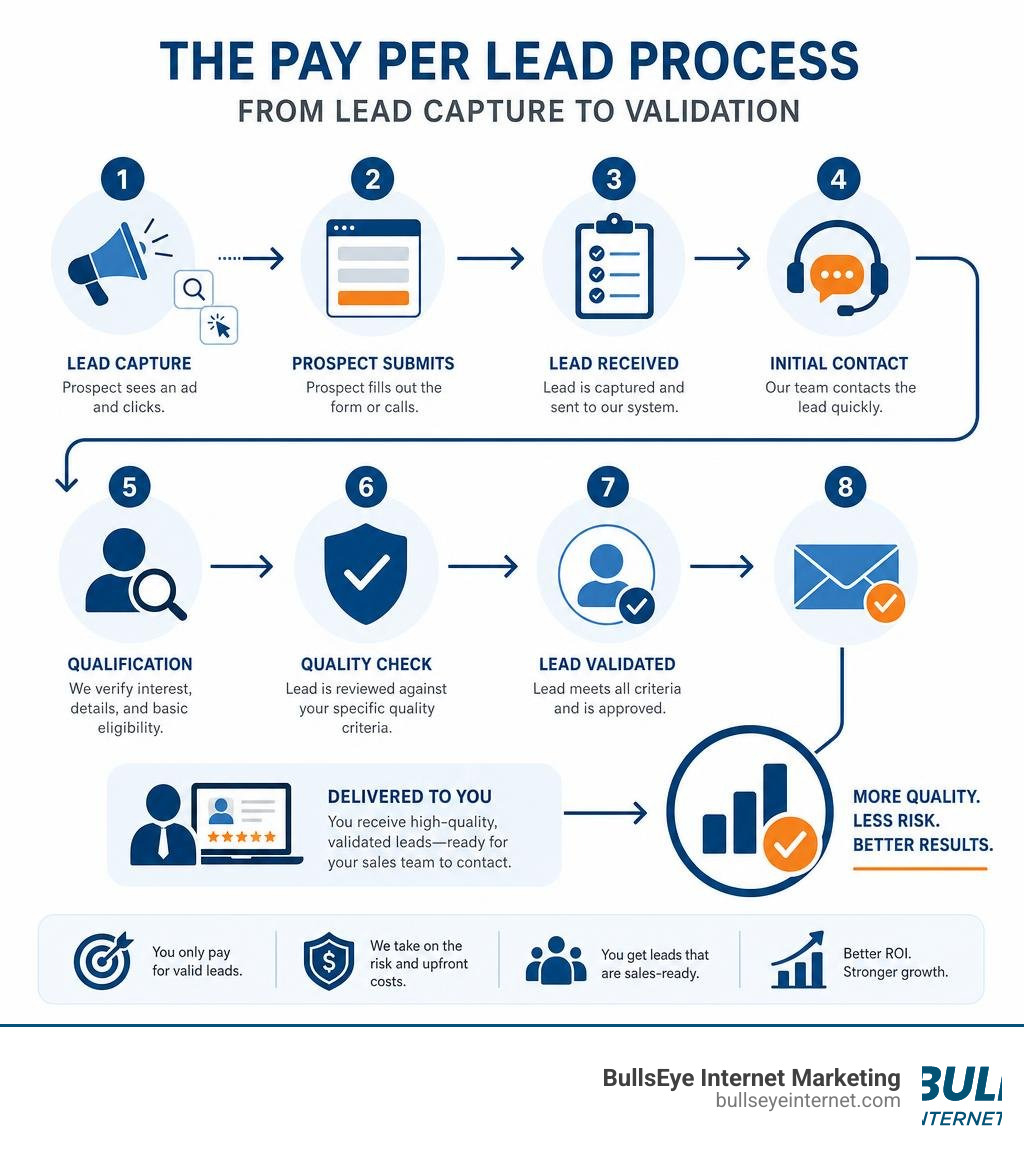
The Shift in Risk Allocation
In traditional advertising models like Cost Per Mille (CPM) or Cost Per Click (PPC), the advertiser carries 100% of the conversion risk. If we set up a standard Google Ads campaign for your business and write compelling copy, you still have to pay for every click even if your landing page fails to convert them, or if the traffic consists of accidental clicks and competitors.
The PPL model completely flips this dynamic. The conversion risk is shifted from your business to the lead generation provider. The agency or publisher absorbs the upfront costs of building landing pages, running search campaigns, and testing ad creatives. You do not pay for impressions, and you do not pay for clicks. You only pay when a prospect successfully crosses the threshold of your quality criteria and submits their validated information.
The Core Mechanics of a PPL Campaign
A successful PPL campaign relies on a highly structured, automated pipeline to function efficiently:
- Defining Lead Criteria: Before a single ad is run, we establish exactly what constitutes a “qualified lead” for your business. This includes geographic boundaries (such as specific ZIP codes in Miami-Dade or Broward County), service intent, and demographic filters.
- Lead Generation: The provider utilizes their own internal traffic sources, search engine optimization (SEO), and paid media channels to drive high-intent traffic to highly optimized landing pages.
- Real-Time Validation: As soon as a prospect submits a form or places a call, automated verification systems check the lead for duplicate entries, valid contact details, and compliance.
- Instant Delivery: The validated lead is routed directly into your CRM or phone system in under three seconds, ensuring your sales team can strike while the iron is hot.
Who Does Pay Per Lead Advertising Across Different Industries?

Not every business model is suited for pay per lead advertising. Low-ticket, low-margin businesses—such as e-commerce stores selling $20 t-shirts or local restaurants—cannot support the unit economics of PPL. If a lead costs $15 to generate, but your average order value is only $30, the math simply does not work.
Instead, PPL is dominated by high-ticket, high-margin industries where a single closed deal can yield thousands of dollars in revenue. For these sectors, paying a fixed cost per lead provides a highly predictable customer acquisition cost (CAC). If you are looking for the Best Lead Generation Companies in United States 2026 | Semrush , you will find that the top players focus heavily on these high-value verticals.
To see how this works in practice, let’s look at the primary industries that rely on Pay Per Lead Advertising to scale their operations:
- Home Services: Plumbing, HVAC, roofing, solar, pest control, and major remodeling.
- Legal Services: Personal injury, criminal defense, family law, and estate planning.
- Financial Services: Mortgage refinance, debt consolidation, and wealth management.
- Insurance: Medicare, private health insurance, auto, and home insurance.
- B2B Tech & SaaS: Enterprise software, IT consulting, and professional services.
For a deeper dive into how these economics play out, you can read more in this breakdown of Pay Per Lead: What It Costs & When It’s Worth It .
Home Services and Local Contractors
Local home service contractors are among the most active buyers of PPL leads. When a homeowner in Fort Lauderdale has a burst pipe or an air conditioning breakdown in the middle of a humid July, they do not want to read blog posts or browse social media—they need an emergency technician immediately.
For these high-intent local searches, Google Local Services Ads (LSAs) have become the gold standard of PPL. These ads appear at the very top of search results, even above traditional PPC ads. They feature a “Google Screened” or “Google Guaranteed” badge, and businesses pay only when a local customer calls or messages them directly through the ad. We specialize in managing these PPL programs for contractors throughout South Florida, ensuring they only pay for actual service inquiries within their specific territories.
High-Value Professional Services
Professional service firms, such as law offices and financial advisors, operate on massive customer lifetime values. A single personal injury case in West Palm Beach can easily result in tens of thousands of dollars in legal fees. Because the financial stakes are so high, competition for keywords like “car accident lawyer near me” is incredibly fierce, with traditional PPC clicks often exceeding $100 or even $200 per single click.
Rather than gambling their budget on expensive clicks that may bounce, smart firms partner with PPL providers to buy verified inquiries. This allows them to maintain a highly predictable pipeline. They know that if they buy 10 exclusive, verified personal injury leads at $400 each, and close just one of those leads, their return on investment will be exceptionally high.
How Do Pay Per Lead Agencies Generate and Deliver Leads?
To understand who does pay per lead advertising, you must understand the operational sophistication required to generate these leads. Reputable PPL agencies do not rely on magic; they build complex, multi-channel digital systems designed to capture prospects at the exact moment of high buying intent.
These agencies run campaigns across search engines, social media, and content syndication networks. They build proprietary landing pages and use advanced call-routing technology to capture and qualify prospects. If you are looking to understand the full operational scope of these firms, our Pay Per Lead Agency Complete Guide provides an in-depth breakdown.
Traffic Sourcing and Compliance
Generating a high-quality lead starts with targeting the right traffic. PPL agencies use search engine optimization (SEO) and targeted paid search campaigns to capture users searching for specific solutions. For instance, an agency generating roofing leads in Martin County might target search terms like “roof replacement cost” or “best roofers in Stuart FL.”
Once a user clicks on an ad or organic search result, they are directed to a specialized landing page. Instead of a generic contact form, these pages use multi-step qualification funnels to ask detailed questions about the prospect’s needs, budget, and timeline.
Crucially, in 2026, compliance is a major focus for any legitimate PPL provider. Under Telephone Consumer Protection Act (TCPA) regulations, agencies must document explicit, written consent from the consumer before they can be contacted by a third party. Reputable providers use compliance tools like TrustedForm or Jornaya to record a video session of the form submission, creating a “consent certificate” that protects businesses from costly legal compliance issues.
Exclusive vs. Shared Leads
When buying leads, one of the most critical decisions you will make is choosing between exclusive and shared leads. This choice heavily impacts both your purchase price and your ultimate conversion rate:
| Feature | Exclusive Leads | Shared Leads |
|---|---|---|
| Distribution | Sold to only one business | Sold to 3 to 5 competing businesses simultaneously |
| Upfront Cost | High (typically 2x to 3x more expensive) | Low |
| Competition | None—you are the sole provider contacting them | Extreme—requires an immediate “race to the phone” |
| Conversion Rate | High (often 15% to 25% for home services) | Low (typically 2% to 5%) |
| Customer Experience | Excellent—personalized and professional | Poor—prospect is bombarded by multiple calls within minutes |
While shared leads look attractive on paper due to their low upfront cost, they often deliver a worse return on investment. They create a “race condition” where the first business to call the prospect within 60 seconds wins the opportunity. For most local businesses without a dedicated, 24/7 call center, exclusive leads are far more profitable and easier to manage.
How Much Does Pay Per Lead Advertising Cost in 2026?

One of the most common questions business owners ask us is, “What is a good price to pay per lead?” The reality is that there is no single, flat rate for PPL advertising. The cost per lead (CPL) is highly dynamic and is influenced by several key factors:
- Industry and Vertical: Highly competitive niches with high average contract values command much higher lead prices.
- Geographic Location: Leads in densely populated, highly competitive markets like Miami or Fort Lauderdale will always cost more than leads in smaller markets like Martin County or St. Lucie County.
- Lead Exclusivity: As detailed above, exclusive leads command a significant premium over shared leads.
- Lead Type: A live inbound phone call from a customer needing immediate service is far more valuable—and expensive—than a basic web form submission.
To give you a clear picture of the market in 2026, let’s look at the average cost ranges across common industries:
| Industry Vertical | Lead Type | Average Cost Per Lead (CPL) |
|---|---|---|
| B2B SaaS (Enterprise) | Booked Meeting / SQL | $400 – $1,500+ |
| B2B SaaS (SMB) | Marketing Qualified Lead (MQL) | $100 – $300 |
| Personal Injury Law | Exclusive Form / Call | $200 – $600 |
| Family Law / Estate Planning | Exclusive Call | $75 – $150 |
| Roofing / Major Remodeling | Exclusive Form / Call | $50 – $150+ |
| HVAC / Plumbing (Emergency) | Live Inbound Call | $40 – $100 |
| Medicare / Health Insurance | Exclusive Lead | $40 – $80 |
| Solar Energy | Exclusive Form | $30 – $80 |
If you want to partner with a specialized agency to manage these costs and maximize your return, finding a dedicated Pay Per Lead Marketing Agency is your best path forward.
Average Cost Per Lead Benchmarks
In the B2B technology sector, the average cost per lead is $208. For enterprise-level SaaS companies, where sales cycles are long and deal sizes can easily exceed $100,000, paying $1,000 or more for a fully qualified, booked meeting with a decision-maker is standard practice.
Conversely, in the local home services space, a plumbing lead in South Florida typically ranges from $20 to $50, while a high-value roofing lead ranges from $50 to $150. These costs are directly proportional to the average job value; a plumber might clear a few hundred dollars on a drain cleaning, while a roofer is looking at a $15,000 to $30,000 roof replacement.
Calculating Your Maximum CPL
To determine if a PPL provider’s pricing makes sense for your business, you should never guess. Instead, use this simple mathematical formula to calculate your Maximum Acceptable CPL:
$$\text{Maximum CPL} = (\text{Average Customer Value} \times \text{Sales Close Rate}) \times \text{Target Lead Acquisition Cost Percentage}$$
Let’s look at a real-world example for an HVAC company in West Palm Beach:
- Average Customer Value (ACV): $5,000 (for a new AC installation)
- Sales Close Rate: 20% (your team closes 1 out of every 5 qualified leads)
- Target Lead Acquisition Cost: 10% of the job value ($500 maximum CAC)
Using the formula:
$$\text{Maximum CPL} = (\$5,000 \times 0.20) \times 0.10 = \$100$$
In this scenario, this HVAC company can comfortably afford to pay up to $100 per qualified, exclusive lead while maintaining their target profit margins. If a provider offers exclusive, high-intent leads for $75, it is an incredibly profitable deal. If they offer cheap, shared leads for $15 that only close at 2%, the effective cost per customer skyrockets, making the “cheap” leads far more expensive in the long run.
How Do You Choose a Reputable Pay Per Lead Provider?
Because the pay per lead model is highly lucrative, the market has attracted both world-class agencies and low-quality lead brokers. Choosing the wrong provider can result in wasted sales hours, frustrated staff, and potential legal compliance issues.
If you want to navigate this landscape safely, you must know what to look for. You can start by reviewing directories of verified providers, such as the Best Lead Generation Companies in West Palm Beach 2026 , but you must also perform your own rigorous vetting. To learn more about the landscape of providers, check out our guide on Pay Per Lead Generation Companies.
Red Flags to Avoid in Lead Providers
When interviewing potential PPL partners, be on high alert for these common industry red flags:
- Lead Recycling: Some unscrupulous brokers will sell a lead as “exclusive,” but if the buyer fails to close it within a few weeks, they will package that same lead up and resell it to another business. Always ask for a written guarantee that your exclusive leads are never resold.
- Vague Qualification Criteria: If a provider cannot give you a precise, written definition of what constitutes a “billable lead,” walk away. You should only pay for leads that meet your exact geographic and service parameters.
- Volume Commitments and Long-Term Contracts: Many agencies try to lock you into 6-month or 12-month agreements with high monthly lead volume commitments. A true performance-based provider should earn your business month-over-month based on the quality of their leads.
- Restrictive Refund Policies: If a provider delivers a lead with a disconnected phone number or a fake email address, you should be credited back immediately with no questions asked. Avoid providers with complex, slow dispute processes.
The BullsEye Internet Marketing Advantage
At BullsEye Internet Marketing, we designed our pay per lead services to solve the exact pain points that business owners hate. We believe in complete transparency, absolute accountability, and zero-risk marketing.
Our unique model is built on two core pillars:
- No Long-Term Contracts: We do not lock you into multi-month commitments. We operate on a month-to-month basis because we are confident in the quality of the leads we generate. If we don’t deliver, you don’t stay—it’s that simple.
- Exclusive Geographic Representation: Unlike massive lead brokers who sell the same lead to five of your local competitors, we work with only one client per industry per geographic area. If we are generating plumbing leads for you in Fort Lauderdale, we will never sell leads to another plumber in Fort Lauderdale. This gives you an unmatched competitive advantage, allowing you to dominate your local market without competing against your own marketing agency.
Whether you need Lead Generation Services FL or highly targeted campaigns in Broward, Miami-Dade, or Palm Beach County, we build custom local campaigns that deliver exclusive, high-intent phone calls directly to your business.
Frequently Asked Questions About Pay Per Lead Advertising?
What is the difference between Pay Per Lead (PPL) and Pay Per Click (PPC)?
The fundamental difference lies in what you are paying for and who carries the conversion risk:
- Pay Per Click (PPC): You pay search engines or social media networks every time a user clicks on your ad, regardless of what they do after landing on your website. If 100 people click your ad at $5 per click, you pay $500. If all 100 of those users bounce without contacting you, your cost is still $500, and your revenue is $0. The conversion risk is entirely on you. If you want to run traditional search campaigns, partnering with a specialized Miami PPC Agency | Best FL Pay Per Click Management Company is highly recommended to minimize wasted spend.
- Pay Per Lead (PPL): You pay a fixed, agreed-upon fee only when a user takes a defined, qualified action to contact your business. If those same 100 people click the provider’s ads, but only 5 of them fill out a form or call your office, you only pay for those 5 validated leads. The provider absorbs the cost of the other 95 non-converting clicks. The conversion risk is carried by the provider.
What happens if a purchased lead is unqualified or fake?
With a reputable PPL provider, you should never have to pay for invalid, duplicate, or out-of-area leads. When you set up your campaign, we establish explicit, written qualification criteria.
If a lead comes through that clearly violates these terms—such as a disconnected phone number, a spam bot submission, a solicitor trying to sell you services, or a prospect looking for a service you do not offer—you simply submit a dispute. At BullsEye Internet Marketing, we manage this dispute process transparently, crediting back invalid leads quickly so you only pay for genuine, high-potential opportunities.
When should a business buy leads versus building an in-house lead generation engine?
This is a strategic decision that depends on your business’s growth stage, budget, and long-term goals. For a comprehensive analysis, you can read our guide on How Pay Per Lead Marketing Drives Real Results.
Here is a quick framework to help you decide:
When to Buy Leads:
- You need immediate volume: Building an organic SEO presence or optimizing a complex PPC campaign can take months. Buying leads allows you to turn on a faucet of qualified prospects instantly.
- Your sales team is underutilized: If you have talented sales reps or technicians sitting idle, buying leads keeps them busy and generating revenue immediately.
- You are testing new markets: If you want to expand your services from Broward County into Martin County, buying local leads is a low-risk way to test the waters before investing heavily in local infrastructure. You can explore local marketing dynamics further with Martin County Digital Marketing Services | Biz Jetpack .
When to Build Your Own Engine:
- You want to build a long-term asset: When you stop paying a PPL provider, the leads stop instantly. Building your own SEO, Google Business Profile, and brand equity creates a compounding marketing asset that you own forever.
- You want complete control over your brand messaging: Running your own campaigns allows you to control every aspect of your brand’s voice, ad creatives, and landing page experiences.
The Hybrid Approach (Recommended): The most successful businesses in 2026 use a hybrid strategy. They buy high-quality, exclusive leads to keep their pipelines full and cash flow strong today, while simultaneously investing in their own long-term digital assets like SEO and local search optimization.
Is Pay Per Lead Advertising the Right Choice for Your Business?
As we navigate the competitive landscape of June 2026, pay per lead advertising stands out as one of the most efficient, risk-free methods for high-ticket businesses to scale their revenue. By shifting the conversion risk to the provider, you protect your marketing budget from wasted clicks and focus your resources entirely on closing qualified prospects.
However, PPL is only as good as the systems you have in place to handle the leads. Before you buy your first lead, ensure your team is prepared:
- The 5-Minute Rule: Are you equipped to call web leads back within 5 minutes? Leads contacted within 5 minutes convert at 10 to 20 times higher rates than those called after 30 minutes.
- CRM Integration: Do you have a CRM system set up to track lead status, follow-up history, and ultimate ROI?
- Dedicated Closers: Do you have trained staff ready to answer inbound calls professionally and book appointments on the spot?
If your sales infrastructure is ready, and you want to dominate your local market without competing against your own marketing agency, we are here to help.
At BullsEye Internet Marketing, we provide exclusive, high-quality, performance-based leads with no long-term contracts and strict geographic exclusivity across Florida, including Miami-Dade, Broward, Palm Beach, Martin, and St. Lucie counties. We only succeed when you succeed.
Ready to secure your exclusive territory and start receiving high-intent leads? Partner with BullsEye Internet Marketing today!
