
Why Answer Engine Marketing Matters for Your Business Right Now
Answer engine marketing is the practice of optimizing your content so AI-powered platforms like ChatGPT, Google’s AI Overviews, and Perplexity cite your business as the authoritative answer to user questions—even when those users never click through to your website.
What you need to know:
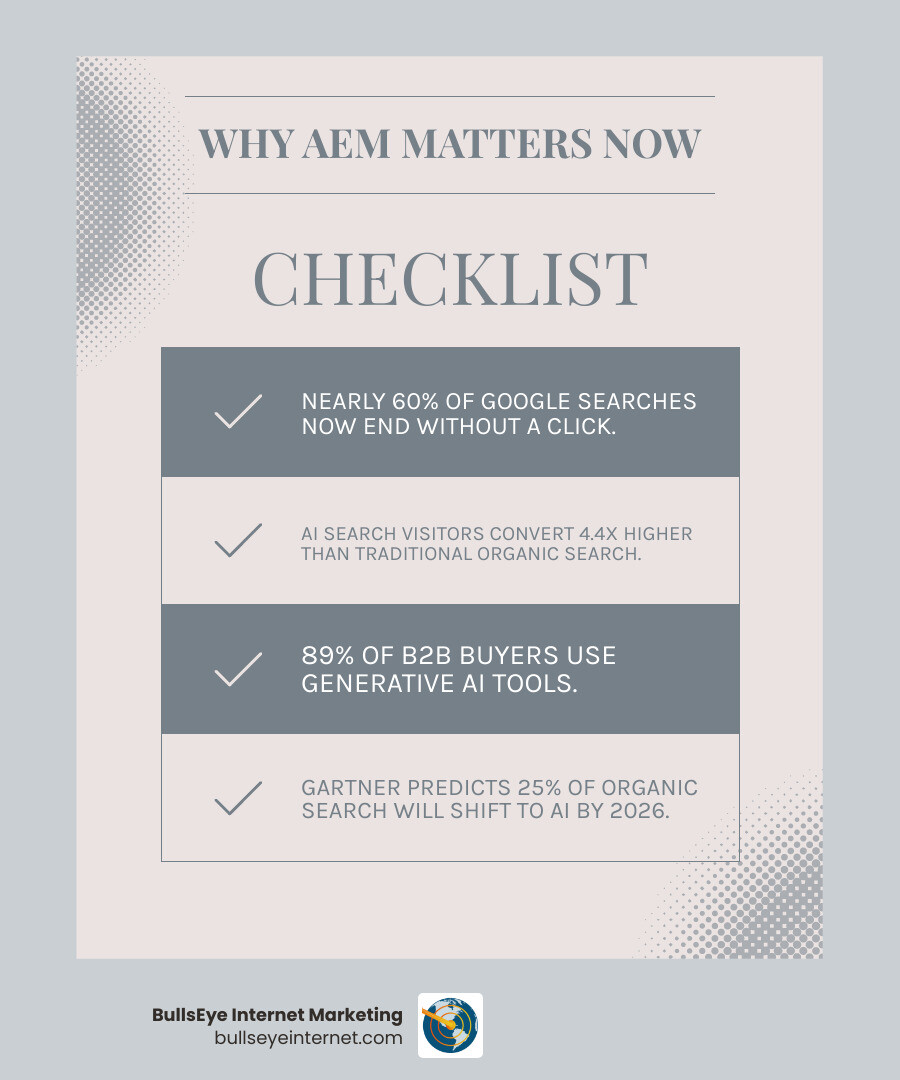
- Answer engines are replacing traditional search – Nearly 60% of Google searches now end without a click, as users get answers directly from AI summaries
- It’s driving higher-quality leads – AI search visitors convert at 4.4 times the rate of traditional organic search visitors
- Your competitors are already there – 89% of B2B buyers use generative AI tools at every stage of their purchase process
- It requires a different approach – You must structure content for AI extraction, not just keyword rankings
- The shift is accelerating – Gartner predicts 25% of organic search traffic will move to AI chatbots by 2026
The internet is going through its biggest shift since Google launched in 1998.
Search engines used to give you ten blue links. Now they give you answers—synthesized, conversational, and often without requiring a single click to your website.
For businesses frustrated by high acquisition costs, this might sound like another problem. But the reality is: businesses in AI answers are winning customers before traditional search results even load.
If you’re not optimizing for answer engines, you’re invisible to a rapidly growing segment of your market. Your competitors who are showing up in ChatGPT responses and Google’s AI Overviews are building trust and capturing leads while you’re stuck fighting for position #3 in traditional search results that fewer people even see.
I’m Ronnie Katz, and since 2006, I’ve helped businesses adapt to major shifts in online marketing. Answer engine marketing is the most significant opportunity I’ve seen in two decades for early adopters to gain a competitive advantage.
Answer engine marketing helpful reading:
The Shift from Search Engines to Answer Engines
Simply ranking high in search results is no longer enough. The digital landscape is shifting from traditional search to sophisticated answer engines. Driven by Artificial Intelligence (AI), this change redefines how users find information and how businesses must position themselves online.
Answer engine marketing (AEO) is the strategic practice of structuring your content so that AI-powered systems can easily extract, understand, and present it as authoritative answers. Unlike traditional Search Engine Optimization (SEO) Expert Guide which focuses on driving clicks to your website through ranked listings, AEO aims to get your content directly cited in AI responses, even in “zero-click” scenarios.
Consider platforms like Google AI Overviews, which summarize results at the top of the screen, or AI engines like ChatGPT and Perplexity, which are taking a significant share of searches. These tools don’t just provide a list of links; they synthesize information to give users direct answers. Our goal with AEO is to ensure AI systems consider our content and that the AI response includes favorable information about our company, names our brand, mirrors our positioning, or recommends solutions we offer.
The rise of “zero-click searches” perfectly illustrates this shift. More than half of all Google searches now end without the user clicking a traditional result link. Users are getting what they need directly from AI Overviews, featured snippets, or knowledge panels. This means if our content isn’t being directly surfaced, we risk becoming invisible to a large portion of our target audience.
User behavior has also shifted. People now ask full, conversational questions, partly due to the 8.4 billion digital voice assistants in use worldwide. AI algorithms use Natural Language Processing (NLP) to understand the intent behind a query, moving beyond simple keyword-matching. This demands content that answers questions clearly and concisely.
This isn’t just a fleeting trend; it’s the future. Gartner predicts that by 2026, 25% of organic search traffic will shift to AI chatbots and virtual assistants instead of traditional search clicks. This means that if we don’t adapt our strategies, we could see a significant drop in organic visibility.
Why AEO is Critical for Businesses in 2025
For businesses in competitive markets like Florida—from Miami to Jacksonville—AEO is a necessity. The landscape of customer acquisition is changing rapidly, and staying ahead means embracing these new realities.
The impact on B2B buyers is particularly striking. Seventy-two percent of B2B buyers now see Google AI Overviews, and according to Forrester’s Buyers’ Journey Survey, 2024, a staggering 89% of B2B buyers are using generative AI tools at every stage of the purchase process. This means our B2B clients in Florida are already using AI tools to research solutions and compare vendors. If our content isn’t optimized for these tools, we’re missing crucial opportunities to influence purchasing decisions.
While traditional organic traffic to publishers has decreased by as much as 55% due to generative AI search, the good news is that the traffic we do get from AI search is often of much higher quality. According to Semrush, AI search visitors convert at a rate 4.4 times higher than those from traditional organic search. This suggests that while overall traffic volume might shift, the value of each visitor from an answer engine is significantly greater. They are often more pre-qualified and further along in their buying journey.
This higher conversion rate highlights why answer engine marketing is so critical for brand visibility. Even if a user doesn’t click through immediately, being cited by an AI engine builds immense trust and authority. It positions our business as a recognized expert and reliable source of information. This trust can then lead to direct brand searches, referrals, and ultimately, conversions.
The shift to zero-click searches, where nearly 60% of searches end without a traditional result link being clicked, underscores this urgency. Users are getting immediate answers, and if our business isn’t providing those answers, a competitor likely is.
How AI Presents Search Results Differently
AI search engines fundamentally transform how information is presented to users. Unlike the familiar list of blue links, AI engines prioritize providing direct, synthesized answers.
Instead of a long list of ranked links, AI search engines like Google AI Overviews and ChatGPT present aggregated summaries. These summaries are compiled from multiple sources, offering a concise and comprehensive answer directly on the search results page. This means that instead of seeing ten different websites, a user might see a single, synthesized answer with a short list of citation links to the sources used.
The format is also much more conversational. AI search results often feel like a dialogue, responding to queries in natural language. This is thanks to advanced Natural Language Processing (NLP) capabilities, which allow AI algorithms to analyze the context and true intent behind a user’s query. The focus shifts from keyword matching to understanding the meaning of the question and providing the most relevant, helpful answer.
Here’s a quick comparison to illustrate the difference:
| Feature | Traditional Search | AI Answer Engine Results |
|---|---|---|
| Result Format | List of ranked links (blue links) | Aggregated summaries, direct answers, conversational text |
| User Interaction | Scan titles/descriptions, click to visit website | Consume answer directly, may or may not click citations |
| Source Attribution | Prominent display of source URL and title | Citations often smaller, sometimes embedded within text |
| Click-Through Rate | Higher emphasis on driving clicks to websites | Lower click-through rates as answers are provided directly |
The Core Components of a Winning Answer Engine Marketing Strategy
A successful answer engine marketing strategy requires a thoughtful approach. It’s not about abandoning SEO fundamentals but evolving them for AI-driven search. We must anticipate AI’s needs and structure our content accordingly.

Structuring Content for AI Findy and Citation
The way we structure content is paramount for AI findability, as AI systems scan for patterns and direct answers.
Prioritize concise answers (30-60 words) at the beginning of sections. Using the “inverted pyramid” style—leading with key information before expanding—makes it easy for AI to extract the core answer.
Optimizing for featured snippets and “People Also Ask” (PAA) boxes boosts AI citation chances, as these SERP features often serve as training data for AI Overviews. Structuring content with clear, question-based headings and providing direct, succinct answers increases the likelihood of appearing in these spots.
Google’s E-E-A-T guidelines (Experience, Expertise, Authoritativeness, and Trustworthiness) are more crucial than ever, as AI engines surface reliable information. Our content must show genuine expertise and be backed by credible sources. Research shows that content with citations, quotes, and statistics is 30-40% more visible in AI search results, reinforcing the need for well-researched content.
Incorporating dedicated FAQ sections is another powerful technique. By directly addressing common questions, we provide AI systems with clear, extractable question-and-answer pairs. For our local businesses in Florida, from Fort Lauderdale to Orlando, answering specific local questions can significantly improve local visibility in AI search. This is a key part of our Local SEO Agency Services You Need to Know About.
The Crucial Role of Structured Data (Schema Markup)
Beyond well-structured content, structured data (Schema.org markup) gives AI a clear signal about your content’s meaning. It’s like a cheat sheet for AI to understand your website.
Structured data is crucial for machine readability, explicitly telling AI what specific information represents. For example, Recipe schema tells an AI the ingredients and instructions, which it would otherwise have to guess.
The most common format is JSON-LD. There’s a full list of Google’s structured data markups here to leverage. For AEO, several schema types are particularly beneficial:
- FAQPage schema: Use on pages with question-and-answer pairs. While Google has limited visible FAQ rich results, this schema still helps AI understand your content.
- HowTo schema: Ideal for instructional content, marking each step, its position, and any associated images or warnings.
- Article schema: Tag editorial content with this, including headline, publish date, author, and organization to establish freshness and authority.
- Speakable schema: This highlights content suitable for text-to-speech conversion, perfect for voice search optimization.
For our clients using WordPress, our Custom WordPress Web Design Company services often include optimizing schema markup to ensure content is machine-readable and primed for answer engines.
Optimizing Technical and Authority Signals
Even perfectly structured content won’t get cited if the website isn’t technically sound or lacks authority. AI systems, like traditional search engines, favor high-quality, reliable sources.
Page speed is critical. Answer engines prioritize sites that load quickly. We aim for Core Web Vitals that pass Google’s thresholds: Largest Contentful Paint (LCP) under 2.5s, First Input Delay (FID) under 100ms, and Cumulative Layout Shift (CLS) under 0.1. This involves compressing images, minimizing render-blocking resources, and using efficient hosting.
Mobile-friendliness is non-negotiable. Websites must be fully responsive for users on mobile devices and interacting with voice assistants.
Internal linking helps AI understand content relationships, signaling topical authority and guiding crawlers. Strong internal linking creates a clear information hierarchy, making your content ecosystem more findable by AI.
Author signals are vital for E-E-A-T. Attributing content to knowledgeable authors with bios and credentials establishes expertise. Similarly, strong backlinks from reputable sites remain a powerful authority signal. We regularly conduct a Website Audit Services Guide 2025 to ensure all technical and authority signals are optimized for both traditional SEO and AEO.
Measuring Success and Adapting for the Future
Answer engine marketing is dynamic, so what works today may not work tomorrow. Continuous measurement and adaptation are key to success.

Measuring the Success of Your Answer Engine Marketing Efforts
Measuring AEO success requires new KPIs that reflect visibility within AI-driven results, going beyond traditional traffic metrics.
Key performance indicators for AEO include:
- Featured Snippet Appearances: Tracking wins for featured snippets and People Also Ask boxes.
- AI-Generated Answer Citations: Monitoring when your brand is cited in AI Overviews, ChatGPT, or other answer engines. Tools like HubSpot’s AI Search Grader can help assess visibility.
- Branded Search Volume Increase: An increase in AI visibility should lead to more direct brand searches.
- Conversion Rate from AI Traffic: AI search visitors convert at 4.4 times the rate of traditional organic search visitors. Tracking this is crucial for understanding AEO’s ROI.
- Structured Data Validation: Ensuring schema markup is correctly implemented and recognized.
For many of our Florida clients, a conversion is a phone call. That’s why we emphasize Call Tracking Services That Turn Every Ring Into Revenue as a vital part of measuring digital marketing success, including AEO.
Common Mistakes to Avoid in Your AEO Strategy
When implementing AEO, avoid common pitfalls that can waste resources and hinder progress in the AI-driven search landscape.
- Burying the Answer: Not providing concise, direct answers at the beginning of sections. AI needs to extract answers quickly; if the core information is hidden, it’s less likely to be cited.
- Keyword Stuffing: AI focuses on user intent, not just keyword density. Over-optimizing can sound unnatural and less credible to AI systems.
- Ignoring Structured Data: Skipping schema markup is a missed opportunity. It provides explicit signals that improve machine readability and extractability.
- Treating AEO as a One-Off Task: AEO is an ongoing process. AI algorithms, user queries, and competitor strategies constantly evolve, requiring continuous monitoring and refinement.
- Neglecting E-E-A-T: If content lacks demonstrable Experience, Expertise, Authoritativeness, and Trustworthiness, AI is less likely to cite it. Strong E-E-A-T signals are fundamental.
- Not Adapting to User Intent: AI excels at understanding user intent. If your content doesn’t truly answer the user’s underlying question, it won’t perform well.
Avoiding these pitfalls requires a strategic approach, which is why our expertise at BullsEye Internet Marketing is invaluable, as detailed in What Sets Expert SEO Consultants Apart From General Marketers.
The Future of AEO and AI-Driven Search
The future of answer engine marketing is one of continuous evolution. Several key trends will shape the landscape:
- Generative Engine Optimization (GEO): This involves influencing how generative AI models interpret and present content. GEO will work with AEO to create the content substrate for AI-generated answers.
- Increased Personalization: AI will deliver more personalized answers based on user history and context, requiring adaptable content.
- Multimodal Search: Search will increasingly incorporate images, video, and audio, requiring new optimization strategies.
- Ethical Considerations: As AI grows, concerns around attribution, misrepresentation, and data privacy will increase, demanding transparency in AEO strategies.
- Impact on PPC: The rise of AEO doesn’t diminish the importance of PPC: Pay-Per-Click Management. Paid ads remain vital for immediate, targeted traffic.
- Continuous Evolution: AEO is not a static strategy. Evolving AI models and search behaviors demand constant learning and adaptation from marketers.
Frequently Asked Questions about Answer Engine Marketing
How does AEO impact lead generation and conversion rates?
Answer engine marketing significantly impacts lead generation and conversions by delivering higher-quality leads, even if direct website traffic volume shifts.
When AI cites our content, users get a precise answer. This results in higher-intent, pre-qualified traffic if they click through. Having gained trust from the AI’s endorsement, these users are often ready for deeper engagement or a decision.
This direct answer approach also builds trust. When an AI system like Google AI Overviews or ChatGPT cites our business as an authority, it builds immense credibility and can lead to higher conversion rates. According to Semrush, AI search visitors convert at a rate 4.4 times higher than those from traditional organic search, a testament to the quality of leads from AEO.
For businesses in Florida, leveraging AEO attracts better visitors who are more likely to convert. Our Local Lead Generation Services Complete Guide integrates AEO principles to capture these high-value opportunities.
How can B2B marketers adapt their strategies for AI search?
B2B marketers in Florida face a unique opportunity with AI search. Since 89% of B2B buyers use genAI tools throughout the purchase process, adapting strategy is non-negotiable.
Here’s how B2B marketers can gain a competitive edge:
- Focus on Problem-Solving Content: B2B buyers have complex problems. Your content should directly address these pain points with clear, actionable solutions that AI can synthesize.
- Create Detailed Guides and Whitepapers: While AI gives concise answers, it draws from in-depth resources. Long-form content like guides and whitepapers serves as a rich source for AI to cite, establishing your authority.
- Target Long-Tail and Conversational Queries: B2B buyers use specific, conversational questions. Optimizing for these long-tail queries increases your chances of appearing in AI-generated answers.
- Use Data and Statistics Heavily: Content with citations, quotes, and statistics is 30-40% more visible in AI search. B2B content rich in data and case studies naturally aligns with this, helping AI validate your authority.
Forrester’s Buyers’ Journey Survey highlights the evolving nature of B2B purchasing. For startups in Florida, adapting to AI search early provides a significant advantage, as explored in our guide to B2B Startup Marketing.
How do you optimize for voice search and local AI queries?
Voice search and local AI queries are a growing search segment, especially for businesses serving specific areas like Fort Lauderdale or Jacksonville. Optimizing for these requires a specific approach.
- Accept Conversational Language: Voice queries are conversational. Your content should reflect natural speech patterns, answering questions as if speaking to a customer.
- Target Question-Based Keywords: People speak their questions (e.g., “What’s the best pizza place near me?”). Your keyword research must include these full questions.
- Use Speakable schema: This schema identifies content suitable for text-to-speech applications, making it easier for voice assistants to read your answers.
- Google Business Profile Optimization: For local AI queries, your Google Business Profile (GBP) is paramount. Ensure it’s fully optimized with accurate NAP information, services, hours, photos, and reviews, as AI relies heavily on GBP for local answers.
- Localized Content: Create content addressing local needs (e.g., “Top plumbing services in Boca Raton”). This signals local relevance to AI.
Our focus on local SEO for Florida businesses means we constantly refine these strategies. Understanding The ROI of Local SEO: Why It’s the Best Marketing Investment for 2025 underscores our commitment to helping clients dominate local AI search.
Get Ahead in the Age of AI Search
The shift to AI-driven search and answer engine marketing is not just a technological upgrade; it’s a fundamental change in how businesses connect with customers. For us at BullsEye Internet Marketing, this represents the most significant opportunity in decades to help our clients gain an unparalleled competitive advantage.
The future outlook for AEO is one of continuous innovation and increasing importance. As AI models become more sophisticated, personalization deepens, and multimodal search becomes standard, our strategies will need to evolve in lockstep. This demands continuous learning and a proactive approach, rather than a reactive one.
By embracing answer engine marketing now, businesses in Florida and across the US can secure their position as authoritative sources in their respective industries. This isn’t about chasing every shiny new tool; it’s about understanding the core principles of AI-driven information retrieval and structuring our digital presence to align with them.
We specialize in helping businesses steer these complex waters, turning the challenge of AI search into a powerful engine for lead generation and sales. Our commitment to no long-term contracts and working with only one client per industry per geographic area ensures that our focus is entirely on your success.
Don’t let the future of search leave your business behind. Contact Us today to learn more about how we can help you thrive in the age of AI. We invite you to learn more about our Answer Engine Optimization (AEO) services and find how we can transform your online visibility.
