
Why B2B Startup Marketing Is Different—And Harder Than You Think
B2B startup marketing is not just “marketing for businesses”—it’s a completely different game with its own rules, timelines, and challenges. Unlike consumer marketing, you’re not convincing one person to click “buy now.” You’re navigating a maze of multiple decision-makers, long sales cycles (often 3-6 months), and buyers who demand hard proof of ROI before they’ll even take a meeting.
Here’s what makes B2B startup marketing unique:
- Multiple stakeholders are involved in every purchase decision (average of 7 people)
- Sales cycles are long—buyers conduct an average of 12 online searches before engaging
- Trust is hard to build when you’re an unknown brand competing against established players
- Budgets are tight—you can’t outspend the competition, so you must outthink them
- Buying decisions are rational, not emotional—features don’t sell, business outcomes do
The good news? With the right strategy, startups can punch above their weight. This guide walks you through the proven framework: building a solid foundation, choosing the right channels, scaling smartly, and measuring what actually matters.
I’m Ronnie Katz, founder of BullsEye Internet Marketing, and I’ve spent over 20 years helping businesses—including B2B startups—cut through the noise and generate real revenue online. Throughout this guide, I’ll show you how to apply effective B2B startup marketing strategies that work even when you’re bootstrapped and unknown.
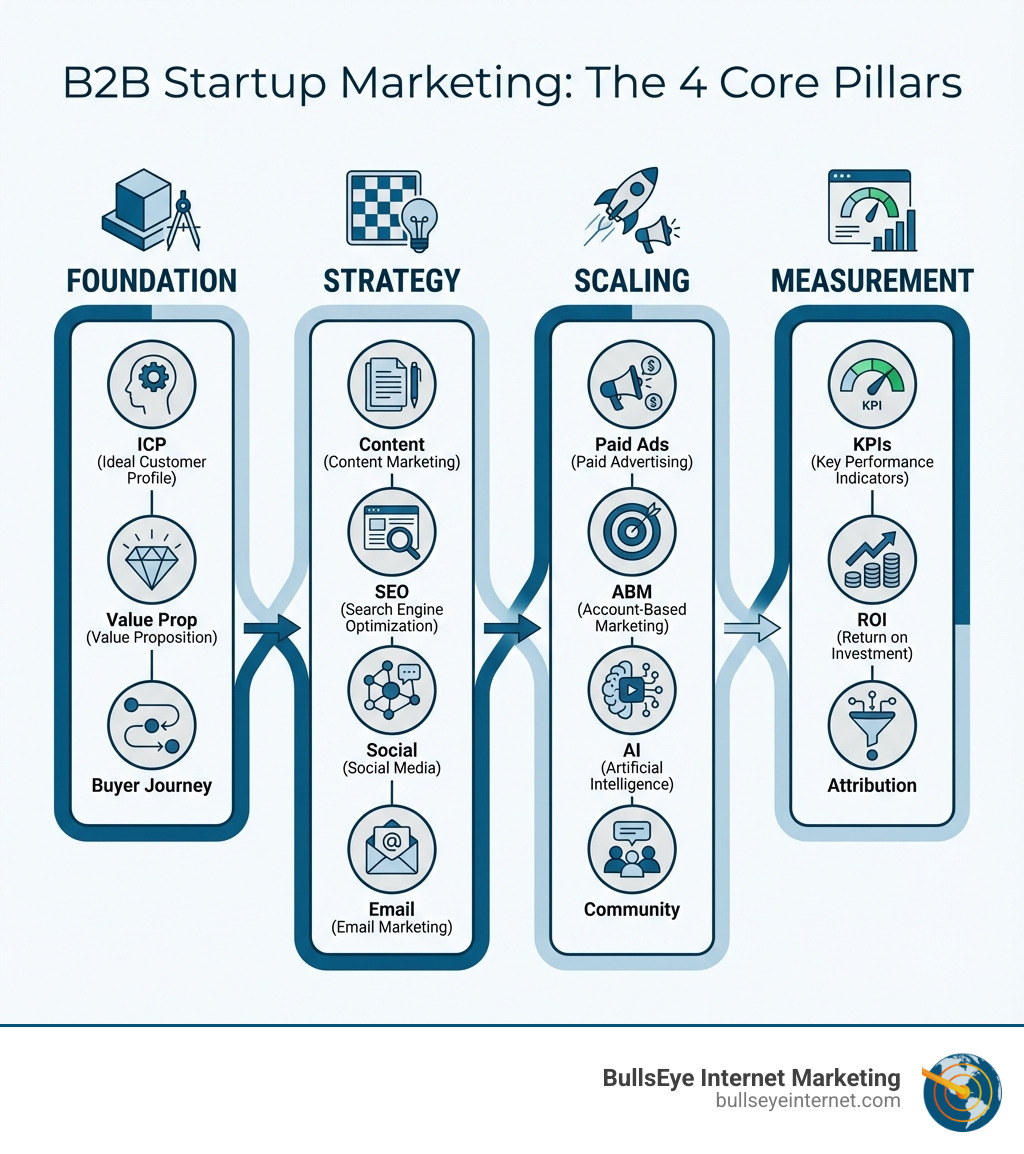
Let’s start with the foundation—because without it, every dollar you spend is a gamble.
The Foundation: Defining Your Strategy Before You Spend a Dollar
Before we even think about marketing tactics, we need a crystal-clear understanding of who we’re trying to reach and why they should care. This foundational work is often overlooked, but it’s the bedrock of successful B2B startup marketing. Without it, we’re just throwing darts in the dark.

Our primary goal here is to define our Ideal Customer Profile (ICP) and buyer personas. We’ll also craft a compelling value proposition and map out the B2B buyer’s journey. This helps us understand that for B2B, sales cycles are longer (often 3-8 months), involve multiple decision-makers (an average of seven people), and are driven by logic and ROI. Buyers are highly analytical and want data-driven proof before buying. This means our marketing needs to educate and convince businesses, focusing on detailed information, efficiency, and reliability, rather than quick transactions or emotional appeals.
An important distinction to make early on is between Demand Generation and Lead Generation. Lead generation is about capturing existing demand, often through forms and gated content. Demand generation, on the other hand, is about creating awareness and desire for our solution before a buyer is actively looking. For B2B startup marketing, demand generation is crucial because most buyers aren’t actively searching for a solution right away. We need to create the market, not just fill a pipeline with names. Buyers conduct an average of 12 online searches before engaging, and according to Forrester’s 2025 predictions, digital self-serve channels will dominate even large transactions, highlighting the importance of being visible and valuable early in their research.
How to Define Your Ideal Customer Profile (ICP)
Defining our Ideal Customer Profile (ICP) is about drilling down from broad ideas to specific, actionable insights. An ICP is a detailed description of the company that would benefit most from our product or service. This helps us focus our marketing and sales efforts on the most promising targets.
We start by analyzing firmographics: what’s the ideal company size, industry, location (like Florida, or the wider US, Canada, and UK markets we serve), and revenue? But we don’t stop there. We also look at technographics (what technology stack do they use?), their common pain points, and their typical buying behavior.
For example, instead of broadly targeting “healthcare organizations,” we’d refine it to “mid-sized provider practices (5–15 members) struggling with delayed reimbursements and denial backlogs that want to streamline their medical billing process using automated AR workflows.” This level of specificity ensures our messaging resonates deeply. We can gather this data by analyzing our best early customers, reviewing CRM data, and utilizing analytics tools to understand who is already finding value in our solution.
Creating a Value Proposition That Resonates
Once we know who we’re talking to, we need to articulate why they should choose us. Our value proposition needs clarity over cleverness. It’s not about listing features; it’s about focusing on the benefits and the tangible ROI our solution delivers. B2B buyers value clarity above cleverness in messaging.
We need to address specific pain points that our ICP faces, highlight what makes us different from competitors, and back up our claims with data or social proof. According to Gartner, buyers are far more likely to engage with vendors who demonstrate a strong understanding of their business needs and challenges, not just those who talk about product features. Our value proposition needs to prove we “get” their problems and have the best solution. A strong value proposition builds credibility with risk-averse B2B buyers, which is especially important for a startup.
Building Your Engine: Essential B2B Startup Marketing Channels
With our foundation firmly in place, it’s time to build the engine that will drive our B2B startup marketing efforts. This involves strategically leveraging key digital marketing channels that are proven to work in the B2B space.
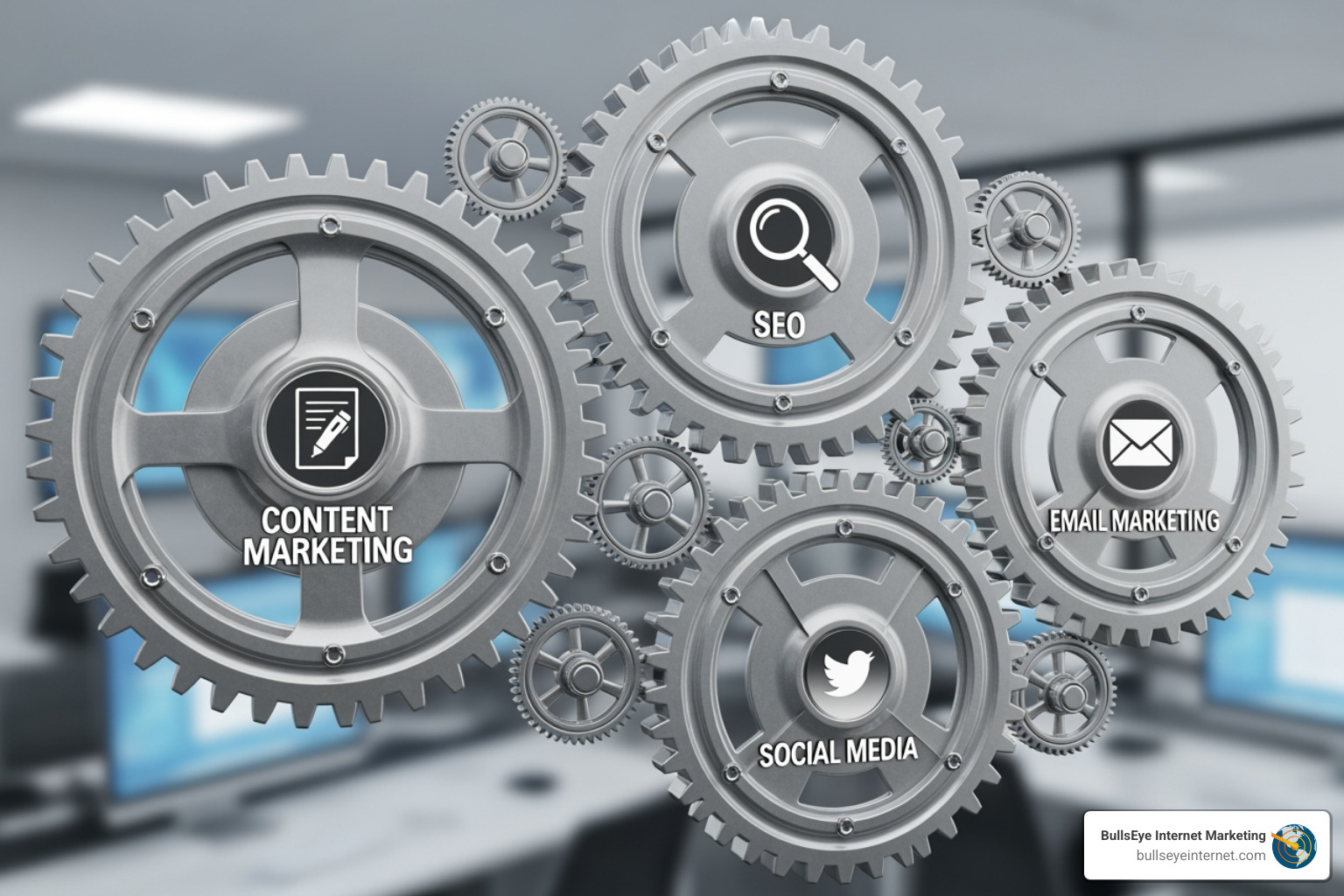
The most effective digital marketing channels for B2B startups include:
- Content Marketing: Building thought leadership and attracting leads.
- SEO (Search Engine Optimization): Improving organic visibility and findability.
- Social Media Marketing: Especially LinkedIn, for brand building and lead generation.
- Email Marketing: For lead nurturing and building relationships.
Content Marketing: Fueling the Entire Buyer’s Journey
Content marketing is the backbone of any successful B2B startup marketing strategy. It’s how we build trust, demonstrate expertise, and guide potential buyers through their complex journey. We’re talking about an educational ecosystem, not just a few blog posts.
Effective content types for B2B startups include:
- Blog Posts: Educational articles addressing pain points and answering common questions.
- Case Studies: Showcasing real-world results and ROI for satisfied customers.
- White Papers & Ebooks: In-depth resources that establish thought leadership.
- Webinars & Online Workshops: Interactive sessions for deeper engagement and lead generation.
- Original Research: Studies and reports that position us as industry experts.
- Demo Videos & Explainer Clips: Visual content to illustrate product value and functionality.
We create “pillar pages” and “topic clusters” to provide comprehensive coverage of key themes relevant to our audience. This not only establishes us as a go-to resource but also significantly boosts our SEO. A smart move is to repurpose content across multiple formats. For example, a successful webinar can be turned into several blog posts, infographics, and short social media clips. Publishing original research can lead to significantly higher traffic, as studies indicate sites publishing original research see ~30% higher traffic.
The key is to focus on user intent, not just chasing fresh keyword volume. Each piece of content should educate our audience and guide them closer to understanding how our solution fits their needs.
SEO and Social Media: Getting Found and Building Credibility
If we can’t be found, we don’t exist. That’s where SEO and strategic social media come in for B2B startup marketing.
SEO (Search Engine Optimization) is fundamental. With buyers conducting an average of 12 online searches before engaging, we need to ensure our website ranks high for relevant keywords. This involves:
- Keyword Research: Identifying the terms our ICP uses when searching for solutions.
- On-Page SEO: Optimizing our content, headings, and meta descriptions with these keywords.
- Technical SEO: Ensuring our site is fast, mobile-friendly, and easily crawlable by search engines.
- Backlink Building: Earning links from reputable sites to boost our domain authority.
Social Media Marketing, particularly on platforms like LinkedIn, is indispensable for B2B. It’s not just for sharing cat videos; it’s a powerful tool for professional networking, brand building, and lead generation. A significant 75% of B2B buyers check social media during their decision process.
Our LinkedIn strategy should include:
- Company Pages: Consistent posting of valuable content, industry insights, and company news.
- Employee Advocacy: Encouraging our team, especially founders, to share their expertise and insights. This builds trust and extends our reach.
- Community Engagement: Participating in relevant LinkedIn groups and industry forums, offering value and answering questions.
- Showcasing Social Proof: We can even embed a social media feed on our website that highlights authentic posts, customer feedback, or event updates, turning static pages into living proof of our community engagement.
By combining robust SEO with a strategic social media presence, we ensure our startup is not only findable but also credible and engaging in the eyes of potential business buyers.
Scaling for Growth: Advanced Tactics and Smart Investments
Once we’ve established our foundation and built our core marketing engine, it’s time to think about scaling. This is where advanced tactics and smart investments come into play, allowing our B2B startup marketing efforts to accelerate efficiently.
For a startup with limited resources, this isn’t about spending big; it’s about spending smart. We focus on strategies that offer high ROI and precision targeting. This includes:
- Paid Advertising (PPC): Leveraging platforms like Google Ads and LinkedIn Ads for targeted reach and lead generation.
- Account-Based Marketing (ABM): A highly targeted approach for high-value accounts.
- AI and Marketing Automation: Streamlining processes and personalizing at scale.
- Community-Led Growth: Building a loyal tribe of users and leveraging user-generated content.
Leveraging Paid Ads and ABM on a Startup Budget
Paid advertising can give our B2B startup marketing efforts a significant boost, even with a limited budget. The key is to focus on intent, not just reach. We start small, test rigorously, and scale what works.
For PPC (Pay-Per-Click), we’ll look at:
- Google Ads: Capturing demand from businesses actively searching for solutions. We focus on long-tail keywords with high commercial intent.
- LinkedIn Ads: Best for B2B targeting based on job title, industry, company size, and specific companies. While often more expensive per click, the quality of leads can be much higher.
- Retargeting: Showing ads to people who have already visited our website. This is a cost-effective way to stay top-of-mind and nurture warm leads, as buyers need to see us 7+ times before they remember us.
We measure our Cost Per Lead (CPL) religiously and only scale campaigns that demonstrate a positive ROI.
Account-Based Marketing (ABM) is a game-changer for startups targeting high-value accounts. Instead of casting a wide net, ABM treats each target company as its own market, personalizing our outreach and content. Industry surveys show ~67% of B2B companies use ABM, and 81% report higher ROI from ABM than other tactics.
For ABM on a startup budget, we will:
- Identify Key Accounts: Focus on a small number of companies that perfectly fit our ICP and have the highest potential value.
- Research & Personalize: Deeply understand their specific challenges, goals, and decision-makers.
- Coordinated Outreach: Deliver highly personalized messages and content across multiple channels (email, LinkedIn, targeted ads) to key stakeholders within those accounts.
- Tools: Use platforms like LinkedIn Sales Navigator to pinpoint decision-makers and Apollo to manage outreach.
Integrating AI and Community into Your B2B Startup Marketing
The future of B2B startup marketing is increasingly intertwined with technology and authentic human connection.
AI and Marketing Automation are no longer luxuries; they are necessities for efficiency and personalization. Around 45% of B2B marketers plan to increase investment in AI tools for personalization and lead scoring. We can integrate AI to:
- Content Repurposing: Automatically turn long-form content into social media snippets, email summaries, or different formats.
- Chatbots: Provide instant support and answer common questions on our website, qualifying leads 24/7.
- Workflow Automation: Automate routine tasks like email sequences, lead scoring, and CRM updates, freeing up our team for more strategic work and relationship building. Companies using field service management software, for example, automate scheduling, invoicing, and communication workflows, allowing teams to focus more on customer relationships and less on repetitive admin tasks.
- Personalization: Deliver customized experiences to buyers based on their behavior and preferences. According to McKinsey, companies that personalize their buyer experience see up to a 20% increase in conversion rates and higher customer satisfaction scores.
Community-Led Growth builds trust and advocacy organically. This involves:
- Building a Tribe: Creating spaces (e.g., LinkedIn groups, Slack channels) where our users and prospects can connect, share insights, and get support.
- User-Generated Content (UGC): Encouraging customers to share their experiences, case studies, and testimonials. This is incredibly powerful because buyers trust other buyers more than our sales deck.
- Founder-Led Thought Leadership: Our founders sharing insights and engaging directly with the community builds immense credibility.
Startups like Notion have demonstrated how empowering users and fostering community can drive explosive growth with minimal direct marketing spend. By automating the mundane and investing in authentic community, we can scale our impact without necessarily scaling our budget.
Measuring Success and Overcoming Common Problems
In B2B startup marketing, what gets measured gets managed. We need to continuously track our progress, understand what’s working (and what’s not), and adapt our strategies accordingly. This data-driven approach helps us overcome common challenges and ensure our investments yield real returns.
Key Metrics and KPIs (Key Performance Indicators) are our compass. For B2B, we prioritize pipeline-focused KPIs over vanity metrics.
| Vanity Metrics (Often Misleading) | Business Metrics (What Truly Matters) |
|---|---|
| Website Traffic | Lead-to-Customer Conversion Rate |
| Social Media Likes/Followers | Sales-Qualified Leads (SQLs) |
| Impressions | Customer Acquisition Cost (CAC) |
| Page Views | Lifetime Value (LTV) |
| Content Downloads (Ungated) | Pipeline Velocity |
| Marketing-influenced Revenue |
We need to align our marketing metrics with sales outcomes. This means focusing on metrics like lead-to-customer conversion rate, sales-qualified leads (SQLs), customer acquisition cost (CAC), and lifetime value (LTV). Measuring the velocity of leads, not just the volume, gives us a better understanding of our sales pipeline health.
Common Challenges B2B startups face in marketing:
- Limited Budget and Team: We counteract this by focusing on high-ROI, inbound strategies and efficient use of automation.
- Building Brand Trust: Essential for B2B. We build credibility through thought leadership, consistent value delivery, and showcasing social proof.
- Standing Out in a Crowded Market: A compelling value proposition and niche specialization help us differentiate.
- Aligning Marketing & Sales: Regular communication and shared goals ensure both teams are working towards the same revenue targets. Tools that connect marketing and sales, like HubSpot or Apollo, automatically sync lead behavior, ensuring both sides act on the same data.
To effectively measure and optimize our B2B startup marketing efforts, we rely on a robust tech stack:
- Google Analytics: An essential tool for measuring and analyzing our site traffic, user behavior, and conversion funnels. Google Analytics 4 provides a free yet powerful foundation for tracking website performance.
- CRM Data: Our Customer Relationship Management system (like HubSpot or Salesforce) is critical for tracking leads through the sales pipeline and understanding their journey from prospect to customer.
- Attribution Tools: Solutions like Dreamdata specialize in B2B revenue attribution, connecting marketing activities to pipeline and revenue across long and complex sales cycles.
By consistently tracking these metrics, analyzing performance data, and making agile adjustments, we can ensure our B2B startup marketing investments are driving tangible business growth.
Frequently Asked Questions about B2B Startup Marketing
We often hear similar questions from founders navigating the complexities of B2B startup marketing. Let’s address some of the most common ones.
What is the difference between lead generation and demand generation?
This is a crucial distinction in B2B startup marketing.
Lead Generation: This focuses on capturing existing demand. Think of it as putting out a net to catch fish that are already swimming by. Tactics include gated content (like an ebook download form), direct response ads, and product-pitching webinars. The goal is to get contact information for immediate sales follow-up. While it can generate quick leads, these often have lower buying intent and require significant nurturing.
Demand Generation: This is about creating awareness and desire for our solution before a buyer is actively looking. It’s like teaching people about the benefits of eating fish and inspiring them to seek out a fishing trip. Tactics include thought leadership content, educational webinars (ungated), community engagement, and brand building. The goal is to make buyers know, trust, and think of us first when they eventually realize they have a problem we can solve.
For startups, demand generation is crucial because it builds a long-term pipeline and positions us as a trusted authority. It creates a market, not just fills a pipeline with names. While lead generation has its place for capturing high-intent prospects, a strong demand generation strategy ensures sustainable growth.
How long is a typical B2B sales cycle?
The typical B2B sales cycle is significantly longer than B2C, averaging around three to eight months. However, this can vary wildly depending on the price, complexity of the solution, and the number of decision-makers involved. We’ve seen cycles extend to years for enterprise-level deals.
A key factor contributing to this length is the sheer number of people involved in the decision. The average B2B buying decision involves an average of seven people. Each of these stakeholders has different priorities, concerns, and needs for justification. Our B2B startup marketing strategies must account for this by providing relevant content and messaging for each stage of their collective journey.
How can startups build trust in a competitive B2B market?
Building trust is paramount for any B2B startup, especially when competing against established players. It’s not about who shouts the loudest; it’s about being genuine, consistent, and delivering value. Here’s how we can build that trust:
- Consistency in Messaging and Content: Ensure our brand voice, values, and solution benefits are consistent across all touchpoints. This builds familiarity and reliability.
- Demonstrating Expertise through Thought Leadership: We position ourselves as experts in our field by creating high-quality, educational content (blogs, whitepapers, webinars) that solves our audience’s problems.
- Showcasing Social Proof: Nothing builds trust like hearing from satisfied customers. We actively collect and promote customer reviews, testimonials, and detailed case studies that highlight real-world results.
- Transparency in Communication: Be open and honest about what our product can and cannot do. Avoid overpromising and under-delivering.
- Leveraging the Personal Brands of Founders on Platforms like LinkedIn: Founders and key team members sharing insights, engaging in discussions, and offering value on LinkedIn can build immense personal credibility that extends to the company. This founder-led thought leadership can reach audiences resistant to traditional marketing and builds trust that extends to the product.
By focusing on these areas, we can systematically build credibility and trust, turning skeptical prospects into loyal customers.
Conclusion: Your Path to Sustainable B2B Growth
Cracking the code of B2B startup marketing requires a strategic, patient, and adaptable approach. We’ve explored the essential pillars: laying a solid foundation by understanding our ICP and value proposition, building a robust engine with content, SEO, social media, and email, scaling smartly with targeted paid ads, ABM, AI, and community, and finally, measuring what truly matters to ensure continuous improvement.
Sustainable growth comes from clarity, connection, and consistency. It’s about knowing who you’re for, building genuine relationships, and showing up reliably with value. At BullsEye Internet Marketing, we understand the unique challenges startups face in the United States, Canada, and the UK, including the vibrant markets of Florida. We specialize in helping businesses like yours turn strategy into sales, providing a competitive advantage with no long-term contracts and an exclusive focus on one client per industry per geographic area.
Ready to accelerate your growth and dominate your niche? Explore our paid ad management services to get expert help in generating the calls and sales you need to thrive. Let’s build your success story together.
