
Why Your Backlink Profile Needs a Workout
A back link audit is a systematic review of all websites linking to yours. It identifies toxic links that could harm your rankings, uncovers opportunities for new quality backlinks, and ensures your link profile supports your SEO efforts. Here’s what it accomplishes:
Quick Answer: What a Backlink Audit Does
- Identifies toxic links – Spots spammy, manipulative, or low-quality backlinks that could trigger Google penalties
- Prevents ranking drops – Finds and removes harmful links before they damage your search visibility
- Uncovers opportunities – Reveals link-building strategies your competitors use successfully
- Recovers lost links – Identifies broken or lost backlinks you can reclaim
- Improves site authority – Strengthens your overall link profile by focusing on quality over quantity
Backlinks remain the second most important ranking factor for Google, right after content. But here’s the catch: not all backlinks help you. Some actively hurt your rankings. If you’re frustrated by stagnant or declining search visibility despite your marketing efforts, your backlink profile might be the culprit.
Think of your link profile like a business reputation. Every backlink is essentially another website vouching for you. Quality endorsements from respected industry sites boost your credibility. But links from spammy, irrelevant, or suspicious sites? They’re like negative reviews that make Google question whether to trust you at all.
A toxic link profile can:
- Trigger manual penalties from Google
- Suppress your organic rankings
- Waste the value of your quality content
- Cost you leads and revenue
The good news? A thorough backlink audit gives you a clear roadmap to fix these issues and identify new opportunities to build authority in your industry.
I’m Ronnie Katz, and since 2006 I’ve been helping businesses recover from toxic backlink profiles and build healthier link strategies through comprehensive back link audit services at BullsEye Internet Marketing. Over two decades of experience has shown me that most businesses have no idea what’s linking to them—or how much those links impact their bottom line.
Back link audit vocab explained:
Foundations: Understanding Backlinks and Their Impact
Imagine your website as a busy storefront in West Palm Beach. Every time another business refers a customer to your store, that’s like a backlink. The more reputable the referring business, the more trust that referral carries. In the digital world, backlinks are essentially “votes of confidence” from one website to another.

A backlink, also known as an external link, inbound link, or incoming link, is simply a hyperlink from one website to another. For example, if a local news site in Miami-Dade County links to your business’s blog post about community events, that’s a backlink for your site. The total number and, crucially, the quality of these backlinks pointing to your website form your overall backlink profile, which directly influences your domain’s authority and its ability to rank in search engines.
Why are backlinks so important for SEO? Google’s algorithms consider them a critical factor in determining a website’s trustworthiness and authority. When a high-quality, relevant website links to yours, it signals to Google that your content is valuable and credible. As Google itself states, having quality links to your site is paramount. The more high-quality backlinks you have, the higher your website is likely to rank in search results.
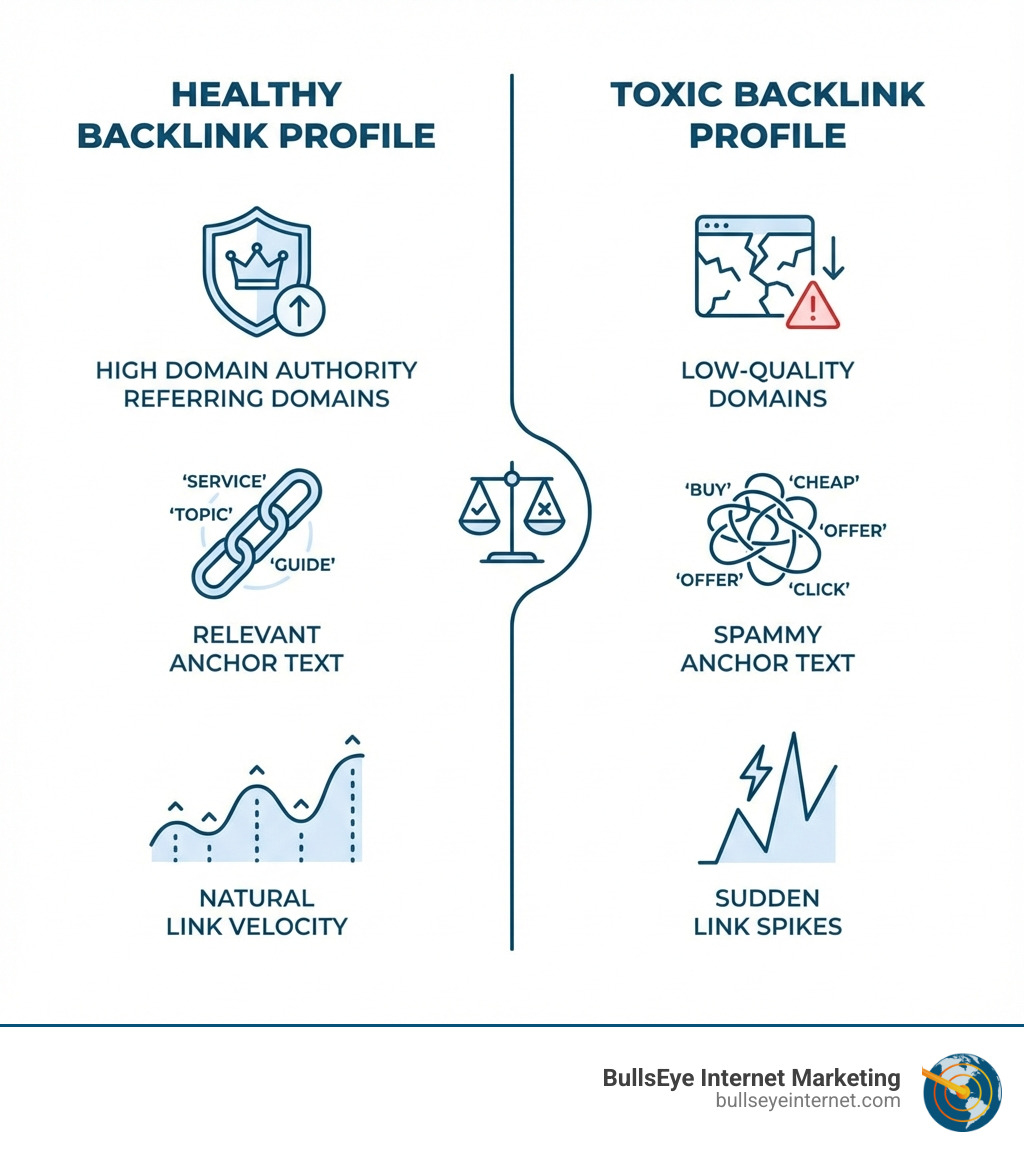
However, not all backlinks are created equal. Just as a referral from a shady character might hurt your reputation, a “toxic backlink” can actively harm your website’s SEO. Toxic backlinks are low-quality, spammy, or manipulative links that violate Google’s Webmaster Guidelines. These might come from:
- Irrelevant websites
- Sites with low authority or spam scores
- Private Blog Networks (PBNs)
- Automated link schemes
- Websites infected with malware
- Sites using deceptive anchor text practices
Spammy links can lead to search engine penalties, negatively impacting your visibility and potentially suppressing your organic rankings. This is why a proactive approach to your link profile is essential. Our philosophy at BullsEye Internet Marketing, as outlined in Link Building Services Explained: Why Quality Matters Over Quantity, is always to prioritize quality over sheer volume.
Key Metrics for Your Back Link Audit
To truly understand the health of your backlink profile during a back link audit, we need to look at specific metrics that paint a clear picture:
- Domain Authority (DA): Developed by Moz, this is a proprietary score (on a 1-100 scale) that predicts how well a website will rank in search engine results. It’s a leading indicator for search visibility improvements and helps us assess the overall strength of a linking domain. Higher DA is generally better.
- Domain Rating (DR): A similar metric from Ahrefs, DR also measures the strength of a website’s backlink profile on a 1-100 scale. It’s another excellent way to gauge the authority of domains linking to you and your competitors.
- Spam Score: Moz’s Spam Score is a quick way to assess how “spammy” a site’s backlink profile is, based on features common among banned or penalized sites. It’s expressed as a percentage:
- 1%-30% is considered a Low Spam Score.
- 31%-60% is considered a Medium Spam Score.
- 61%-100% is considered a High Spam Score.
- Toxicity Score: Semrush offers a Toxicity Score, which measures the risk of a particular backlink using a 100-point scale from 0 (not suspicious) to 100 (very suspicious). This score considers over 45 different “Toxic Markers” that Semrush identifies. An overall Toxicity Score is calculated for your entire profile:
- Low if lower than 3% of toxic backlinks.
- Medium if the percentage is 3%-9%.
- High if there are more than 10% of toxic backlinks.
- Referring Domains: This metric tells us the number of unique websites (domains) that are linking to your site. A diverse range of high-quality referring domains is a strong positive signal.
- Anchor Text Analysis: Anchor text is the visible, clickable text in a hyperlink. Analyzing the distribution of anchor text is crucial. An unnatural or over-optimized anchor text profile (e.g., too many exact-match keywords) can be a red flag for Google, potentially indicating manipulative link building. We look for a natural mix of branded, naked URL, generic, and keyword-rich anchors.
- Dofollow vs. Nofollow Links: These attributes tell search engines how to treat a link.
- Dofollow links (the default) pass “link equity” or “link juice” from the linking site to your site, directly influencing your rankings. These are generally the most valuable for SEO.
- Nofollow links (and newer attributes like
sponsoredorugcfor user-generated content) tell search engines not to pass equity. While they don’t directly boost rankings, they can still drive referral traffic and contribute to a natural-looking backlink profile.
Essential Backlink Audit Tools
Performing a thorough back link audit requires robust tools to gather and analyze vast amounts of data. While we leverage a suite of industry-leading software, here are some essential tools that provide invaluable insights:
- Google Search Console: This is our first stop, as it provides direct data from Google itself. It reveals how many backlinks are pointing to your site, the anchor text used, and your most linked pages. It’s the most accurate source for understanding how Google views your site’s links.
- Ahrefs: Arguably offering the most comprehensive array of backlink audit features, Ahrefs provides in-depth information about your backlink profile, including the number of referring domains, your Domain Rating (DR), and extensive data on competitor links.
- Moz: Moz offers a reliable link checker, an easy-to-use interface, and its proprietary Domain Authority (DA) and Spam Score. The Spam Score, as we discussed, is a quick way to assess how spammy a site’s backlink profile is.
- Semrush: Semrush boasts a powerful one-click backlink audit tool that automatically compiles and surfaces relevant backlink information. Its Toxicity Score, based on 45+ Toxic Markers, is a fantastic feature for identifying risky links. It can gather information on up to 500 links from a single referring domain.
- Majestic: Known for its extensive link index and proprietary metrics like Trust Flow and Citation Flow, Majestic provides an idea of how Google looks at a website’s overall site authority.
- SpyFu: A good alternative for competitive analysis, providing insights into competitor backlink profiles.
At BullsEye Internet Marketing, we often combine data from several of these tools to get the most complete and accurate picture of your backlink profile, ensuring no stone is left unturned.
Your Step-by-Step Guide to a Comprehensive Back Link Audit
A back link audit isn’t just a technical exercise; it’s a strategic deep dive into your website’s online reputation. This section provides a complete walkthrough of the audit process, from data collection to taking action. It’s a core part of any SEO Audit Service.

Step 1: Gather and Analyze Your Backlink Data
The first step in any effective back link audit is to collect all the raw data. We need to see every link pointing to your site, good or bad.
- Export Backlink Data from Multiple Tools: We start by exporting backlink data from Google Search Console, Ahrefs, Moz, and Semrush. Each tool has its own unique index and metrics, so combining them gives us the most comprehensive dataset. For instance, Semrush allows importing files up to 50 MB, ensuring we can handle extensive link profiles.
- Compile a Master List: Once we have exports from various sources, we compile them into a single master spreadsheet. This allows us to deduplicate links and ensure we have every known inbound link in one place for analysis.
- Initial Review of Referring Domains: We begin by looking at the sheer volume of referring domains. A high number is generally good, but we immediately start scanning for obvious red flags:
- Are there many links from irrelevant niches (e.g., gambling sites linking to a medical practice in Broward County)?
- Are there domains with suspiciously low authority scores or foreign Country Code Top-Level Domains (ccTLDs) that don’t match your target audience (unless you operate globally)?
- Identifying Top-Linked Pages: We analyze which pages on your website attract the most backlinks. This helps us understand what content resonates and naturally earns links. This insight is invaluable for future content creation and link-building strategies. For example, if a specific local guide for Coconut Creek is highly linked, we know that type of content performs well.
Step 2: Assess Backlink Quality and Identify Toxic Links
Now, the real detective work begins. We move beyond raw numbers to evaluate the quality and potential risk of each backlink. This is where your back link audit truly earns its stripes.
- Evaluating Referring Domain Relevance: Does the linking website make sense for your business? A link from a local Chamber of Commerce in Doral is highly relevant for a Miami business, but a link from a distant, unrelated blog is less so, and potentially harmful if it’s low quality.
- Checking Spam Score and Toxicity Score: We use the metrics provided by tools like Moz (Spam Score) and Semrush (Toxicity Score) to quickly flag potentially problematic links. We look at individual links and the overall profile. An Overall Toxicity Score that is High (more than 10% toxic backlinks) or even Medium (3-9%) is a serious concern. Semrush’s tool sorts toxic backlinks by Toxicity Score, helping us prioritize.
- Spotting Link Schemes: We carefully look for patterns indicative of manipulative link-building tactics, such as:
- Links from Private Blog Networks (PBNs)
- Excessive guest posts on low-quality, article-farm type sites
- Paid links (which violate Google’s guidelines)
- Comment or forum spam
- Analyzing Anchor Text Distribution: We examine the anchor text used for your backlinks. A natural profile has a diverse mix of:
- Branded: “BullsEye Internet Marketing”
- Naked URL: “bullseyeinternet.com”
- Generic: “click here,” “read more”
- Long-tail/Compound: “best SEO services in South Florida”
- Exact match: “SEO audit”
Over-optimization with too many exact-match keywords can signal manipulation to Google.
- List of Toxic Link Warning Signs: Here’s a quick checklist of what we look for:
- Links from spammy, low-quality sites (e.g., gambling, adult, payday loans, or completely irrelevant niches).
- Links from websites that are clearly not indexed by Google.
- Sites with known malware or security warnings.
- A sudden, unexplained influx of many low-quality links (a sign of negative SEO).
- Links from foreign-language sites that have no relevance to your audience or business in Florida.
- Links embedded in HTML frames which are less common and can sometimes be suspicious.
- Links with over-optimized, exact-match keyword anchor text.
- Links from private blog networks (PBNs) or other artificial link schemes.
Step 3: The Disavow Process for Harmful Backlinks
Once we’ve identified toxic links, we need to take action. This often involves the disavow process, a crucial step in any comprehensive back link audit.
- When to Disavow: Disavowing links is a powerful tool, but it should be used judiciously. We typically consider disavowing when:
- Links are clearly manipulative, spammy, or unnatural.
- You’ve received a manual penalty from Google related to unnatural links.
- You suspect a negative SEO attack.
- You’ve attempted to contact the linking webmaster for removal, but they haven’t responded or complied.
- Link Removal Outreach vs. Disavowing: Our first approach is always to try and get the link removed manually. We reach out to the webmaster of the linking site, politely explaining why the link is problematic and requesting its removal. Semrush’s tool, for example, allows us to connect an email account and send up to 500 outreach emails per day. If outreach is unsuccessful or impractical (e.g., for thousands of spammy links), then we move to disavowing.
- Creating a Disavow File: After careful consideration, we compile a list of the specific URLs or entire domains we want Google to ignore. This list is formatted as a plain text (.txt) file. Tools like Semrush can automatically generate this file based on the links we’ve marked for disavowal.
- Submitting to the Google Disavow Tool: Finally, we upload this .txt file to the Google Disavow Tool. This tells Google, “Hey, we don’t endorse these links, please don’t count them when evaluating our site.” Disavowing doesn’t remove the link; it simply asks Google to disregard its impact on your rankings.
Step 4: Find and Reclaim Lost or Broken Backlinks
A back link audit isn’t just about playing defense; it’s also about reclaiming lost opportunities and maximizing your existing link equity.
- Identifying 404 Errors with Inbound Links: Over time, pages on your site might be moved, deleted, or their URLs changed, leading to “404 Not Found” errors. However, some of these broken pages might still have valuable backlinks pointing to them. Our audit identifies these 404 pages that are still receiving inbound links.
- Using 301 Redirects: For these broken pages with existing backlinks, we implement 301 redirects. A 301 redirect is a permanent redirect that tells search engines (and users) that a page has moved to a new location. This ensures that the “link juice” from the inbound backlink is passed to a relevant, live page on your site, preserving its SEO value.
- Contacting Webmasters to Fix Broken Links: Sometimes, other websites might be linking to a page on your site that no longer exists or has moved, resulting in a broken link on their site. We can identify these instances and reach out to the webmasters of those sites, informing them of the broken link and politely suggesting they update it to the correct, active URL on your site. This is a win-win: they fix a broken link on their site, and you reclaim a valuable backlink.
- Recovering Lost Link Equity: By fixing 404 errors with inbound links and correcting external broken links, we reclaim lost link equity. This ensures the effort put into earning those backlinks continues to benefit your site’s authority and rankings, rather than being wasted.
Beyond Cleanup: Analysis and Opportunity Finding
A back link audit isn’t just about defense; it’s a powerful tool for offense and a key component of a full Website SEO Audit. Once we’ve cleaned up your existing link profile, we turn our attention to leveraging these insights for future growth.
How to Analyze Your Industry’s Back Link Landscape
To truly dominate your market, whether you’re a local business in Palm Beach County or serving all 50 USA States, we need to understand the competitive backlink landscape.
- Identifying Industry Trends: We analyze the types of websites that typically link within your industry. Are they industry associations, news sites, blogs, or educational institutions? This helps us understand the natural flow of links and identify valuable sources.
- Reviewing Authoritative Sites in Your Niche: We identify the top-ranking, most authoritative websites in your specific niche. By examining their backlink profiles, we can see who links to them, what content attracts those links, and what their overall link-building patterns look like. This provides a blueprint for success.
- Understanding Common Link Building Strategies in Your Field: Using tools, we can see how your competitors are acquiring their backlinks. Are they actively engaged in guest posting? Do they have valuable resource pages that attract links? Are they getting mentions in local news in Fort Lauderdale? This helps us refine our own Link Building strategies to be more effective and competitive.
Uncovering New Link Building Opportunities
A cleaned-up backlink profile acts as a strong foundation, but the real growth comes from strategically building new, high-quality links. Your back link audit provides a treasure trove of opportunities.
- Finding Content Gaps: By analyzing competitor backlink profiles, we often find content topics or formats that attract many links, but which your site currently lacks. These are prime content gaps we can fill to earn new links.
- Identifying Linkable Assets: What unique value does your business offer? This could be original research, comprehensive guides, free tools, infographics, or local data. These are “linkable assets” that other websites will naturally want to reference and link to. For example, a local real estate agency in Broward County could create an in-depth guide to local housing market trends, attracting links from other local businesses or news outlets.
- Replicating Successful Strategies: If we see that a competitor is consistently getting links from a specific type of website (e.g., industry directories, review sites, local business roundups), we can target those same types of sources to secure similar backlinks for your site.
- Guest Posting Opportunities: Guest posting on relevant, authoritative websites remains a highly effective way to earn high-quality backlinks. Your audit helps us identify sites that link to your competitors or are active in your niche, making them ideal targets for guest contributions.
- Top 10 Link Building Strategies: We constantly evaluate and implement the most effective tactics. For a deeper dive into modern approaches, explore our insights on Top 10 Link Building Strategies for 2024: What Works and What Doesn’t.
Frequently Asked Questions about Backlink Audits
How often should I perform a backlink audit?
The frequency of a back link audit depends on several factors, including the size and age of your website, the competitiveness of your industry, and the intensity of your link-building efforts. However, as a general guideline, we recommend performing a comprehensive audit:
- At least quarterly or semi-annually: For most businesses, conducting a thorough audit every 3 to 6 months is a good practice to maintain a healthy link profile.
- More frequently after a major link building campaign: If you’ve recently engaged in aggressive link building, a more frequent check (e.g., monthly) can help ensure the quality of newly acquired links.
- Immediately if you suspect a negative SEO attack: A sudden drop in rankings or an unusual spike in low-quality links detected by your monitoring tools warrants an immediate audit.
- After a Google algorithm update: Major updates (like Penguin, which targeted spammy links) can sometimes reveal issues in your link profile that weren’t previously penalized.
Regular audits are crucial because your backlink profile is dynamic—links can be gained, lost, or even turn toxic over time.
What is a “good” Spam Score or Toxicity Score?
Understanding these scores is key to interpreting your back link audit results:
- Spam Score (Moz): As mentioned earlier, a Spam Score of 1%-30% is considered a Low Spam Score. Ideally, you want your overall profile to be in this range. A score above 30% indicates increasing risk.
- Toxicity Score (Semrush): This score helps us analyze the presence of suspicious links. An overall Toxicity Score is considered Low if there are fewer than 3% of toxic backlinks. It’s Medium if the percentage is between 3%-9%, and High if it exceeds 10%. While we aim for a low overall score, it’s important to focus on the individual link toxicity. One very suspicious link can be more damaging than several mildly suspicious ones.
These are proprietary metrics from different tools. They serve as valuable indicators, but the ultimate assessment also involves our expert human review to understand the context of each link.
Can I ignore bad backlinks?
While Google’s algorithm has become increasingly sophisticated at identifying and devaluing spammy links, it’s a myth to think you can simply ignore bad backlinks without consequence.
- Google’s algorithm is better, but not perfect: Yes, Google is smarter now. It can often ignore blatantly manipulative links without penalizing your site directly. However, it’s not foolproof. Some still get through, and a high volume of low-quality links can still suppress your rankings, even without a formal penalty.
- A high percentage of toxic links is still risky: If a significant portion of your backlink profile consists of toxic or spammy links, it signals to Google that your site might be engaging in manipulative practices or, at the very least, isn’t diligent about its online reputation. This can lead to suppressed rankings, making it harder for your quality content to shine.
- Proactive management is the safest approach: We believe in proactive management. Cleaning up your backlink profile shows Google you’re committed to quality and adhere to their guidelines. This builds trust and ensures your site isn’t held back by past mistakes or malicious attacks. Leaving spammy links as is might be acceptable if the percentage is small and the site is still generating traffic, but for sustained long-term success, proactive management is always the best practice.
Whip Your SEO Into Shape
In the changing landscape of digital marketing, a healthy backlink profile is not just an advantage—it’s a necessity. A comprehensive back link audit is your secret weapon, allowing you to identify and neutralize threats while simultaneously uncovering powerful opportunities for growth. It’s a cornerstone of effective SEO, ensuring your website builds authority, earns trust, and consistently ranks for the searches that matter most to your business in Florida and beyond.
At BullsEye Internet Marketing, we understand the critical role backlinks play in your online success. We’ve been helping businesses in Broward County, Miami-Dade County, Palm Beach County, and across the USA, cultivate robust, penalty-proof backlink profiles for over two decades. Our expertise ensures that your website isn’t just surviving in search results, but thriving.
For a professional analysis of your site’s strengths and weaknesses, and to truly understand how a meticulous back link audit can transform your online presence, consider a comprehensive SEO Audit with us. Let’s whip your SEO into shape and drive the calls and sales your business deserves!
