
SEO Helps Customers Find Your Business Without Paying for Every Click
SEO, or search engine optimization, is the work of making your website easier for search engines and people to understand. It helps your pages appear in organic search results when potential customers look for the products, services, or answers you provide.
Effective SEO is not a shortcut to the top of Google. It combines useful content that matches search intent, a technically healthy website that search engines can crawl, and credible signals such as relevant links and brand mentions. Done well, it can create a steady source of qualified traffic, calls, and sales without charging you for each visitor.
Search has changed fast, from keyword-based results to AI-generated answers and more personalized results. The core principle has not changed: create pages that genuinely help people, make them easy to access, and give search systems clear reasons to trust them.
I am Ronnie Katz, founder and Principal CEO of BullsEye Internet Marketing, with more than 20 years of online marketing experience and SEO work dating back to 2006. In this guide, I will break down the practical SEO fundamentals that support measurable visibility, leads, and growth.
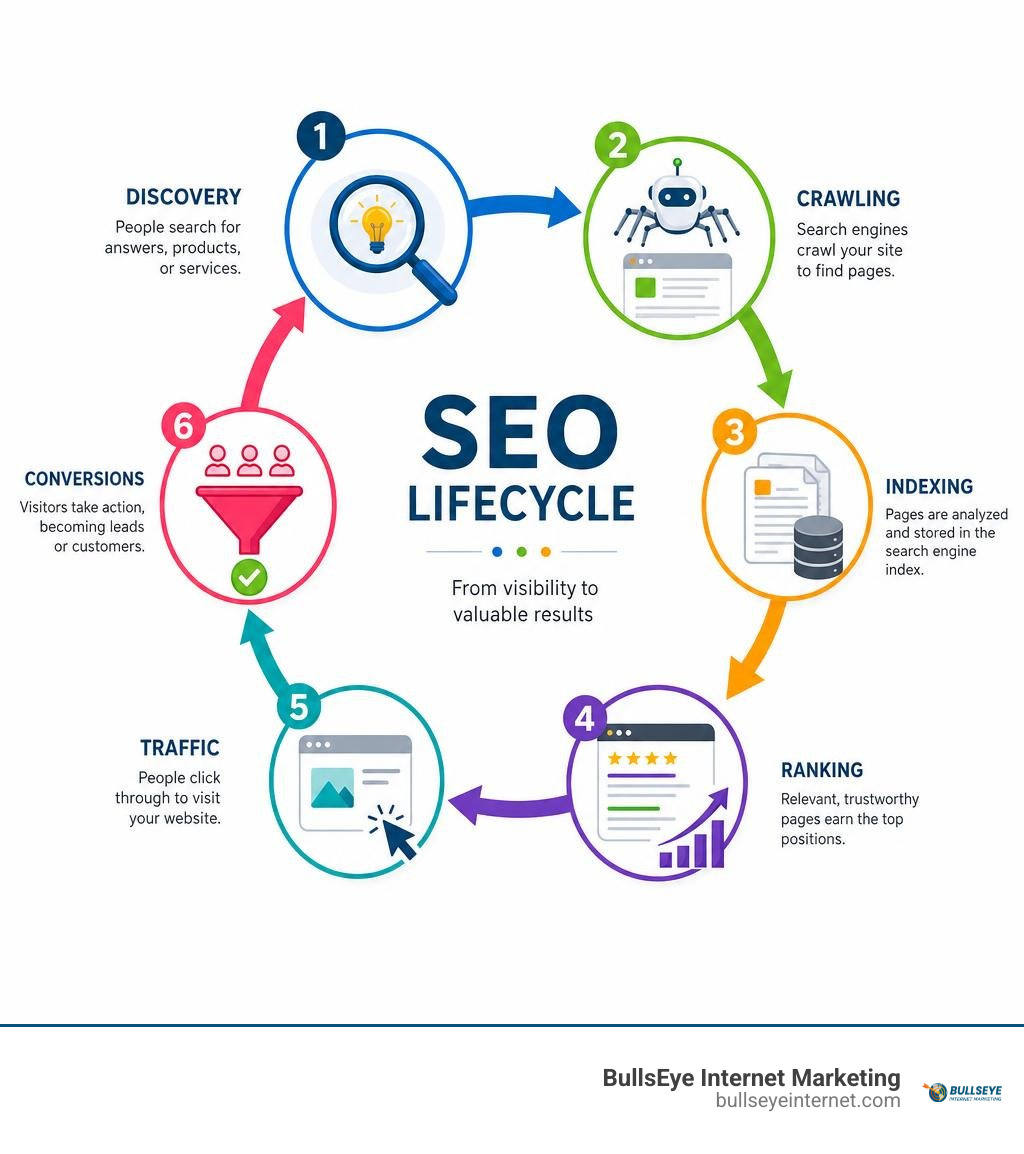
Common SEO vocab:
What Is SEO and Why Does It Matter for Modern Websites?
Organic search remains the undisputed backbone of online traffic. Billions of searches happen daily, and organic searches drive the majority of website traffic across nearly every major industry. When users have a problem, need a local service, or want to purchase a product, their journey almost always begins in a search box.
The primary goal of search engine optimization is to position your digital assets directly in front of active searchers. Unlike outbound marketing, which interrupts people with display banners or cold calls, search optimization delivers high-intent inbound prospects who are already hunting for what you provide. Gaining top organic placement establishes immediate brand credibility; users inherently trust the non-paid results Google selects as the top answers to their queries.
Understanding the historical foundation of organic discovery helps clarify why modern algorithms behave the way they do. As outlined in this Search engine optimization historical overview, the discipline originated in the mid-1990s as a basic effort to categorize directories and manipulate simple meta keywords. Today, search engines have evolved into sophisticated semantic systems powered by machine learning and entity analysis.
If you are launching a new enterprise or refreshing an older website, getting these fundamentals straight from day one prevents costly technical debt. We recommend reviewing The Ultimate SEO Starter Guide for New Businesses to set realistic benchmarks and build a sturdy digital footprint.
| Feature / Metric | Organic Search (SEO) | Paid Search (PPC) | Search Engine Marketing (SEM) |
|---|---|---|---|
| Direct Cost | Free per click; requires investment in content and technical infrastructure | Pay-per-click model; cost incurred every time an ad is clicked | Combined budget covering both organic strategies and paid advertising |
| Placement Speed | Compound growth taking weeks to months to achieve steady ranking | Instant visibility on top ad placements upon campaign activation | Hybrid: immediate paid placement alongside gradual organic growth |
| Traffic Longevity | Sustainable, ongoing traffic that remains even when active work pauses | Traffic stops entirely the moment ad spend or daily budget runs out | Sustained base of organic traffic supplemented by targeted paid bursts |
| Click-Through Trust | Higher organic trust; users frequently skip past sponsored tags | High commercial intent, but subject to ad blindness from some users | Maximizes total screen real estate across sponsored and organic tiers |
How Search Engines Crawl, Index, and Rank Webpages
Search engines perform four discrete technical tasks before displaying a webpage to a user: discovering, crawling, rendering, and indexing.
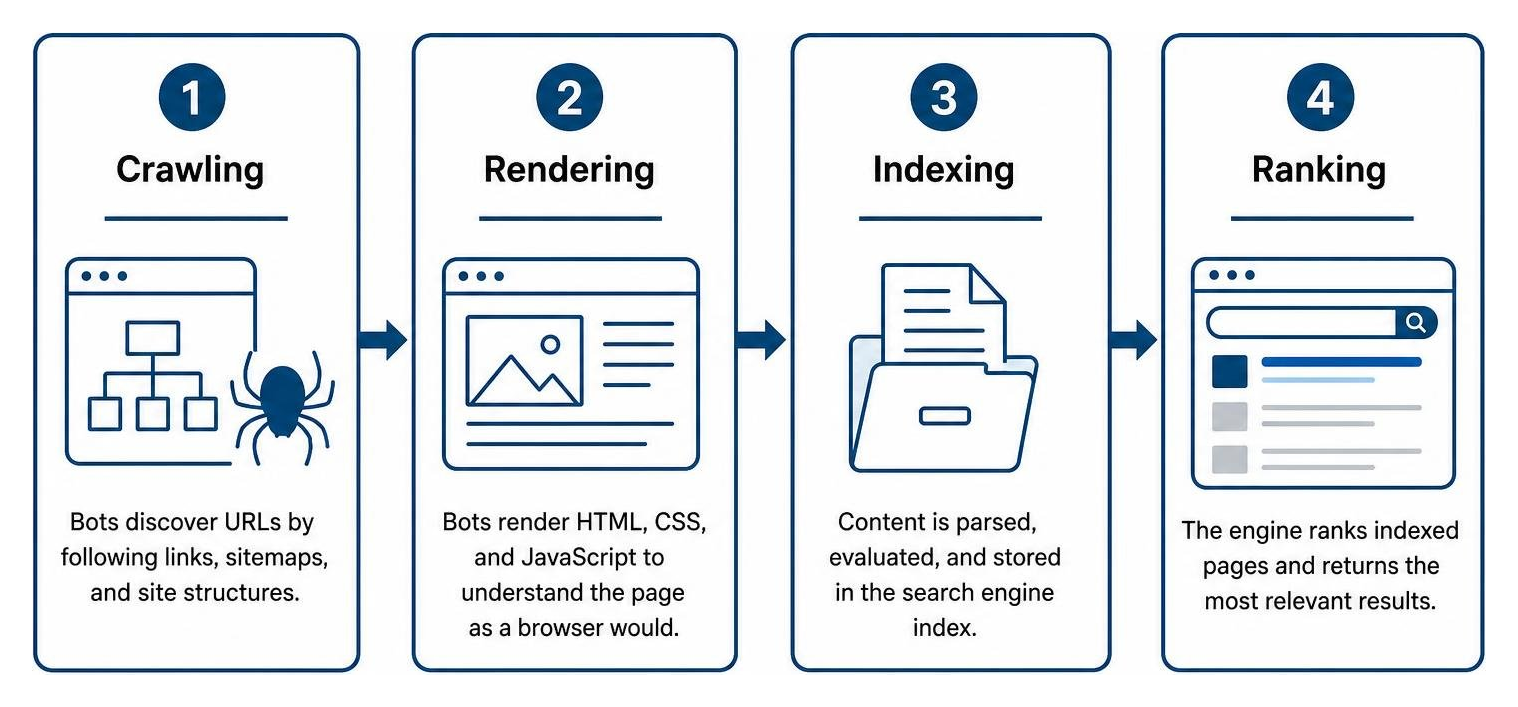
- Crawling (Discovery): Search engines use automated programs—frequently called bots or spiders (such as Googlebot)—to explore the web. Bots discover new and updated URLs by following hyperlinks from known pages, scanning submitted XML sitemaps, and reading site structures. If a page has no incoming links or is blocked by directives, the bot cannot discover it.
- Rendering: Once the crawler accesses a page, it processes the underlying code (HTML, CSS, and JavaScript). Modern bots render pages much like an actual browser to understand how elements visually appear and interact. If key text or links are locked behind uncrawlable scripts, the search engine misses the context entirely.
- Indexing: After rendering, the engine parses the content, images, videos, and semantic structure. It evaluates whether the content is unique, valuable, and compliant with quality guidelines, then stores that processed information inside a massive database known as the index. If your page fails to provide sufficient unique value, or contains duplicate content without canonical directives, the bot may choose not to index it.
- Ranking: When a user types a query, the search engine scans its indexed database to return the most relevant, authoritative answers. Ranking algorithms calculate hundreds of signals—including query relevance, technical speed, user experience, backlink authority, and geographic proximity—in milliseconds.
As explained in the official Google Search Central documentation on search fundamentals, search engines do not charge fees to crawl or rank web pages; everything earned in organic search is decided by algorithmic evaluation of quality and relevance. To identify any underlying crawl barriers or indexing roadblocks holding your site back, our comprehensive SEO audit guide provides an actionable step-by-step diagnostic workflow.
Organic Search vs. Paid Advertising (SEM and PPC)
While both organic search and paid advertising share the search engine results page (SERP), they operate under completely different economic and strategic models.

Search Engine Marketing (SEM) is an umbrella term encompassing both organic optimization (SEO) and paid acquisition channels like Pay-Per-Click (PPC). PPC platforms allow advertisers to bid on specific commercial keywords, placing sponsored text ads above, below, or alongside organic results. PPC delivers immediate traffic, making it exceptional for testing offer conversions, launching flash sales, or filling lead pipelines while organic rankings mature.
However, PPC carries a continuous marginal cost: the moment you stop funding the ad budget, your lead flow drops to zero. Organic search, by contrast, behaves like an equity investment. The effort you put into building exceptional cornerstone content, fixing technical architecture, and earning authoritative citations builds long-term domain authority. Over time, organic search delivers a dramatically lower cost per acquisition (CPA) and sustainable return on investment. The smartest marketing programs utilize PPC for immediate commercial capture while simultaneously building organic authority to capture non-paid search volume over the long haul.
The Core Pillars of Effective Search Optimization
A successful organic campaign operates much like a high-performance vehicle: content provides the engine power, technical infrastructure builds the sturdy chassis, and off-page authority provides the fuel that drives it forward. Neglecting any single pillar undermines overall performance.
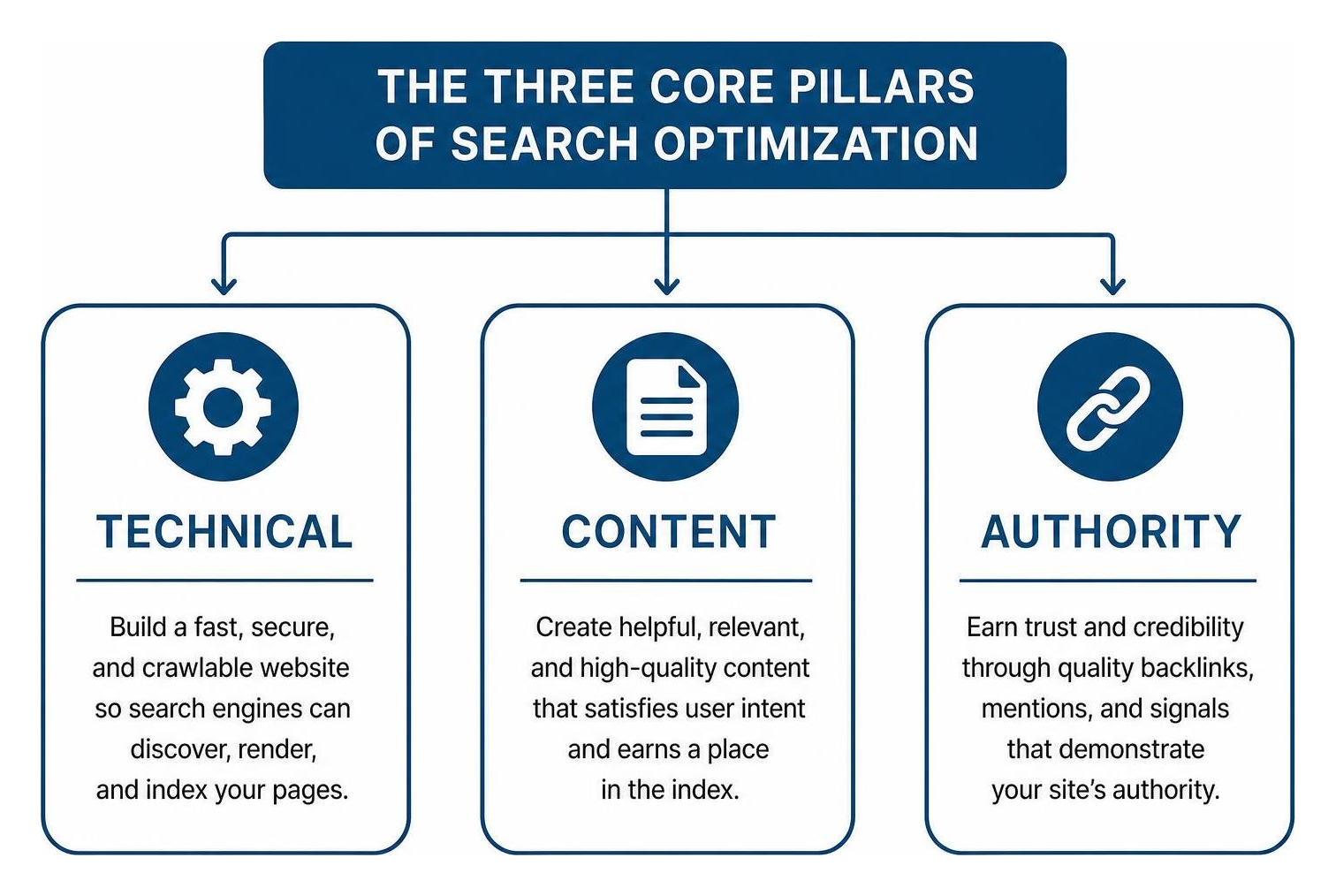
Implementing proven steps to improve website SEO requires balancing all three pillars rather than focusing exclusively on one tactic.
Mastering On-Page Elements and Content Quality
On-page optimization involves refining the visible text and underlying HTML source code of individual pages to satisfy user intent and demonstrate topical relevance.
- Keyword Research and Search Intent: Modern keyword research goes beyond finding high-volume phrases; it requires matching user intent. Search intent falls into four primary buckets: informational (“how does technical crawling work”), navigational (“BullsEye Internet Marketing contact”), commercial investigation (“best SEO tools compared”), and transactional (“hire Florida SEO agency”). Content must directly solve the specific problem the user searched for without fluff.
- Title Tags and Meta Descriptions: Your title tag is one of the strongest on-page ranking signals. Keep it under 60 characters, place primary keywords toward the front, and craft a compelling hook. Meta descriptions do not act as direct ranking signals, but an engaging description under 155–160 characters acts as ad copy that dramatically lifts organic click-through rates (CTR).
- Logical Header Structure (H1, H2, H3): Use a single, descriptive H1 tag per page, followed by an organized hierarchy of H2 and H3 subheadings. This helps both readers and bots scan the flow of information smoothly.
- Content Depth and Semantic Entities: Search engines rely on natural language processing to identify topical relationships between words. Utilizing semantic search optimization practices allows you to cover sub-topics, synonyms, and related entities thoroughly, establishing deep topical authority rather than repeating a single phrase.
- Image and Media Optimization: Visual media keeps users engaged. Ensure all image files are compressed (using modern formats like WebP), feature descriptive file names, and include concise image alt text to improve accessibility and image search indexing.
Building Authority with Off-Page Signals
Off-page optimization focuses on actions taken outside your own website to impact your trustworthiness, reputation, and prominence across search systems.
- Backlink Profiles and Domain Authority: When an external website links to your page, search engines interpret that link as a vote of confidence. Backlink quality significantly outweighs pure volume. A single link from an established, topically relevant educational, government, or high-authority industry domain carries exponentially more algorithmic weight than dozens of low-tier directory links.
- Digital PR and Brand Mentions: Earning genuine press coverage, participating in industry podcasts, publishing original data research, and securing expert mentions all build natural link equity. Unlinked brand mentions also signal to modern search algorithms that your business is an active, recognized authority in its market.
- Local Signals and Citation Management: For regional enterprises, off-page prominence relies heavily on structured citations (matching Name, Address, and Phone number across directories like Google Business Profile, Apple Maps, and Yelp). Deploying specialized local search optimization services ensures local citation consistency, driving high-intent local phone calls and showroom visits.
Technical Infrastructure and Site Performance
Technical SEO ensures that search engine bots can access, crawl, interpret, and index your digital pages without encountering structural errors.
- Site Architecture and URL Hierarchy: Organize pages into logical directories (for example,
/services/seo/) and maintain a shallow click-depth where every critical page is accessible within three clicks of the homepage. URLs should be clean, lowercase, and descriptive. - Mobile-First Indexing and Responsive Design: Since late 2016, when mobile devices surpassed 50% of global web browsing (StatCounter tracked 51.3% of pages loading via mobile in October 2016), search engines predominantly use the mobile version of a site’s content for indexing and ranking. Sites must feature fully responsive design, responsive images, and unobstructed mobile navigation.
- Core Web Vitals and Page Speed: Google evaluates real-world user experience metrics, including Largest Contentful Paint (LCP for loading speed), Interaction to Next Paint (INP for responsiveness), and Cumulative Layout Shift (CLS for visual stability). Pages that load within 2 seconds exhibit significantly higher user engagement and conversion rates.
- Robots.txt, Canonical Tags, and XML Sitemaps: Maintain a clean
robots.txtfile to prevent bots from wasting crawl budget on private admin directories or internal search results. Implementrel="canonical"tags to resolve duplicate content across parameter URLs, and submit structured XML sitemaps directly through Google Search Console. - Structured Data (Schema Markup): Adding Schema.org JSON-LD microdata helps search engines understand specific content types—such as FAQs, reviews, local business details, and articles—allowing your listings to win rich snippets in search results.
To thoroughly assess these infrastructural elements, our guide on evaluating website technical health walks you through auditing your server response headers, crawl paths, and indexing efficiency.
Strategic Approaches and Emerging Search Technologies
Search engine optimization is not static. Back in 2010, Google rolled out over 500 algorithm updates in a single year—averaging nearly 1.5 adjustments per day. Today, machine learning algorithms adapt continuously. Staying visible requires adhering to ethical guidelines while adopting emerging search technologies.
To stay ahead of algorithmic changes, explore the forward-thinking framework in our Next-Gen SEO framework guide.
White-Hat vs. Black-Hat SEO Practices
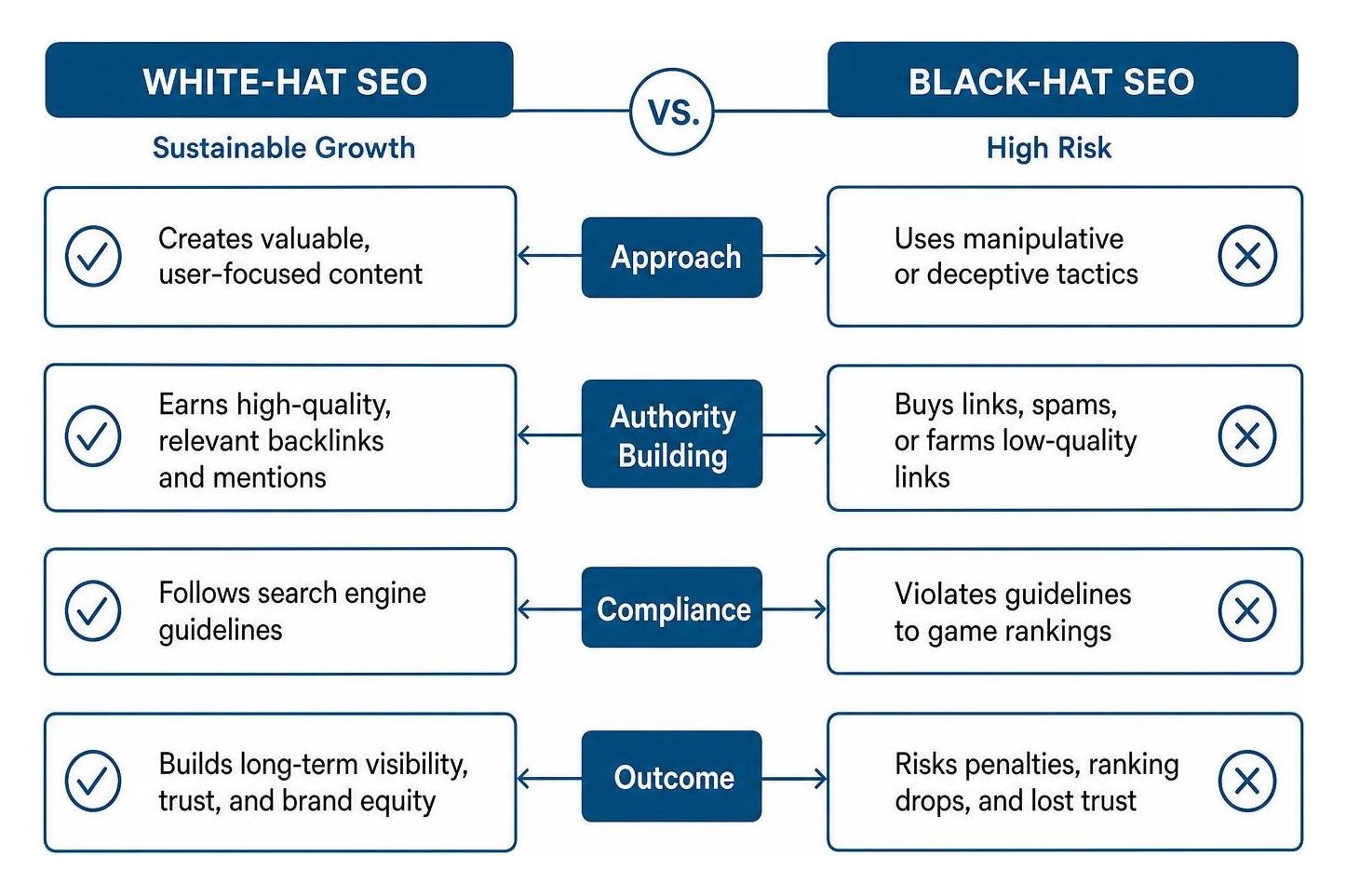
The SEO industry is divided into distinct operational methodologies based on compliance with search engine webmaster guidelines:
- White-Hat SEO: Ethical, sustainable practices designed around human users. White-hat tactics focus on creating valuable, original content, optimizing site architecture for fast page loads, earning natural editorial backlinks, and ensuring accessibility. While white-hat approaches require time and disciplined execution, they deliver durable, long-term rankings immune to sudden manual spam penalties.
- Black-Hat SEO: Deceptive, high-risk tactics engineered to manipulate search algorithms for quick, unearned ranking spikes. Black-hat methods include keyword stuffing, hidden text, doorway pages, cloaking (showing different content to search bots than to human visitors), private blog networks (PBNs), and buying bulk automated links.
The consequences of black-hat tactics are severe. Search engines regularly issue algorithmic filters and manual actions that de-index offending domains entirely, wiping out revenue overnight. Historically, even major corporations like BMW Germany and Ricoh Germany faced temporary total removal from Google’s index after utilizing deceptive doorway pages.
- Grey-Hat SEO: Tactics that skirt the edge of published guidelines without triggering explicit algorithmic violations—such as aggressive link acquisition or repurposed expired domains. While tempting, grey-hat tactics carry lingering risk whenever core updates roll out.
Generative Search Engines and Modern SEO Architecture
The search landscape is experiencing a massive evolution with the arrival of artificial intelligence, Answer Engine Optimization (AEO), and Generative Engine Optimization (GEO). Search engines now integrate generative models (such as Google’s AI Overviews) that synthesize answers directly at the top of search result pages for conversational queries.
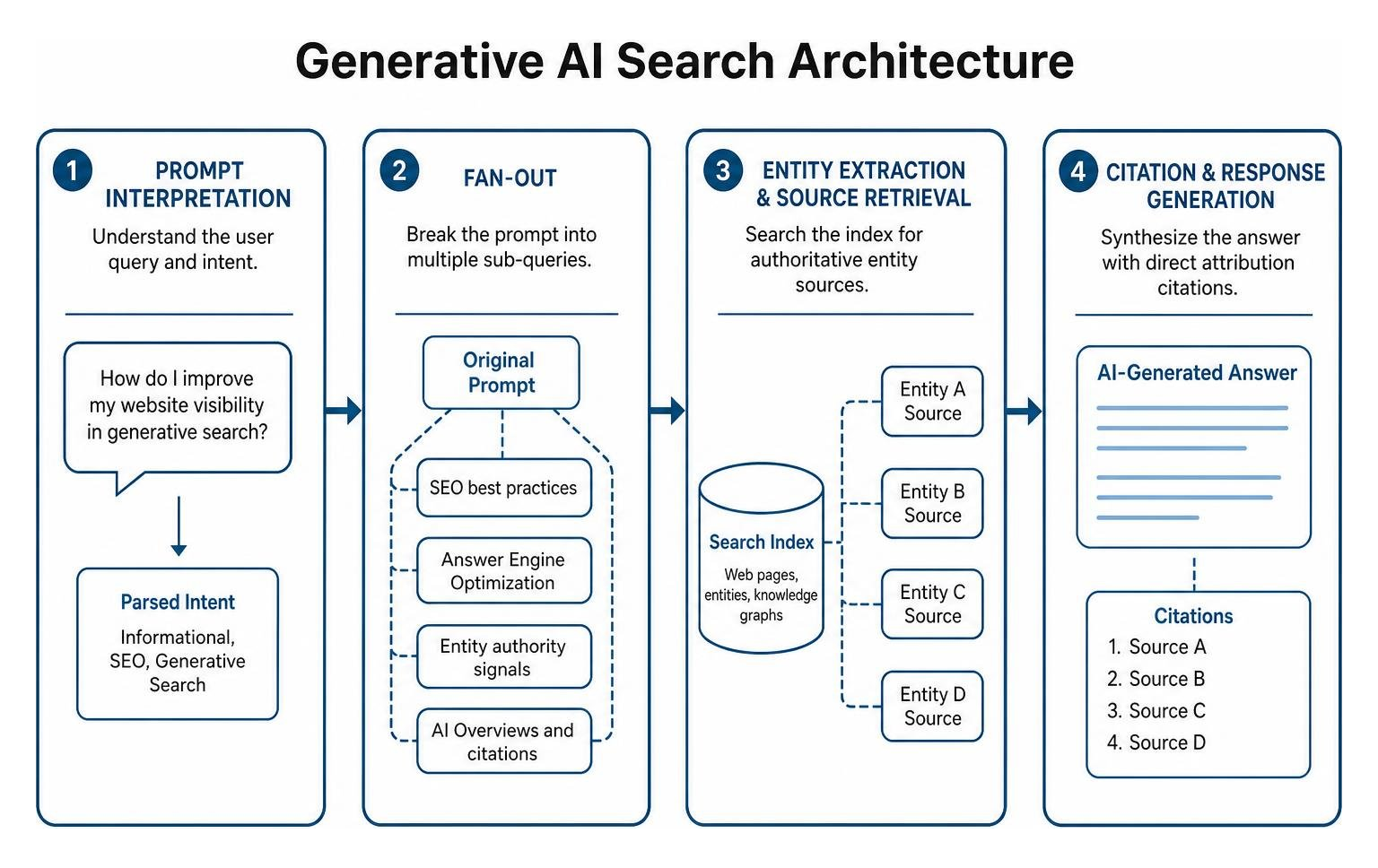
Modern generative search engines employ query fan-out techniques, breaking complex user prompts into multiple sub-queries, scanning the index for authoritative entity sources, and aggregating answers with direct attribution citations. Industry research indicates that while AI Overviews change user browsing behavior, visitors arriving from AI search summaries often convert at substantially higher rates because they have already been pre-educated by the AI’s synthesized response.
Optimizing for this generative environment requires specific tactical adjustments:
- Targeting Question and Intent Density: Generative answers trigger frequently for long-tail, conversational, and “why/how” queries. Formatting content with concise summary paragraphs followed by detailed breakdowns helps AI systems parse and cite your text.
- Strengthening Entity Authority: Search engines cross-reference knowledge graphs to determine if a brand is an acknowledged authority on a topic. Publishing unique proprietary research, case studies, and maintaining unified digital profiles establishes entity trust.
- Structured Contextual Formats: Using clear tables, bulleted takeaways, and semantic markup allows large language models to extract accurate data points directly from your pages.
For a deeper dive into optimizing for these systems, review our guides on generative search optimization strategies and large language model SEO insights.
Frequently Asked Questions About Search Optimization
How long does it typically take to see measurable organic results?
For most newly optimized websites, measurable improvements in organic impressions and keyword rankings begin appearing within 4 to 12 weeks, while significant gains in qualified traffic, calls, and conversions generally take 3 to 6 months of consistent effort.
The exact timeline depends on several factors:
- Domain Age and Historical Authority: Established domains with a clean history rank new content faster than freshly registered domains operating in a sandbox phase.
- Competition Index: Ranking for hyper-competitive, national commercial terms requires extensive authority building, whereas localized service queries often produce faster wins.
- Technical Health and Crawl Frequency: Fixing critical technical roadblocks (such as broken render scripts or indexing directives) can trigger rapid positive ranking adjustments once bots recrawl the site.
- Resource Consistency: Sites that continuously publish deep, authoritative content and earn quality links compound their visibility far more reliably than those making sporadic updates.
What is the primary difference between white-hat and black-hat techniques?
The fundamental difference lies in user value versus algorithmic manipulation.
White-hat SEO focuses on improving user experience, delivering thorough answers, and earning genuine digital recommendations. It builds an asset that grows in value over time without fear of algorithmic crackdowns.
Black-hat SEO seeks to game algorithmic vulnerabilities for immediate gratification. Because search engines invest billions in machine learning systems designed to catch and neutralize artificial ranking schemes, black-hat tactics inevitably lead to algorithmic suppression or complete domain de-indexing.
How are generative AI engines transforming organic search discovery?
Generative AI engines are shifting search from a pure list of 10 blue links to an interactive answer-and-discovery engine. For broad informational questions, AI summaries provide instant answers directly on the SERP, leading to more zero-click searches for basic trivia.
However, for commercial, technical, and high-consideration queries, generative AI acts as an advanced research assistant. Users are asking longer, more conversational questions, and AI engines cite reputable domains that demonstrate distinct topical depth and first-hand experience. Businesses that structure their data clearly, publish original insights, and establish strong entity authority will capture these high-value citations. Learn how to adapt your digital presence in our comprehensive AI search optimization manual.
Conclusion
Search engine optimization is not a one-time project or a series of hidden tricks. It is an ongoing business discipline that aligns your website’s technical health, content quality, and digital reputation with what both search engines and real human visitors want. By establishing a solid technical foundation, producing comprehensive content that satisfies user intent, and earning authoritative off-page signals, you create a sustainable organic traffic channel that compounds in value month after month.
At BullsEye Internet Marketing, we have helped businesses across the United States navigate search engine updates and build profitable organic visibility since 2006. We specialize in driving measurable phone calls, leads, and sales through customized SEO, Google Business Profile optimization, Pay-Per-Click management, and conversion rate enhancement.
Our unique advantage is straightforward: we offer no long-term contracts and strictly work with only one client per industry per geographic market, ensuring your company receives an exclusive competitive edge.
To build an organic strategy that drives real revenue, explore our professional search engine optimization services and discover how we can help your business dominate search rankings.
