
Why Most SEO Reports Get Ignored (And What to Do About It)
The best SEO reporting tools don’t just collect data — they tell a story your clients actually want to read.
Here’s a quick look at the top options:
| Tool | Best For | Starting Price |
|---|---|---|
| Whatagraph | Data blending & AI insights | Custom pricing |
| AgencyAnalytics | Multi-client agencies | $59/month |
| Databox | Deep custom dashboards | Free plan available |
| DashThis | Simple, scalable reporting | $44/month |
| SEOmonitor | SEO + AI search tracking | Custom pricing |
| Swydo | Fast white-label reports | Free trial available |
| SE Ranking | Budget-friendly teams | $52/month |
Think about the last time you spent a Friday pulling numbers from Google Analytics, Search Console, and Ahrefs — then manually pasting them into a slide deck or spreadsheet. Hours of work. A report that looked messy. And a client who barely glanced at it.
That’s the reality for a lot of agencies and marketers right now.
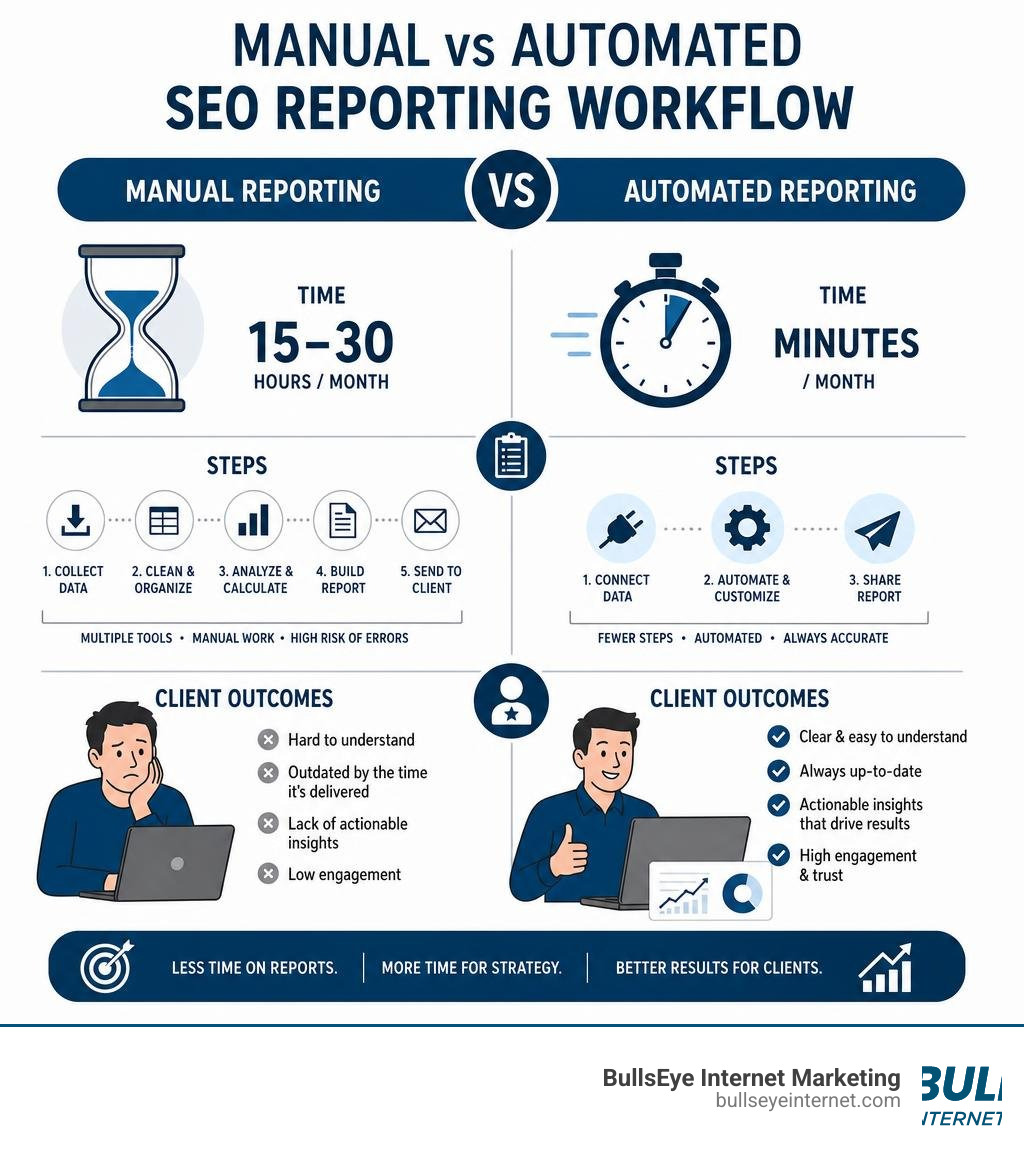
Reporting fatigue is real. Some agencies report spending 15 to 30 hours a month just wrestling with data — not analyzing it, not drawing conclusions from it, just trying to make it fit together. Meanwhile, clients want clear answers: Is our SEO working? Are we getting more traffic? What’s driving leads?
The gap between “data collected” and “insight communicated” is exactly where most SEO reporting falls apart.
The good news? A new generation of reporting tools is closing that gap fast — with automation, AI-driven summaries, white-label branding, and real-time dashboards that make your work visible and your value undeniable.
I’m Ronnie Katz, founder of BullsEye Internet Marketing, and after 20 years of managing SEO reporting tools and client campaigns across dozens of industries, I’ve seen which platforms actually move the needle and which ones just add noise. In this roundup, I’ll walk you through the advanced options worth your time.
SEO reporting tools terms to remember:
The Evolution of Client Reporting: Why Static Dashboards Fail

For years, the standard agency workflow involved exporting CSV files on the last day of the month, fighting with Excel formulas, and hoping the client wouldn’t notice a broken cell. This manual data extraction didn’t just drain productivity — it also opened the door to costly human errors. Worst of all, it contributed to client churn because clients received confusing, static reports weeks after the actual performance occurred.
In the fast-moving search landscape of June 2026, static reports simply cannot keep up. When a search engine drops a major core update, waiting until the end of the month to explain a sudden shift in rankings is a recipe for losing client trust. Modern marketing demands agility, which is why agencies are shifting toward Real-Time Analytics Dashboards: How Web Analytics Services Enable Agile Marketing.
Furthermore, data fragmentation remains a major headache. An agency might track technical health on one platform, keyword positions on another, and conversion metrics on a third. When these data streams live in silos, getting a clear picture of performance is nearly impossible. Regular health checks, like a Strategic Site Audit, are crucial, but the insights gained from those audits must be easily integrated into your regular reporting to prove your ongoing value.
Why Agencies Are Moving Beyond Basic SEO Reporting Tools
While legacy suites like Semrush are fantastic for keyword research and competitive intelligence, their native reporting features can feel rigid when you need to present cohesive narratives to non-technical clients. Similarly, while Google Looker Studio is free and highly customizable, it comes with a notoriously steep learning curve, frequent API latency issues, and frustrating data sampling limitations that can hide the true picture of your organic traffic.
Agencies need tools that can handle advanced data blending and custom metrics without requiring a degree in data engineering. If you are looking for a comprehensive breakdown of the market, check out 10 Free & Paid SEO Reporting Tools in 2026 – Stackby to see how different platforms stack up on usability and pricing.
How Automated SEO Reporting Tools Save Time and Prove ROI
Automation is the ultimate scalability lever for modern digital marketing agencies. By scheduling automated report deliveries, you eliminate the last-minute monthly scramble and ensure your clients receive consistent, timely updates. This frees up your strategists to focus on actual optimization rather than data entry.
Using white-label capabilities also builds client trust. When a client logs into a beautifully branded portal that features your agency’s logo and color palette, it elevates your professional image. More importantly, automated tools make it easy to tie organic search performance directly to business outcomes, such as leads and sales. This is why pairing your reporting suite with expert Web Analytics Services is so critical — it allows you to transition your client conversations from abstract metrics like “impressions” to concrete realities like “revenue generated.”
Top Advanced SEO Reporting Platforms Reviewed

To help you find the right fit for your agency, we have evaluated the top advanced platforms on the market, looking closely at their pricing models, integration ecosystems, and unique strengths.
Whatagraph: The Intuitive Data Blending Powerhouse
Whatagraph has built a reputation as one of the most user-friendly and visually appealing reporting tools available. It excels at data blending, allowing you to seamlessly merge metrics from Google Analytics 4, Google Search Console, and various social media platforms into a single, cohesive widget.
With a rock-solid 99.95% uptime guarantee and a data refresh rate of every 30 minutes, you can trust that your client dashboards are always accurate and accessible. The platform also features “Whatagraph IQ,” an AI-driven insights engine that automatically analyzes performance trends and writes natural-language summaries. This means you can deliver reports with instant, written context without spending hours drafting summaries manually.
AgencyAnalytics: Built Specifically for Multi-Client Agencies
AgencyAnalytics is designed from the ground up for agencies managing a large roster of clients. It acts as a true multi-client command center, allowing you to create custom-branded, individual dashboards for every client in your portfolio.
Beyond standard integrations, it features built-in SEO rank tracking and backlink monitoring, saving you from having to pay for separate third-party tracking software. You can easily automate PDF reports or grant clients access to their own white-label portals, making client communication completely hands-off.
Databox: Deep Customization and Metric Tracking
If you love data visualization and want complete control over how your metrics are presented, Databox is a powerful contender. It offers deep customization capabilities and supports hundreds of integrations.
With Databox, you can build highly specific, multi-source dashboards using their vast library of visualization templates. However, keep in mind that this level of flexibility comes with a learning curve; some agencies report spending 15 to 30 hours a month just trying to build and maintain complex workarounds in Databox to get their reports looking exactly right.
DashThis: Simple, Scalable, and Client-Ready
For agencies that want to get beautiful reports up and running in minutes without a complex setup process, SEO Reporting Software for Agencies & Marketers | DashThis is an excellent choice.
DashThis features an incredibly intuitive drag-and-drop widget builder and pre-configured templates tailored for SEO, PPC, and social media. It supports automated email dispatch and allows you to host reports on custom domains. It strikes a great balance between ease of use and professional, client-ready output, helping smaller teams scale their reporting efforts effortlessly.
SEOmonitor: Unified SEO and AI Search Tracking
As organic search evolves, legacy trackers are struggling to capture the full picture of modern search behavior. This is where Unified SEO & AI Search Tracking Platform Designed for Agencies | SEOmonitor shines.
Using their advanced Rank Tracker: Unified SEO + AI Search Performance | SEOmonitor , this platform treats traditional Google rankings and modern AI search visibility as comparable metrics in a single view. It tracks ChatGPT citations, Gemini mentions, Perplexity citations, and Google AI Overviews. Furthermore, its Dynamic Depth Crawling methodology tracks the full top 100 search results daily, ensuring you never miss volatile rank shifts in positions 11-50.
How to Evaluate and Choose the Best SEO Reporting Tools
Choosing the right reporting platform depends heavily on your agency’s size, your team’s technical expertise, and your clients’ expectations. When evaluating software, look closely at onboarding support, customer service responsiveness, and overall value for money.
If you are currently auditing your agency’s tech stack or preparing to scale your client services, reviewing our Website Audit Services Guide 2025 can provide a helpful framework for aligning your reporting tools with your broader technical SEO goals.
Essential Integrations: Connecting GSC, GA4, and Beyond
An SEO reporting tool is only as good as the data it can import. At a bare minimum, your chosen platform must offer native, seamless integrations with Google Search Console and Google Analytics 4.
However, advanced reporting requires looking beyond basic traffic. Your tool should also integrate with backlink monitoring databases and local SEO tracking tools (like Google Business Profile) to track calls, directions, and reviews. For enterprise clients, look for platforms that offer full API access so you can export raw data directly into your own data warehouses.
White-Labeling and Custom Branding Capabilities
To maintain a professional image, white-labeling is non-negotiable. The best tools allow you to fully customize the visual presentation, including:
- Custom domains (e.g.,
reports.youragency.cominstead of the software’s URL) - Custom color themes that match your agency’s or your client’s brand book
- Complete removal of the reporting software’s branding from all PDFs and client portals
- Tailored client portals where stakeholders can view real-time data at their convenience
AI-Driven Insights and Predictive Analytics
By June 2026, AI has moved from a buzzword to an essential feature in the marketer’s toolkit. Modern reporting tools use AI to scan your data for anomalies — such as a sudden drop in traffic on a high-value page — and alert you before the client even notices.
AI-driven reporting tools can also generate automated, written summaries of monthly performance, translate reports into multiple languages instantly, and provide predictive forecasting to show clients the potential ROI of targeting specific keyword clusters. This is particularly valuable for Generative Engine Optimization (GEO), helping you track how often your brand is cited by LLMs.
Frequently Asked Questions about Search Performance
How often should agencies send SEO reports to clients?
While real-time dashboards are excellent for clients who want to check performance on demand, we recommend sending structured reports on a monthly basis. Monthly summaries allow you to smooth out daily rank volatility and tell a cohesive story about long-term trends. However, for highly active campaigns or during major site migrations, brief weekly automated updates can help keep stakeholders aligned and build trust.
Can these platforms track competitor performance?
Yes. Many advanced reporting platforms allow you to track competitor keyword rankings, estimate their organic traffic, and monitor their backlink acquisition rates. This competitive intelligence helps you calculate your client’s “Share of Voice” in their industry and identify new content gap opportunities to help them outrank their rivals.
What is the difference between tracking keywords and tracking prompts for AI search?
Traditional keyword tracking monitors specific search terms entered into search engines like Google. AI prompt tracking, on the other hand, monitors how brands appear in conversational queries within AI tools like ChatGPT or Gemini.
Tracking keywords remains superior because keywords have verified search volumes, whereas individual prompts are highly fragmented and infinite in variation. Leading platforms like SEOmonitor solve this by mapping your core keywords to both traditional search results and AI search engine citations, giving you a unified view of your organic visibility.
Conclusion
The right SEO reporting tools do more than just save your team time — they transform your data into a powerful retention tool by clearly demonstrating the ROI of your hard work. Whether you choose the visual blending of Whatagraph, the agency-scale features of AgencyAnalytics, or the AI-ready tracking of SEOmonitor, upgrading your reporting stack is one of the smartest investments your agency can make.
At BullsEye Internet Marketing, we believe in keeping things simple, transparent, and highly effective. We don’t believe in locking our clients into long-term contracts; instead, we earn your business month after month by delivering clear, measurable results. To give you a true competitive advantage, we also operate under a strict exclusivity policy: we work with only one client per industry per geographic area.
Whether you need to dominate local search through Google Business Profile Optimization, scale your leads with Pay Per Lead campaigns, or maximize your ad spend with precision PPC and conversion optimization, we are here to help you grow.
Ready to see what professional, transparent search marketing looks like? Contact us today to learn more about our BullsEye Internet Marketing SEO Services and let’s start driving more calls and sales to your business.
