
Why Knowing How to Build Citations Matters More Than Ever
Knowing how to build citations correctly is one of the most practical skills you can develop — whether you’re writing a research paper, managing a local business listing, or trying to get your content cited by AI tools like ChatGPT or Perplexity.
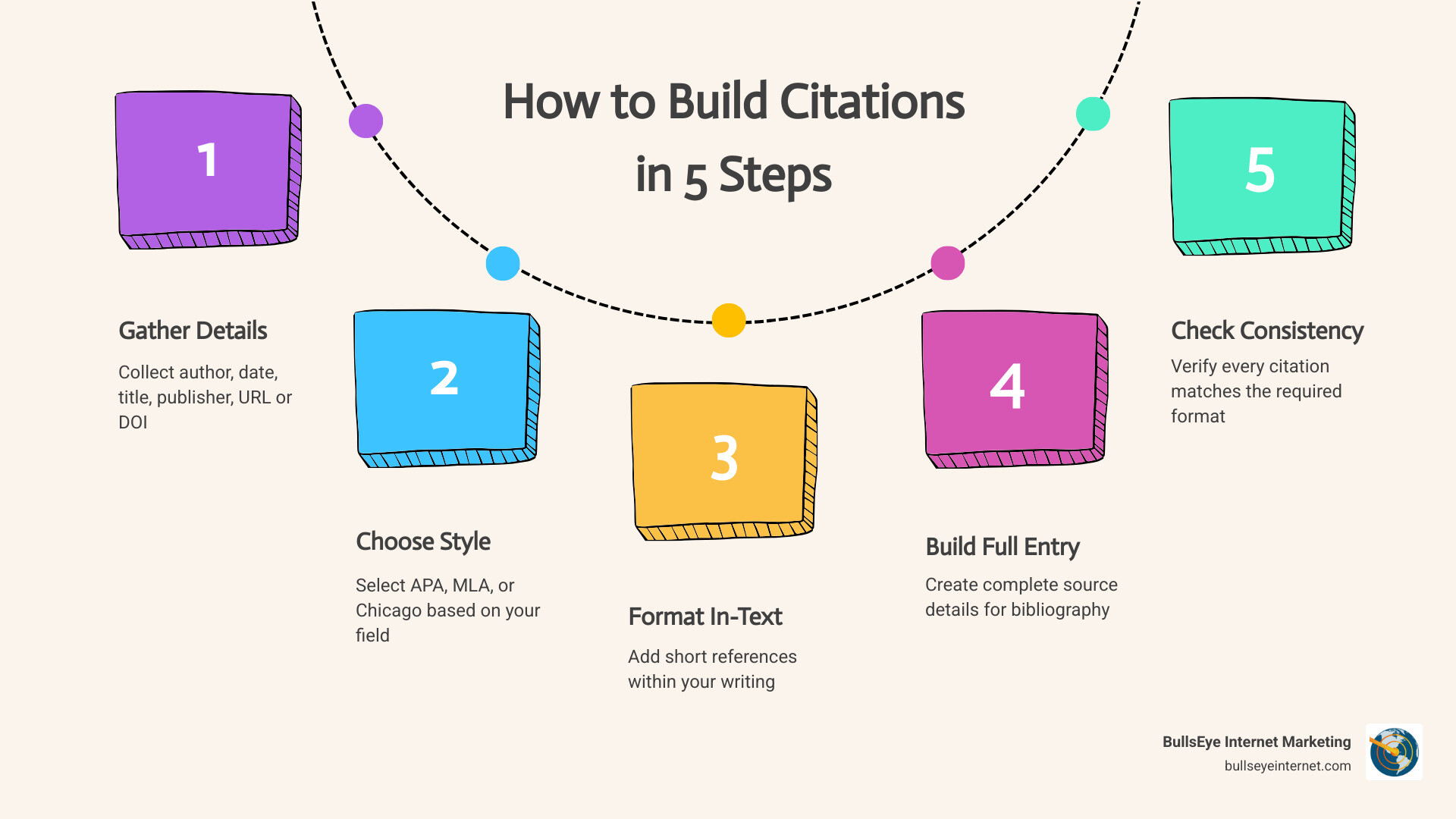
Here’s how to build citations in 5 steps:
- Gather your source details — author name, publication date, title, publisher, and URL or DOI
- Choose your citation style — APA, MLA, or Chicago depending on your field or platform
- Format the in-text citation — a short reference inside your writing that points to the source
- Build the full reference entry — the complete source details in your bibliography or reference list
- Check for consistency — make sure every citation matches the required format exactly
Citations do two things. They give credit to the original source. And they help readers — or AI models — verify that your information is trustworthy.
Get them wrong, and you risk losing credibility fast. According to research, 80% of consumers lose trust in a business when they see incorrect or inconsistent information online. The same principle applies to academic work: inaccurate citations can cost you marks, credibility, and your reader’s confidence.
The good news? Online tools have made citation building far faster and more accurate than doing it by hand.
I’m Ronnie Katz, founder of BullsEye Internet Marketing, and with over 20 years of experience helping businesses build online authority — including through strategic citation building — I’ve seen how proper citations impact visibility and trust. In this guide, I’ll walk you through everything you need to know about how to build citations with ease, using the best tools available in May 2026.
Quick how to build citations definitions:
The Core Components of a Proper Citation
To master how to build citations, we first need to understand what makes up a “complete” reference. Whether you are working on a thesis or optimizing your brand’s digital presence, the goal is always verifiability. A citation is a formal way of showing that a piece of information, data, or an idea came from another source.
In the academic world, three main styles dominate:
- APA Style (American Psychological Association): Widely used in psychology, education, and the sciences. It focuses heavily on the date of research to show freshness.
- MLA Format (Modern Language Association): The go-to for literature, arts, and humanities. It prioritizes the author’s name.
- Chicago Manual of Style: Often used in history and business, known for its versatile use of footnotes and endnotes.
Every proper citation consists of two parts: the in-text attribution and the full reference. In-text citations are brief “signposts” within your sentences—often parenthetical (Author, Year) or narrative (Author states…)—that point the reader toward the end of your document. The full reference list provides the “meat”—the author, title, publisher, and location (like a URL or DOI).
For those looking at this from a digital authority perspective, more info about local citation essentials can help bridge the gap between academic accuracy and online visibility. Proper citation building is about plagiarism prevention and research integrity. By following How to Cite Sources in APA and MLA | Methodology Hub, you ensure that your work stands on a foundation of verified evidence.
A Step-by-Step Guide on How to Build Citations for Academic Research
Building citations manually can feel like a chore, but it is a vital part of source evaluation. Before you even type a single comma, we recommend using the CRAAP test to evaluate your sources:
- Currency: Is the information timely?
- Relevance: Does it fit your research needs?
- Authority: Who is the author or publisher?
- Accuracy: Is the content supported by evidence?
- Purpose: Why does this information exist?
Once you’ve vetted your primary and secondary sources, it’s time to collect the data. You’ll need author credentials, publication dates, and unique identifiers like DOI numbers (for digital journal articles) or ISBN numbers (for books).

When using online resources, Wikipedia:Citing sources is a great guideline for how to handle open-source information, though we usually suggest finding the original source Wikipedia is citing for your final bibliography.
Comparison of Citation Styles
| Feature | APA (7th Ed) | MLA (9th Ed) | Chicago (17th Ed) |
|---|---|---|---|
| Primary Use | Social Sciences | Humanities | History/Business |
| In-text Style | (Author, Year) | (Author Page) | Footnotes or (Author Year) |
| Full List Name | References | Works Cited | Bibliography |
| Date Placement | After Author | End of Citation | After Publisher |
Beyond Manual Entry: Using Online Tools for Efficiency
In May 2026, nobody should be typing out every period and italicized title by hand. Modern reference management tools have introduced autocite features that allow you to simply paste a URL or scan a barcode to generate a perfect entry.
These tools add an accuracy layer by cross-referencing multiple databases to find missing metadata, such as volume numbers or publisher locations. Many now offer expert verification, where seasoned citation experts have perfected the algorithms to ensure the formatting is “hand-in ready.”
Using these tools doesn’t just save time; it builds authority. Much like The SEO Power of Citations: How Business Listings Build Authority, academic citations create a “paper trail” of credibility. Most tools also allow for folder organization and seamless Word integration, meaning your bibliography updates automatically as you write.
Using Automated Generators to Learn How to Build Citations Quickly
Platforms like Scribbr and Citation Machine use advanced formatting algorithms to handle complex styles, including BibTeX for LaTeX users. These generators offer:
- Instant generation: Turn a DOI into a citation in seconds.
- Error reduction: Automatically handles tricky capitalization and punctuation rules.
- Export options: Download your entire bibliography directly into Word or Bib(La)TeX.
How to Build Citations for Different Media Types
Not everything is a book or a journal article anymore. We often have to cite:
- Digital PDFs: Treat these as web documents but include the file type.
- Video/Audio: Cite the creator, the platform (YouTube/Spotify), and the timestamp if relevant.
- Social Media: Use the handle and the first few words of the post as the title.
- Website Metadata: Look for the “last updated” date rather than the copyright year in the footer.
The Evolution of Citations: From Paper to AI Search Engines
The world of citation building has moved beyond the classroom. We are now in the era of Generative AI and Retrieval-Augmented Generation (RAG). When you ask ChatGPT, Perplexity, or Gemini a question, they don’t just “know” the answer—they pull from a source stack of high-quality content.
AI models use entity graphs to decide which sources are trustworthy enough to cite. If you want your own content to be cited by these models, you need to follow The 31-Point Citation Readiness Checklist: What Makes AI Actually Cite Your Content. AI citations are the new “backlinks” of the 2020s; they provide the topical authority that tells a machine your content is the definitive answer.

How to Build Citations That AI Models Can Easily Recognize
To make your content “citable” for AI, we use several strategies:
- Answer-First Blocks: Put the direct answer to a question in the first 1-2 sentences of a section.
- FAQ Schema: Use structured data to tell search engines exactly what question you are answering.
- Technical Accessibility: Ensure your site isn’t blocking AI crawlers (like GPTBot or PerplexityBot) in your robots.txt file.
- Extractable Claims: Use specific numbers and dated statistics. Research shows that content with 3+ named statistical sources gets 67% more AI citations.
Citing AI-Generated Content in May 2026
If you use AI to help with your research, you must cite it ethically. Treat the AI company (OpenAI, Anthropic, Google) as the author and the model (GPT-4o, Claude 3.5) as the version. Always record your prompts and the date of the response, as AI outputs can change daily. This ethical disclosure is essential for maintaining research integrity.
Frequently Asked Questions about Citation Building
What is the difference between a citation and a reference?
A citation is the brief mention (in-text) that happens while you are writing. A reference is the full entry at the end of your document that provides all the details needed to find that source. You can’t have one without the other!
How do I find a DOI for an older journal article?
Many older articles weren’t assigned DOIs originally. You can use tools like CrossRef’s metadata search or check the article’s page on research databases like JSTOR. If no DOI exists, use the stable URL (permalink) of the article.
Can I use AI tools to format my entire bibliography?
Yes, but with a warning: AI can “hallucinate” sources that don’t exist. Always use a dedicated citation generator or reference manager (like Zotero or Mendeley) rather than asking a chatbot to write your bibliography from scratch.
Building Authority and Trust with BullsEye Internet Marketing
Mastering how to build citations is about more than just following rules—it’s about participating in a global conversation with honesty and clarity. Whether you are aiming for academic excellence or building digital authority for a business, citations are the currency of trust.
At BullsEye Internet Marketing, we understand that visibility is built on a foundation of accuracy. Just as a researcher needs a perfect bibliography, a business needs accurate business listings to prove to both humans and AI engines that they are legitimate and authoritative.
By using the tools and strategies we’ve discussed—from automated generators to AI-ready content structures—you can build citations with ease and ensure your work gets the recognition it deserves.
Ready to boost your digital authority? Get started with professional business listings today and let us help you navigate the complex world of online visibility.
