
Selecting the Right Startup Growth Partner: BullsEye Internet
A marketing agency for startups helps early-stage companies achieve rapid growth through specialized services like SEO, PPC, conversion optimization, and brand strategy—designed specifically for limited budgets and the need to prove ROI quickly. The right agency acts as a strategic partner to validate your market fit, generate traction, and build a scalable customer acquisition engine.
Quick Guide: What to Look for in a Marketing Agency for Startups
- Proven Track Record – Case studies showing CAC reduction and revenue growth
- Industry Expertise – Experience with startups in your stage and sector
- Flexible Engagement – No long-term contracts; adaptable to your growth phase
- Data Transparency – Clear reporting on metrics like CAC, LTV, and conversion rates
- Strategic Approach – Focus on sustainable growth, not just quick wins
- Full-Service or Specialized – Choose based on your specific needs and budget
Here’s the hard truth: 90% of startups fail. But with 50 million new startups launching globally each year, the ones that succeed aren’t just building better products—they’re getting marketing right from day one.
The difference between a startup that scales and one that stalls often comes down to one critical decision: choosing the right marketing partner. Unlike established companies with big budgets and brand recognition, startups need agencies that understand rapid experimentation, limited resources, and the pressure to show ROI yesterday.
The challenge? Not all marketing agencies are built for the startup journey. Many are designed for corporate clients with deep pockets and long timelines. Startups need something different—a partner who can move fast, test relentlessly, and help you build a growth engine that actually works.
As a VP of Marketing at a rapidly growing company once shared, a good agency can deliver measurable impact, leading to significant drops in Customer Acquisition Cost (CAC) and improvements in conversion rates. They build a scalable, reliable growth engine you can trust.
That’s the kind of result that separates agencies who get startups from those who don’t.
I’m Ronnie Katz, and over the past 18+ years at BullsEye Internet Marketing, I’ve helped startups and small businesses steer the complexities of finding and working with the right marketing agency for startups to drive measurable growth. In this guide, I’ll walk you through exactly what to look for, what to avoid, and how to ensure your marketing investment delivers real results.
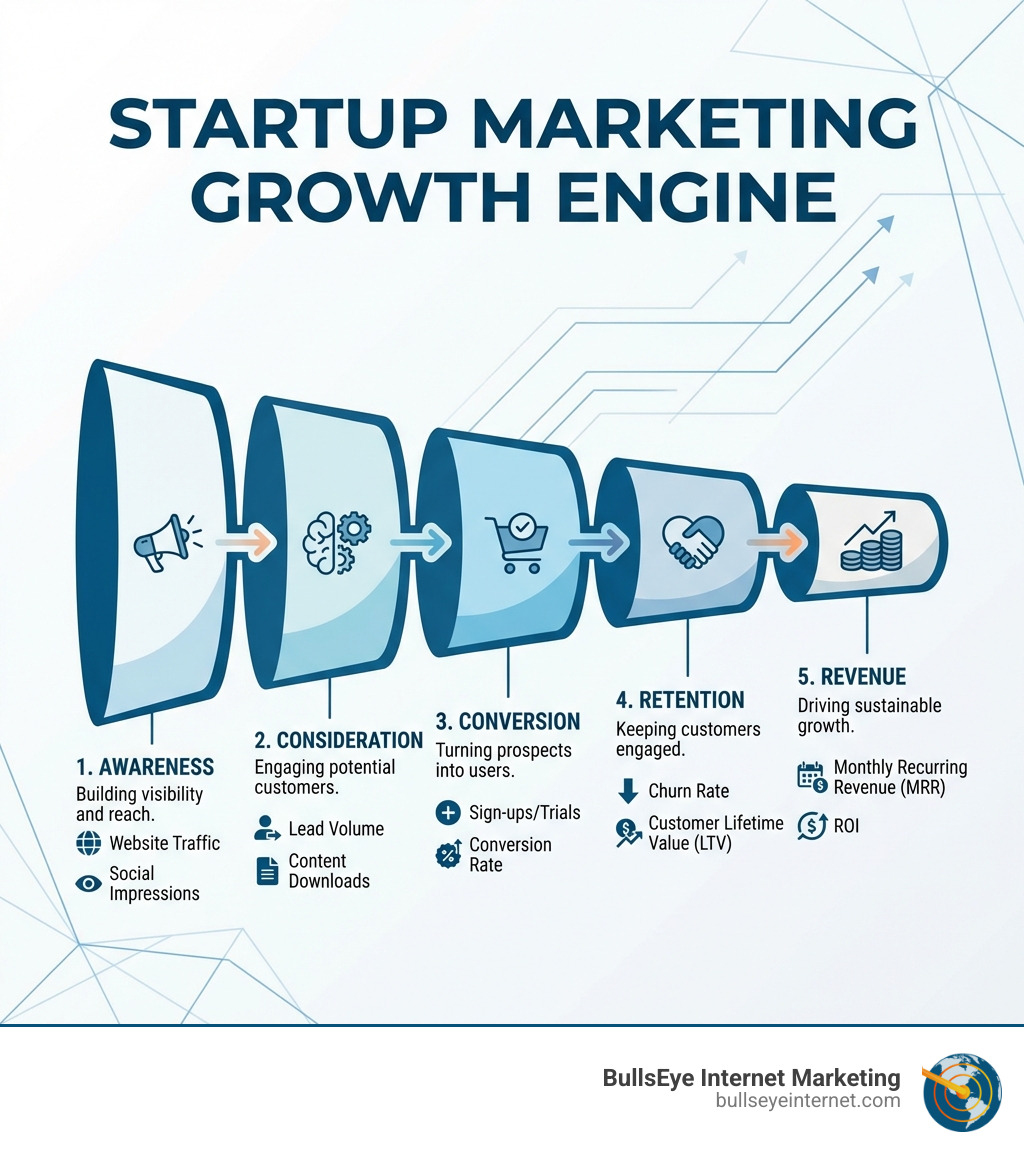
Common marketing agency for startups vocab:
Why Startup Marketing is a Different Beast

What exactly is startup marketing, and why is it so different from what traditional, established businesses do? We often see this question come up, and the answer lies in the unique environment and pressures that startups face.
Startup marketing isn’t just about selling a product or service; it’s about validating an idea, finding product-market fit, and achieving rapid, scalable growth with often very limited resources. It’s a journey down a winding road, not a straight highway, where every turn presents a new challenge and opportunity. While 50 million new startups emerge globally each year, the harsh reality is that about 90% of them fail. This high failure rate underscores the critical importance of effective, agile marketing.
For startups, marketing is about leveraging every dollar and every minute to gain visibility, acquire customers, and prove the business model. It prioritizes speed, measurability, and a deep understanding of the customer.
Key Differences from Corporate Marketing
Let’s break down why traditional marketing approaches often fall short for startups:
- Resource Constraints: Traditional businesses typically operate with substantial marketing budgets, allowing for extensive campaigns, brand building, and long-term strategies. Startups, however, nearly always have limited budgets and tight timelines. This means every marketing dollar must generate a quantifiable return on investment (ROI) directly linked to scalable growth metrics.
- Speed and Agility: Corporate marketing often involves slower, more deliberate planning cycles. Startups need to move fast, embracing rapid experimentation and data-driven pivots. What works today might not work tomorrow, so the ability to test, learn, and adapt quickly is paramount.
- Focus on Acquisition vs. Maintenance: Traditional marketing often focuses on brand maintenance, loyalty, and incremental growth. Startup marketing, conversely, is heavily geared towards customer acquisition and generating initial traction. It’s about getting the first users, proving the value, and then scaling that process.
- Proving ROI Quickly: Startups need to demonstrate quick ROI to attract further investment and sustain operations. This demands marketing strategies that are highly measurable and focused on immediate, tangible results.
- Growth Hacking Mindset: This concept, born in the startup world, emphasizes creative, low-cost marketing tactics focused on rapid growth and experimentation. It’s about finding unconventional ways to reach customers and scale quickly.
As one expert puts it, “You cannot solve new problems using old solutions.” Traditional business marketing used to be about “fitting in” with everyone else. Today, for startups, it’s about standing out and demonstrating how you’re different, or you risk being invisible.
Core Goals for Startup Marketing
The primary objectives for a marketing agency for startups are distinct:
- Validating the Business Idea: Early marketing efforts help confirm if there’s a real market need for the product or service. This involves testing messaging and gauging audience response.
- Generating Initial Traction: This means getting those crucial first customers, users, or leads. It’s about creating initial momentum and proving demand.
- Building a User Base: Beyond the first few, the goal is to systematically grow the customer base, often through performance-driven campaigns.
- Securing Follow-on Funding: For many startups, marketing success directly impacts their ability to raise subsequent funding rounds. Agencies can help showcase the potential for scalable growth and market penetration, which has helped some startups raise over $2 billion in follow-on funding.
- Creating a Repeatable Growth Engine: The ultimate goal is to establish marketing processes that can be scaled efficiently, turning marketing into a predictable source of growth.
Decoding Agency Services: What Startups Really Need
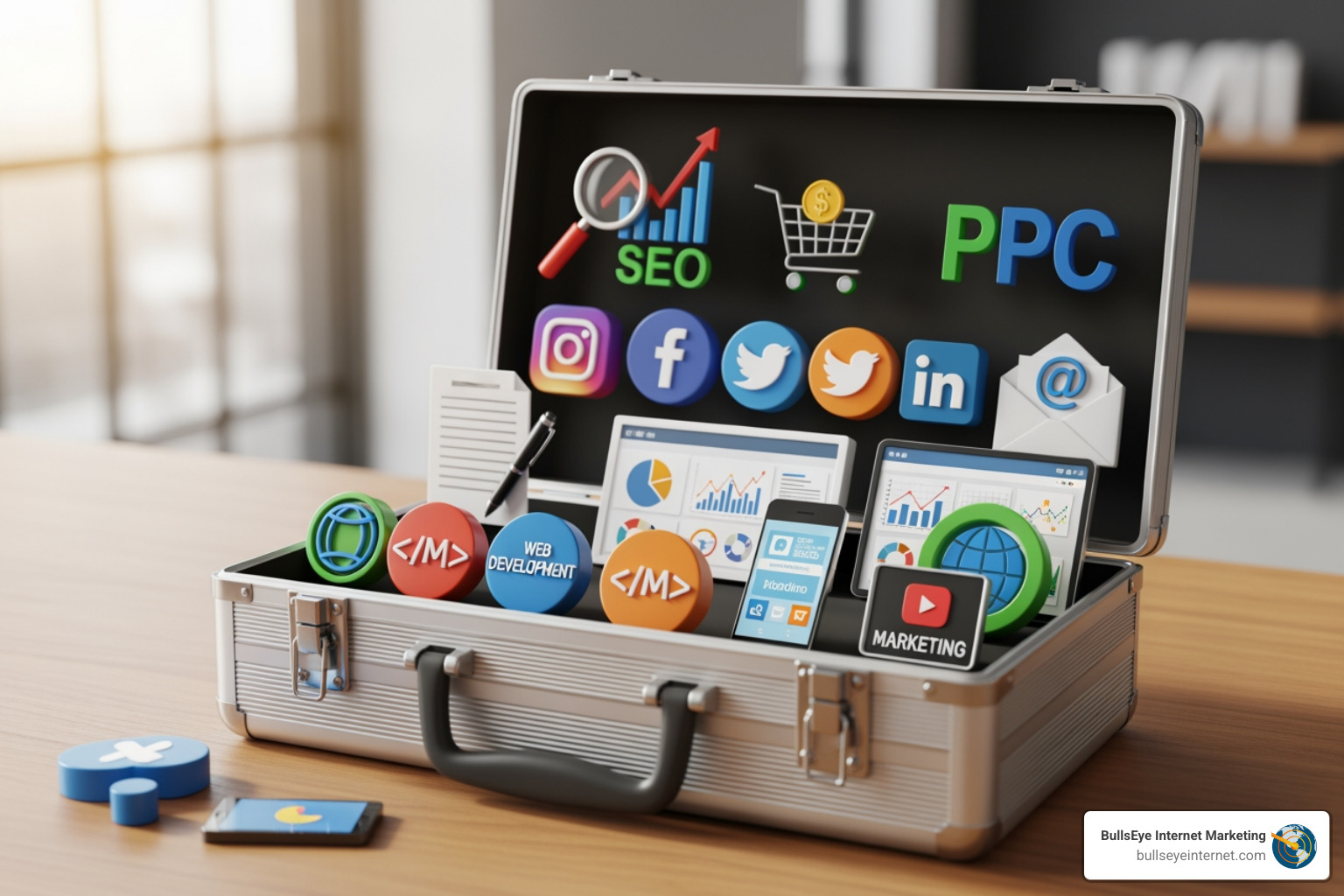
When considering a marketing agency for startups, understanding the breadth of services they offer is crucial. For us at BullsEye Internet Marketing, we know that startups need partners who can provide end-to-end strategy and execution, often at a startup-friendly budget, without compromising on quality or results. We combine the right processes, people, and playbooks to get to your goal, whether you’re in Miami, West Palm Beach, or anywhere in between.
Here’s a breakdown of the key services that can fuel your startup’s growth:
Foundational Services for Brand Building
Before you can scale, you need a solid foundation. These services help establish your brand, build credibility, and ensure your target audience can find you.
- Search Engine Optimization (SEO): Getting found organically is vital. SEO for startups focuses on optimizing your website and content to rank higher in search engine results for relevant keywords. This includes technical SEO, on-page optimization, and local SEO strategies—especially important for businesses targeting specific geographic areas like Broward County or Palm Beach County.
- Content Marketing: Creating valuable, relevant content (like blog posts, articles, videos) that attracts and engages your target audience. This helps establish your expertise and build trust long before a sale is made.
- Brand Strategy & Value Proposition: Defining what makes your startup unique and why customers should choose you. This involves sharpening your positioning and value proposition to resonate with your market. A strong brand isn’t just a logo; it’s a narrative that builds belief and earns conviction from early adopters.
- Website Development & User Experience (UX): Your website is your digital storefront. It needs to be fast, mobile-friendly, and easy to steer. A well-designed user journey maximizes engagement and guides visitors towards desired actions. Our team ensures your online presence is not just functional but also a powerful conversion tool.
Growth Acceleration & Lead Generation Services
Once your foundation is set, these services kick into high gear to drive traffic, leads, and sales.
- Pay-Per-Click (PPC) Advertising: Get immediate visibility by paying to appear at the top of search results and on social media feeds. PPC allows for precision targeting, putting your message in front of the right audience at the right time. For every $1 spent on Google Ads alone, businesses typically see $2 in revenue, making it a powerful channel for startups needing quick, measurable results. We specialize in managing PPC campaigns across platforms like Google Ads to ensure efficient spend and maximum ROI.
- Paid Social Media: Leverage platforms like Facebook, Instagram, and LinkedIn to reach specific demographics and interests. Paid social can be incredibly effective for building brand awareness and driving conversions, especially when integrated with a broader strategy.
- Conversion Rate Optimization (CRO): This is about making the most of your existing traffic. CRO involves analyzing user behavior on your website and making changes to improve the percentage of visitors who complete a desired action, such as signing up for a newsletter or making a purchase. This is a critical service for optimizing your marketing funnel and ensuring every click counts.
- Email Marketing: Building an email list and executing targeted campaigns to nurture leads and drive conversions. Email remains one of the most cost-effective channels for engaging prospects and prompting desired actions.
- Google Business Profile Optimization: For local businesses, optimizing your Google Business Profile is crucial for appearing in local search results and map packs. This is a powerful tool for driving calls and foot traffic to your business in specific areas like Miami-Dade County or St. Lucie County.
The Role of AI in Modern Startup Marketing
The landscape of marketing is constantly evolving, and Artificial Intelligence (AI) is playing an increasingly significant role, especially for agile startups.
- Task Automation: AI tools automate repetitive marketing tasks like content generation, data entry, and ad management. This saves valuable time and reduces costs, allowing small startup teams to focus on strategic development and creative work.
- Campaign Optimization: AI-powered platforms can analyze vast amounts of data to optimize ad bids, target audiences, and personalize content in real-time, leading to more efficient campaigns and better results. This is crucial for optimizing your Google Ads and paid social spend.
- Predictive Analytics: AI can forecast market trends, predict customer behavior, and identify potential growth opportunities, giving startups a competitive edge.
- Audience Segmentation: AI helps refine audience targeting by identifying nuanced patterns in customer data, ensuring your marketing messages reach the most receptive groups.
- AI & Search Visibility Expertise: In 2026 and beyond, findy will happen across search engines, AI-driven platforms, social feeds, and recommendation systems. Agencies with AI and search visibility expertise are crucial for optimizing for both human users and AI findy systems, ensuring your startup remains visible in an increasingly complex digital world.
The integration of AI marketing tools provides the efficiency and insight of a large marketing department, which is necessary for achieving the scalable growth demanded of a startup. As the Creative Boom Podcast discusses, creativity in the age of AI is about leveraging these tools to amplify human ingenuity, not replace it.
How to Choose the Right Marketing Agency for Startups
Choosing the right marketing agency for startups is one of the most critical decisions you’ll make. It’s not just about finding someone to run your ads; it’s about finding a true partner who understands your vision, your constraints, and your ambition. This decision can be the difference between scaling rapidly and becoming part of that 90% failure statistic.
We’ve seen countless startups struggle because they chose the wrong partner. To avoid this pitfall, we’ve developed a vetting process to help you find the perfect fit.
Your 7-Point Vetting Checklist
Here’s how to conduct your due diligence:
- Proven Track Record: Look for agencies that can demonstrate clear results with startups. Ask for case studies that show measurable impacts like reduced Customer Acquisition Cost (CAC) or increased conversion rates. For example, some successful agencies boast an 84% client retention rate, with 65% of clients doubling their revenue within the first six months. They’ve produced over $1 million in eCommerce revenue for clients and increased client revenue by over 55%. These are the kinds of numbers that matter.
- Industry Expertise: Does the agency understand your specific industry? While general marketing principles apply, an agency with experience in your niche (e.g., SaaS, eCommerce, local services in South Florida) will grasp your unique challenges and opportunities faster. We ensure our team is well-versed in the nuances of various sectors to provide custom solutions.
- Pricing Transparency: Vague or overly complex pricing models can be a major red flag. Understand exactly what you’re paying for and how the budget is allocated across strategy, labor, and media spend. Transparency is key to building trust.
- Communication Cadence: How will the agency communicate with you? Will there be weekly strategy calls, live dashboards, and regular performance reports? Clear, consistent communication is vital for a strong partnership.
- Strategic vs. Tactical Focus: Does the agency offer just execution, or do they provide strategic guidance? Startups need partners who can help develop a strategic foundation that attracts customers, builds credibility, and drives revenue, not just run campaigns. They should act as co-pilots, not just consultants.
- Data and Reporting Clarity: The agency should not only track key metrics but also provide clear, actionable insights. Avoid agencies that focus solely on vanity metrics like likes and impressions. Instead, prioritize those who report on metrics directly tied to your business outcomes like CAC, Lifetime Value (LTV), and conversion rates.
- Contract Flexibility: Startups operate in a dynamic environment. Long-term, rigid contracts can be stifling. We believe in providing flexibility, which is why we offer no long-term contracts. This allows us to adapt to your evolving needs and ensures our commitment is continuously earned.
Here’s a look at common agency pricing models:
| Pricing Model | Description | Pros for Startups | Cons for Startups |
|---|---|---|---|
| Retainer | Fixed monthly fee for a set scope of work. | Predictable budgeting, continuous support. | Can be expensive for limited scope, less flexible if needs change rapidly. |
| Project-Based | Fixed fee for a specific project (e.g., website redesign, single campaign). | Clear deliverables, defined cost, good for one-off needs. | May not cover ongoing growth, requires managing multiple projects. |
| Performance-Based | Fees tied to achieving specific KPIs (e.g., percentage of sales, cost-per-lead). | Agency’s incentives align with your success, potentially lower upfront cost. | KPIs must be carefully defined, can be complex to track, may prioritize short-term gains. |
| Hourly Rate | Pay for the actual time spent by agency staff. | Flexible, good for unpredictable needs or small tasks. | Costs can escalate quickly, less predictable budget. |
| Pay Per Lead (PPL) | Agency charges a fixed or variable fee for each qualified lead generated. | Highly aligned with lead generation goals, clear ROI per lead. | Quality of leads must be carefully vetted, may not cover full-funnel marketing. |
Red Flags to Watch For
Just as important as knowing what to look for is knowing what to avoid. Here are some red flags that signal a marketing agency for startups may not be worth your time:
- Promises of Instant Results: Marketing is a marathon, not a sprint. Any agency promising “rank #1 on Google in 30 days” or “instant viral success” is selling speed over strategy. Real digital marketing takes time, testing, and iteration.
- Vague Pricing: If an agency can’t clearly explain how your budget will be spent, or if their pricing seems too good to be true, proceed with caution. Lack of transparency often leads to hidden costs or subpar work.
- Their Own Marketing Isn’t Good: This is a simple but powerful indicator. If an agency can’t effectively market themselves, how can they market your business? Check their website, blog, and social media. Is it engaging, informative, and professional?
- Lack of Questions About Your Business: A good agency will ask deep questions about your customer personas, business model, sales process, past failures, and current bottlenecks. If they don’t, they’re likely using a generic, one-size-fits-all strategy rather than building a custom one for you.
- Focus on Vanity Metrics: Be wary of agencies that only talk about likes, impressions, or website traffic without tying them to tangible business outcomes like leads, sales, or ROI. Meaningful data insights are crucial.
- Inconsistent Communication: If their response times are slow during the sales process, expect the same once you’re a client. Look for clear communication cadences, shared dashboards, and dedicated account managers.
- Ownership Gets Messy: Ensure you retain full ownership of all your digital assets—ad accounts, creative files, analytics dashboards, and email lists. You should always have control over your intellectual property.
Key Questions to Ask a Potential Marketing Agency for Startups
When you’re ready to interview potential partners, arm yourself with these questions:
- How do you measure success for clients like us? Look for agencies that focus on your specific business objectives (e.g., lead generation, conversion rates, customer acquisition cost) and can provide clear, data-driven reporting.
- What is your process for strategy development? A good agency will have a systematic approach to understanding your business, market, and goals before proposing solutions.
- Who will be on our account team? Will you have a dedicated point of contact? What is their experience level? Understanding the team structure ensures you’ll have consistent support.
- Can you show us a sample report? This will give you a clear idea of their reporting style, the metrics they track, and the insights they provide.
- What are your contract terms? As we mentioned, look for flexibility. Agencies that offer no long-term contracts demonstrate confidence in their ability to deliver ongoing results. We pride ourselves on earning your business month after month.
Measuring Success and Ensuring a Positive ROI
For startups, marketing isn’t just an expense; it’s an investment. And like any investment, you need to see a clear return. The right marketing agency for startups doesn’t just run campaigns; they establish a clear framework for measuring success and ensuring a positive ROI. We believe in turning your marketing into a predictable revenue engine.
The Metrics That Truly Matter for Growth
While vanity metrics might look good on paper, they don’t tell the full story for a startup. We focus on the key performance indicators (KPIs) that directly impact your bottom line and sustainable growth:
- Customer Acquisition Cost (CAC): This is the total cost associated with acquiring a new customer. A good agency will work to reduce your CAC over time, making your growth more efficient. We’ve seen successful agencies help clients drop their CAC significantly, with some reporting a 37% reduction.
- Lifetime Value (LTV): How much revenue does a customer generate over their entire relationship with your business? A high LTV relative to CAC is a strong indicator of a healthy, scalable business model.
- Conversion Rates: The percentage of website visitors or leads who complete a desired action (e.g., make a purchase, sign up for a demo). Improving conversion rates directly impacts your ROI. Some agencies have helped clients improve conversion rates by as much as 40%.
- Churn Rate: The rate at which customers stop doing business with you. While primarily a product/customer success metric, marketing plays a role in attracting the right customers who are more likely to stay.
- Return on Ad Spend (ROAS): This metric measures the revenue generated for every dollar spent on advertising. For PPC campaigns, for instance, a strong ROAS is crucial. As we mentioned, businesses typically see $2 in revenue for every $1 spent on Google Ads alone, but top agencies aim for even higher returns.
These metrics aren’t just numbers; they tell a story about your business’s health and potential for scale. We use these insights to continuously optimize our strategies and ensure your marketing investment is working hard for you.
How to Partner with Your Marketing Agency for Startups for Maximum Impact
Getting a good ROI isn’t solely the agency’s responsibility; it’s a partnership. Here’s how you can ensure you get the most out of your marketing agency for startups investment:
- Setting Clear Goals: Before you even begin, define what success looks like. Is it a specific number of leads, a target CAC, or a certain revenue milestone? Clear, measurable goals provide a roadmap for both you and your agency.
- Establishing a Single Point of Contact: Designating one person from your team to be the primary liaison with the agency streamlines communication and prevents confusion.
- Providing Timely Feedback: Your insights are invaluable. Provide prompt and constructive feedback on campaigns, creative assets, and performance reports. This helps the agency iterate and improve faster.
- Trusting the Experts: While you should always be informed, trust your agency’s expertise. They are specialists in their field, and their recommendations are based on data and experience.
- Sharing Business Insights: Don’t hold back information about your product roadmap, sales process, customer feedback, or market challenges. The more your agency understands your business, the more effectively they can market it. They should act as an extension of your team, not just an external vendor.
By working collaboratively and strategically, you can transform your marketing efforts into a powerful engine for sustainable growth.
Conclusion: Building Your Unfair Advantage
The startup journey is fraught with challenges, but the right marketing agency for startups can be your most powerful ally. We’ve seen how expert guidance, data-driven strategies, and a focus on measurable results can help businesses not only survive but thrive. From navigating limited budgets to achieving product-market fit and securing crucial funding, a dedicated marketing partner is indispensable.
At BullsEye Internet Marketing, we understand the unique pressures and ambitions of startups. We specialize in generating calls and sales through effective Google Business Profile Optimization, SEO, PPC, and conversion optimization. Our commitment is to provide you with a competitive advantage by working with only one client per industry per geographic area, ensuring your marketing efforts are truly unique. And with no long-term contracts, we’re continuously motivated to deliver outstanding results that earn your trust every single month.
Don’t let your startup become another statistic. Partner with an agency that acts as your co-pilot, helping you build a brand people can’t imagine life without.
Ready to accelerate your growth and build your unfair advantage?
