
Why Google Ads Are the Fastest Path to Qualified Leads
Digital marketing Google Ads is Google’s pay-per-click (PPC) platform that places your business at the top of search results. It’s a paid system where you bid on keywords and pay only when someone clicks your ad, connecting you with people actively looking for what you sell. With 5.6 billion daily Google searches, it puts your business in front of high-intent customers at the exact moment they’re ready to buy. Unlike organic SEO, Google Ads can drive qualified traffic and calls within days.
Whether Google Ads feels like a money printer or a slot machine comes down to strategy, not luck. Targeting the right keywords, using a focused landing page, and tracking conversions are what make it a reliable source of qualified leads. Without these steps, budgets disappear without results.
Google Ads works best when your ideal customer is already searching for what you offer. If someone types “emergency plumber near me,” they’re ready to buy now. Your job is to show up at that moment with a clear offer and an easy way to make contact.
This guide explains how Google Ads fits into an integrated digital marketing system for measurable growth. We’ll cover core components, campaign building, and measurement to help you decide if it’s the right investment for your business.
I’m Ronnie Katz, founder of BullsEye Internet Marketing. Since 2006, I’ve helped businesses master Google Ads campaigns that drive calls and sales, not just clicks. I’ve learned what works in competitive markets, and this guide shares those insights.
Essential digital marketing google ads terms:
The Core Components of Digital Marketing Google Ads
At its heart, digital marketing Google Ads is a sophisticated ecosystem designed to connect advertisers with consumers at crucial moments. Success requires understanding the different ad formats, the ad auction, Quality Score, and bidding strategies.
Understanding the Different Google Ad Formats
Google Ads offers formats for different stages of the customer journey. Choosing the right one depends on your business goals.
- Search Ads: Text-based ads at the top of Google search results. They are ideal for capturing high-intent users actively searching for your products or services, like someone in Miami searching for “emergency AC repair.”
- Display Ads: Visual ads (images or animations) that appear across millions of websites and apps. They are excellent for building brand awareness and remarketing to past visitors.
- Video Ads (YouTube): With over 122 million daily active users, YouTube ads let you tell a compelling story. They are perfect for demonstrating products, sharing testimonials, and conveying your brand’s personality.
- Shopping Ads: A must for e-commerce, these ads display product images, titles, and prices directly in search results. They cater to users with strong purchase intent and provide a direct path from search to sale.
The Google Ads Auction: How Your Ad Gets Seen
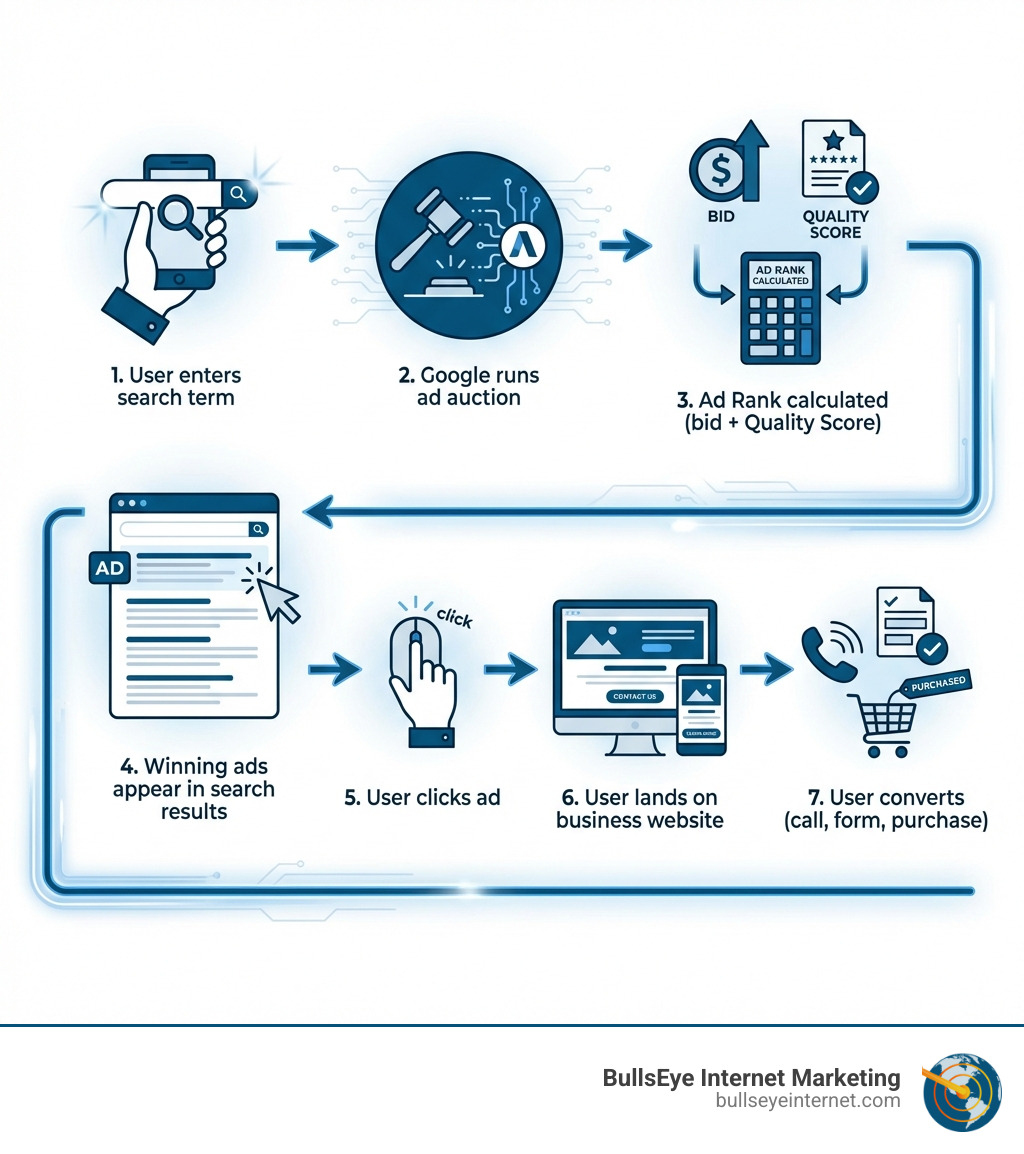
Every time someone searches, a lightning-fast ad auction decides which ads to show and in what order. It’s not just about the highest bid. Google calculates an “Ad Rank” for each eligible ad to determine its position.
Ad Rank is determined by a complex set of factors, including:
- Your Bid: The maximum you’re willing to pay per click.
- Quality Score: The quality and relevance of your ads and landing page.
- Ad Rank Thresholds: Minimum quality an ad must meet to show.
- Auction Competitiveness: The bids of your competitors.
- Search Context: User’s location, time of day, device, etc.
- Expected Impact of Ad Extensions: Add-ons that can improve your ad’s visibility.
This system ensures users see relevant, high-quality ads, benefiting both users and advertisers.
The Power of Quality Score and Bidding Strategies
Quality Score and bidding strategies directly impact your ad’s visibility, cost, and performance.
What is Quality Score and Why is it Important? Quality Score is Google’s 1-10 rating of your ad, keyword, and landing page relevance. A higher Quality Score leads to lower costs, better ad positions, and increased eligibility to show. Its components are:
- Expected Click-Through Rate (CTR): The likelihood your ad will be clicked.
- Ad Relevance: How well your ad matches the user’s search intent.
- Landing Page Experience: The relevance and usability of your landing page.
Google’s Search Quality signals emphasize the importance of usefulness and relevance.
Different Bidding Strategies Choose a bidding strategy that aligns with your goals, whether it’s maximizing clicks, conversions, or visibility.
- Cost-Per-Click (CPC): Pay each time someone clicks your ad. You can set a maximum bid. Ideal for driving website traffic.
- Cost-Per-Thousand Impressions (CPM): Pay per thousand times your ad is shown. Used for display ads to maximize brand visibility.
- Cost-Per-Engagement (CPE): With cost-per-engagement bidding, you pay when users interact with your ad, like watching a portion of a video. Great for fostering deeper engagement.
Building Your First High-Impact Campaign
Starting a digital marketing Google Ads campaign requires a structured approach to attract qualified leads and drive conversions.
Setting Up Your First Digital Marketing Google Ads Campaign
Setting up your first campaign involves a series of strategic decisions that lay the foundation for success. Here’s a quick overview:
- Define Goals: What do you want to achieve? More phone calls in Palm Beach County? More online sales in Orlando? Clear, quantifiable goals are essential for choosing the right campaign type and measuring success.
- Choose a Campaign Type: Based on your goals, select a Search, Display, Video, or Shopping campaign. A Search campaign is best for immediate leads, while Display or Video is better for brand awareness.
- Set a Budget and Bidding Strategy: Decide your daily budget. While Google may spend up to twice your daily budget on some days, your monthly charge won’t exceed your daily budget multiplied by 30.4. Select a bidding strategy that aligns with your goals.
- Choose Ad Placements: For Search campaigns, ads appear on Google search results. For Display, you choose websites across the Google Display Network. We strategically select placements to reach your target audience.
- Add Extensions: Ad extensions add extra information like phone numbers or site links, significantly improving visibility and click-through rates.
Google offers resources on how to create your first Google Ads campaign for new advertisers.
The Role of Keyword Research and Landing Pages
Thorough keyword research and high-quality landing pages are critical for success.
Google Keyword Planner: This free tool helps us find new keywords, research search volume and trends, and understand search intent (whether users are researching, comparing, or ready to buy).
We focus on tight keyword groups, creating small, focused ad groups with closely related keywords. This allows for highly relevant ad copy and landing pages, which improves Quality Score. For example, an ad group for “plumber Fort Lauderdale” would have specific ads and a landing page for that service and location.
Landing Page Relevance: The page a user lands on after clicking your ad must be highly relevant to the ad and keyword. A mismatch will cause users to leave, hurting your Quality Score and wasting ad spend.
Website Quality and Conversion Optimization: Your landing page must be fast, mobile-friendly, and easy to steer. It needs a clear value proposition and a strong Call to Action (CTA), like “Call Now for a Free Estimate.” We ensure your landing pages are optimized to turn visitors into leads and sales.
Integrating Google Ads with Your Broader Marketing Funnel
Digital marketing Google Ads works best when integrated with your overall marketing strategy, especially SEO. Advanced tactics like remarketing also create a more cohesive and effective marketing funnel.
Key Differences and Synergies: SEO vs. Digital Marketing Google Ads
Should you invest in SEO or Google Ads (PPC)? The strongest brands use both, as they complement each other by addressing different needs.
| Feature | Google Ads (PPC) | SEO (Organic Search) |
|---|---|---|
| Speed | Immediate visibility and traffic | Takes time (weeks to months) to rank |
| Control | Full control over ads, keywords, bids, targeting | Less direct control; relies on algorithm changes |
| Cost | Pay-per-click; budget is directly tied to traffic | Free clicks; significant investment in content/optimization |
| Visibility | Top of search results, ad section | Organic search results, below ads |
| Data | Rich, real-time data on keywords, performance, costs | Analytics on organic traffic, rankings |
| Flexibility | Quick to start, pause, or adjust campaigns | Slower to see impact from changes |
| Intent | Captures high-intent users actively searching | Captures users at various stages of their journey |
Synergies:
- PPC data informs SEO: High-performing PPC keywords are great candidates for your SEO strategy, helping prioritize content.
- SEO supports PPC: A strong organic presence builds trust and authority, which can improve your Quality Score.
- Brand defense: Running ads on your brand name protects you from competitors and ensures you dominate search results.
- Testing ground: PPC provides fast traffic to test offers, headlines, and landing pages before committing to long-term SEO changes.
Advanced Tactics: Remarketing and YouTube Ads
Lift your strategy with advanced tactics like remarketing and YouTube ads.
Remarketing (Retargeting) This powerful strategy shows ads to people who have previously visited your website. Since many people don’t convert on their first visit, remarketing keeps your brand top-of-mind. We can segment audiences based on their behavior (e.g., viewed specific products) and tailor messages to them, which significantly increases conversion likelihood.
YouTube Ads YouTube ads are fantastic for building brand awareness and educating potential customers who aren’t actively searching yet. Video is the perfect medium to explain complex services, demonstrate products, or share testimonials. YouTube’s ad system offers granular targeting, allowing us to reach specific audiences in South Florida who are most likely to be interested in your offerings.
Measuring and Optimizing for Maximum ROI
The beauty of digital marketing Google Ads is its measurability. We don’t guess; we track performance, analyze data, and continuously optimize to ensure the best possible Return on Investment (ROI).
Key Metrics to Track: Beyond the Click
To understand campaign success, we look beyond clicks at these crucial metrics:
- Return on Ad Spend (ROAS): Measures the revenue generated for every dollar spent on ads. For lead generation, we track Cost Per Lead (CPL) and work backward to determine ROI based on your sales conversion rates.
- Click-Through-Rate (CTR): The percentage of people who click your ad after seeing it. A high CTR indicates ad relevance and is a key factor in Quality Score.
- Cost-per-conversion: How much it costs to get a desired action (phone call, form submission, sale). Our goal is to drive this cost down while maintaining lead quality.
- Conversion Rate: The percentage of visitors who complete a desired action after clicking your ad. Optimizing this rate is crucial for maximizing ad spend.
We consistently monitor these metrics to improve your campaigns in real-time.
Boosting Performance with Ad Extensions and Optimization Tricks
We use proven strategies to boost performance, not fleeting “hacks.”
- Add More Extensions: Ad extensions are a fast way to increase clicks and conversions. They add valuable information to your ad, making it stand out. Google data shows extensions can increase CTR by 10-15%. We can add extensions to Google ads like sitelinks, call extensions (perfect for local Florida businesses), location extensions, and structured snippets.
- Implement UTM Tracking: UTM codes are text snippets added to URLs for detailed tracking in Google Analytics. They show which specific ads or keywords drive the most valuable traffic, providing granular data for optimization. You can use Google’s URL builder to create them.
- Keep Keyword Groups Tight: We structure ad groups around specific keyword themes. This allows for highly relevant ad copy, which boosts Quality Score. For example, we create separate ad groups for “emergency plumber Miami” and “drain cleaning Boca Raton.”
- Eliminate Duplicate Keywords: Having the same keyword in multiple ad groups can cause your ads to compete against each other, driving up costs. We audit accounts to prevent this “keyword cannibalization.”
- Leverage Branded Terms: Bidding on your brand name is a smart defensive strategy. It protects your brand from competitors and ensures you dominate search results when people look for you.
Is Google Ads the Right Investment for Your Business?
Deciding to invest in digital marketing Google Ads is a strategic business decision that requires assessing your resources, goals, and product-market fit.
When to Invest and When to Pause
Google Ads is powerful when used strategically. Here’s when it’s a smart investment and when you should pause.
When to Invest:
- Existing Search Demand: Your ideal customer is actively searching for what you offer (e.g., “roof repair services”).
- Strong Unit Economics: Your profit per customer is high enough to cover ad spend and still be profitable.
- Conversion-Ready Website: Your site is fast, mobile-friendly, and designed to convert visitors into leads or sales.
- Budget for Testing: You have a budget for at least three months of data gathering and optimization.
- Need for Speed and Control: You need immediate, measurable traffic and the ability to test offers quickly.
When to Pause:
- No Search Demand: People aren’t searching for your new or niche product. Google Ads captures existing demand, it doesn’t create it.
- Low Profit Margins: Your margins can’t support the cost of paid clicks.
- Poor Website Conversion: Your site has issues like slow load times or no clear CTA. Fix the funnel before sending paid traffic.
- No Budget for Testing: You expect instant returns from a small, one-time budget.
Benefits for Small Businesses and Small Budgets
Many small businesses in Florida find immense value in Google Ads.
- Low Entry Cost: You can start with a modest budget and scale as you see results.
- Targeting High-Intent Customers: Reach customers who are actively looking for your specific offerings right now.
- Supplementing SEO: Generate immediate leads and sales while your long-term organic rankings mature.
- Geographic Targeting: Target specific areas, like a 10-mile radius around your shop in Boca Raton, to ensure your budget reaches local customers.
- Starter Budget Recommendations: A budget of $1,000 to $2,000 per month is often enough for local businesses to gather data and make decisions.
Managing Your Campaigns: In-House or with a Partner?
Successful Google Ads management requires time and expertise. Businesses must choose between managing campaigns in-house or partnering with an agency.
Managing In-House: This requires a significant time commitment (at least 30-60 minutes per week for checks, plus time for setup and optimization) and a steep learning curve to master the platform’s complexities. The main benefit is direct control.
Partnering with an Agency (Like BullsEye Internet Marketing):
- Expertise and Experience: We bring years of experience and deep knowledge of best practices, including local Florida markets.
- Time Savings: We handle all aspects of campaign management, freeing you to run your business.
- Advanced Strategies and Tools: We use advanced tools and techniques that may be beyond the scope of an in-house team.
- Cost-Effectiveness: While there’s a management fee, a skilled agency can often achieve better results and a higher ROAS, making the investment worthwhile. An agency’s structured approach can save you time and wasted spend.
For many businesses, partnering with an experienced agency is the most efficient path to maximizing their Google Ads investment. You can use Google’s find a partner program to connect with qualified agencies.
Conclusion: Making Google Ads Your Growth Engine
We’ve explored digital marketing Google Ads, from its core components and ad formats to building and integrating campaigns. We’ve seen that meticulous keyword research, optimized landing pages, and integration with SEO are non-negotiable. Most importantly, rigorous measurement and continuous optimization are essential to turn ad spend into tangible ROI.
Digital marketing Google Ads is not just a tool for clicks; it’s a strategic growth engine that generates qualified calls and sales for businesses across Florida. When managed with expertise, Google Ads puts your business directly in front of customers at their moment of highest intent.
At BullsEye Internet Marketing, we specialize in turning your Google Ads investment into consistent, measurable results. We understand you’re looking for customers, not just traffic. Our approach is built on transparency and a relentless focus on your bottom line. We work with only one client per industry per geographic area, ensuring you have a competitive advantage that drives growth.
Ready to stop guessing and start growing? Learn how our Google Ads services can generate more calls and sales for your business.
