
Why Small Businesses Can’t Afford to Ignore Local Search in 2026
If you want to improve local search presence, here are the most important steps to take right now:
- Claim and verify your Google Business Profile with accurate name, address, and phone number
- Choose the right primary category — it’s the #1 ranking factor according to Whitespark’s 2026 expert survey
- Build consistent NAP citations across major directories like Yelp, Bing Places, and Apple Maps
- Generate steady Google reviews and respond to every single one
- Optimize your website with local keywords, schema markup, and fast mobile load times
- Post regularly to your Google Business Profile with photos, updates, and offers
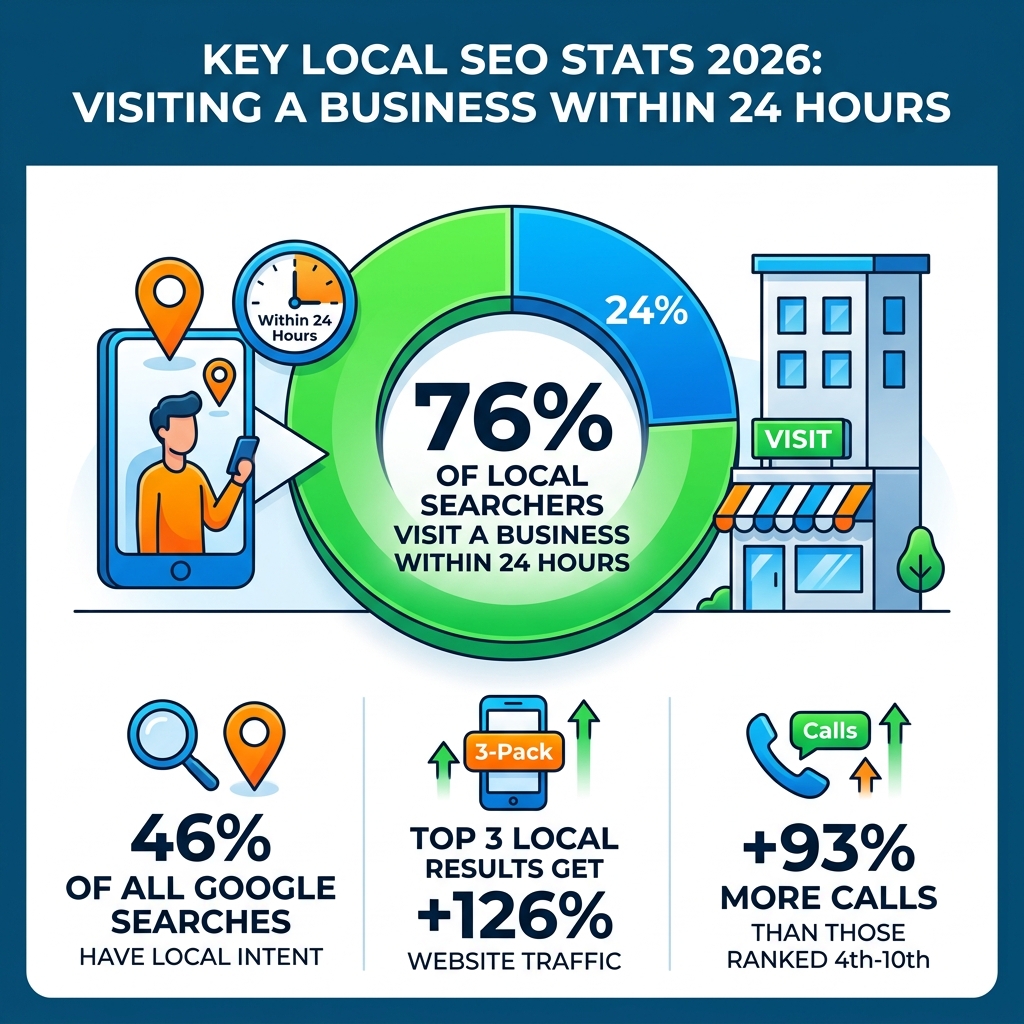
Here’s a number that should stop you in your tracks: 76% of people who search for something nearby on their smartphone visit a business within 24 hours. And 46% of all Google searches have local intent.
That means your next customer is already searching. The only question is whether they find you — or your competitor down the street.
Local search isn’t just about showing up on a map. It’s about showing up first, in the right context, at the exact moment someone is ready to buy. Businesses that land in Google’s top 3 local results get 126% more website traffic and 93% more calls than those ranked 4th through 10th. That gap is enormous — and it’s entirely winnable with the right strategy.
This guide walks you through everything you need to know to dominate Google Maps and local search results, step by step.
My name is Ronnie Katz, and since 2006 I’ve helped hundreds of businesses improve local search presence through SEO, Google Business Profile optimization, and local citation building at BullsEye Internet Marketing. Over nearly two decades, I’ve seen what actually moves the needle in local rankings — and I’m sharing the exact strategies that work right now.
Improve local search presence terms to remember:
The Core Pillars of Google’s Local Ranking Algorithm
To win at local search, we first have to understand how the “referee” (Google) scores the game. Google doesn’t just throw darts at a map; it uses a sophisticated algorithm designed to provide the most helpful answer to a user’s query.
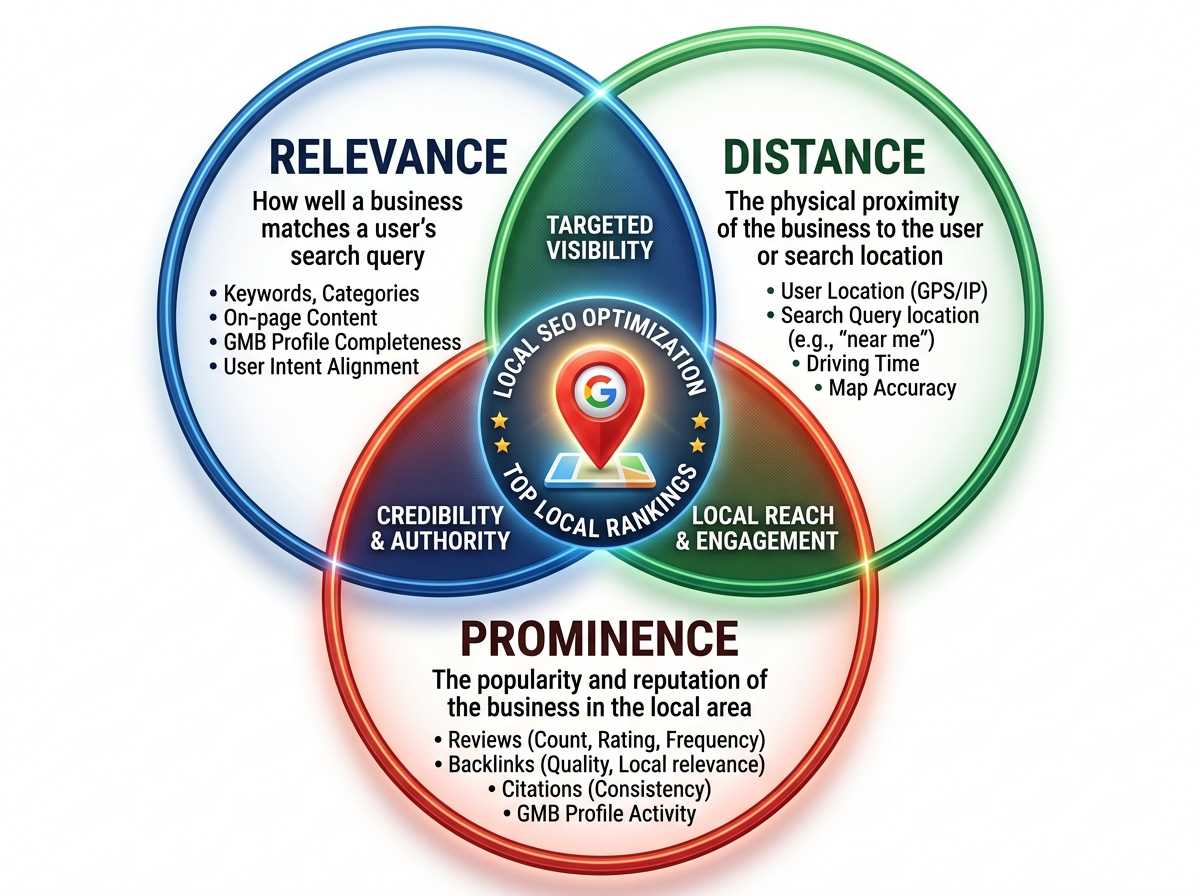
Google officially states that local rankings are determined by three primary factors: Relevance, Distance, and Prominence. When these three align, your business moves into that coveted “Local Pack” or “3-Pack” at the top of the search results.
You can find official Tips to improve your local ranking on Google directly from the source, but we’re going to dive deeper into how these apply to your daily operations. For a broader look at how these fit into a marketing plan, check out our More about Local SEO Services.
Understanding Relevance and Distance
Relevance is how well your business profile matches what someone is searching for. If a customer in Miami searches for “emergency plumber,” Google looks for businesses that have clearly signaled they provide that specific service. This is why choosing the correct business categories and using specific keyword matching in your description is vital.
Distance is exactly what it sounds like: how far is the searcher from your business? While we can’t move your physical address, we can optimize your “service area” settings if you’re a Service Area Business (SAB) like a roofer or landscaper. Google calculates distance based on what it knows about the user’s location, which is why “near me” searches are so powerful.
The Role of Prominence in Search
Prominence is Google’s way of asking, “How famous is this business?” It’s based on information Google has about a business from across the web. This includes backlinks from local news sites or blogs, your review count and score, and overall SEO signals from your website.
| Feature | Local Map Pack | Local Organic Results |
|---|---|---|
| Primary Driver | Google Business Profile (GBP) | Website Content & Backlinks |
| Key Ranking Factor | Proximity & GBP Categories | Domain Authority & On-Page SEO |
| Visual Elements | Map, Star Rating, Photos | Text Snippets, Meta Descriptions |
| Click-Through Rate | Extremely High (50%+) | Moderate (varies by position) |
Strategies to Improve Local Search Presence in 2026
The landscape of local search is shifting. In 2026, a “set it and forget it” approach to your Google Business Profile (GBP) will leave you in the dust. To truly improve local search presence, you need an active, optimized profile that acts as a second homepage for your business.
The first step is always profile verification. Without it, you have no control over the data Google shows. Once verified, focus on your primary category. This is often the single most important factor for ranking. If you’re a “Personal Injury Attorney,” don’t just settle for “Lawyer.” Be specific.
You can also add up to nine secondary categories. These help you show up for a wider variety of searches without diluting your main focus. Our GMB Optimization Services are designed to help you navigate these technical nuances.
Maximizing Google Business Profile Features
Think of your GBP as a social media platform for your local customers.
- Google Posts: Share weekly updates about offers, events, or new services. This keeps your profile “fresh” in Google’s eyes.
- Business Attributes: Are you “women-led”? “Veteran-owned”? Do you offer “free Wi-Fi”? These attributes help you stand out and can even be used as filters by searchers.
- Q&A Section: Don’t wait for customers to ask questions. You can post your own “Frequently Asked Questions” and answer them yourself to provide immediate value.
- Messaging: Enable this feature to allow customers to text you directly from the search results. In 2026, speed of response is a massive trust signal.
- Product Catalogs & Photos: High-quality, authentic photos of your team and work are 2.7 times more likely to make your business seem trustworthy to consumers.
Managing Multi-Location Profiles
If you have locations across South Florida—say, one in Fort Lauderdale and another in West Palm Beach—you must treat them as distinct entities. Never use the same description for both. Each location needs its own verification, unique local photos, and location-specific reviews to rank effectively in its specific neighborhood.
Technical Foundations: NAP Consistency and Schema Markup
Google is a giant data-matching machine. If your business is listed as “BullsEye Internet Marketing” on your website but “BullsEye Marketing” on Yelp, Google gets confused. In SEO, confusion equals lower rankings.
This is where NAP consistency (Name, Address, Phone) comes in. We recommend performing regular directory audits to ensure your info is identical across the web. For a deeper dive, read The Essential Guide to Local Citations.
Optimizing Your Website to Improve Local Search Presence
Your website and your GBP are two sides of the same coin. To rank well on the map, your website must be technically sound.
- Local Landing Pages: If you serve Miami-Dade and Broward counties, create dedicated pages for each.
- Mobile Responsiveness: Since more than half of search traffic is mobile, a site that is hard to use on a phone will be penalized.
- Core Web Vitals: Google rewards sites that load in under 3 seconds.
- Embedded Google Maps: Placing a map on your contact page helps Google confirm your physical location.
For more tips, check out How to Optimize Google Business Profile.
Implementing Local Business Schema
Structured data, specifically JSON-LD, is a piece of code you add to your site that tells Google exactly what your business is in a language it understands perfectly. By using LocalBusiness schema documentation, you can define your geo-coordinates, opening hours, and even your price range. This often results in “Rich Results,” which are more eye-catching snippets in the search results.
Building Authority Through Reviews and Local Citations
In 2026, Google doesn’t just look at how many reviews you have; it looks at Review Velocity (how often you get them) and Sentiment (what people are actually saying).
According to research, 95% of customers read online reviews before making a purchase. A steady stream of 4 and 5-star reviews is the ultimate social proof.
Leveraging Reviews to Improve Local Search Presence
Don’t just collect reviews—engage with them. 92% of consumers now consider business owner responses to be a part of modern customer service.
- Professional Responses: Always thank your happy customers. For negative reviews, respond calmly and offer to fix the issue offline.
- Keyword-Rich Reviews: While you shouldn’t coach customers, reviews that naturally mention your services (e.g., “Best HVAC repair in Hollywood”) help Google understand your relevance.
- Trust Signals: A complete profile with high ratings makes you 2.7 times more likely to be seen as a reputable business. Our Google 3-Pack Tips Guide offers more on this.
Effective Local Link Building
Forget about buying thousands of cheap links. In local SEO, one link from a local Chamber of Commerce, a local news site like the Miami Herald, or a local charity you sponsor is worth more than 100 random links. These “local backlinks” prove to Google that you are a real, active member of your community.
Adapting to AI Overviews and Voice Search Trends
Search is changing. With the rise of AI search (like Google’s Gemini) and voice assistants (Siri, Alexa), people are searching using natural language. Instead of typing “Pizza Miami,” they’re asking, “Where is the best gluten-free pizza near me open now?”
Our Local Search Domination: Google Maps SEO Secrets Revealed guide dives into how to stay ahead of these trends.
Optimizing for Voice Search and Mobile
Voice searches are typically longer and more conversational. To capture this traffic, your content should answer questions directly. Use FAQ sections on your website to target these “long-tail” keywords. Voice search results often pull directly from the “Local Justifications” found in your GBP reviews and posts.
Preparing for AI-Powered Local Results
AI-powered search results prioritize “entities.” This means Google is looking for a consistent brand presence across the entire web. By maintaining strong entity signals—consistent NAP, active social profiles, and mentions on reputable local sites—you ensure that AI systems trust your business enough to recommend it.
Frequently Asked Questions about Local Search Presence
How long does it take to see results from local SEO?
Typically, you’ll see initial movement in 4 to 6 weeks. However, dominating competitive markets in South Florida usually takes 3 to 6 months of consistent effort. Local SEO is a marathon, not a sprint; maintenance is required to keep your spot once you’ve earned it.
Do I need a physical office to rank in Google Maps?
Not necessarily. If you are a Service Area Business (SAB), you can verify your profile using your home address but keep that address hidden from the public. You simply tell Google which ZIP codes or cities you serve. This makes you eligible for the Map Pack without needing a storefront.
What is the most important factor for local ranking in 2026?
While there are over 100 factors, the Primary Category on your Google Business Profile remains the most influential. Following closely behind are Review Velocity and Entity Trust—essentially, how much the web “talks” about your brand as a reliable local authority.
No-Contract SEO: How to Get Calls Now – BullsEye Internet Marketing
At BullsEye Internet Marketing, we’ve spent nearly two decades helping businesses from Miami to West Palm Beach dominate their local markets. We understand that as a small business owner, you don’t have time to play “SEO scientist.” You need calls, and you need them now.
Our approach is different. We offer no long-term contracts because we believe our results should keep you with us, not a legal document. Plus, we work with only one client per industry per geographic area, giving you a massive competitive advantage over your rivals. Whether you need Pay Per Lead services or comprehensive SEO, we are here to help you win.
Ready to take your business to the top of the map? Improve your visibility with GMB Optimization Services and let’s start growing your local presence today.
