
Why HVAC Business Advertising Is Harder — and More Important — Than Ever
HVAC business advertising has never been more competitive, or more critical to your bottom line.
The HVAC market is on track to hit $367.5 billion by 2030. Over 120,000 contractors are competing for the same local customers. And 89% of those customers start their search on Google.
Here’s what the best HVAC advertising strategies look like in 2026:
- Google Business Profile — Claim, complete, and actively manage it. It’s your single most important free tool.
- Local Services Ads (LSA) — Appear above everyone else with a “Google Guaranteed” badge. Pay per lead, not per click.
- Google Search Ads (PPC) — Capture emergency intent fast. Average cost per lead is around $104, but close rates on emergency keywords hit 60-80%.
- Organic SEO — Build location pages, write helpful content, earn rankings that pay off for years.
- Reviews — 76% of consumers read reviews before hiring. More reviews = more calls.
- Email marketing — Returns up to $40 for every $1 spent. Ideal for slow seasons and past customers.
- Referral programs — Referred customers convert at 4x the rate of cold leads.
- Traditional tactics — Truck wraps, door hangers, and direct mail still generate real results.
The contractors winning right now aren’t necessarily spending more. They’re spending smarter — combining the right channels, responding faster, and converting more of the traffic they already have.
It’s a crowded market. When a homeowner’s AC fails at 2 PM on a 97-degree day, they’re calling whoever shows up first and looks trustworthy. That’s the window you’re competing for.
I’m Ronnie Katz, founder of BullsEye Internet Marketing, and since 2006 I’ve helped HVAC businesses and other home service companies cut through the noise with data-driven HVAC business advertising strategies that actually generate calls and booked jobs. In this guide, I’ll walk you through exactly what’s working in 2026 — from Google Ads and Local Services Ads to SEO, reviews, and beyond.
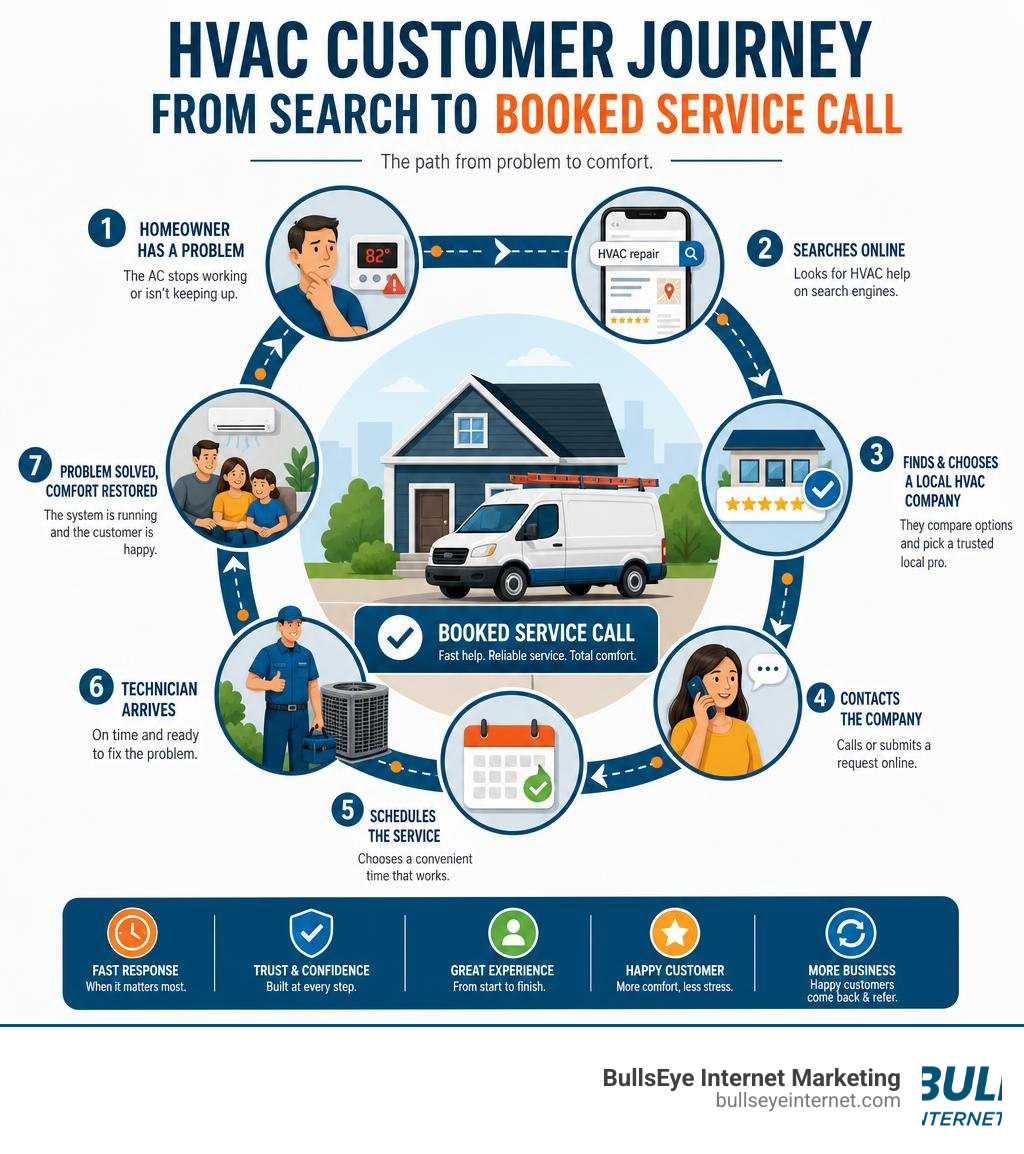
Basic HVAC business advertising vocab:
Organic vs. Paid: The Core Pillars of HVAC Business Advertising
When building a reliable stream of inbound jobs, you cannot rely on just one source of traffic. If you rely solely on paid ads, your leads stop the second you turn off your budget. If you rely solely on organic search engine optimization (SEO), you might wait months to see traction in highly competitive South Florida markets like Miami, Fort Lauderdale, or West Palm Beach.
The secret to dominating your local market is balancing organic and paid channels. Think of organic SEO as your long-term wealth builder and paid advertising as your short-term cash register. When combined correctly, they create a defensive moat around your business. To understand how these channels feed into a larger business strategy, check out our Complete Guide To Hvac Marketing Strategies.
Organic SEO and Local SEO for HVAC
Organic SEO is about positioning your website as the ultimate local authority on heating, ventilation, and air conditioning. In South Florida, where your customers’ AC systems run around the clock, search engines prioritize relevance, distance, and prominence. To rank organically, your business must establish a flawless local footprint.
- NAP Consistency: Your Name, Address, and Phone number (NAP) must be identical across your website, Google Business Profile (GBP), Yelp, and every other local directory. A single discrepancy—like “St.” instead of “Street”—can confuse search engine algorithms and damage your local rankings.
- Service Area Pages: Do not just target “South Florida AC Repair.” Create dedicated, highly optimized location pages for specific cities and neighborhoods where you want to win jobs, such as Coral Gables, Boynton Beach, Davie, or Delray Beach. Each page should contain 300 to 500 words of unique, useful content, local maps, and localized customer testimonials.
- Mobile Optimization: Over 76% of all HVAC searches in 2026 happen on mobile devices. If a homeowner in Hollywood or West Palm Beach is sweating in a hot house, they are searching from their smartphone. Your site must load in under two seconds, feature an obvious “Click-to-Call” button, and offer seamless navigation.
Paid Search and HVAC Business Advertising
Paid search is the fastest way to get your phone ringing. While organic SEO takes 6 to 12 months to mature, paid advertising puts your brand right in front of active buyers within hours.
For home services, paid search is divided into traditional Google Search Ads (Pay-Per-Click or PPC) and Google Local Services Ads (LSA). The main advantage of paid search is its ability to capture high-intent, immediate-need search queries. When someone searches for “emergency AC repair near me” at midnight, they are not looking to read a blog post; they want a technician at their door. To learn more about setting up these digital campaigns, see our guide on Hvac Digital Advertising.
Dominating Google: Local Services Ads and PPC Strategies

Google is the undisputed king of local search, owning over 92% of the market. To win the battle for local visibility, you must occupy as much real estate on the first page of Google as possible. This means utilizing both Google Local Services Ads and traditional PPC. For a deep dive into how to set up and dominate these platforms, read our Google Local Services Ads Complete Guide.
Maximizing ROI with Google Local Services Ads
Google Local Services Ads (LSAs) sit at the absolute top of the search results page, even above traditional PPC ads. They feature your business name, star rating, hours, and the highly trusted “Google Guaranteed” badge.
The biggest advantage of LSAs is the pay-per-lead model. Unlike traditional PPC, where you pay every time someone clicks your ad (regardless of whether they call), LSAs only charge you when a customer actually calls, messages, or books a job directly through the ad. In 2026, the average cost per lead for HVAC LSAs is around $51, with an impressive average booking rate of 44%.
To maximize your ROI, we strongly recommend implementing strict call tracking and auditing. Google occasionally charges for spam calls, telemarketers, or calls outside your service area. By actively monitoring your call logs and disputing unqualified leads, you can keep your marketing dollars focused entirely on real, paying customers. Discover how to leverage these ads specifically for heating and cooling companies in our resource on Local Services Ads For Heating Air Conditioning Companies.
Advanced PPC Tactics and HVAC Business Advertising
Traditional Google Ads (PPC) are highly customizable and allow you to target specific, high-value keywords that LSAs might miss. However, because competitive markets like Miami-Dade and Broward counties can see cost-per-click (CPC) rates ranging from $20 to $45, you must run highly optimized campaigns to avoid wasting budget.
- Single Keyword Ad Groups (SKAGs): By organizing your campaigns into highly specific ad groups containing just one primary keyword (e.g., “AC installation Fort Lauderdale”), you can write ad copy that perfectly matches the user’s search intent. This relevance can double your click-through rates (CTR) and lower your overall cost per click.
- Negative Keywords: This is your shield against wasted ad spend. You must actively build a list of negative keywords to block searches from people looking for “DIY AC repair,” “HVAC jobs,” “cheap parts,” or competitors’ brand names. Without a robust negative keyword list, 25% to 30% of your budget could easily bleed out on irrelevant clicks.
- Landing Page Optimization: Never send paid traffic to your homepage. If a customer clicks an ad for “furnace repair” or “heat pump installation,” they should land on a dedicated page focused solely on that service. The landing page must load in under 2.5 seconds, clearly display financing options, show real team photos, and feature a prominent click-to-call button.
Optimizing Your Website and Google Business Profile for Local Leads
Your website and your Google Business Profile (GBP) are the digital front doors of your HVAC company. If they are slow, confusing, or lack social proof, potential clients will bounce straight to your competitors.
Building a High-Converting HVAC Website
A high-converting website does not just look pretty; it acts as a silent, 24/7 salesperson. In our years of managing campaigns through our Ppc Services Florida, we have identified the core elements that separate high-converting websites from those that lose money:
- Prominent Click-to-Call Buttons: Place your phone number in the top right corner of every page. On mobile, implement a sticky “Call Now” button that stays at the bottom of the screen as the user scrolls.
- Speed to Lead Infrastructure: If a user fills out a contact form, you must respond within minutes. Implementing automated text-back software (which automatically texts a lead within 60 seconds of form submission) can increase your booking rates by over 300%.
- Clear Service Areas: List your exact service cities—whether you operate in Boca Raton, Boynton Beach, Coral Springs, or Wellington—directly on your homepage and in your footer to boost local search signals.
Leveraging Social Proof and Reviews
In 2026, 91% of homeowners check online reviews before letting a technician into their home. Prospective customers read an average of 10 reviews before they feel they can trust an HVAC contractor.
To build a competitive advantage, you must implement an automated review generation system. Don’t wait days to ask for feedback. Have your automated SMS review system send a text request within two hours of service completion, while the cold air is still blowing and the customer is happiest.
Additionally, make sure you professionally respond to every review—both positive and negative—within 24 hours. When responding to negative feedback, keep it polite, acknowledge the issue, and offer to resolve it offline. This shows prospective customers that you are accountable and dedicated to exceptional service.
Scaling with Pay Per Lead and Conversion Optimization
Many HVAC business owners find themselves frustrated by traditional marketing agencies that charge hefty monthly retainers regardless of whether they actually deliver customers. That is why pay-per-lead models have become incredibly popular for contractors looking for predictable, risk-free growth. For a comprehensive look at how this model works, read our Hvac Pay Per Lead Guide.
The Power of Pay Per Lead for HVAC Businesses
Under a pay-per-lead model, you only pay when a qualified prospect contacts your business. This shifts the marketing risk from your shoulders to the agency.
| Feature | Pay Per Lead (PPL) | Traditional Monthly Retainer |
|---|---|---|
| Payment Structure | Pay only for qualified, exclusive phone calls. | Flat monthly fee regardless of lead volume. |
| Risk Mitigation | Extremely high; no waste on empty clicks or impressions. | Low; you pay even if the campaign underperforms. |
| Lead Quality | High; leads are pre-screened for your service area. | Variable; can include spam, job seekers, and DIY searches. |
| Contract Terms | Typically performance-based or no long-term contracts. | Often requires 6 to 12-month commitments. |
By utilizing pay per lead, you can scale your operations up or down depending on your capacity and the season, ensuring your marketing spend directly correlates to revenue.
Conversion Optimization: Turning Clicks into Scheduled Jobs
Driving traffic to your website is only half the battle. If your conversion rate is sitting at a typical 2% to 3%, you are leaving a massive amount of money on the table. By optimizing your site for conversions (CRO), you can double your lead volume without spending an extra penny on ads.
Focus on the user experience. Make sure your call-to-action buttons are bright, contrasting colors. Streamline your contact forms by only asking for essential information (Name, Phone, ZIP Code, and Service Needed). Most importantly, ensure your site speed is lightning fast; a one-second delay in page load time can drop conversions by up to 20%.
Setting and Managing Your HVAC Marketing Budget
One of the most common questions we receive is: How much should my HVAC company spend on marketing?
The answer depends heavily on whether you are looking to maintain your current size or aggressively grow your market share. To understand how to align your budget with a performance-based model, check out our insights on Pay Per Lead.
Here is our recommended budget allocation for balanced, sustainable growth:
- Growth-Focused Budget (8-12% of gross revenue): Recommended for contractors looking to acquire new customers, expand their service areas, and build long-term brand equity.
- Maintenance Budget (5-8% of gross revenue): Suitable for established businesses with a large, active customer base looking to maintain their current market position.
- Google-Centric Allocation (50% of total ad spend): Half of your paid advertising budget should always go directly to Google-related platforms (LSAs, Google Search Ads, and Google Business Profile optimization) because that is where high-intent buyers go first.
- Evergreen vs. Seasonal Split: Allocate 50% of your paid budget to evergreen keywords (like system replacements, maintenance agreements, and duct cleaning) and 50% to highly targeted seasonal campaigns (like emergency AC repair during South Florida’s brutal summer months).
Frequently Asked Questions about HVAC Business Advertising
What is the average cost per lead for HVAC advertising in 2026?
In 2026, the average cost per lead (CPL) for HVAC services sits around $145, with a typical range of $110 to $185 depending on your specific market size and competition level. LSAs generally offer the lowest CPL (averaging $51), while highly competitive Google Search terms like “emergency AC replacement Miami” can push traditional PPC lead costs higher. However, because system replacements can easily run from $8,000 to $15,000+, these lead costs remain highly profitable.
How do I market my HVAC business during the slow shoulder seasons?
The spring and fall shoulder seasons can be stressful, but they are also the best times to run targeted maintenance campaigns. Instead of pausing your ads (which hurts your Google Quality Score and algorithm learning), shift your focus to seasonal tune-up promotions and preventative maintenance agreements. Send targeted email campaigns to your past customer database offering “early bird” AC checkups in March before the summer heat hits. This keeps your technicians busy and builds a reliable recurring revenue stream.
How fast should my team respond to incoming HVAC leads?
You must respond to every digital lead within one minute. According to industry data, responding to a lead within 60 seconds increases your conversion rate by an incredible 391%. If you wait just five minutes, your chances of qualifying that lead drop by 80%. Homeowners facing an AC emergency in South Florida will not wait for you to call them back; they will simply call the next contractor on the list. Implement instant call routing and automated text-back systems to ensure you are always the first to respond.
Conclusion
Dominating your local market requires a smart, multi-layered approach to HVAC business advertising. By combining high-intent paid strategies like Google Local Services Ads with long-term assets like local SEO, you can keep your schedule full through every season.
At BullsEye Internet Marketing, we do things differently. We specialize in driving real, high-quality phone calls and booked jobs through tailored Pay Per Lead, Google Business Profile optimization, and local SEO. Best of all, we offer no long-term contracts and provide a massive competitive advantage by working with only one client per industry per geographic area.
If you are ready to stop wasting money on empty clicks and start paying only for real, exclusive leads in your local Florida market, we are here to help. Discover how we can help you scale your home services business by checking out our guide on Google Local Services Ads For Home Services or contact us today to secure geographic exclusivity for your area!
