
Build a Patient Pipeline That Patients Can Find and Trust
The most effective doctor marketing strategies connect high-intent local search with a fast, trustworthy path to booking. Start by strengthening your Google Business Profile and local SEO, building service pages that work well on mobile, earning authentic reviews, and tracking every call, form, and booked appointment. Then use targeted paid search, referral relationships, patient education, and automated follow-up to grow without wasting budget.
Patients often research a practice long before they call. More than 90% consult online reviews, yet 88% of healthcare appointments are still scheduled by phone. That means your digital presence must do two jobs: build confidence online and make it easy for someone to reach a real person or book at any hour.
The goal is not more website traffic for its own sake. It is a measurable pipeline of qualified new patients, returning patients, and referrals – at an acquisition cost that makes sense for the lifetime value of each patient.
I am Ronnie Katz, founder and Principal CEO of BullsEye Internet Marketing, with more than 20 years of experience helping businesses improve visibility, traffic, and conversions. Since 2006, I have applied practical SEO, local search, paid lead generation, and conversion principles to build doctor marketing strategies focused on calls, appointments, and transparent ROI.
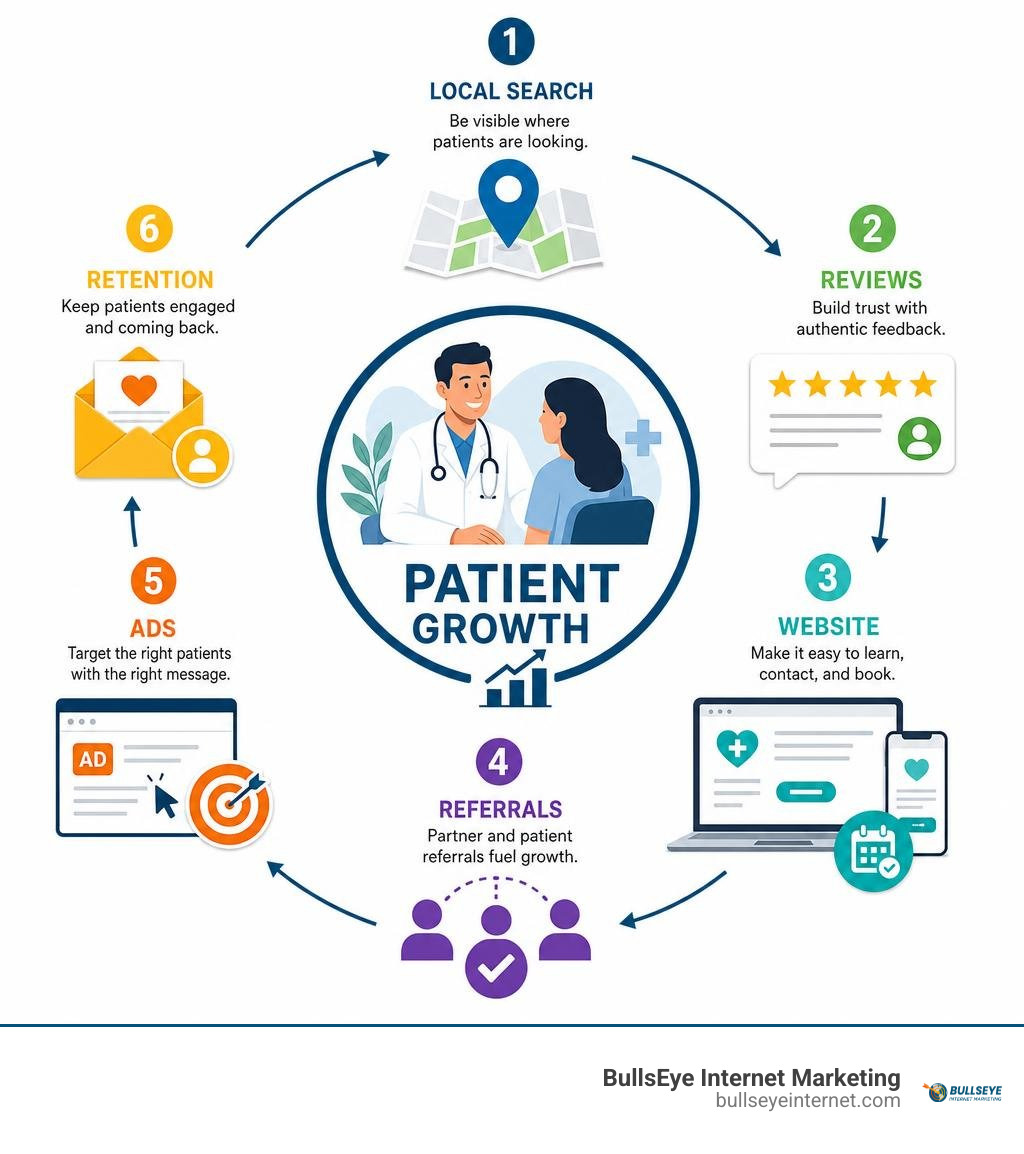
Doctor marketing strategies word roundup:
Core Digital Doctor Marketing Strategies for Practice Growth

The healthcare marketplace is more competitive than ever. Proximity alone no longer guarantees a steady flow of patients into your waiting room. When an individual experiences new symptoms or seeks specialized care, they do not default to the closest clinic down the street; they initiate a comprehensive digital decision journey.
Prospective patients evaluate your clinical credentials, browse online patient reviews, inspect your procedural descriptions, and check appointment availability across multiple digital touchpoints. Because 88% of healthcare appointments are still scheduled over the phone, your digital presence must serve as an engaging, high-converting front door that seamlessly guides a visitor from a search query to a live phone conversation or direct online booking.
To capture market share in 2026, medical practices must deploy a cohesive, multi-channel strategy that addresses patient intent at every stage of their search. Practices experiencing positive year-over-year revenue growth invest approximately three times more in digital marketing and targeted ad campaigns than practices with stagnant revenue. By implementing proven digital acquisition channels, your clinic can capture high-intent demand and build long-term patient loyalty.
Local Search Optimization and Doctor Marketing Strategies
Local search visibility is the single most critical asset for any independent practice or specialty clinic. When prospective patients search for care, the vast majority click within the Google Map Pack (the top three local listings). Practices ranking in the Google 3-Pack capture 3 to 5 times more appointment requests than practices relegated to page two.
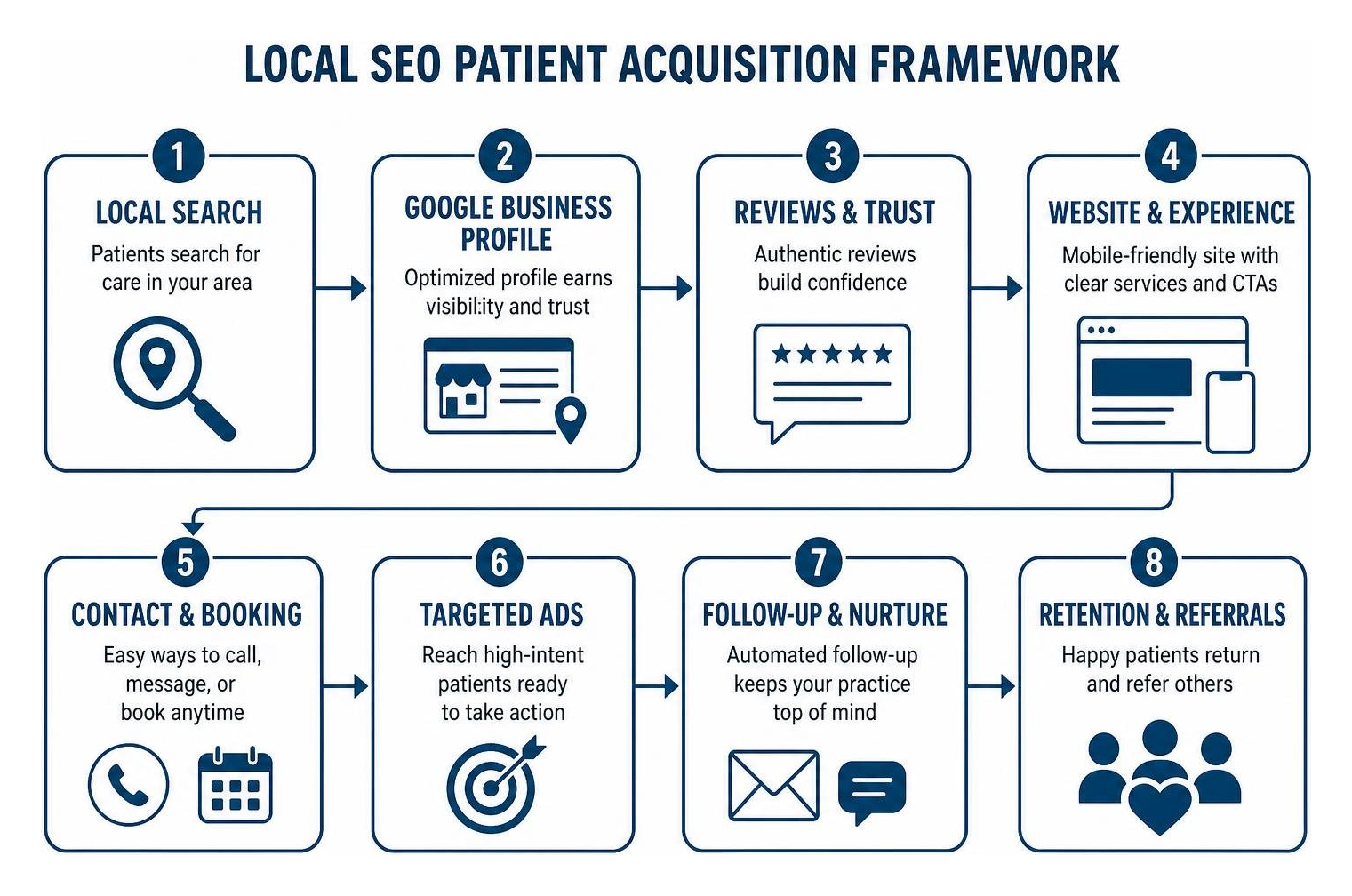
Securing a top position requires technical precision and active profile management:
- Google Business Profile (GBP) Optimization: Claim, verify, and complete every available section of your profile. Add specific primary and secondary medical categories, up-to-date operating hours, telehealth capabilities, accepted insurance plans, and detailed service descriptions. Uploading 10 or more high-resolution photos of your clinic, provider staff, and diagnostic technology yields 42% more direction requests and 35% more website clicks.
- Name, Address, and Phone (NAP) Consistency: Maintain identical contact information across major healthcare directories like WebMD, Healthgrades, Vitals, and CareDash. Inconsistent suite numbers or outdated phone lines dilute local search signals.
- Structured Schema Markup: Implement
MedicalOrganizationandLocalBusinessschema markup on your website. This structured code provides search engines with precise data regarding physician specialties, clinical sub-categories, accepted insurances, and physical office locations. - Geo-Targeted Service Landing Pages: For practices serving diverse communities—such as clinics across Miami, Fort Lauderdale, West Palm Beach, or Coral Gables—create dedicated service pages tailored to each physical area. Pairing localized content with comprehensive medical SEO implementation ensures your practice ranks for high-intent queries like “cardiologist near me” and specialty terms in your specific municipality.
Targeted Paid Search and Lead Generation Campaigns
While organic search builds long-term equity, paid search delivers immediate visibility for high-intent, urgent medical searches. Patients searching for “urgent pediatric care,” “same-day joint injection,” or “emergency root canal” require care immediately and convert at exceptionally high rates.
To maximize return on ad spend (ROAS) and avoid burning budget on unqualified clicks, healthcare pay-per-click (PPC) campaigns require rigorous structure:
- Negative Keyword Filtering: Implement an aggressive negative keyword list to eliminate non-patient searches. Exclude terms like “salary,” “jobs,” “degree,” “definition,” “billing codes,” and “DIY.” This prevents your clinic from paying for clicks from medical students, billing coders, or job seekers.
- Radius and Geo-Fencing Controls: Restrict your ad delivery to a realistic patient travel radius—typically 5 to 15 miles around your clinic, adjusted for urban versus suburban traffic patterns. Directing clicks to dedicated, single-service landing pages rather than a generic homepage prevents bounce rates and cuts wasted spend by up to 70%.
- High-Converting Ad Formats: Complement standard search ads with Google Local Services Ads (LSAs) and call-only extensions. Utilizing healthcare Google local ads enables practices to build immediate trust through verified badges. Furthermore, deploying Google Local Services Ads for health clinics allows you to pay per qualified phone lead rather than per click, delivering predictable acquisition costs.
- Strategic Lead Generation: Implementing systematic, modern lead generation models allows your practice to capture after-hours appointment requests via secure web forms and integrated click-to-call buttons. Aligning these ad assets with the American Medical Association’s ethical principles for physician marketing and branding protects your reputation while accelerating patient volume.
Content Marketing, Patient Education, and Video Outreach
Modern patients conduct extensive research before scheduling diagnostic procedures or elective treatments. High-quality content marketing bridges the gap between patient curiosity and clinical trust.
- Evidence-Based Written Content: Publish authoritative, plain-language guides explaining common conditions, procedural expectations, recovery timelines, and preventive care. Structuring healthcare articles with concise direct-answer sections (80 to 150 words) optimizes your site for both traditional search engines and emerging AI answer engines.
- Procedural Video Walkthroughs: Video is one of the most underutilized assets in healthcare marketing. Short, 2-minute clinical videos filmed on a smartphone—such as an orthopedic doctor demonstrating what happens during an MRI or a dermatologist explaining post-laser care—demystify visits and alleviate patient anxiety.
- Specialty-Specific Campaigns: For cash-pay, elective, or specialized procedures, content must highlight aesthetic outcomes, advanced technology, and personalized care plans. Tailored campaigns, such as specialized aesthetic clinic marketing, require rich visual galleries and clear explanations of treatment longevity. Integrating these assets with comprehensive digital patient acquisition strategies establishes your physicians as the preeminent local authorities in their fields.
Patient Acquisition Cost Benchmarks and Referral Channel Economics
To maintain practice profitability, clinical directors and practice administrators must understand the underlying unit economics of patient acquisition. Measuring marketing performance solely by vanity metrics like website traffic or impressions obscures true practice ROI. Sustainable growth requires tracking Patient Acquisition Cost (PAC) against the long-term Patient Lifetime Value (LTV).
| Medical Specialty | Typical Patient Acquisition Cost (PAC) | Average Patient Lifetime Value (LTV) | Target PAC-to-LTV Ratio | Recommended Primary Channels |
|---|---|---|---|---|
| Primary Care / Family Medicine | $50 – $150 | $1,500 – $3,500 | < 10% | Local SEO, Google Business Profile, Automated Recalls |
| Medical Aesthetics / Dermatology | $100 – $300 | $2,500 – $7,000 | 10% – 15% | Paid Search (PPC), Meta Ads, Video Content, Email Workflows |
| Orthopedics & Sports Medicine | $150 – $500 | $5,000 – $15,000 | < 10% | Google Ads, Local Map Pack, P2P Referral Networks |
| Cardiology & Interventional Care | $200 – $600 | $6,000 – $18,000+ | < 5% | P2P Physician Referrals, Organic Search, Local Directories |
| Pediatrics | $60 – $180 | $2,000 – $4,500 | < 8% | Community Outreach, Local SEO, Direct Mail Postcards |
Establishing a sustainable growth strategy requires following a proven blueprint for new patient marketing that balances immediate paid acquisition with organic referral loops.
Calculating PAC and Managing Practice Marketing Budgets
Patient Acquisition Cost represents the total operational investment required to bring a single new patient through your clinic doors. To calculate PAC accurately, evaluate data across a rolling 90-day window:
$$text{PAC} = frac{text{Total Marketing Spend (Ad Spend + Agency Fees + Creative Assets + Software)}}{text{Total Number of Verified New Patients Acquired}}$$
A healthy, sustainable medical practice maintains an aggregate PAC-to-LTV ratio under 20%, with high-performing clinics achieving sub-10% ratios.
Budget allocation benchmarks depend heavily on practice lifecycle goals:
- Practice Maintenance (2% to 3% of gross revenue): Designed for mature clinics operating at near-capacity, focused on patient retention, local directory management, and replacing natural annual patient churn.
- Moderate Growth (4% to 5% of gross revenue): Recommended for established practices looking to expand patient panels, introduce a new associate provider, or launch an ancillary service line.
- Aggressive Expansion (6% to 10%+ of gross revenue): Critical for new practices, clinics entering competitive urban markets, or facilities launching major cash-pay service lines.
Industry data shows that 62% of private practices invest only 1% to 5% of revenue into marketing; however, practices treating marketing as a scalable investment engine rather than a fixed overhead cost consistently outpace local competitors. For deeper insights into managing specialty acquisition metrics, consult established patient acquisition cost models.
Physician-to-Physician (P2P) Referral Network Development
Not every patient begins their search on a search engine. A massive volume of specialized clinical care originates via direct doctor-to-doctor recommendations. Relying exclusively on informal, passive word-of-mouth leaves your schedule vulnerable to competing hospital networks.
Building an active, resilient physician referral network involves specific, systematic workflows:
- The 48-Hour Consultation Loop: The number one complaint among referring primary care providers (PCPs) is the lack of timely communication following a patient consult. Establish a protocol ensuring diagnostic summaries, operative notes, and treatment recommendations are transmitted back to the referring physician’s EMR within 48 hours. When PCPs know their patients are managed promptly and returned for ongoing primary care, referral loyalty surges.
- Concise, Actionable Thought Leadership: Research reveals that 82% of physicians say peer-reviewed articles are the most influential format when making treatment decisions, and 75% prefer accessing updates through digital platforms and online journals. However, because 76% of doctors struggle with severe time constraints, physician outreach must be brief, evidence-based, and focused on clinical outcomes rather than sales copy.
- Specialist Co-Management Networks: Create direct communication pathways with allied health professionals. Orthopedic specialists should build systematic ties with local physical therapy clinics; periodontists should co-manage complex cases with general dentists; and cardiologists should maintain relationships with internal medicine groups.
- Professional Platform Engagement: Maintain active physician profiles on Doximity and LinkedIn. Sharing concise clinical case studies, novel surgical techniques, and diagnostic protocols establishes clinical leadership and keeps your practice top-of-mind among local medical peers.
Reputation Systems, Modern UX, and Retention Automation
Acquiring a new patient costs approximately five times more than retaining an existing one. True practice scalability requires aligning modern web design with automated post-visit engagement systems.
A high-converting medical website must function flawlessly across mobile devices. With over 60% of healthcare searches occurring on smartphones, slow load speeds, cluttered navigation menus, and non-responsive intake forms destroy conversion rates. A healthy healthcare website converts between 3% and 5% of visitors into booked appointments or direct phone calls; conversion rates below 2% signal serious friction in your digital intake pipeline.
Online Reviews and Proactive Reputation Management
Online reviews serve as the primary trust currency for modern healthcare consumers. Over 90% of prospective patients read online reviews before booking an appointment with a new doctor. A stellar clinical reputation cannot be left to chance. Satisfied patients rarely think to post a review unprompted, whereas frustrated patients frequently seek a public outlet.
Practices must establish proactive, systematic reputation workflows:
- Automated Post-Visit Review Requests: Integrate your practice management system to send automated SMS review requests within two hours of discharge. Texts containing a direct, single-click link to your Google Business Profile generate substantially higher review volume than email requests sent days later.
- Net Promoter Score (NPS) Filtering: Deploy brief, one-question satisfaction surveys (“How likely are you to recommend Dr. Smith to a friend or family member?”). Route highly satisfied promoters directly to Google or Healthgrades to leave public feedback, while routing neutral or dissatisfied responses internally to your practice manager for immediate resolution.
- Public Review Etiquette: Never ignore patient feedback. Responding professionally to both positive and critical reviews demonstrates clinical attentiveness. Addressing criticism constructively reassures prospective patients far more than having a flawless profile devoid of commentary. Discover additional reputation blueprints in our comprehensive medical practice growth guide.
Advanced Automation and Doctor Marketing Strategies for Retention
Silence from your front office is the leading cause of patient attrition. Automated retention systems maintain engagement without burdening administrative staff:
- Automated Appointment Reminders: Deploy a multi-touch reminder cadence—an SMS confirmation at the time of booking, a follow-up 48 hours prior, and a final text reminder 2 hours before the visit. This simple workflow reduces costly clinic no-show rates by 20% to 30%.
- Automated Service Recalls: Re-engage overdue patients through systematic recall workflows. Configure triggers based on clinical service intervals—such as 6-month dental hygiene recalls, 12-week aesthetic follow-ups, or 11-month annual wellness exam notices. Well-structured recall workflows routinely convert 15% to 25% of inactive patient panels back into active bookings.
- 24/7 Digital Self-Scheduling: Modern patients expect the ability to schedule visits outside standard business hours. Embedding real-time scheduling widgets on your site captures high-intent patients booking appointments late in the evening or over weekends, bypassing front-desk phone bottlenecks entirely.
Essential HIPAA and Compliance Standards in Healthcare Marketing
Healthcare marketing operates under stringent regulatory oversight. Violating patient privacy regulations can result in catastrophic financial penalties and severe reputational damage. Under 2026 Department of Health and Human Services (HHS) enforcement standards, Tier 1 HIPAA violations carry mandatory minimum fines, while willful-neglect penalties exceed $2 million per violation.
Every digital marketing strategy must adhere to strict healthcare compliance standards:
- Written Testimonial Authorizations: Never publish patient testimonials, success stories, video interviews, or before-and-after clinical photographs without an explicit, signed HIPAA media release form. Verbal consent is legally invalid. The authorization must outline exactly where, how, and for how long the media will be displayed.
- Public Review Response Safeguards: When replying to public reviews on Google, Yelp, or Healthgrades, never acknowledge that the reviewer is a patient of your practice, even if they explicitly state their treatment details in their review. Acknowledge feedback using generalized, privacy-compliant language (e.g., “Our practice is committed to delivering compassionate, timely care to every individual. Please reach out to our office manager directly at our main office phone line so we can address your feedback privately.”).
- Advertising Tracking Pixel Restrictions: Meta (Facebook/Instagram) and Google do not sign Business Associate Agreements (BAAs) covering consumer advertising tools. Embedding unconfigured Meta Pixels or standard Google Analytics tags on patient portal pages, scheduling confirmation screens, or condition-specific symptom pages can illegally transmit Protected Health Information (PHI)—such as IP addresses paired with medical search intent—to third-party ad platforms. Ensure all tracking pixels are fully anonymized or managed via server-side HIPAA-compliant tracking wrappers.
- Prohibition on Direct Retargeting: Retargeting users who visited specific specialty pages (such as oncology, addiction treatment, or mental health) with personalized display ads is strictly prohibited without explicit patient authorization.
- FTC Endorsement Compliance: All patient endorsements, influencer partnerships, or sponsored health content must clearly disclose material connections in accordance with Federal Trade Commission (FTC) guidelines, explicitly stating that clinical outcomes vary across individuals.
Frequently Asked Questions About Medical Marketing
What is a typical marketing budget for a private medical practice?
A private medical practice typically allocates between 3% and 10% of gross annual revenue toward marketing, depending on market competition and practice lifecycle:
- Established practices in maintenance mode allocate 2% to 3% of revenue to maintain search visibility, manage directories, and replace standard patient turnover.
- Practices targeting moderate growth allocate 4% to 5% of revenue to expand patient panels and support new associate doctors.
- New practices or those pursuing aggressive growth allocate 6% to 10%+ of projected revenue to build market presence, secure organic map rankings, and fuel paid search campaigns.
For paid digital search campaigns (Google Ads), medical practices generally require a dedicated monthly ad spend of $3,000 to $8,000 to gather statistically significant conversion data and outrank competitive local networks.
How do patient reviews affect search engine rankings and bookings?
Patient reviews serve as a primary local ranking signal and the ultimate conversion catalyst:
- Map Pack Visibility: Google’s local search algorithm evaluates review volume, average star rating, review recency, and review velocity. Practices that regularly generate authentic, positive reviews consistently outrank competitors with dormant profiles.
- Keyword Integration: When patients naturally include procedure names or location details in their reviews (e.g., “Dr. Miller provided the best pediatric care in Miami”), Google associates those clinical keywords with your Google Business Profile.
- Booking Conversions: Over 90% of prospective patients evaluate online ratings prior to selecting a provider. A clinic with a 4.8-star rating across 150 reviews will dramatically outperform a competing clinic with a 5.0-star rating across only 3 reviews.
What are the primary HIPAA risks in digital advertising?
The primary HIPAA compliance risks in modern healthcare digital advertising include:
- Third-Party Tracking Pixels: Installing standard ad tracking scripts on pages that reveal patient medical conditions or inside appointment-booking workflows. Transmitting an IP address alongside medical search metadata violates federal privacy mandates.
- Improper Review Responses: Confirming patient relationships or disclosing medical details when publicly answering reviews on third-party sites.
- Unencrypted Intake Forms: Using non-compliant web contact forms that store patient health data without end-to-end encryption or a signed Business Associate Agreement (BAA) with the hosting vendor.
- List Retargeting: Uploading patient email lists or phone numbers into ad platforms (like Meta Custom Audiences or Google Customer Match) without explicit, written HIPAA authorization.
Conclusion
Building a resilient, predictable patient pipeline requires moving away from fragmented, ad-hoc marketing tactics. Sustainable medical practice growth in 2026 demands a complete, integrated system: dominant local map visibility, high-converting mobile web experiences, automated reputation workflows, ethical physician referral networks, and strict HIPAA compliance.
At BullsEye Internet Marketing, we specialize in driving qualified patient inquiries and appointment bookings through disciplined local search optimization, pay-per-lead strategies, and high-performance professional service ads. We deliver a distinct competitive edge by operating with no long-term contracts and maintaining strict market exclusivity—working with only one practice per medical specialty per geographic area across our service locations throughout the United States and Florida. Contact us today to secure your market exclusivity and build a thriving, predictable patient pipeline.
