
Why an AI Visibility SEO Strategy Matters in 2026
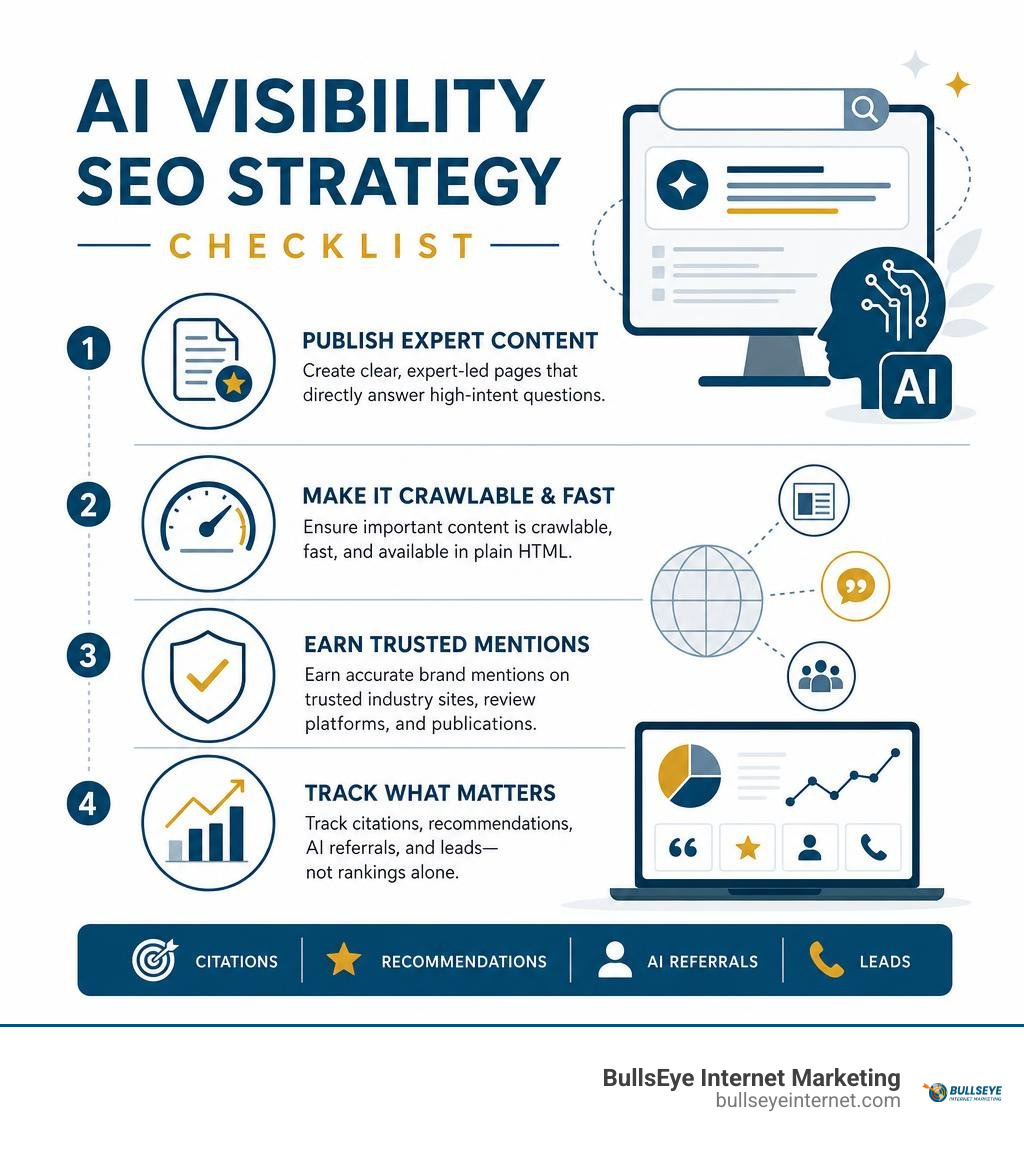
An effective ai visibility seo strategy helps your business show up when ChatGPT, Perplexity, Google AI Overviews, and other AI tools answer customer questions. Start by:
- Publishing clear, expert-led pages that directly answer high-intent questions.
- Making important content crawlable, fast, and available in plain HTML.
- Earning accurate brand mentions on trusted industry sites, review platforms, and publications.
- Tracking citations, recommendations, AI referrals, and leads – not rankings alone.
Traditional SEO is still the foundation. But AI search often gives users a synthesized answer instead of a list of links. If your brand is not cited, named, or recommended in that answer, a strong Google ranking may not be enough to win the customer.
This shift matters because people are changing how they research. Roughly 37% of consumers now begin searches with an AI tool, while AI-driven referrals have grown quickly. These visitors can also be more engaged: research cited in this guide shows AI-referred users view more pages and bounce less often than other visitors.
AI systems look for information they can retrieve, understand, verify, and confidently use. That means useful first-hand experience, specific facts, clear page structure, consistent brand details, and third-party proof all matter. There is no reliable shortcut such as stuffing keywords, creating thin AI-written pages, or relying on an llms.txt file.
I am Ronnie Katz, founder and Principal CEO of BullsEye Internet Marketing, and I have spent more than 20 years helping businesses improve online visibility, traffic, and conversions. My approach to an ai visibility seo strategy combines proven SEO, local search, reputation work, and measurable conversion-focused marketing so visibility leads to more calls and sales.
Understanding AI Visibility vs. Traditional SEO in 2026
Search has evolved beyond ten blue links. In 2026, generative engines construct direct, conversational answers on the fly. Traditional SEO focuses on optimizing individual URLs to rank for specific search queries. AI visibility—often called Generative Engine Optimization (GEO) or Answer Engine Optimization (AEO)—focuses on whether large language models (LLMs) extract your data, cite your URLs, and recommend your brand when answering complex user prompts.
This divergence is clear in modern search data. Comprehensive research on AI visibility benchmarks reveals that only about 8% of ChatGPT and Gemini citations come from URLs in Google’s top 10 organic results. While Google AI Overviews overlap more closely with organic rankings, third-party AI assistants rely on distinct live web retrieval indexes, Brave search APIs, Bing pipelines, and specialized evaluation weights.
| Feature / Metric | Traditional SEO | AI Visibility (GEO / AEO) |
|---|---|---|
| Primary Goal | SERP rank positions (#1–#10) | Citations, brand mentions, and model recommendations |
| User Experience | Click-through to visit a webpage | Zero-click synthesized summaries and follow-up prompts |
| Core Retrieval Unit | Full HTML document / URL | Specific extracted text capsules, data points, and entities |
| Authority Signals | Backlink volume, anchor text, PageRank | Brand mentions, third-party corroboration, entity consensus |
| Technical Focus | Indexing, mobile rendering, Core Web Vitals | Raw HTML delivery, SSR, entity schema, fast extraction |
| Conversion Metric | Organic sessions, direct CTR | Assisted conversions, AI referrals, qualified pipeline |
When brands rank in the top 3 positions on Google for a keyword, they show up in ChatGPT and Perplexity responses roughly 82% of the time, dropping to 77% for first-page rankings. However, if your content lacks extractable facts, the model may bypass your site entirely in favor of an industry directory or competitor page. To understand this landscape deeply, review the ultimate guide to generative engine optimization and ai search visibility.
How AI Engines Synthesize Answers and Select Citations
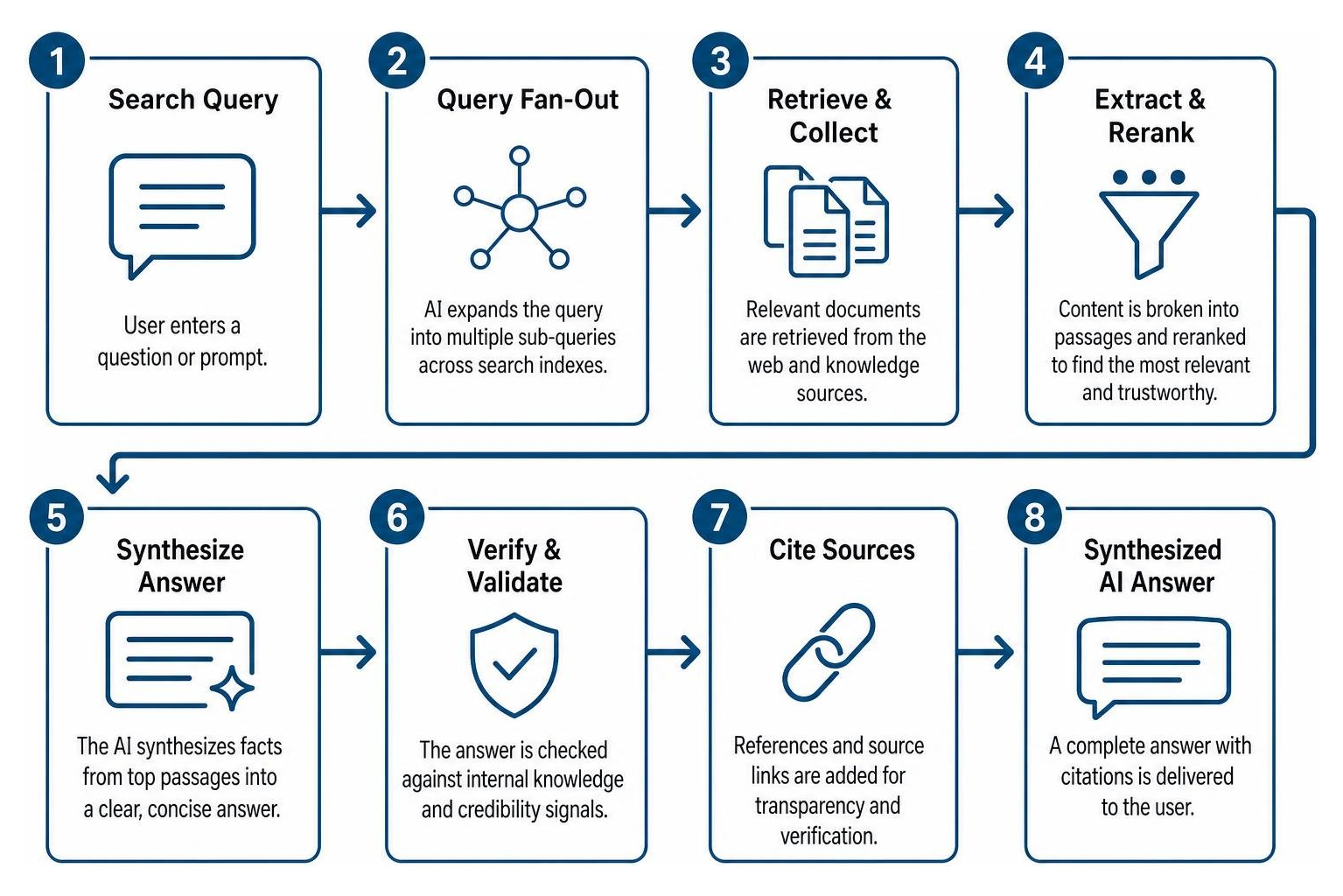
Modern answer engines use Retrieval-Augmented Generation (RAG) to produce real-time responses. When a user enters a prompt, the system issues several background sub-queries across search indexes—a process called query fan-out.
The AI retrieves relevant documents, breaks them down into context passages, and applies reranking algorithms to determine which passages best satisfy the prompt. Understanding key ai search ranking factors ensures your content is selected during this reranking phase. The model synthesizes facts from top-scoring passages, checks them against internal knowledge, and appends reference links to verified sources.
The Value of AI Referral Traffic and Zero-Click Discovery
While click-through rates for informational queries may decrease by over 50% due to AI Overviews, visitors arriving from AI recommendations are exceptionally valuable. Data shows AI-referred visitors browse 12% more pages per visit and show a 23% lower bounce rate than non-AI referrals.
Furthermore, 84% of B2B decision-makers report buying based on an AI’s first suggestion, and nearly half of all executives believe AI will replace traditional search for business research by 2030. When an assistant recommends your firm, it acts as a trusted advisor, driving high-intent buyers directly into your conversion funnel.
Core Pillars of an Effective AI Visibility SEO Strategy
Winning citations requires a structured approach across content, authority, and data architecture.

Our team at BullsEye Internet Marketing uses a battle-tested hierarchy:
- Tier 1: High-Value Owned Assets: Deep, authoritative bottom-of-the-funnel pages covering category definitions, service differentiations, and direct answers.
- Tier 2: Off-Site Authority & Corroboration: Third-party brand mentions, industry reviews, and PR placements that validate your claims across the web.
- Tier 3: Machine-Readable Formatting: Schema markup, entity disambiguation, and answer-first content blocks that simplify model parsing.
If you are looking to scale this framework across competitive markets, partnering with a professional generative engine optimization service will accelerate your path to sustained inclusion.
Structuring Content for an AI Visibility SEO Strategy
LLMs favor clear, modular, and verifiable content. According to a landmark Princeton GEO study, adding statistics, quotations, and cited sources each lifted model visibility by 30% to 40%. Conversely, keyword stuffing reduced citation probability by roughly 10%.
To make your content extractable:
- Lead with direct answers: Place a concise 40-to-60-word answer capsule immediately below each question-focused H2 or H3 heading.
- Use factual, non-promotional language: Avoid vague marketing superlatives. State exactly what a service does, who it is for, and how it performs.
- Incorporate original data: Publish unique survey results, client case studies, and proprietary statistics that external publications and LLMs can cite.
- Format with semantic HTML: Use clean lists, clear tables, and descriptive headings rather than complex nested visual layouts.
For a detailed blueprint on writing for conversational engines, explore how to do ansswer engine optimization. You can also review Research on LLM citation optimization to examine how models score passage relevance.
Scaling Your Brand with an AI Visibility SEO Strategy
In the AI search ecosystem, brand visibility extends far beyond your primary domain. When evaluating product and service recommendations, LLMs cite industry-specific sites 86% of the time, compared to generic community forums like Reddit at only 16%.
Across 75,000 brands analyzed in recent industry benchmarks, branded web mentions correlate with AI visibility about 3x more strongly than traditional backlinks. AI models scan trusted third-party directories, industry trade journals, review hubs, and news platforms to confirm entity authority. Integrating digital PR and brand seeding into your broader large language model seo initiatives ensures that when an AI evaluates your industry, consensus data points directly to your business.
The Power of Entity Disambiguation and Brand Corroboration
AI search engines understand the world through entities—distinct people, organizations, places, and concepts. If an engine conflates your brand with another business or cannot find consistent descriptions of your services, it will hesitate to cite you.
To secure your entity footprint:
- Create an unambiguous, 50-word canonical description of your business and maintain it across your website, Google Business Profile, and directory profiles.
- Implement comprehensive
Organizationschema markup featuring a robustsameAsarray linking directly to your verified profiles on LinkedIn, industry associations, and major authority databases. - Align your service definitions across all digital channels, ensuring that your core offerings, leadership, and operational locations are crystal clear.
Technical Architecture and Optimization for LLM Retrieval
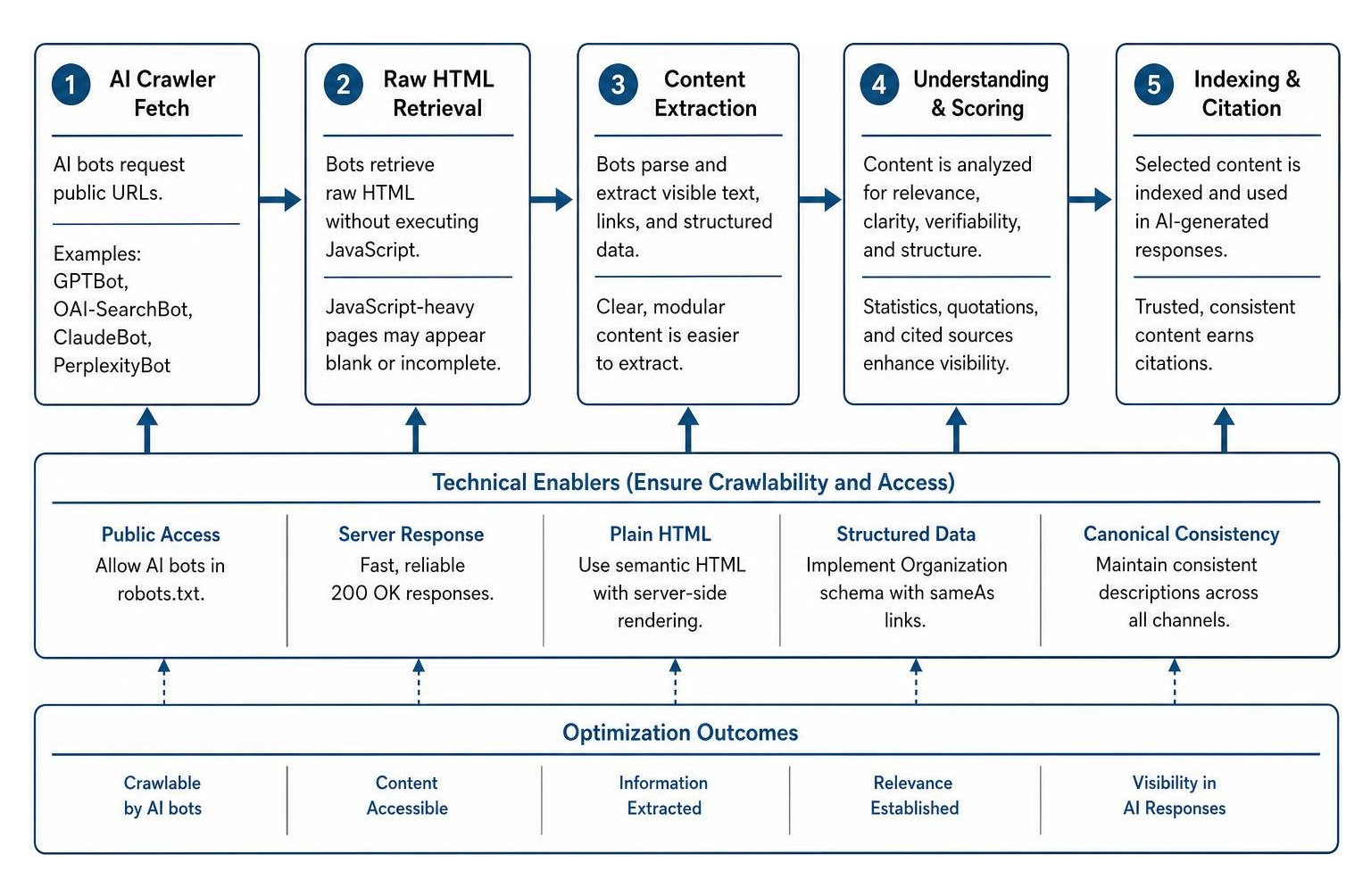
Content quality means little if AI crawlers cannot read your text. The technical layer for AI visibility focuses on raw crawlability, rapid response times, and machine-readable data structures.
Overcoming the JavaScript Rendering Gap and Crawler Blockers
The single biggest technical hurdle in AI search is the JavaScript rendering gap. Traditional Googlebot renders client-side JavaScript before indexing. However, dedicated AI fetch bots—such as GPTBot, OAI-SearchBot, ClaudeBot, and PerplexityBot—frequently pull raw HTML without executing JavaScript.
If your pricing, service details, or FAQ modules rely on client-side rendering frameworks (like heavy React or Vue setups without SSR), AI search bots may see a blank page.
To ensure comprehensive discovery:
- Implement Server-Side Rendering (SSR) or Prerendering: Serve fully formed, static HTML containing all essential copy on the initial HTTP response.
- Verify robots.txt Directives: Explicitly allow search and user-fetch bots (e.g.,
OAI-SearchBot,PerplexityBot) so your content is eligible for real-time retrieval. - Deploy IndexNow: Push instant updates to search engines whenever critical pages are updated to minimize index latency.
Fact-Checking Myths: LLMS.txt and Micro-Chunking Inefficiencies
As AI search has grown, several misconceptions have emerged:
- Myth 1: You must have an
llms.txtfile to rank. While anllms.txtmarkdown file can help some experimental bots discover key markdown documentation, Google, Perplexity, and major search engines do not require it. It is no substitute for standard sitemaps, semantic HTML, and proper schema. - Myth 2: You must artificially chop your text into micro-chunks. Forcing rigid, arbitrary character counts disrupts natural readability. AI systems evaluate contextual relevance within natural document hierarchies. Well-organized headings with direct answer capsules outperform fragmented content.
- Myth 3: AI optimization replaces traditional SEO. AI search uses the same foundational web indexes as classic search. Technical health, fast load speeds, clean navigation, and crawl efficiency remain essential.
Maintaining content freshness is also vital. The median citation half-life in AI search responses is approximately 4.5 weeks. Regularly refreshing your cornerstone content with up-to-date data keeps your URLs in active retrieval rotations.
Preparing for Agentic AI Experiences and Automated Discovery
Search is shifting toward agentic AI—autonomous agents that research, compare, negotiate, and execute transactions on behalf of human users.
To ensure your digital storefront is ready for automated agents:
- Maintain a clean Document Object Model (DOM) and logical accessibility tree so assistive AI agents can navigate interactive elements seamlessly.
- Ensure product pricing, stock availability, and service booking paths are clearly exposed via structured feeds and standard schemas.
- Prepare your infrastructure for emerging standards such as the Universal Commerce Protocol, enabling frictionless interactions between autonomous buyer bots and your checkout systems.
Measuring AI Visibility: Citations, Share of Model, and ROI
Traditional rank tracking fails to capture how often your brand is mentioned inside generated summaries. Measuring AI visibility requires monitoring model-level presence and referral behavior.

Essential Tracking Metrics: Citation Half-Life, Prompt Coverage, and Share of Voice
Evaluate your AI footprint using four primary metrics:
- Prompt Coverage: The percentage of industry-relevant target prompts that generate an answer mentioning or citing your brand.
- Citation Share & Frequency: How often your specific URLs are cited as primary reference sources compared to competitor domains.
- Share of Model (SoM): The overall proportion of generated answers in your niche that recommend your brand across ChatGPT, Claude, Perplexity, and Google AI Overviews.
- Brand Sentiment & Accuracy: Evaluating whether AI models accurately represent your core services, pricing, and unique selling points without hallucinating false claims.
Integrating Search Console and Referral Analytics for Attribution
Connecting AI discovery to bottom-line revenue requires combining several analytics data streams:
- Google Search Console: Monitor performance metrics within generative search features and track impressions from AI Overviews.
- GA4 Custom Channel Grouping: Build dedicated tracking buckets for AI referrers (e.g.,
chatgpt.com,perplexity.ai,claude.ai) to measure engagement, page depth, and assisted goal completions. - Self-Reported Attribution: Add an open-text “How did you hear about us?” field to your lead capture forms. Many high-value B2B buyers will note: “ChatGPT recommended you for our project.”
Frequently Asked Questions About AI Search Optimization
How does AI visibility differ from traditional search rankings?
Traditional SEO focuses on positioning a URL on a page of search results. AI visibility measures whether an AI assistant extracts your data, includes your brand in synthesized answers, and recommends your business when responding to conversational, multi-step user prompts.
Why are off-site brand mentions more influential than backlinks for LLMs?
Large language models process text semantically to establish factual relationships between entities. When authoritative industry sites, news platforms, and review portals consistently mention your company in relation to specific services, the AI treats this third-party consensus as a strong trust signal—even without a live hyperlink.
How do businesses track traffic originating from AI assistants?
Organizations track AI traffic by setting up custom referral filters in web analytics (GA4) for domains like chatgpt.com and perplexity.ai, monitoring Search Console generative reporting, running regular prompt simulation tests, and capturing self-reported attribution directly on lead intake forms.
Conclusion
The shift toward AI-powered search is one of the most substantial transformations in digital marketing history. As millions of buyers rely on conversational assistants to guide purchasing decisions, establishing strong visibility across large language models is essential for sustained growth.
At BullsEye Internet Marketing, we help businesses build resilient digital footprints that dominate traditional search while capturing high-value AI recommendations. Our proven approach combines technical SEO excellence, authoritative digital PR, structured data implementation, and conversion-focused design to turn visibility into calls and sales. We back our results with a strict standard: we offer no long-term contracts and work with only one client per industry per geographic area, giving your business an exclusive competitive advantage.
To future-proof your digital presence and capture more high-intent customers, explore our dedicated ai visibility optimization programs and secure your leadership in the generative search landscape.
