
Why Most Schools Are Invisible Online — And How Google Ads Changes That
Google Ads for education is one of the fastest ways for schools, colleges, and universities to reach students and parents at the exact moment they’re searching for programs.
Here’s a quick-start overview of how it works:
- Choose your campaign type — Search ads for high-intent queries, Display for awareness, YouTube for storytelling
- Target the right audience — Segment by demographics, device, location, and intent signals
- Set your budget — Starting budgets range from $1,000–$5,000/month per program
- Write program-specific ads — Match ad copy to each program’s landing page
- Track what matters — Measure cost per inquiry, application completions, and enrolled students
Think about what happens when a parent sits down on a Sunday evening and types “best private high schools near me” into Google. Or when a working professional searches “online MBA programs” during a lunch break. Those are high-intent moments — and if your school isn’t showing up, a competitor is.
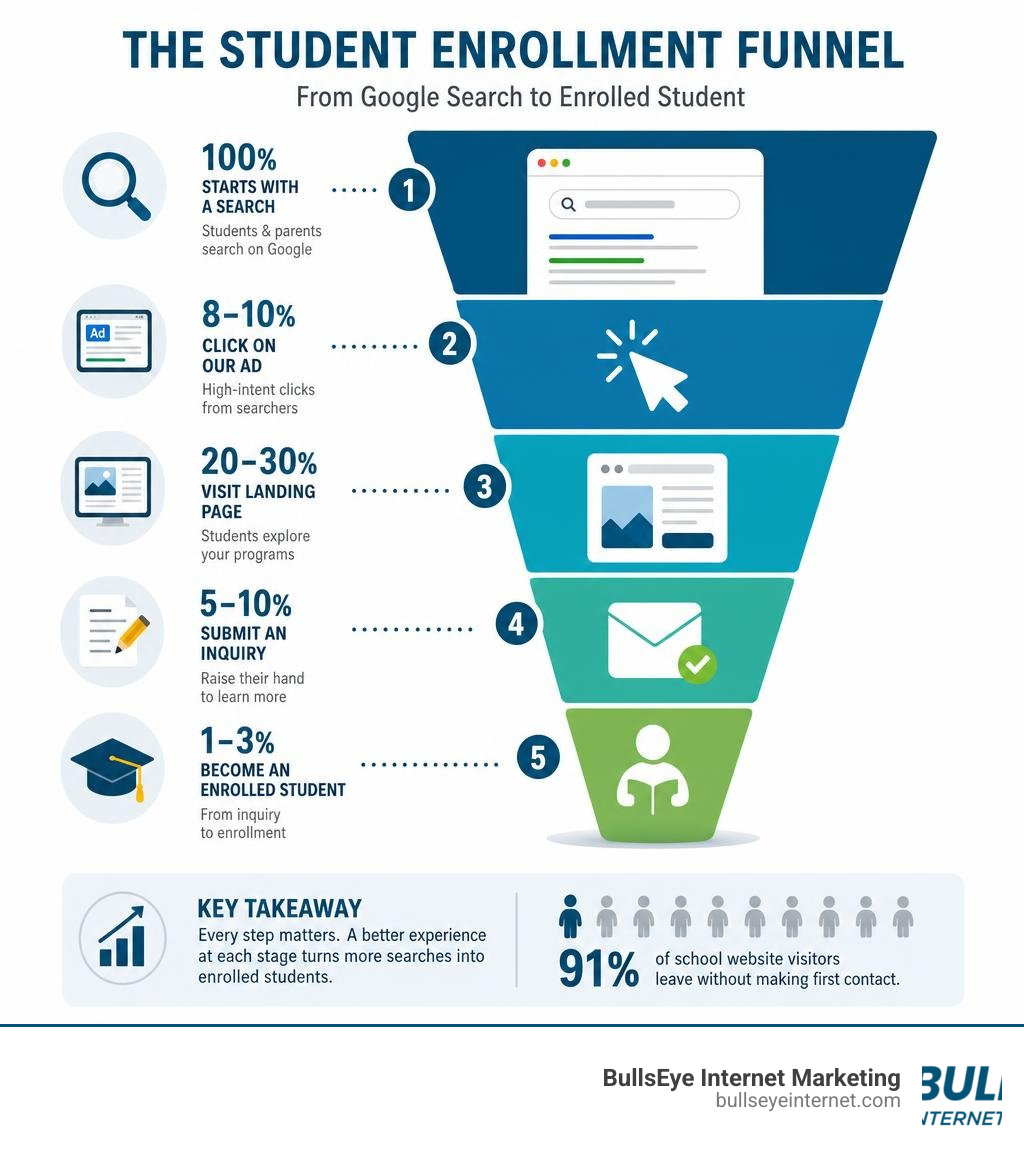
The numbers back this up. A staggering 91% of school website visitors leave without making first contact. Meanwhile, the average private school takes 47 hours to respond to a prospect email. By the time you follow up, that student may have already enrolled somewhere else.
Google Ads closes that gap. It puts your school in front of the right people at the right time — before they move on.
But running Google Ads for schools isn’t the same as running ads for a retail store. The enrollment cycle is long. The decision involves multiple people. And wasted budget is shockingly common — one audit found that 94% of keywords in a typical education ad account produced zero conversions while eating up 76% of the budget.
This guide walks you through exactly how to avoid those mistakes and build campaigns that actually fill seats.
I’m Ronnie Katz, founder of BullsEye Internet Marketing, and with over 20 years of experience managing Google Ads for education clients and beyond, I’ve seen what separates campaigns that generate real enrollments from those that just burn through budget. Let’s get into it.
Google Ads for education further reading:
Why Google Ads for education is Essential in 2026
In the current landscape of June 2026, the enrollment journey is digital-first. Gone are the days when families relied solely on physical brochures or local college fairs to make their decisions. Today, the modern student journey begins with search intent. Whether it’s a parent looking for a specialized private academy in South Florida or an adult professional seeking an online master’s degree, Google is the modern-day counselor.
Understanding this journey is critical because education is a high-consideration purchase. A student doesn’t click an ad and register on a whim. They research, compare, read reviews, and discuss options with family members. This multi-step process means you must capture demand at every stage of the funnel.
By utilizing strategic search campaigns, we can intercept prospects exactly when their intent is highest. If you’ve ever wondered about the viability of paid search for your school, checking out our resource on Does Google Ads Really Work? Your Guide to Marketing with Google can help demystify the platform’s incredible power. To build a solid foundation, our Google Ads Complete Guide covers the fundamental mechanics that govern every successful campaign.
Why Google Ads for education Matters
When compared to other digital channels, search advertising offers unparalleled benefits for educational institutions. The most compelling reason is high search intent. Unlike social media platforms where users browse passively, someone searching “nursing schools in Miami” is actively looking to take the next step in their career.
This high intent translates into highly competitive performance metrics. In fact, the education and instruction vertical enjoys an average conversion rate of 11.4%, which is one of the highest benchmarks across all major industries. This means that when you get the right traffic to your site, they are highly likely to fill out an inquiry or start an application.
Additionally, Google Ads provides immediate visibility. While search engine optimization (SEO) is a powerful long-term asset, it takes time to rank organically for competitive terms. Google Ads allows you to bypass the queue and land directly at the top of the search engine results page (SERP). For more on how to leverage Google’s immediate placement, check out the official Google Ads Help: Reach Potential Customers documentation.
Reaching the Dual Audience of Parents and Students
One of the most unique challenges of Google Ads for education is that you are often marketing to two distinct decision-makers: the student and the parent.
For K-12 private schools, the parent is the primary decision-maker, but for undergraduate programs, both parties play active roles. For graduate and adult education, the student is the sole decision-maker. To run a profitable campaign, you must segment your targeting to reach both audiences effectively:
- Parent Targeting: Parents tend to search during weekends or midday on desktops. Their queries often focus on “tuition costs,” “safety,” “academic reputation,” and “college prep.”
- Student Targeting: Students are highly mobile-centric and search late in the evening. Their queries lean toward “student life,” “career outcomes,” “campus culture,” and “flexible schedules.”
By setting up device segmentation and hour-of-day bidding, you can adjust your bids to favor mobile devices in the evening for student-focused keywords, while prioritizing desktop bids during the day for parent-focused terms. This ensures you aren’t wasting budget showing the wrong message to the wrong audience at the wrong time.
Building a High-Converting Campaign Structure
To keep your ad spend efficient, you must avoid the temptation to throw all your budgets into a single campaign. A messy account structure dilutes your data, confuses Google’s bidding algorithms, and makes it impossible to see which programs are actually driving enrollments.
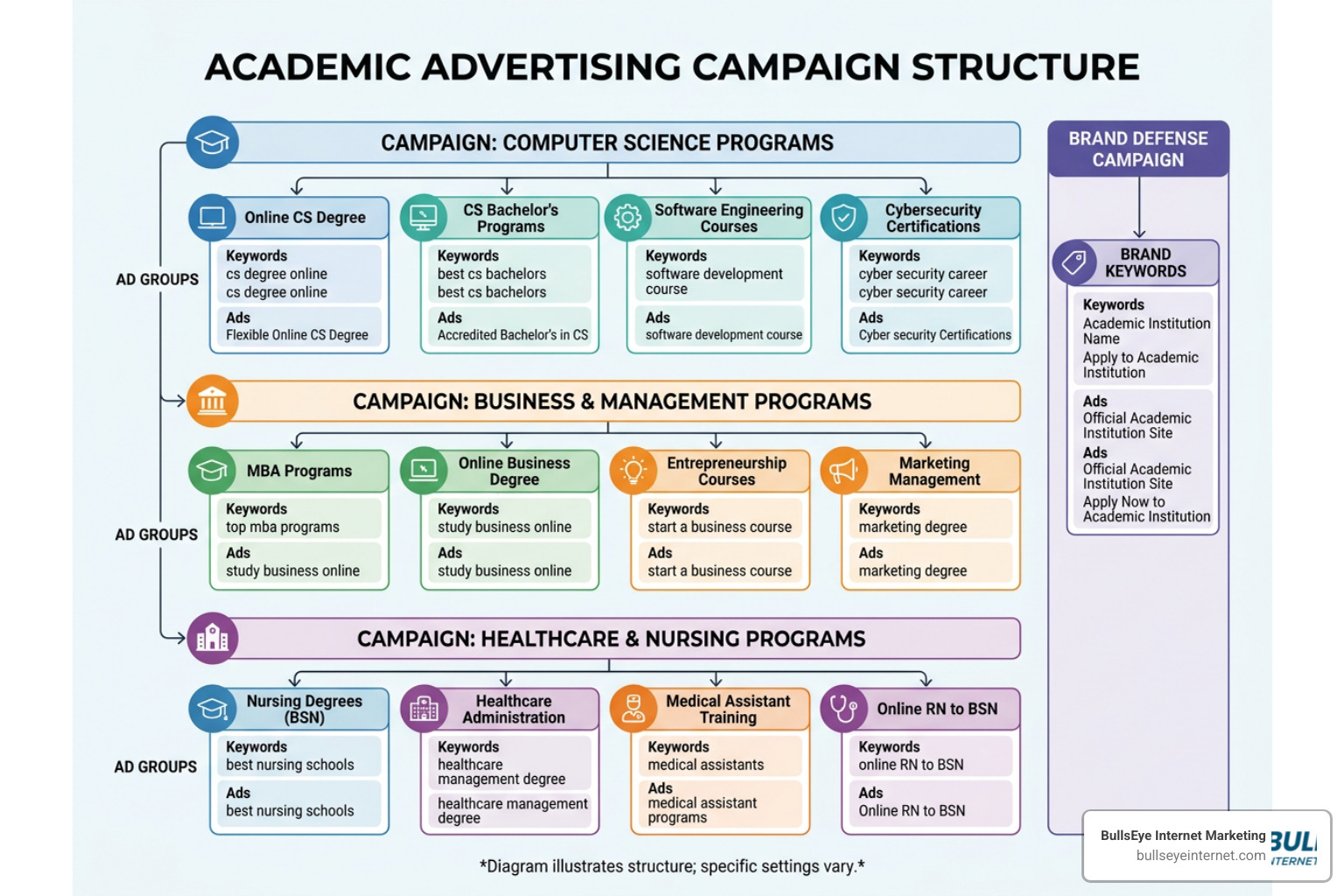
A high-performing account relies on program-specific campaigns. This means if your school offers an MBA, an Engineering degree, and an IT certificate, each of these must live in its own campaign. Why? Because the search behavior, cost-per-click (CPC), and conversion rates vary wildly between them.
For instance, website-to-enrollment conversion rates average 2.3% for business programs, 4.1% for engineering, and 5.2% for IT. Mixing these together ruins your ability to optimize.
Additionally, you must run a dedicated brand defense campaign. This involves bidding on your own school’s name (e.g., “BullsEye Academy”). Bidding on your brand name ensures competitors can’t hijack your high-intent traffic, and it typically yields your lowest CPC and highest conversion rates. For a deeper understanding of campaign architecture, review our Google Ads Management for Beginners: A Complete Guide and read about What Every Business Owner Should Know Before Running a Google Ads Campaign.
Setting Up Your First Google Ads for education Campaign
When setting up your initial campaign, we recommend starting with the Search Network. Search ads are the bread and butter of student recruitment because they capture active search intent.
While the Display Network is great for brand awareness, mixing Search and Display in a single campaign is a common mistake that quickly drains budgets with low-quality clicks. Keep them strictly separated.
For a step-by-step walkthrough of the technical configuration, refer to the Google Ads Help: Campaign Setup Guide to understand how to align your initial setup with educational goals.
Keyword Strategy and Match Types
Your keyword strategy is the foundation of your campaign’s success. In the education space, keywords can be incredibly expensive, with some competitive MBA or online degree keywords costing upwards of $40 to $60 per click. Therefore, match type discipline is non-negotiable.
- Exact Match: Use this for high-intent, program-specific terms (e.g.,
[online nursing degree miami]). This ensures your ad only shows when the search matches your keyword exactly. - Phrase Match: This allows for slight variations (e.g.,
"best private schools Broward County"). It captures relevant searches while keeping some guardrails in place. - Negative Keywords: This is your secret weapon to stop wasted ad spend. You must actively add negative keywords for terms like “free,” “jobs,” “salary,” “salary scale,” “accreditation issues,” or “sponsorship.” For international campaigns, adding terms like “visa support” or “free university” is crucial to filter out junk leads.
For a complete breakdown of how match types function, consult Google Ads Help: Keyword Matching Options. To discover average bids and search volumes across different education niches, you can utilize the Google Keyword Planner tool within your account.
Best Practices for Google Ads for education
Running a successful campaign isn’t just about bidding on the right keywords; it’s about what happens after the click.

Your ad copy must speak directly to the student’s or parent’s pain points. Highlight unique selling propositions (USPs) like class sizes, career placement rates, flexible schedules, or financial aid options.
Always use Responsive Search Ads (RSAs), which allow you to input multiple headlines and descriptions. Google’s AI then tests different combinations to find the highest-performing variation for each search query. For tips on writing compelling copy, see Google Ads Help: Create Effective Search Ads.
Additionally, your ads must point to dedicated, mobile-friendly landing pages—never your homepage. Your homepage contains too many distractions (news, campus calendars, faculty directories) that pull visitors away from the primary goal: filling out an inquiry form. A dedicated landing page should focus entirely on one program, outlining curriculum, tuition, outcomes, and a clear, simple call-to-action (CTA).
Aligning Ads with the Enrollment Cycle
Educational marketing is highly seasonal. You cannot run the same budget and messaging year-round and expect consistent results. Your campaigns must align with key enrollment milestones:
- The Awareness Phase (Spring/Summer): Allocate budget to broader search terms and YouTube ads to build your pipeline.
- The Application Push (Fall/Winter): Reallocate 30% to 35% of your annual budget to high-intent search terms and deadline-focused ad copy (e.g., “Apply by Dec 1st”).
- Financial Aid Season (October–February): Run secondary search campaigns targeting terms like “scholarships” or “financial aid options,” which see a massive search spike during these months.
By adjusting your bids and budgets dynamically to match these seasons, you maximize your visibility when families are actively making decisions.
Leveraging YouTube and Display for Awareness
While search campaigns capture existing demand, YouTube and the Google Display Network (GDN) are essential for creating demand.
YouTube is the third-most-visited website globally, making it an incredible platform for storytelling. You can run short bumper ads (6 seconds) or non-skippable video ads showcasing campus tours, student testimonials, and success stories.
These top-of-funnel campaigns are incredibly cost-effective. YouTube CPMs (cost per thousand impressions) are significantly cheaper than search CPCs; you can often reach 50,000 prospective students on YouTube for the cost of just 200 search clicks. Furthermore, running YouTube awareness campaigns has been shown to generate a 15% to 25% lift in branded search volume over a 90-day period.
This multi-layered funnel approach allows you to integrate top-of-funnel awareness campaigns with high-intent bottom-funnel search to maximize your overall enrollment pipeline.
Budgeting and Measuring Campaign Success
To ensure your campaigns are profitable, you must understand the financial benchmarks of the education sector. Costs vary significantly depending on the level of study and competition.
Below is a benchmark table for 2026 showing typical costs across various program types:
| Program Type | Average CPC (2026) | Average CPL (Cost per Lead) | Website-to-Lead Conv. Rate |
|---|---|---|---|
| Community College | $2.50 – $4.50 | $30 – $60 | 8.0% – 12.0% |
| K-12 Private School | $3.50 – $6.00 | $50 – $90 | 6.0% – 10.0% |
| Undergraduate Degree | $5.00 – $9.00 | $80 – $130 | 5.0% – 8.0% |
| Graduate / MBA Programs | $15.00 – $40.00+ | $150 – $250+ | 2.0% – 4.0% |
| IT & Trade Certifications | $3.00 – $7.00 | $40 – $80 | 10.0% – 14.0% |
To track these metrics in your own account, you must set up robust conversion tracking. This allows you to see exactly which keywords and ads are generating inquiries, and which are just wasting money. Learn how to configure this by reading Google Ads Help: About Conversion Tracking.
Setting Your Education Ad Budget
When deciding on your budget, we recommend starting with a minimum viable budget of $1,000 to $5,000 per month per program. If you are a mid-sized regional university in Florida with multiple flagship programs, a realistic starting point is $10,000 to $30,000 per month across all campaigns to gather enough data for Google’s Smart Bidding to optimize effectively.
Remember to evaluate your budget based on Cost per Enrollment (CPE) rather than just Cost per Lead (CPL). If a campaign has a high CPL of $150 but converts to enrolled students at a 25% rate, it is far more valuable than a campaign with a $30 CPL that never actually enrolls a single student. For guidance on setting your initial daily budgets, see Google Ads Help: Set a Campaign Budget.
Tracking the Metrics That Matter
To get a true picture of your ROI, you must look beyond basic metrics like impressions and clicks. The metrics that truly matter are:
- Inquiry-to-Application Rate: What percentage of people who filled out an inquiry form went on to start an application?
- Application-Completed Rate: How many started applications actually got completed and submitted with the application fee? (This is the optimal event to optimize your Smart Bidding on).
- Cost per Enrolled Student: The ultimate metric. Total ad spend divided by the number of registered students.
To track this accurately, you must integrate your Google Ads account with your school’s CRM (like Salesforce, Slate, or HubSpot). This integration allows you to feed offline conversion data—like when an applicant officially enrolls—back into Google Ads, giving the algorithm the exact data it needs to find more high-value prospects, even during long enrollment cycles (which typically last 8 to 18 months).
Frequently Asked Questions about Google Ads for Schools
What budget should I allocate for Google Ads in education?
Your budget should be determined by your enrollment goals and the competitiveness of your programs. For local or regional schools, such as K-12 private schools or community colleges in South Florida, a starting budget of $2,500 to $5,000 per month is usually sufficient to see meaningful results.
For highly competitive fields like online graduate programs, nursing, or business degrees, you should allocate at least $3,000 to $10,000 per month per program. This ensures you have enough budget to compete for high-value keywords and maintain a strong impression share.
What types of ads work best for educational institutions?
A balanced, full-funnel approach works best:
- Search Ads: These are essential for capturing high-intent prospects who are actively searching for your specific programs.
- YouTube Ads: Excellent for top-of-funnel brand awareness, allowing you to showcase student testimonials and campus culture.
- Remarketing Ads: Crucial for re-engaging the 91% of website visitors who left without completing an inquiry form. You can show them ads highlighting upcoming application deadlines or financial aid options to bring them back.
How can I measure the success of my Google Ads campaigns for education?
Success is measured by setting up end-to-end conversion tracking from the initial ad click to the final enrollment. Track intermediate key performance indicators (KPIs) like inquiry form submissions, open house registrations, and application starts.
Integrate your CRM with Google Ads to track the Cost per Enrolled Student and calculate your true return on investment based on tuition revenue.
Conclusion
Running successful Google Ads for education campaigns requires a deep understanding of the student journey, precise targeting, and continuous optimization. When done correctly, it is one of the most powerful tools available to fill your classrooms with qualified, high-intent students.
At BullsEye Internet Marketing, we specialize in helping educational institutions navigate the complexities of digital marketing. We do things differently:
- No Long-Term Contracts: We earn your business month after month based on the real-world results we deliver.
- Exclusive Partnerships: We work with only one client per industry per geographic area. This means if we partner with your school in South Florida, we will never work with your direct local competitors—giving you a massive competitive advantage.
Ready to stop wasting ad spend and start filling your enrollment pipeline? Grow your enrollment with professional Google Ads services and contact our expert team today for a comprehensive campaign audit!
