
Why Marketing for HVAC Companies Is Harder — and More Rewarding — Than Ever in 2026
Marketing for HVAC companies is one of the most competitive challenges in local business today. Here’s what works in 2026:
The fastest wins for HVAC marketing:
- Google Business Profile — free, high-impact, and where most local customers start
- Google Local Services Ads (LSA) — pay only per verified lead, with a Google Guarantee badge
- Reviews — 94% of consumers say positive reviews make them more likely to hire a business
- Mobile-optimized website — over 60% of local service searches happen on mobile
- Email marketing — returns roughly $40 for every $1 spent
- Referral programs — referred customers convert at 4x the rate of cold leads
The HVAC industry is booming. The market is projected to hit $367.5 billion by 2030, and there are already over 120,000 contractors competing for local customers right now.
That competition is the real problem.
Being a skilled technician is not enough. When a homeowner’s AC dies on a 95-degree afternoon, they grab their phone and call whoever shows up first in Google. If that’s not you, the job goes to someone else — regardless of how good your work is.
Consumer behavior has shifted fast. More than 80% of people research local services online before making a purchase decision. And 46% of all Google searches have local intent — meaning people are actively looking for businesses near them, right now.
The gap between a fully booked HVAC company and one struggling through slow seasons is rarely about technical skill. It’s almost always about marketing execution.
I’m Ronnie Katz, founder of BullsEye Internet Marketing, and I’ve spent over 20 years helping local service businesses — including HVAC contractors — build marketing systems that actually drive calls and booked jobs. Marketing for HVAC companies is one of my core areas of focus, and this guide covers everything I’ve learned works in the current market.
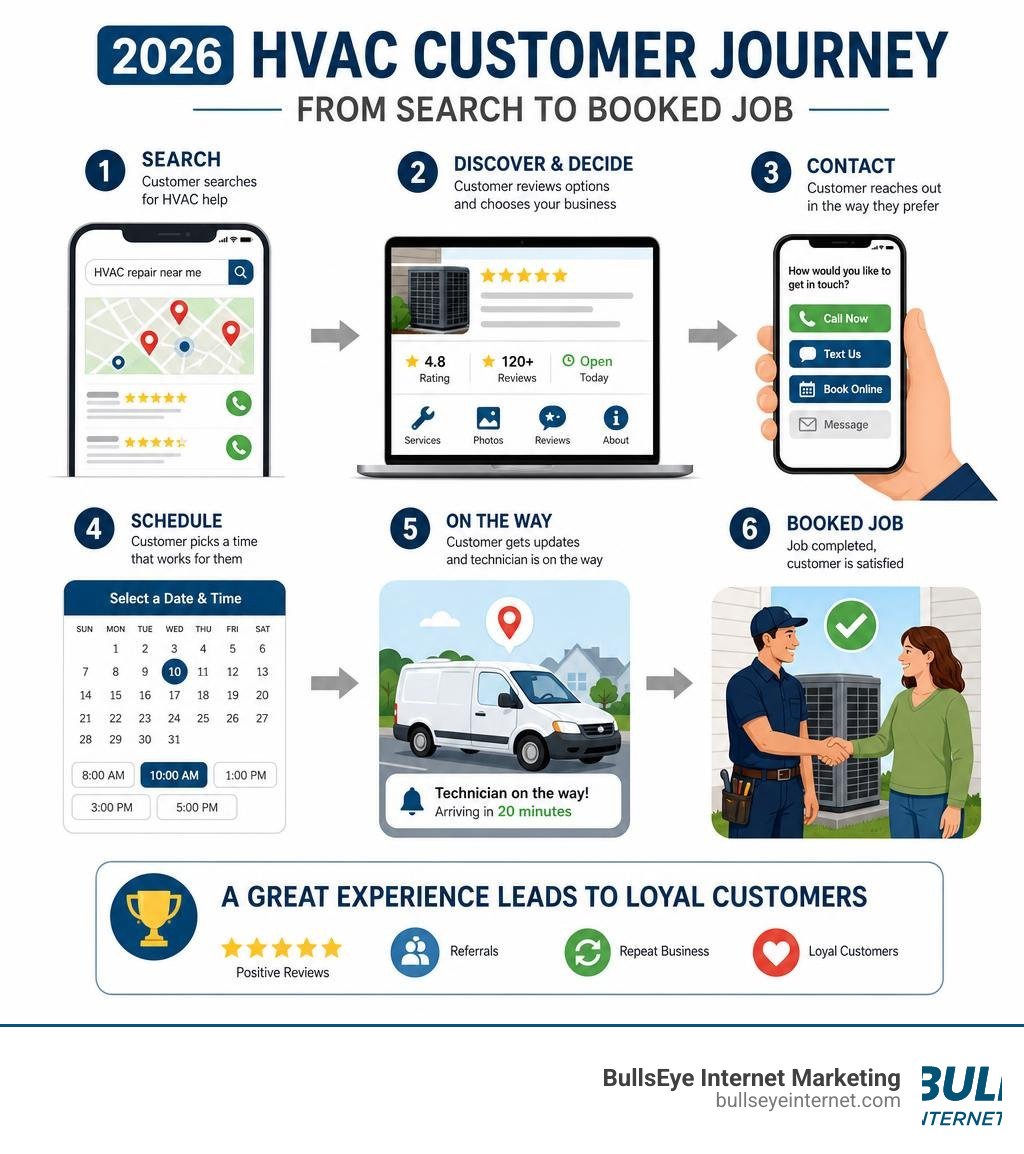
Related content about marketing for HVAC companies:
HVAC Marketing Challenges and Success with BullsEye Internet Marketing
Think of your website as your virtual storefront. It is the place where potential customers in Miami, Fort Lauderdale, or West Palm Beach go to decide whether they should trust you with their home comfort. If your website is slow, confusing, or hard to use on a phone, you are practically handing leads to your competitors.
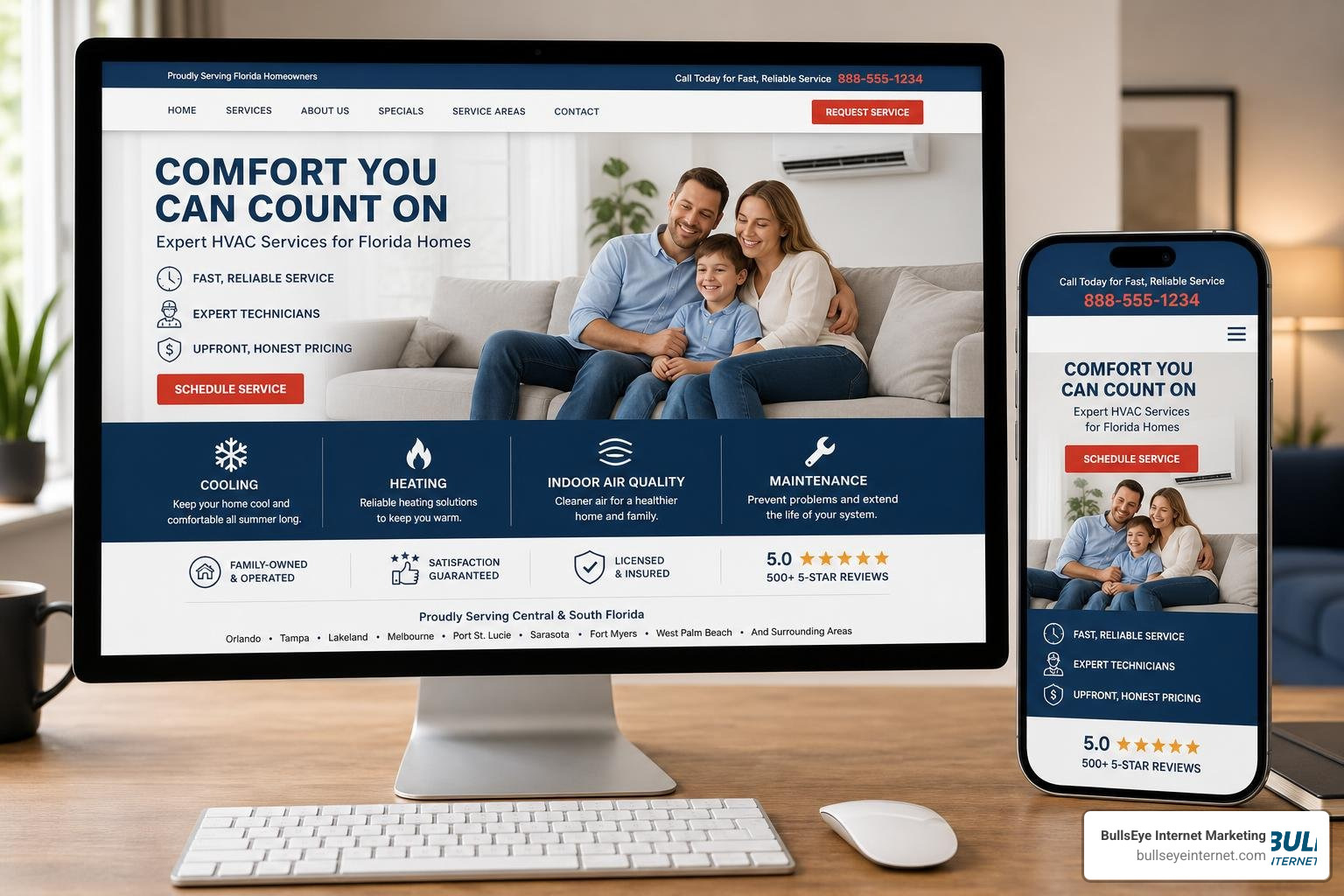
Mobile Responsiveness and Page Speed
We live in a mobile-first world. In fact, smartphones account for 63% of organic search engine visits in the United States, and more than 60% of all local service searches now happen on mobile devices.
When a homeowner’s air conditioning unit breaks down on a humid July afternoon in Boynton Beach, they are not booting up a desktop computer. They are searching on their phone while sweating in their living room.
If your website takes longer than 3 seconds to load, more than half of those mobile users will click away. To turn those desperate searchers into booked jobs, your site must load instantly and feature clear, sticky “Click-to-Call” buttons that remain visible as the user scrolls.
User Experience and Trust Signals
To convert visitors into leads, your website needs to make booking a service as frictionless as possible. Keep your contact forms short—asking only for a name, phone number, zip code, and the service needed.
You should also prominently display trust signals above the fold:
- Your license numbers and certifications (like NATE certification).
- Clear mentions of 24/7 emergency services.
- Icons showing that you offer financing options.
- Real customer reviews and ratings.
For professional assistance in building a site that converts, many contractors partner with specialized HVAC digital marketing agencies. If you are operating in South Florida, working with a local HVAC marketing company ensures your site is tailored specifically to the unique needs of coastal homeowners.
Local SEO Best Practices in Marketing for HVAC Companies
Ranking organically on Google is the ultimate way to secure free, high-quality leads. While paid ads get you immediate visibility, a solid organic strategy provides compounding returns over time. For a deep dive into these strategies, read our Local SEO Complete Guide.
1. NAP Consistency
Your Business Name, Address, and Phone number (NAP) must be identical across every single corner of the internet. This includes your website footer, your Google Business Profile, local directories, and social media pages. Even minor discrepancies—like writing “Street” on one site and “St.” on another—can confuse search engine algorithms and hurt your local search rankings.
2. Service Area Pages
If your main office is in Delray Beach, but you also service Boca Raton, Boynton Beach, and Lake Worth, you need dedicated service area pages. Each page should feature 300 to 500 words of unique, localized content. Don’t just copy and paste the same text and swap the city names; write about specific neighborhood challenges, local weather patterns, and regional building codes. Utilizing targeted Miami-Dade and South Florida growth marketing strategies can help you dominate these individual micro-markets.
3. Schema Markup and AI Search Optimization
In 2026, search engines are smarter than ever. Search engines pull answers directly from websites to answer conversational queries. To ensure your business is recommended by AI search assistants, you must implement local business schema markup. This structured data tells search engines exactly what services you offer, your operating hours, and which neighborhoods you serve.
Dominating Local Search with Google Business Profile and Reviews
The Google Map Pack is the holy grail of local search. When someone searches “AC repair near me,” the three businesses featured in the Map Pack capture over 75% of all local search clicks.
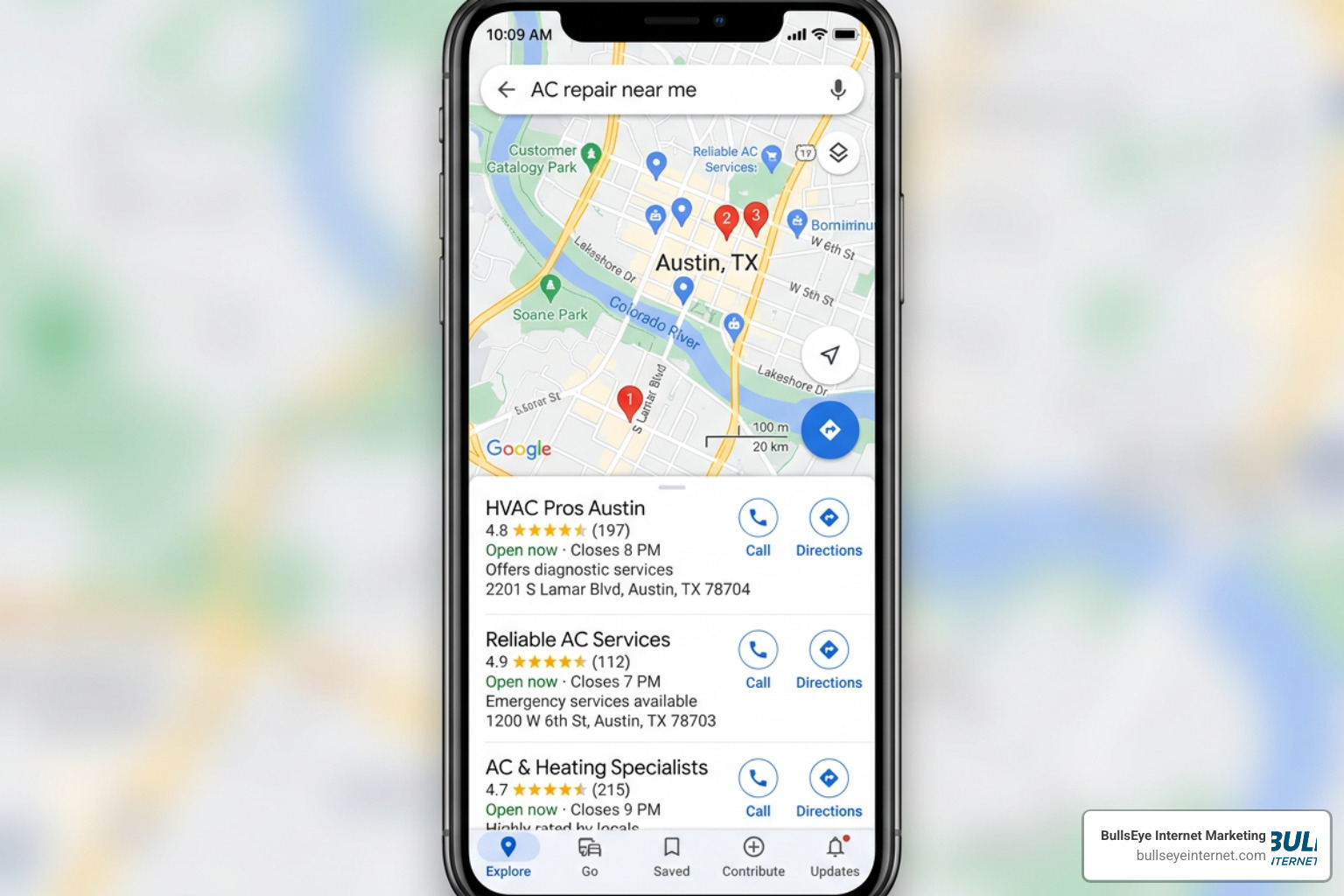
To secure a spot in this coveted section, your Google Business Profile (GBP) must be fully optimized:
- Select the correct primary category (e.g., “Air Conditioning Contractor” or “Heating Contractor”).
- Upload high-resolution photos of your branded trucks, real technicians, and completed installations weekly.
- Keep your operating hours accurate, especially during holiday weekends or extreme weather events.
The Power of Online Reviews
Your reputation is your most valuable marketing asset. The data speaks for itself:
- 95% of customers read online reviews before making a purchase.
- 94% of consumers say positive reviews make them more likely to use a business.
- 89% of people aged 35 to 54 trust online reviews as much as personal recommendations.
- 88% of consumers are likely to use a business if they can see the business actively responding to reviews.
To stand out, you need a steady stream of fresh, positive feedback. Google prioritizes “review velocity” (how frequently you receive reviews) and “review diversity” (having reviews that mention specific services and locations). For more actionable ideas on managing your local reputation, check out these 30+ HVAC marketing ideas.
Automating Review Generation and Reputation Management
You cannot rely on customers remembering to leave a review on their own. You need a systematic, automated process to ask for feedback when customer satisfaction is at its peak.
[Job Completed] ➔ [Automated Text Sent within 15 Mins] ➔ [Direct Link to Google Review] ➔ [Review Posted]
SMS Review Requests
SMS requests have significantly higher open and response rates than email. Set up your CRM or dispatch software to automatically text a review link to the homeowner within 15 minutes of the technician completing the job. Keep the message simple:
“Hi [Name], thank you for choosing [Company] today! Our technician, [Tech Name], loved helping you get your AC back up and running. Could you take 30 seconds to share your experience with us here? [Link]”
Technician Incentives
Your field technicians are the face of your company. Get them bought into your reputation marketing by running monthly competitions. Offer a cash bonus (e.g., $25 to $50) for every 5-star review that mentions a technician by name. This motivates your team to deliver exceptional customer service and actively ask for reviews before leaving the driveway.
Handling Feedback
Always respond to 100% of your reviews within 24 to 48 hours. When responding to positive reviews, naturally include your target keywords (e.g., “Thank you for the great review! We love providing top-tier AC repair services here in Coral Gables!”).
If you receive a negative review, do not get defensive. Respond politely, acknowledge the frustration, and offer to resolve the issue offline. Prospective customers will judge your business based on how you handle complaints, and a well-managed negative review can actually build more trust than a perfect rating.
Paid Advertising Strategies for Immediate Lead Generation
While organic SEO is a long-term compounding asset, paid advertising is the faucet you can turn on to generate high-intent leads immediately. When a homeowner’s furnace fails in the winter or their AC stops working in the dead of summer, they want help right now. Paid ads put your phone number directly in front of them at the exact moment of peak demand.
For a comprehensive breakdown of how to structure these campaigns, read The Definitive Guide To Advertising For Home Services Companies.
Targeting Emergency Keywords
To avoid wasting your ad budget, your Google PPC campaigns must target high-intent, emergency keywords rather than broad informational search terms.
- High-Intent Keywords (Target these): “emergency AC repair Miami”, “24 hour AC service near me”, “air conditioner repair Delray Beach”. These searchers have an immediate problem and a high conversion rate (typically 8% to 12%).
- Informational Keywords (Avoid or bid low): “how does an air conditioner work”, “average cost of a new heat pump”. These searchers are researching and have a low conversion rate (1% to 3%).
To further optimize your budget, implement negative keywords to prevent your ads from showing up for irrelevant searches like “HVAC training programs” or “cheap DIY AC parts.” For expert help setting this up, explore our Google Ads For Contractors.
Google Local Services Ads (LSA) vs. Traditional PPC
Google Local Services Ads (LSAs) are widely considered one of the highest-ROI paid channels for HVAC contractors. They appear at the absolute top of the Google search results page, even above traditional pay-per-click (PPC) text ads.
Here is how they compare:
| Feature | Google Local Services Ads (LSA) | Traditional Google PPC Ads |
|---|---|---|
| Payment Model | Pay-per-lead (pay only for valid calls/texts) | Pay-per-click (pay every time someone clicks your ad) |
| Trust Signal | Features the green “Google Guaranteed” badge | No badge; relies entirely on ad copy and landing page |
| Average Cost | $25 to $55 per lead | $15 to $45 per click (can easily exceed $100+ per lead) |
| Placement | Absolute top of search results page | Directly below LSAs, above organic results |
| Control | Set monthly budget; bid on service categories | Highly customizable keywords, ad copy, and landing pages |
With LSAs, you only pay when a customer contacts you directly through the ad. If a competitor clicks your ad, or if someone calls from outside your service area, you can dispute the lead and get your money refunded. This makes it an incredibly safe and cost-effective option for small businesses.
To learn more about maximizing this channel, check out our Local Services Ads For Heating Air Conditioning Companies and our Google Local Services Ads Complete Guide.
Budget Allocation and ROI in Marketing for HVAC Companies
A common question we hear is: How should I allocate my marketing budget?
For steady growth, we recommend allocating 5% to 10% of your target gross revenue to marketing. If you are aiming for aggressive growth, that budget should increase to 10% to 20%.
However, rather than focusing solely on percentages, the most critical metric to track is your cost per booked job. For service and repair work with an average ticket of $250 to $600, you should aim for a cost per booked job of $180 to $320. For system replacements (where tickets range from $5,000 to $12,000+), a cost per booked job of $400 to $800 is highly profitable.
Performance Comparison across Channels
To help you decide where to put your money, here is a breakdown of typical performance metrics for a South Florida HVAC contractor:
| Marketing Channel | Average Cost Per Lead (CPL) | Average Book Rate | Primary Benefit |
|---|---|---|---|
| Google LSAs | $25 – $55 | 40% – 50% | Highest trust, pay-per-lead protection |
| Traditional PPC | $40 – $104 | 25% – 35% | Immediate visibility for emergency keywords |
| Organic SEO | $8 – $25 (long-term average) | 35% – 45% | Compounding, long-term free leads |
| Email Marketing | < $5 | 15% – 25% | Excellent for seasonal tune-ups and retention |
To get the best results, we recommend a balanced approach: allocate 50% of your paid media budget to Google LSAs first, using traditional Google Ads to fill in the gaps for highly specific search terms.
To manage your ad spend efficiently, consider partnering with an agency that offers specialized PPC Management For Small Business or utilizes a transparent Pay Per Lead model. You can also explore customized, advanced HVAC marketing and advertising services to scale your operations rapidly.
Multi-Channel Marketing: Email, Video, and Referral Programs
Relying on a single marketing channel is risky. If Google changes its algorithm or ad costs spike, your lead flow can dry up overnight. Building a multi-channel marketing system ensures a steady stream of business year-round.
Email Marketing and Seasonal Demand Smoothing
The HVAC industry operates on a seasonal roller coaster. In South Florida, your phone rings off the hook in July, but February can be painfully quiet.
Marketing should not simply mirror demand; it should smooth it out. Your customer database is a goldmine for filling those slow “shoulder seasons.”
- Segment Your List: Don’t send the same blast email to everyone. Segment your audience by equipment age, service history, and geographic location. If you want to sell system replacements in Boynton Beach, send a targeted offer specifically to homeowners with AC units over 10 years old.
- Maintenance Agreements: Use email campaigns to promote your annual maintenance agreements. These agreements provide predictable, recurring revenue and ensure your trucks stay busy during the slower spring and fall months.
- “We Miss You” Campaigns: Send automated, personalized emails to past customers who haven’t booked a service in the last 12 months. A single proactive email campaign offering a “Winter Prep Tune-Up” can generate thousands of dollars in unexpected revenue.
To learn more about building targeted campaigns to reach other local businesses, check out this guide on how to market and sell to HVAC companies.
Video Content and Referral Networks
Video content is one of the easiest ways to build immediate trust with local homeowners. You do not need a Hollywood budget; a modern smartphone and a friendly technician are all it takes.
- Educational Walkthroughs: Record short, 30-second videos explaining simple maintenance tasks, like how to change an air filter or clean a condensate drain line. Post these on your website and social media profiles. When homeowners see your team sharing helpful, free advice, they will naturally think of you first when they need a professional repair.
- Before-and-After Showcases: Take photos and videos of messy, outdated equipment and contrast them with your clean, professionally installed new systems. This visual social proof speaks volumes about your company’s quality of work.
Strengthening Referral Networks
Word-of-mouth is still one of the most powerful sales drivers in home services. Referred customers convert at 4x the rate of cold leads and have a 16% higher lifetime value.
- The Referral Coin: Give happy customers a physical, branded “referral coin” or card that they can pass to a neighbor. When the neighbor redeems it for a discount on their first service, both the new customer and the referrer receive a reward (like a $50 credit or a free maintenance visit).
- Strategic B2B Partnerships: Build relationships with local real estate agents, home inspectors, and plumbers. Offer to send them referrals first, and they will gladly return the favor when their clients need reliable HVAC services. If you are targeting commercial clients, researching the best commercial HVAC contractors in Miami can help you find non-competing businesses to partner with. You can also consult an HVAC marketing expert in Florida to refine your local networking strategy.
Tracking Performance and Measuring HVAC Marketing ROI
If you cannot measure it, you cannot improve it. Too many HVAC owners spend thousands of dollars a month on marketing without knowing which channels are actually driving revenue. To scale your business profitably, you need a robust tracking system.
Call Tracking and Lead Attribution
Never rely on asking customers, “How did you hear about us?” Most people will simply say “Google,” which doesn’t tell you whether they found you through an organic blog post, a Google Business Profile listing, a Local Services Ad, or a paid search campaign.
Use call tracking software (like CallRail) to assign unique phone numbers to each marketing channel. When a customer calls, the software automatically attributes the lead to the correct source and feeds that data directly into your CRM (like ServiceTitan or Housecall Pro). This allows you to track a customer’s journey from their very first click all the way to the final invoice.
Key Performance Indicators (KPIs) to Monitor
To keep your marketing profitable, monitor these four essential KPIs on a weekly dashboard:
- Answer Rate: The average HVAC company only answers 68% of inbound calls. That means 32% of your hard-earned paid leads are going unanswered and calling your competitors instead. Aim for an answer rate of 95% or higher. If you cannot handle the volume, hire a 24/7 answering service.
- Booking Rate: This is the percentage of inbound service calls that turn into booked appointments. A healthy target is 75% to 85%. If your booking rate is low, your office staff may need additional training on phone handling and customer service.
- Cost Per Booked Job: Calculate this by dividing your total marketing spend on a channel by the number of jobs booked from that channel. Keep this within your target threshold ($180 to $320 for repairs).
- Revenue Per Truck (or Dispatch Efficiency): Track how much revenue each technician generates per day. Optimizing your dispatch routing to minimize “windshield time” ensures your technicians spend more time billing and less time driving.
Frequently Asked Questions about HVAC Marketing
How much should an HVAC company spend on marketing in 2026?
For maintaining your current market share, allocate 5% to 10% of your gross revenue to marketing. For aggressive growth, recommend spending 10% to 20%. However, the most accurate way to budget is using the cost per booked job formula. Aim to spend between $180 and $320 to secure a standard repair job, and $400 to $800 to book a high-value system replacement.
How long does it take to see results from HVAC SEO?
Most HVAC contractors see noticeable improvements in their local search rankings and organic lead volume within 3 to 6 months of launching a professional local SEO campaign. In highly competitive South Florida markets, it can take 6 to 12 months of consistent content creation, link building, and review generation to secure top rankings in the Google Map Pack.
Are Google Local Services Ads worth it for HVAC contractors?
Yes, Google LSAs are highly recommended for HVAC businesses. Because you pay per verified lead rather than per click, you are protected from wasted ad spend. The prominent placement at the top of Google and the inclusion of the “Google Guaranteed” badge build instant trust, resulting in conversion rates that are often double those of traditional PPC ads.
Conclusion: Partner with BullsEye Internet Marketing for Exclusive Growth
Building a comprehensive HVAC marketing system takes time, technical expertise, and constant optimization. As an HVAC contractor, your focus should be on delivering exceptional service, training your technicians, and keeping your trucks running—not fighting with Google’s algorithms.
At BullsEye Internet Marketing, we specialize in generating high-quality calls and booked jobs for HVAC companies through a combination of:
- Pay Per Lead campaigns
- Google Business Profile optimization
- Local SEO
- High-intent Google PPC management
- Conversion rate optimization
Our Unique Advantage
We do things differently than standard marketing agencies. We offer no long-term contracts, meaning we have to earn your business every single month with real, measurable results.
Additionally, we maintain a strict territory exclusivity policy: we work with only one client per industry in any geographic area. When you partner with us, we will never work with your direct competitors in Miami, Boynton Beach, Delray Beach, or West Palm Beach. Your growth is our sole focus.
Ready to stop chasing leads and start filling your schedule? Let’s build a marketing system that keeps your trucks busy year-round.
Explore our Contractor Advertising Solutions or contact us today to secure your exclusive local territory and launch your Google Local Services Ads For Home Services.
