
Conversational Search Optimization Helps You Match How Customers Ask
Conversational search optimization means shaping your content around the full questions customers ask, not just the short keywords they type. To start, write clear answers to common questions, use natural language in headings, keep key passages short and focused, and make local details easy for search engines and voice assistants to verify.
People now ask search tools things like, “Which plumber near me can fix a leaking water heater today?” They expect a useful answer, often without clicking through a list of links. That changes the goal: your website must be easy for people, search engines, and AI tools to understand, extract, and trust.
This approach supports voice search, Google results, AI-generated answers, and on-site chatbots. It does not replace classic SEO. It builds on it by adding stronger intent matching, clearer content structure, fast mobile pages, and accurate business information.
I am Ronnie Katz, founder and Principal CEO of BullsEye Internet Marketing, with more than 20 years of experience helping businesses earn visibility, calls, and conversions online. My work in Conversational search optimization combines SEO, local search, Google Business Profile optimization, AEO, and measurable strategies built to help businesses show up when ready-to-buy customers ask.
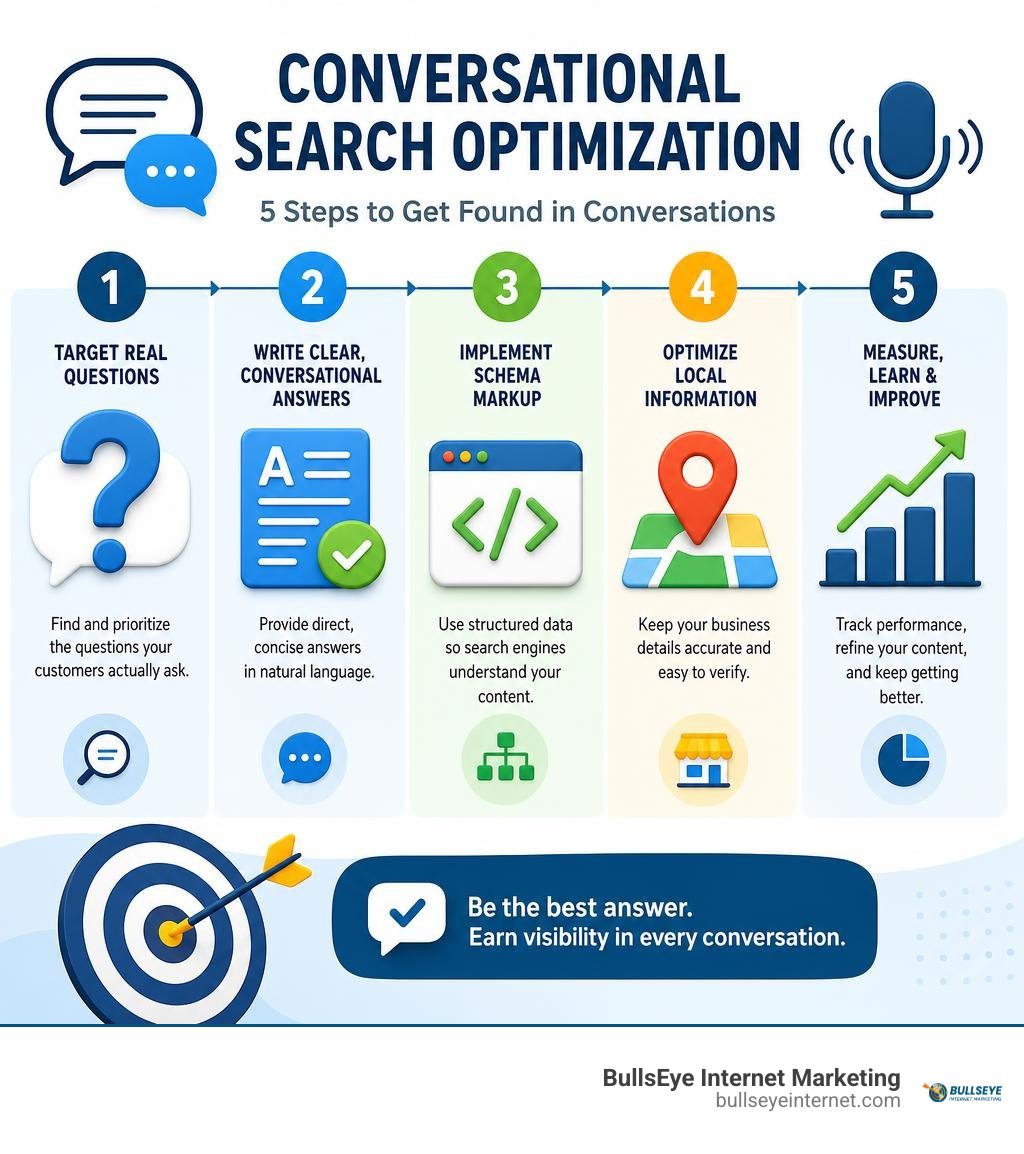
Essential Conversational search optimization terms:
Understanding the Shift from Keywords to Natural Dialogue
The era of typing disjointed phrases into a search bar—like “best Italian food open late”—is fading fast. Today, users speak naturally to virtual assistants or type multi-sentence prompts into AI interfaces. This change marks a monumental transition from index-based information retrieval to interactive, dialogue-led discovery.
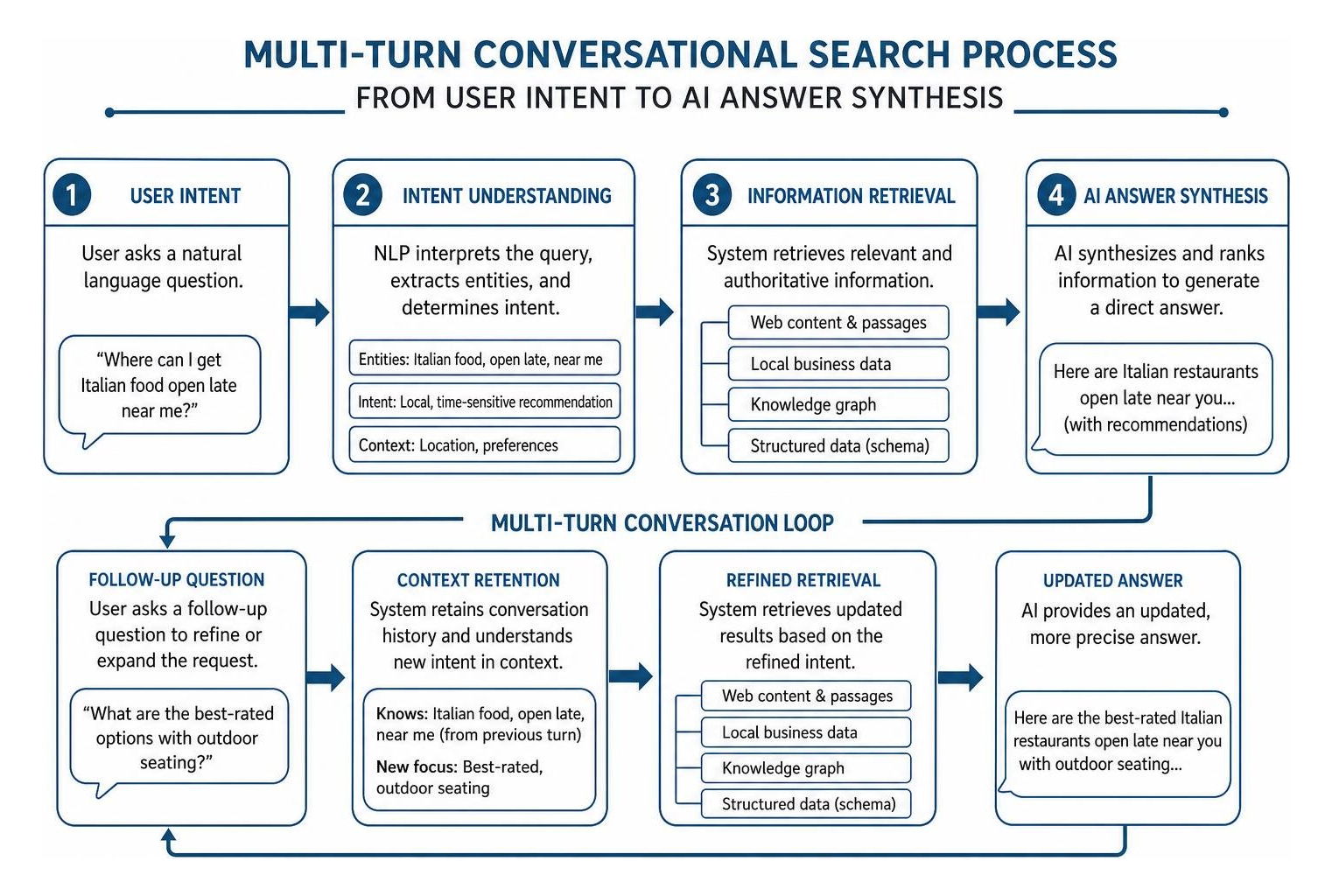
Search engines no longer merely match query tokens to webpage text. Instead, they operate as interactive systems capable of maintaining conversational context. Users treat search platforms like knowledgeable advisors. They ask follow-up questions, request tailored recommendations based on constraints, and expect instant answers. Adapting your marketing to this shift ensures your brand remains visible where these dialogues unfold.
How Conversational Search Differs from Traditional Search
Traditional search relies heavily on short, keyword-dense fragments. In contrast, conversational search centers on natural language, full sentences, and multi-turn context retention.
| Feature | Traditional Keyword Search | Conversational Search |
|---|---|---|
| Input Structure | 2–3 word keyword fragments | Complete, grammatically natural sentences |
| Context Retention | Single-query isolated processing | Multi-turn memory across follow-up queries |
| Result Delivery | 10 blue links on a SERP | Direct synthesized answers, voice responses, or snippets |
| User Interaction | Manual browsing and link clicking | Conversational refinement and dialogue |
| Optimization Focus | Keyword density, metadata, backlinks | Semantic entities, passage extractability, intent |
Nearly 60% of searches now end without a click, primarily because conversational interfaces extract direct answers and present them immediately. Voice assistants like Apple Siri, Google Assistant, and Amazon Alexa deliver single-answer responses rather than a page of options. As a result, businesses must prioritize what is aeo to ensure their content is selected as the primary authoritative answer.
How Natural Language Processing Decodes User Intent
Natural Language Processing (NLP) bridges human speech and algorithmic understanding. Modern search engines use advanced transformer architectures, including Google’s BERT and MUM models, to analyze entire sentences rather than isolated words.
BERT evaluates words in relation to all other words in a sentence, grasping subtle prepositional nuances. MUM builds on this foundation by processing multimodal inputs—such as text, audio, and imagery—across multiple languages. These systems identify named entities, assess semantic relationships, and position the query along an intent spectrum:
- Exploration: Broad informational queries where the user discovers concepts.
- Validation: Comparing specific solutions against constraints and requirements.
- Decision: Identifying vendors, pricing, and purchase logistics.
- Synthesis: Summarizing complex data points into actionable next steps.
By understanding where a user sits along this spectrum, modern engines retrieve passages that directly address nuanced intent.
Core Principles of Conversational Search Optimization
Succeeding in natural language search requires moving past basic keyword density. Algorithms evaluate topical depth, entity relationships, and passage clarity. Your digital assets must be structured so that retrieval-augmented generation (RAG) systems can parse, verify, and cite your answers seamlessly.
Adapting Keyword Research for Conversational Search Optimization
Keyword research for natural dialogue focuses on question modeling and semantic expansion. Instead of tracking high-volume head terms in isolation, map conversational prompts that real prospects speak aloud.
To discover high-intent conversational phrases:
- Analyze Question Modifiers: Target queries starting with who, what, where, when, why, and how.
- Mine People Also Ask (PAA): Identify common secondary and tertiary questions searchers ask after an initial query.
- Map Multi-Turn Prompts: Group related queries into topic clusters to answer both primary questions and predictable follow-up queries.
- Incorporate Natural Speech Patterns: Target full-sentence long-tail queries that mirror spontaneous spoken phrasing.
Adopting established semantic SEO services complete guide best practices helps you build topical authority clusters that answer complete problem-to-solution conversational paths.
Content Structuring and Passage Extractability for AI Models
AI models break documents into discrete passages during retrieval. If your core answer is buried within dense text, language models may bypass it for a clearer source.

To maximize content extractability:
- Use Answer-First Structure: State the direct answer in the first 1–2 sentences immediately beneath a question-based heading.
- Maintain Passage Length: Keep core informational blocks between 50 and 150 words. This range is optimal for AI overview citations and voice snippets.
- Implement the Claim-Evidence Pattern: Make a definitive factual claim, support it immediately with data or verifiable examples, and conclude with context.
- Maintain Optimal Entity Density: Ensure clear mentions of products, locations, and brand entities (aiming for 2–4% entity density).
- Structure with Visual Breaks: Use bullet points, short paragraphs, and clear subheadings to allow algorithms to isolate key takeaways.
Applying proven the complete guide to large language model seo principles ensures your website serves as a reliable knowledge base for automated discovery systems.
Technical and Local SEO for Spoken and Generative Search
Content clarity must be supported by robust technical infrastructure. Spoken and generative search systems prioritize websites that deliver structured, machine-readable data with rapid load speeds.
Technical SEO Foundations for Conversational Search Optimization
Search engines and AI assistants require clear technical signals to extract information accurately. Establishing strong technical foundations prevents misinterpretation and reduces crawler friction.
Key technical requirements include:
- Structured Data Implementation: Implement Schema.org vocabularies, particularly
FAQPage,HowTo, andArticlemarkup. These tags explicitly define entity relationships for retrieval engines. - Speakable Schema Markup: Add
SpeakableSpecificationmarkup to highlight text sections best suited for audio playback by voice assistants. - Core Web Vitals Optimization: Maintain fast loading speeds (aiming for under 3 seconds), minimal layout shift, and immediate interactivity.
- Mobile-First Design: Optimize layout, font sizing, and touch elements for mobile devices, where the majority of voice searches occur.
Reviewing our guide on ai search best practices provides actionable steps to align your technical architecture with automated search parsers.
Capturing Local and Near-Me Voice Queries
Local visibility is closely tied to voice search. With 75% of local searches expected to occur via voice, mobile users rely on voice assistants for immediate local recommendations. Furthermore, 58% of voice searches target local business information, and 76% of those lead to same-day visits.

To capture “near me” voice demand:
- Optimize Your Google Business Profile: Maintain complete, verified details, correct categories, accurate hours, and consistent updates.
- Ensure NAP Consistency: Standardize your Name, Address, and Phone number across all major business directories.
- Incorporate Conversational Geotargeting: Naturally integrate local landmark references, neighborhood names, and intersection details into your content.
- Manage Customer Reviews: Encourage detailed client reviews mentioning specific services and locations, which search engines use to assess relevance.
Aligning your local presence with voice search helps capture high-intent inquiries from local consumers looking for immediate assistance. For businesses exploring paid natural language visibility, understanding why conversational search is the next big frontier for digital advertisers offers valuable context on how conversational formats influence advertising.
Tracking Performance and Future-Proofing for AI Engines
Traditional keyword tracking tools alone cannot fully capture how conversational AI systems retrieve and present your brand. Measuring success requires evaluating generative visibility, citation frequency, and zero-click engagement.
Measuring AI Citations and Voice Search Analytics
Tracking natural language visibility involves monitoring multiple data sources:
- Google Search Console Analytics: Monitor impressions and clicks on conversational, long-tail queries (phrases of 5+ words). Track queries containing question terms (how, can I, where).
- AI Citation Frequency: Regularly monitor whether generative search engines like Google AI Overviews cite your content for primary industry questions.
- Local Interaction Metrics: Track click-to-call actions, direction requests, and message inquiries generated through local listings.
- Engagement and Dwell Time: Evaluate bounce rate and time-on-page metrics to ensure your content answers the searcher’s intent.
Emerging Trends in Multi-Turn Search and Voice Commerce
The conversational search landscape continues to evolve alongside advances in consumer hardware and machine learning:
- Voice Commerce Expansion: The voice commerce market is projected to reach $151.39 billion, with 49.6% of U.S. consumers (154.3 million people) using voice assistants for shopping.
- Persistent Multi-Turn Memory: AI platforms remember preferences across browsing sessions, creating ongoing conversational journeys.
- Multimodal Search Capabilities: Users increasingly combine spoken questions with camera images or video feeds to troubleshoot problems in real time.
- Autonomous Agent Integration: Emerging AI systems can research, compare, and complete service bookings on behalf of consumers through conversational interfaces.
Frequently Asked Questions About Conversational Search
What is the difference between conversational search and traditional search?
Traditional search relies on rigid keyword fragments typed into a search box, returning a list of links. Conversational search uses full, natural-language sentences and dialogue. It retains context across follow-up questions, leverages NLP to understand user intent, and delivers synthesized, direct answers.
How does conversational search impact local businesses?
Conversational search drives hyper-targeted, high-intent local traffic. Because most voice searches are for local services and frequently lead to same-day store visits or phone calls, businesses with complete Google Business Profiles and localized conversational content capture ready-to-buy customers.
Which technical SEO elements are most critical for voice search?
The most critical technical elements are Schema.org structured data (such as FAQPage and Speakable markup), rapid page load speeds (under 3 seconds), excellent mobile responsiveness, and clean HTML heading structures that allow AI bots to extract answers easily.
Conclusion
The shift toward natural language discovery has transformed how audiences interact with search systems. By structuring content around complete questions, providing direct answers, implementing robust schema markup, and optimizing for local intent, businesses can maintain strong visibility across voice assistants and generative AI platforms.
At BullsEye Internet Marketing, we help businesses establish sustainable competitive advantages through targeted SEO, Google Business Profile optimization, Pay Per Lead, and conversion strategies. We operate without long-term contracts and work with only one client per industry per geographic area. To build an authoritative search presence that captures high-intent conversational queries, explore our comprehensive answer engine optimization aeo geo llm seo solutions.
