
Why Your Website Traffic Isn’t Turning Into Sales
Conversion rate optimization is the systematic process of increasing the percentage of website visitors who complete a desired action—whether that’s making a purchase, filling out a form, or picking up the phone to call your business.
Quick Answer: What is Conversion Rate Optimization?
- Definition: CRO is the practice of testing and improving website elements to turn more visitors into customers or leads
- Core Goal: Get more value from your existing traffic without spending more on advertising
- Method: Uses data analysis, user research, and systematic testing (like A/B tests) to identify and fix barriers to conversion
- Result: Lower customer acquisition costs and higher revenue from the same amount of traffic
Here’s why this matters: if your website gets 10,000 visitors per month and generates 100 leads, your conversion rate is 1%. If you improve that to 2% through CRO, you suddenly have 200 leads—you’ve doubled your results without spending an extra dollar on ads.
Most businesses focus on driving more traffic to their website. They pour money into ads, SEO, and social media. But if your site isn’t converting those visitors effectively, you’re essentially pouring water into a leaky bucket.
CRO fixes the leak. It’s about understanding why visitors aren’t converting and systematically removing those obstacles. Maybe your call-to-action button is hard to find. Maybe your forms ask for too much information. Maybe your value proposition isn’t clear. CRO helps you find these issues through data—not guesswork—and test solutions to see what actually works.
The beauty of CRO is that it’s a compounding advantage. Every improvement you make continues to deliver results from all your future traffic. A one-time investment in testing and optimization pays dividends month after month.
I’m Ronnie Katz, founder of BullsEye Internet Marketing, and I’ve been helping businesses implement Conversion rate optimization strategies since 2006 to turn their website visitors into paying customers. Through systematic testing and data analysis, I’ve seen how small changes can dramatically impact a company’s bottom line.
The Foundations: Understanding and Calculating Conversions
Why is Conversion rate optimization so important? It’s a game-changer for businesses in the United States, Canada, the UK, and right here in Florida. CRO maximizes the value of every visitor. Instead of chasing new traffic, it helps you get more from the traffic you already have. This lowers customer acquisition costs and gives you a competitive edge. It’s about working smarter, not harder.
The idea of systematic testing goes back to direct response marketing, where every ad was a test. Today, websites give us even more powerful tools to measure and optimize. For a deeper dive into testing mechanics, we refer to resources like this A/B Testing Guide.
What is a Conversion and How is the Rate Calculated?
A “conversion” is any desired action a visitor takes on your website. This isn’t just about sales; it’s about progress. We categorize them into two main types:
- Macro-conversions: These are your big goals, like a completed purchase, a submitted lead form, or a phone call to your business.
- Micro-conversions: These are smaller steps that indicate a user is moving towards a macro-conversion, such as signing up for a newsletter, downloading a resource, or adding an item to a cart. Tracking these helps us understand the user journey.
Calculating your conversion rate is straightforward: the total number of conversions divided by the total number of visitors, multiplied by 100.
Conversion Rate = (Total Number of Conversions / Total Number of Visitors) x 100
For example, if a Miami Dade County website gets 10,000 visitors and 100 leads, its conversion rate is 1%. Increasing that to 2% through optimization doubles the leads to 200 without more ad spend. That’s the power of CRO.
When calculating, be clear if you’re using unique visitors or sessions. For consistency, we stick to one metric throughout our analysis.
What is a Good Conversion Rate?
This is a tricky question, as the answer is: “it depends!” While a 2023 survey by Ruler Analytics found an average conversion rate across fourteen industries was 2.9%, this figure can be misleading.
Several factors influence a “good” conversion rate:
- Industry Benchmarks: An e-commerce site in the UK will have a different average rate than a local service provider in Broward County. E-commerce order conversion rates are often between 2.5% and 3%.
- Traffic Channel: Visitors from a targeted PPC campaign convert at a higher rate than casual browsers from social media.
- Device Type: Mobile and desktop conversion rates differ significantly. For instance, 85% of mobile shoppers may leave a site without checking out, yet 59% of e-commerce sales come from mobile. This highlights the need for mobile optimization.
- Niche and Goal: An email sign-up (micro-conversion) will have a higher conversion rate than a high-value purchase (macro-conversion).
A “good” conversion rate is one that’s better than your last. We encourage clients to set benchmarks based on historical performance and continuous improvement, not just an elusive industry average.
Building a Winning CRO Strategy
Building a successful Conversion rate optimization strategy isn’t about guessing; it’s a methodical process. Think of it like a scientist in a lab, but instead of beakers and test tubes, we’re experimenting with headlines, button colors, and form fields.
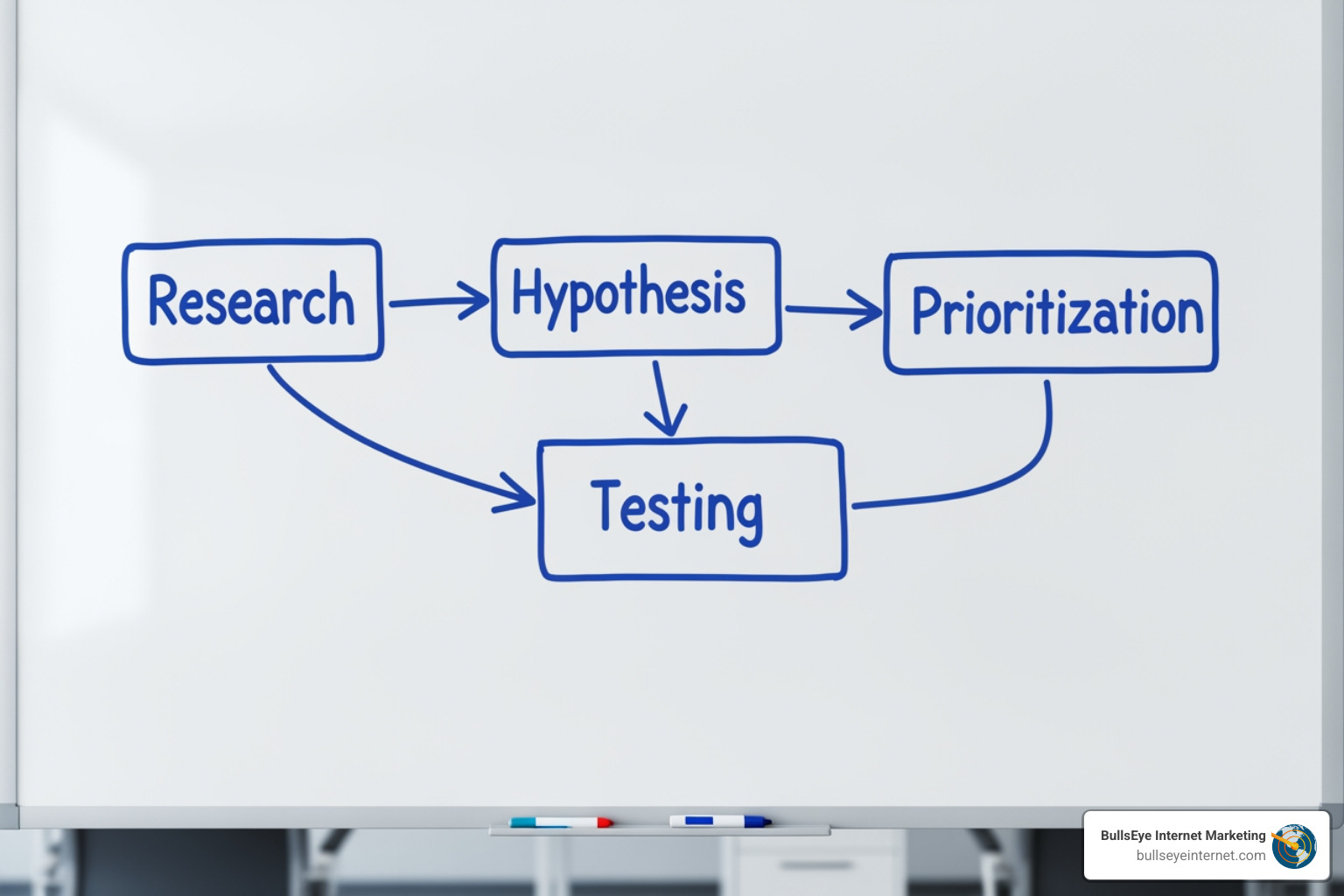
Our approach integrates rigorous data analysis with a deep understanding of user behavior. However, we’ve seen businesses face common challenges:
- Insufficient traffic: If your website doesn’t have enough visitors, it can be hard to get statistically significant results from your tests. We need a decent sample size to ensure our findings are reliable.
- Lack of resources: CRO requires time, tools, and expertise. Without a dedicated approach, efforts can fall flat. That’s where our team comes in, providing the specialized knowledge and tools needed to implement effective strategies.
The Role of Data and Analytics in CRO
Data is the lifeblood of Conversion rate optimization. Without it, we’re just rearranging deck chairs on the Titanic. We use a combination of quantitative and qualitative data to paint a complete picture of user behavior.
Quantitative Data: The “What”
This tells us what users are doing on your site. We use analytics tools like Google Analytics to track metrics such as:
- Page views: Which pages are popular?
- Bounce rate: How many visitors leave after viewing only one page? A high bounce rate could signal issues with relevance or user experience.
- Exit pages: Where are users dropping off in your conversion funnel?
- Traffic sources: Where are your most valuable visitors coming from?
Our clients often find that by using platforms with built-in analytics, like Shopify Analytics’ Behavior reports, they can easily understand what people do on their site and how to arrange their store to encourage more purchases.
Qualitative Data: The “Why”
While quantitative data tells us what happened, qualitative data helps us understand why. This is where we dig into the user’s mindset.
- Heatmaps: These visual tools show us where users click, move their mouse, and scroll on a page. They can highlight areas of interest or, conversely, areas of frustration like “rage clicks.”
- Session recordings: We can literally watch anonymous user sessions to see their journey through your site, identifying pain points, confusing navigation, or elements that capture their attention.
- User surveys: Asking your visitors directly for feedback through on-site surveys (often called Voice of Customer or VoC) can reveal motivations, barriers, and what persuaded them to convert. We can also conduct user interviews to get deeper insights.
By combining these data types, we can form strong hypotheses about what changes will genuinely improve your conversion rates.
Building a Continuous Conversion Rate Optimization Process
Conversion rate optimization isn’t a one-and-done project; it’s an ongoing journey of findy and improvement. To keep our efforts focused and impactful, we often use frameworks like PIE:
- Potential: How much room for improvement does this page or element have? Is it a high-traffic page with a low conversion rate?
- Importance: How critical is this page or element to our overall business goals? Does it directly impact revenue or lead generation?
- Ease: How difficult will it be to implement and test this change? Do we have the resources and technical capability?
By scoring potential CRO ideas against these three criteria, we can create a prioritized testing backlog. This ensures we’re always working on the most impactful optimizations first.
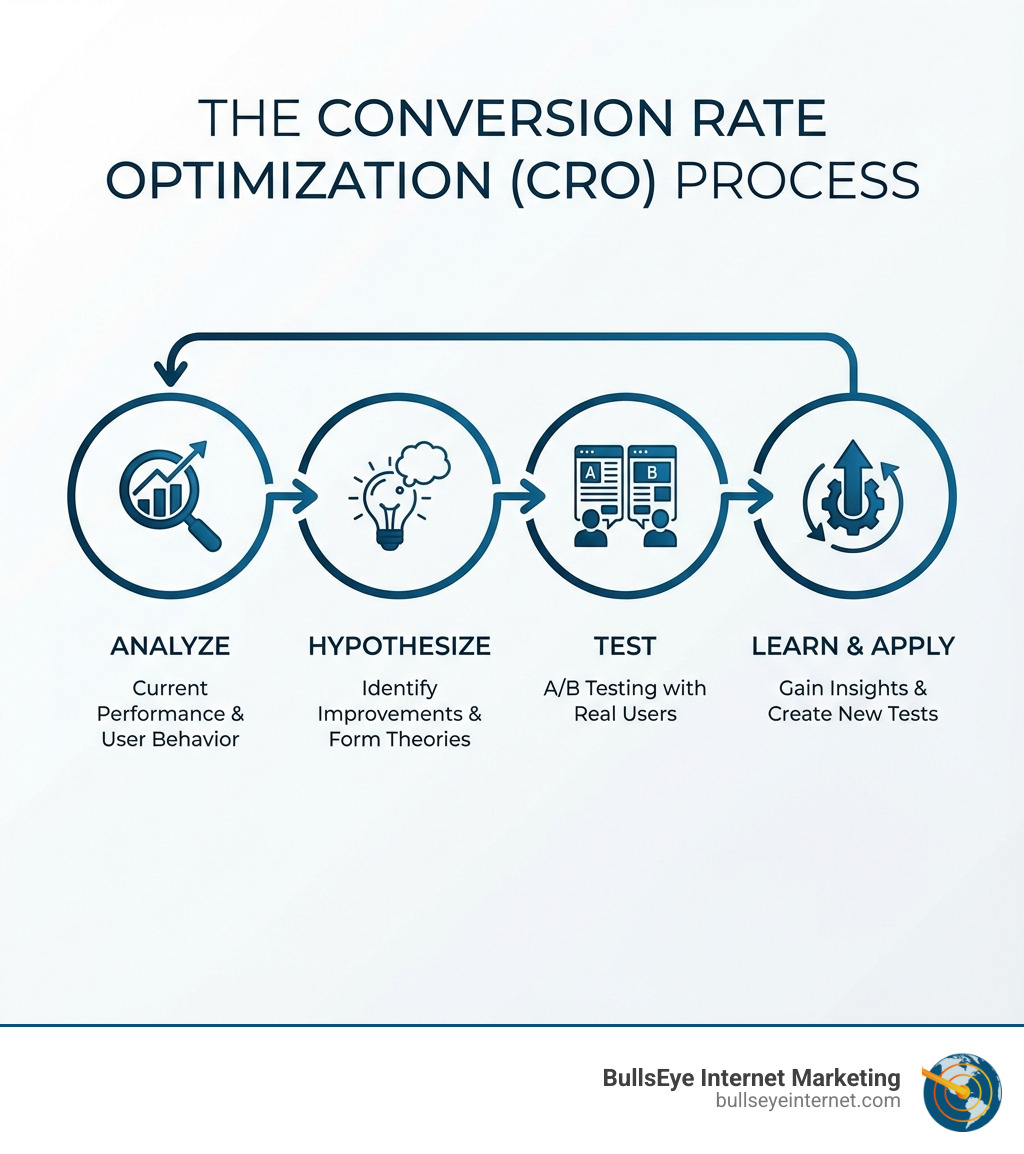
The process is iterative:
- Analyze: We constantly monitor data and user behavior.
- Hypothesize: Based on our analysis, we form educated guesses about what changes will improve conversions.
- Test: We run A/B tests (more on this in a moment!) to validate our hypotheses.
- Learn: We analyze the results, understand why a test won or lost, and apply those learnings to future optimizations.
This continuous loop of analysis, hypothesis, testing, and learning is how we drive sustainable growth for our clients.
Effective Conversion Rate Optimization Strategies and Tactics
Now that we understand the foundations, let’s talk about the specific strategies and tactics we employ to boost conversions. This is where the rubber meets the road, and small tweaks can lead to big wins!
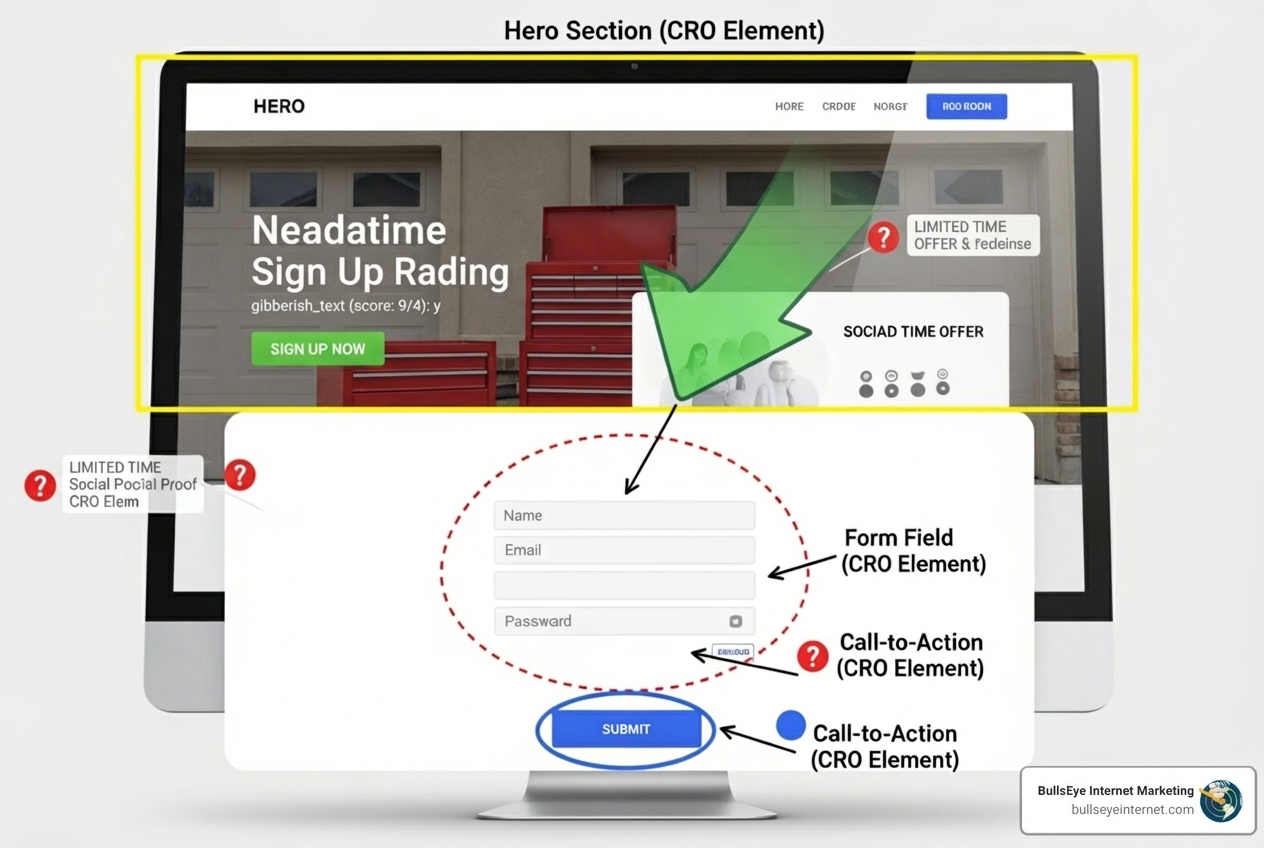
We’ll leverage tools like A/B testing, study user experience (UX), optimize Calls-to-action (CTAs), and fine-tune landing pages to ensure every element works towards your conversion goals.
Where to Focus Your CRO Efforts
You can’t optimize everything at once, so strategic focus is key. We typically prioritize our Conversion rate optimization efforts on pages that offer the highest potential impact:
- High-Traffic Pages: Even a small percentage increase on a page with thousands of monthly visitors can lead to a significant boost in conversions.
- Underperforming Pages: Pages with high traffic but low conversion rates or high bounce rates are prime candidates. They indicate a mismatch between user expectation and page content or experience.
- Homepage: This is often your digital storefront. Optimizing elements like hero imagery, headlines, and calls-to-action can guide visitors deeper into your site. For example, a simple email opt-in pop-up on a pricing page once garnered over 400 new leads in just three weeks for a company. We’ve seen similar success with well-placed pop-ups in our local markets.
- Product Pages (e-commerce): For our e-commerce clients in places like Miami or Vancouver, these are critical. High-quality product photography, compelling descriptions, social proof (reviews), and clear CTAs are non-negotiable. Getting product reviews can increase conversions by anywhere from 3% to 37%.
- Pricing Pages: These are often the make-or-break point. Clear pricing structures, value propositions, and trust signals are vital.
- Blog Posts: While often seen as top-of-funnel content, blog posts are massive conversion opportunities. We’ve found that text-based CTAs embedded within the content, rather than just end-of-post banners, can generate up to 93% of a post’s leads. A pop-up offer for a free guidebook once converted at 10.8% and captured 271 new leads in a month.
- Landing Pages: Since landing pages are designed with a single goal in mind, they inherently have the highest average conversion rate of all signup forms, often around 23%. Optimizing these with clear information hierarchy and minimal distractions is crucial.
Optimizing User Experience (UX) for More Conversions
A smooth, intuitive user experience is paramount for high conversions. We always remember Jakob’s Law: users spend most of their time on other sites, so they prefer your site to work the same way as all the other sites they already know. This means adhering to common design patterns and expectations.
Key UX elements we optimize include:
- Website Speed: This is huge. Almost 70% of consumers say slow-loading websites influence their willingness to purchase from an online retailer. Websites loading within one second convert 2.5 times higher than those loading within five seconds. If your site takes longer than a blink (50 milliseconds) to make a good first impression, you’re already losing. We use tools like Google’s PageSpeed Insights to diagnose and fix speed issues.
- Mobile Responsiveness: With over half of global web traffic coming from mobile devices, your site must be mobile-first. A seamless mobile experience is critical; otherwise, you risk losing those 85% of mobile shoppers who abandon carts.
- Site Navigation: Clear, logical navigation helps users find what they need quickly. Smart search bars with predictive results can significantly improve this experience.
- Readability: Concise, scannable content with clear headings and bullet points keeps users engaged.
- Trust Signals: Displaying security badges, customer reviews, testimonials, and clear return policies builds confidence. We’ve seen brands significantly increase their conversion rates by prominently featuring customer star ratings.
- Social Proof: Highlighting how others use and benefit from your product or service creates a sense of validation.
To uncover UX issues, we often rely on user research. You might be surprised to learn that you only need 5 participants to find 85% of the usability problems on your website. This focused approach allows us to quickly identify and address major roadblocks.
Mastering A/B Testing and Experimentation
A/B testing is the cornerstone of Conversion rate optimization. It’s how we move beyond opinions and make data-driven decisions. As the book Experiment!: Website conversion rate optimization with A/B and multivariate testing highlights, it’s about systematic experimentation.
What is A/B Testing?
It involves comparing two versions of a webpage or app element (A and B) to see which one performs better. Version A is the “control” (your original), and version B is the “variation.” We split your website traffic, showing half to A and half to B, then measure the results.
Formulating a Hypothesis
Before any test, we develop a clear hypothesis: “If we change X, then Y will happen, because Z.” For example: “If we change the CTA text from ‘Learn More’ to ‘Get Your Free Quote,’ then lead submissions will increase, because it clearly communicates the next step and value.”
Statistical Significance
We don’t just look for an improvement; we look for a statistically significant improvement. This means the results are unlikely to be due to random chance. We typically aim for a 95% confidence level before declaring a winner.
Examples of A/B Testing in Action:
- Headlines: A simple change to a headline can dramatically impact conversions. One company increased their lead conversion rate by 79% by swapping a generic headline for one that clearly conveyed a value proposition (“Save Up to 32% on Your Health Insurance”).
- CTAs: We’ve seen success stories like a brand increasing logins by 36% (and orders by 4.1%) just by updating their login CTA from an icon to text. This shows how crucial clarity is.
- Page Layouts: Testing different arrangements of elements on a page, from product grids to checkout flows, can reveal what resonates best with users. Small design tweaks can drive big changes in engagement and revenue.
A/B testing helps us understand what your audience truly prefers, leading to continuous, incremental improvements.
The CRO Toolkit: Tools, Measurement, and SEO
To effectively implement Conversion rate optimization, we rely on a suite of powerful tools and a deep understanding of how CRO integrates with other digital marketing efforts like SEO.
Common CRO Tools and Technologies
The right tools can make all the difference in uncovering insights and running effective tests. Here are some categories and examples we frequently use:
- Analytics Tools: These provide the “what” – data on visitor behavior, traffic sources, bounce rates, and conversion paths.
- Google Analytics: Essential for tracking website performance and user flow.
- Kissmetrics: Great for understanding specific user or cohort data and how people move through your site.
- A/B Testing Tools: These allow us to create variations of pages and run experiments to see which performs better.
- Google Content Experiments (now largely integrated into Google Optimize, which is sunsetting, but the principle remains): A free tool for testing.
- Unbounce: Excellent for quickly creating and testing landing pages.
- Optimizely: A powerful platform for web experimentation.
- Visual Website Optimizer (VWO): Another robust tool with an intuitive interface.
- User Feedback Tools: These provide the “why” – direct insights from your users.
- Hotjar: Offers heatmaps, session recordings, and on-site surveys (like the email opt-in pop-up that got 400+ leads).
- Qualaroo: Provides on-site surveys to ask visitors why they are or aren’t converting.
- UserTesting.com: Allows us to watch recorded videos of real people interacting with your site and verbalizing their thoughts.
- Heatmap Tools: Visual representations of user clicks, scrolls, and movement.
- CrazyEgg: Shows exactly where users are engaging or getting stuck on a page.
- Lucky Orange: Offers heatmaps, session recordings, and live chat.
- Other Optimization Tools:
- Privy: Specializes in pop-ups, email, and SMS marketing for lead generation.
- ImageOptim: Helps compress images to improve site speed.
- Lighthouse / PageSpeed Insights: Google tools for auditing website performance and speed.
How CRO and SEO Work Together
While Conversion rate optimization and Search Engine Optimization (SEO) have distinct focuses, they are not mutually exclusive; they are two sides of the same coin, ultimately working towards the same goal: increasing sales and business growth.
| Feature | SEO (Attracting Traffic) | CRO (Converting Traffic) |
|---|---|---|
| Primary Goal | Increase visibility and organic traffic | Increase the percentage of visitors who complete a desired action |
| Focus | Keywords, backlinks, technical health, content relevance | User experience, calls-to-action, page layout, persuasive copy |
| Key Question | “How can we get more people to find our website?” | “How can we get more people who find our website to act?” |
| Metrics | Rankings, organic traffic, impressions | Conversion rate, lead submissions, sales, average order value |
| Relationship | Drives qualified traffic to the site | Optimizes the site to make that traffic more valuable |
CRO inherently supports SEO because many of the factors that improve user experience (like fast page speeds, mobile-friendliness, and clear navigation) are also signals Google uses for ranking. When users have a positive experience on your site, they spend more time, visit more pages, and are less likely to bounce—all positive signals to search engines.
We focus on balancing keyword optimization (for SEO) with user-centric copy (for CRO). It’s not about keyword stuffing; it’s about creating high-quality, relevant content that satisfies both search engines and human visitors. A well-optimized page that converts well often performs better in search results because it offers a superior user experience.
Measuring Success and the Evolution of CRO
Measuring the success of our Conversion rate optimization efforts is critical. We look beyond just the conversion rate itself, considering several Key Performance Indicators (KPIs):
- Conversion Rate Lift: The percentage increase in conversion rate directly attributable to our optimizations.
- Revenue Per Visitor (RPV): This metric tells us how much revenue each visitor generates, regardless of whether they convert. It’s a great way to measure the overall value of your traffic.
- Lead Quality: For lead generation businesses in places like Boynton Beach or Coconut Creek, it’s not just about more leads, but better leads. We track the conversion rate from lead to qualified prospect or customer.
The field of CRO isn’t new; it has a rich history rooted in direct response marketing, which focused on tracking and testing every marketing tactic for ongoing improvement. Pioneers like John Caples in the 1920s and 30s were already conducting A/B split-testing and response tracking for mail, radio, and print campaigns.
The modern era of CRO truly began after the dot-com bubble burst. E-commerce marketers, facing increased competition and the availability of website analytics tools, realized they needed to improve website performance to survive. This led to a shift from simply attracting traffic to optimizing the website experience itself. The introduction of tools like Google Website Optimizer in 2007 democratized testing, making it accessible to more businesses and accelerating the evolution of CRO. Books like “Conversion Optimization: The Art and Science of Converting Prospects to Customers” by Saleh and Shukairy (2010) and “Landing Page Optimization” by Ash, Ginty, and Page (2012) helped formalize the methodologies.
Today, CRO is a sophisticated blend of art and science, constantly evolving with new technologies and deeper understandings of human psychology and user behavior.
Frequently Asked Questions about Conversion Rate Optimization
We often get asked similar questions about Conversion rate optimization. Here are some of the most common ones:
What are the first steps to starting CRO?
Start by defining your primary conversion goal. Is it a purchase, a lead form submission, or a phone call? Then, use analytics to identify a high-traffic, underperforming page. This could be a page with a high bounce rate or a low conversion rate compared to similar pages. Analyze user behavior on that page using tools like heatmaps or session recordings to identify pain points or areas of confusion. Based on these insights, you can then form a testable hypothesis for improvement.
How long should you run an A/B test?
Run a test long enough to reach statistical significance (typically 95% or higher) and to account for weekly business cycles. This usually means running a test for at least one to two full weeks, but it depends on your website traffic. If you have very high traffic, you might reach significance faster. For lower-traffic sites, it might take longer. Ending a test too early can lead to misleading results, while running it too long can expose you to external factors that skew data.
Can CRO hurt my SEO?
No, when done correctly, CRO supports SEO. Google encourages A/B testing and has stated that performing an A/B or multivariate test poses no inherent risk to your website’s search rank. To avoid issues, always use a rel="canonical" tag on test pages (if you’re using separate URLs for variations) to point to the original URL. Also, ensure you avoid “cloaking,” which means showing different content to Googlebot than to human users. As long as your tests aim to improve user experience, they generally align with Google’s goals.
Turn Your Website Visitors into Customers
We’ve covered a lot about Conversion rate optimization today, from its fundamental definition and calculation to advanced strategies, tools, and its symbiotic relationship with SEO. The key takeaway is this: your website is a powerful asset, and CRO is the process that open ups its full potential.
It’s a continuous journey of understanding your audience, experimenting with improvements, and learning from the data. The power of incremental improvements cannot be overstated; small, consistent optimizations compound over time, leading to significant growth. We believe in getting more value from your existing resources, turning browsers into buyers, and maximizing every opportunity your website presents.
At BullsEye Internet Marketing, we specialize in helping businesses across the United States, Canada, the UK, and locally in Florida harness the power of CRO. Our expertise ensures you’re not just driving traffic, but intelligent, converting traffic.
Ready to stop leaving money on the table and start generating more leads from your website traffic? Let us help you optimize your digital presence and transform your website into a conversion powerhouse.
