
Why Most Local Businesses Are Invisible on Google (And How to Fix It)
If you want to improve your Google local ranking, here is the fastest path forward:
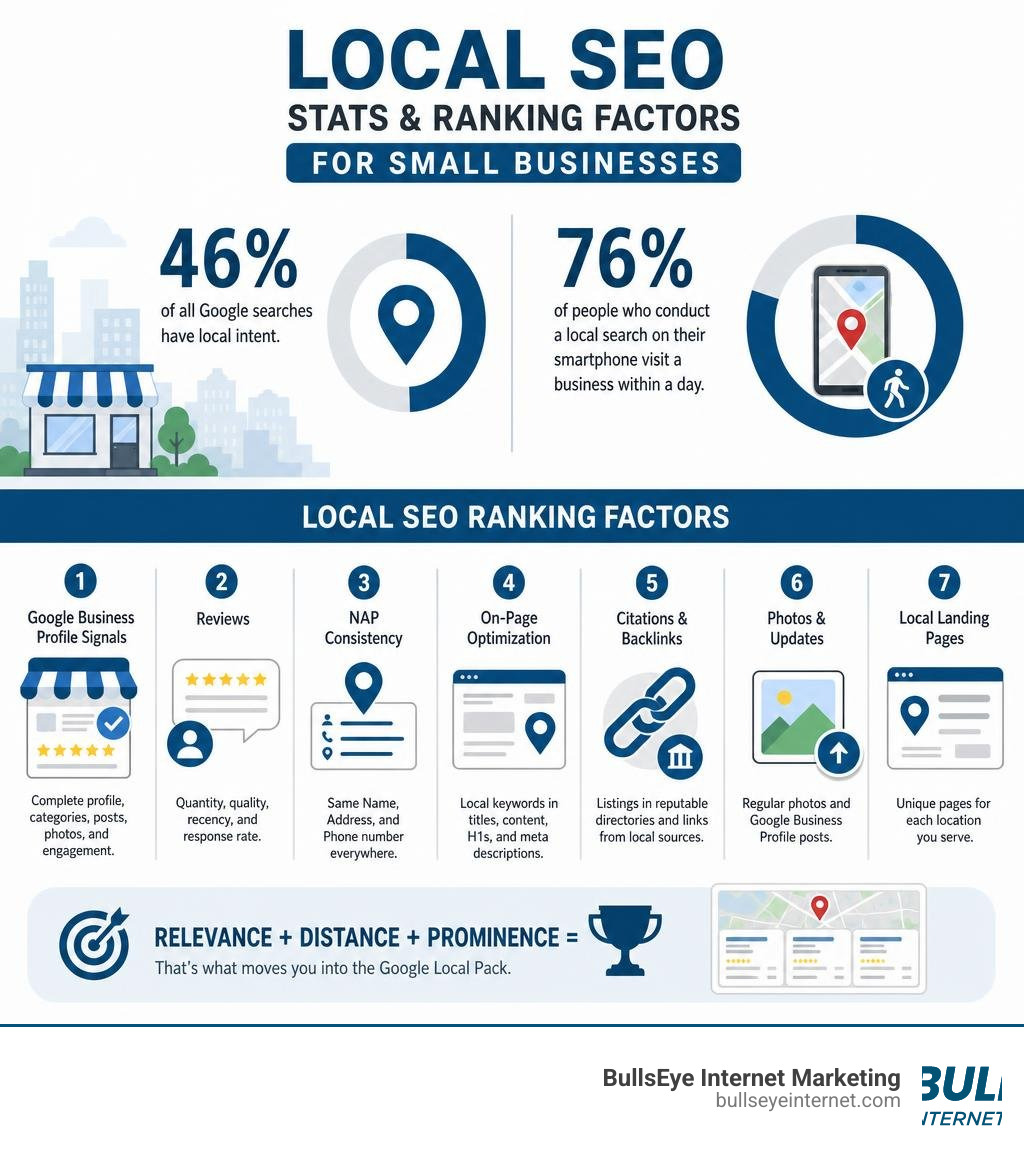
- Complete your Google Business Profile — verify it, choose the right primary category, and fill out every field
- Build review velocity — get a steady stream of new reviews weekly, and respond to all of them
- Keep your NAP consistent — same name, address, and phone number everywhere online
- Add local keywords to your website — especially on service pages, H1 tags, and meta descriptions
- Earn local citations and backlinks — get listed in reputable directories and earn links from local sources
- Post photos and updates regularly — fresh, original images and GBP posts send strong engagement signals
- Create location-specific pages — unique content for each area you serve, not copy-paste templates
Nearly half of all Google searches — 46% — have local intent. And when someone searches for a business near them, 76% visit that business within a day. That is not a browsing behavior. That is a buying behavior.
Yet most small business owners are barely showing up.
You might have a decent website. You might even have a handful of reviews. But if your business is not appearing in the Google Local Pack — that prominent box of three listings at the top of search results — you are essentially invisible to the customers most likely to call you today.
The frustrating part? The businesses ranking above you are not necessarily better than you. They have just figured out what Google’s local algorithm actually rewards.
That algorithm looks at three core things: relevance (does your business match what the person searched for?), distance (how close are you to the searcher?), and prominence (how well-known and trusted is your business online?). Get those three pillars right, and your ranking moves. Ignore them, and no amount of paid ads will fill the gap.
This guide breaks down exactly what moves the needle in June 2026 — no guesswork, no outdated tactics.
I’m Ronnie Katz, founder of BullsEye Internet Marketing, and since 2006 I’ve helped hundreds of local businesses improve their Google local ranking through hands-on GBP optimization, citation building, and local search strategies that generate real calls and real revenue. Everything in this guide comes from over 20 years of doing this work in competitive markets.
What is Google Local Ranking and Why It Matters
When we talk about local ranking, we are talking about real estate. Specifically, the highly coveted digital storefronts on page one of Google. In June 2026, local search results are divided into two main areas: the Local Pack (often called the 3-Pack or Map Pack) and Google Maps itself.
The Local Pack is the golden ticket. It captures roughly 44% of all clicks for high-commercial-intent local queries. If you run a plumbing business in Fort Lauderdale or a medical spa in Miami, ranking in positions 1, 2, or 3 means you capture the lion’s share of local phone calls. Ranking at position 4 or 5, especially on mobile devices where Google frequently defaults to a 2-pack for high-intent queries, makes your business functionally invisible.
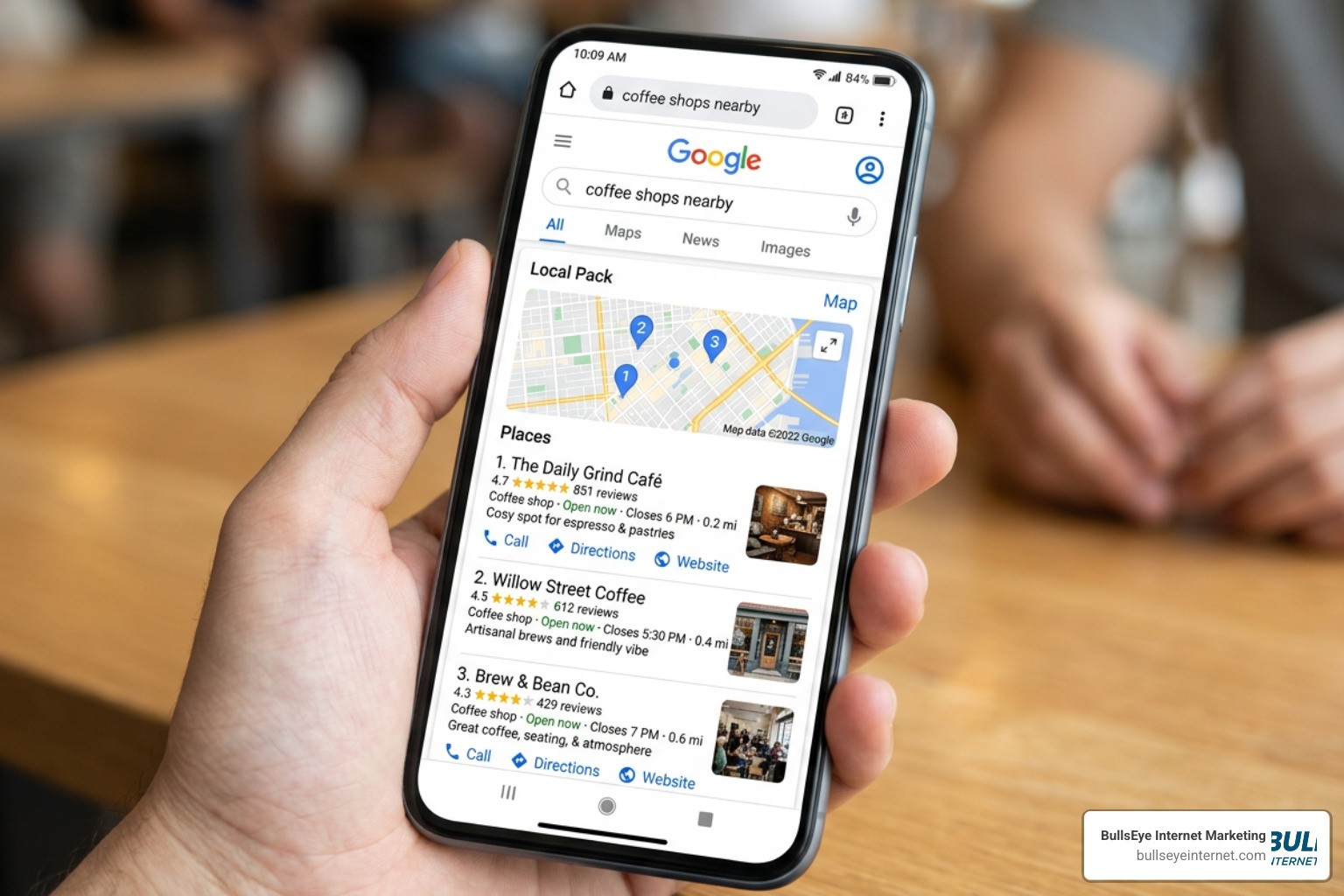
Furthermore, user journeys are shifting rapidly. Nearly 90% of consumers use Google Maps to look up a business, and 84% of those users end up on Google Business Profiles (GBP) from “discovery” searches. This means they are not typing your business name; they are searching for a keyword like “emergency roofer in West Palm Beach” or “best Italian restaurant in Delray Beach.”
To make matters more challenging, we are living in a “zero-click” era. Over 60% of searches end without the user clicking through to a website. Instead, they call you, ask for directions, or read your reviews directly inside the Google Local Pack. If your profile isn’t fully optimized to convert searchers on the spot, you are losing customers to competitors who have dialed in their local presence.
The Economic Impact of Local Search on Small Businesses
For small businesses across South Florida — from Broward County down to Miami-Dade and up through Palm Beach, Martin, St. Lucie, and Indian River counties — local search is the ultimate equalizer. Unlike national organic search, where you have to compete with massive brands and giant aggregators, the Local Pack is strictly territorial.
Consider this: over 1.5 million searches each month include the phrase “near me.” When a smartphone user in Boynton Beach searches for “AC repair near me,” Google does not show them a national brand based in another state. It shows them local, verified businesses within their immediate vicinity.
Because of this hyper-local targeting, local search has the highest conversion rate among all local advertising channels. It is a direct stream of high-intent buyers. If you want to dive deeper into how this works across your entire digital footprint, check out our Local SEO Complete Guide.
The Core Pillars of Google’s Local Algorithm
Google’s local algorithm is not a mystery, but it is highly sophisticated. In 2026, Google relies heavily on three core pillars to determine local rankings: Relevance, Distance, and Prominence.
However, if your current SEO agency is still talking about keyword density and meta descriptions as the holy grail, they are running a decade-old playbook. Today, Google uses advanced systems like S2 Cells (a geographic grid system that divides the world into tiny cells) and BERT optimization (natural language processing that evaluates context, position, and structure) to deliver results. Let’s break down how these pillars actually function.
Relevance: Aligning Your Business with Search Intent
Relevance is all about how well your local business entity matches what the user is looking for. Google determines this by analyzing your Google Business Profile, your website content, and your broader digital footprint.
The single most critical lever for relevance is your Primary Category on your GBP. It accounts for roughly 14% of your total local ranking weight. If you get this wrong, nothing else matters. For example, if you run a wellness clinic in Coconut Creek that specializes in medical weight loss, setting your primary category to “Medical Spa” instead of “Weight Loss Center” (or vice versa) can make or break your visibility for your most profitable keywords.
To ensure you are aligning with Google’s official standards, you should regularly review the official Tips to improve your local ranking on Google.
Distance and Proximity in the Era of S2 Cells
Proximity used to be the dominant factor in local search. If you were 500 feet closer to the searcher, you ranked higher. But in 2026, raw physical distance has dropped in weight (from roughly 18% down to 12%). Why? Because Google has gotten much smarter at measuring behavioral signals and entity trust.
Instead of drawing a simple circle around a searcher, Google utilizes S2 Cells (specifically Levels 10 through 14) to map out service areas and local markets. S2 cells are a mathematical geographic grid. Google evaluates “S2 cell occupancy” to see how active, trusted, and relevant your business is within specific geographic blocks.
If your business in Hollywood, FL has incredibly strong engagement signals, high review velocity, and localized website content, Google’s algorithm will gladly display your business to a searcher 4 miles away, bypassing a weaker competitor who is only 0.5 miles away. Proximity is now a tiebreaker, not the sole deciding factor.
Prominence: Building Authority and Trust Online
Prominence reflects how well-known and credible your business is, both offline and online. Google measures this through:
- Review signals: Your overall rating, review volume, and review velocity (how frequently you get new reviews).
- Local citations: Having your Name, Address, and Phone number (NAP) perfectly consistent across major directories.
- Backlink profile: High-quality links from locally relevant websites (like local chambers of commerce, South Florida newspapers, and neighborhood blogs).
Prominence is Google’s way of asking, “Do people in the real world actually trust this business?” To build this authority effectively, many businesses partner with professional Local SEO Services to secure high-quality local links and manage their digital entity.
How to Optimize Your Google Business Profile to Improve Google Local Ranking
Your Google Business Profile is the absolute foundation of your local search presence. It is the primary node that connects your business to Google’s Entity Graph. If your profile is incomplete, unverified, or neglected, your rankings will suffer.
Completing your profile from a basic 40% up to 100% can boost your Map Pack visibility significantly. Let’s look at the specific steps required to turn your GBP into a ranking machine.
Selecting Categories and Services to Improve Google Local Ranking
When choosing categories, accuracy is everything. You must select one primary category that matches your core business offering, and then use up to four additional secondary categories. Data shows that profiles utilizing exactly four secondary categories achieve the highest average map rankings.
Inside your profile, you also have a Services Menu. Do not leave this blank or rely on generic auto-generated lists. You should write a unique, factual, 300-character description for every single service you offer. This feeds Google’s natural language processing models with rich semantic data, making it highly clear what search terms your business is relevant for.
If you are operating in highly competitive South Florida markets, you can read our localized strategic breakdown in Miami Local SEO: Master Your Google Business Profile to see how top-tier local entities structure their categories.
Leveraging Photos, Videos, and Posts to Improve Google Local Ranking
Google loves what searchers love, and searchers love visual proof. Profiles with high-quality, original photos receive significantly more direction requests and website clicks than those relying on boring stock imagery.
- Avoid stock photos: Google’s AI can easily detect stock photos, and using them can actually suppress your listing’s trust score.
- Geotagged photos: Upload real photos taken on-site by your team or customers. These images contain EXIF metadata (GPS coordinates) that verify your physical presence in places like Coral Gables, Fort Lauderdale, or West Palm Beach.
- GBP Posts: Treat your GBP like a mini-social platform, but with an SEO focus. Publish 1-2 posts per week highlighting recent projects, special offers, or helpful tips. Keep them between 150-300 words and always include a clear Call-to-Action (CTA) button like “Call Now” or “Book.”
For a step-by-step blueprint on maximizing these engagement signals, explore our guide on How to Optimize Your Google Business Profile for Maximum Local Reach.
The Power of Reviews and Reputation Management
Reviews are no longer just a nice-to-have trust signal; they are a direct ranking factor. In fact, reviews represent the second most important factor for Local Pack rankings and AI-driven search results in 2026.
But here is the catch: total review count matters far less than review velocity and semantic content.
An older business in Boca Raton with 400 reviews but no new feedback in the last six months will easily be outranked by a newer competitor who consistently generates 5 to 10 high-quality reviews every single week. Furthermore, Google reads the actual words within your reviews. When a customer writes, “They did an amazing job repairing my leaky water heater in Fort Lauderdale,” Google bolds those terms and associates your business directly with those highly valuable keywords.
Building a Review Collection Routine
To maintain a healthy review velocity, you cannot rely on customers remembering to leave a review on their own. You must build a consistent, automated routine.
- Automate the ask: Set up SMS or email triggers through your customer relationship management (CRM) software to automatically send a review link immediately after a service is completed.
- Make it easy: Generate a custom short link or a QR code and place it on your physical receipts, business cards, or technician clipboards.
- Train your team: Encourage your staff to ask for feedback in person. A simple prompt like, “If you were happy with our service today, would you mind leaving us a quick review mentioning the specific service we provided and the neighborhood you live in?” works wonders.
- Respond to everything: Always respond to every single review within 24 to 48 hours. Use professional, warm, and keyword-rich language. If you receive a rare negative review, do not argue. State your commitment to quality, keep it factual, and invite them to resolve the issue privately.
For more actionable tips on securing the top spots, check out our Google 3-Pack Tips Guide.
On-Page SEO and Technical Tactics for Local Dominance
Your website is the digital anchor for your Google Business Profile. Google constantly cross-references your website’s content, structure, and technical health to verify the legitimacy of your local business entity.
To understand how traditional SEO differs from local SEO, let’s look at this comparison:
| Optimization Factor | Traditional SEO | Localized SEO |
|---|---|---|
| Primary Target | Global or National SERPs | Local Pack, Google Maps, local organic results |
| Keyword Focus | Broad informational & transactional terms | Service + City, “near me”, neighborhood terms |
| Core Ranking Signals | Domain Authority, content depth, global backlinks | Relevance, Distance, Prominence, GBP optimization |
| Geographic Focus | None (unrestricted) | Hyper-local (S2 cells, specific zip codes/cities) |
| Key Entity Nodes | Brand website, social profiles | GBP, local directories, local schema, localized pages |
Creating Unique Location and Service-Area Pages
If your business serves multiple cities across South Florida — such as Coral Springs, Pembroke Pines, Miramar, and Pompano Beach — you must build dedicated location pages.
The biggest mistake we see weekly is “cookie-cutter” location pages where the business simply swaps out the city name on identical templates. Google’s algorithm easily detects this duplicate content and penalizes your site’s overall authority.
Instead, build a hub-and-spoke model. Create a main regional page, and link it to individual, highly unique neighborhood spoke pages. Each page should contain:
- At least 80% unique content.
- Mentions of local landmarks, local street names, and neighborhood-specific vernacular.
- Real project photos from that specific area.
- An embedded Google Map pointing directly to your verified address or service area.
For a deeper dive into structuring these high-performing pages, read our guide on Local Search Domination: Google Maps SEO Secrets Revealed.
Technical Local SEO and Schema Implementation
From a technical standpoint, Google needs to read your site easily. This means your site must load fast, be fully responsive on mobile devices, and contain structured data.
- Core Web Vitals: Aim for a page load time of 3 seconds or less. Optimize your images, minify your CSS/JS, and choose a high-quality web host. A slow site increases bounce rates and tells Google your user experience is poor.
- LocalBusiness Schema: Use JSON-LD structured data to tell search engines exactly who you are, what you do, and where you are located. This schema must match your Google Business Profile details (Name, Address, Phone) down to the exact comma and abbreviation.
If you want to ensure your technical foundation is flawless, check out our professional Google Maps Ranking Service.
Frequently Asked Questions about Local SEO
How long does it take to see results from local SEO efforts?
While traditional organic SEO is a marathon that can take 6 to 12 months, local SEO typically yields faster results.
If your business already has a verified profile and you implement quick, high-impact fixes — like correcting your primary category, cleaning up duplicate listings, or completing your services menu — you can often see ranking improvements in as little as 30 to 45 days. However, in highly competitive markets or for brand-new websites, building the necessary prominence, review velocity, and local link signals to crack the top 3 of the Map Pack generally takes 3 to 6 months of consistent, ongoing effort.
What are the most common mistakes that hurt local rankings?
The most common mistakes we see that actively suppress local rankings include:
- Inconsistent NAP Data: Having different phone numbers, old addresses, or slight name variations across directories (e.g., “BullsEye Internet Marketing” vs. “BullsEye Marketing LLC”) creates entity confusion and damages trust. Consistent NAP data makes you 40% more likely to appear in the Local Pack.
- Keyword Stuffing the Business Name: Adding extra keywords to your GBP name (e.g., “Miami Plumber – Best Emergency Plumbing Services”) might offer a temporary boost, but it is a direct violation of Google’s terms and frequently leads to profile suspension.
- Duplicate Listings: Having multiple listings for the same physical location dilutes your authority and confuses the algorithm.
- Incentivized or Fake Reviews: Google’s NLP models are highly skilled at detecting unnatural review patterns. Buying reviews or offering discounts in exchange for reviews can result in your profile being permanently removed from Google Maps.
Can a service-area business rank without a physical storefront?
Absolutely. If you operate a service-area business (SAB) — like a mobile detailer in Coral Gables or an electrician in Sunrise — you do not need a physical storefront where customers visit.
You can set up your GBP as a Service-Area Business and define your service area using specific cities, counties, or zip codes. While storefront profiles historically held a slight ranking advantage, that gap has narrowed significantly in 2026 as Google’s proximity weight has decreased in favor of behavioral signals and entity trust.
To learn how to structure your service area polygon perfectly without triggering spam filters, refer to our Local Pack Optimization Ultimate Guide.
Optimizing Your Google Business Profile: BullsEye Internet Marketing
Improving your Google local ranking is not about chasing shortcuts or trying to trick an algorithm. It is about building a highly verified, trusted, and active local entity that Google’s systems can confidently recommend to nearby searchers.
At BullsEye Internet Marketing, we do things differently. We are a premier digital marketing agency specializing in generating real calls and sales for businesses across South Florida.
We don’t believe in locking you into long-term contracts because we believe our results should keep you with us. Best of all, to give our clients an unfair competitive advantage, we work with only one client per industry per geographic area. When you partner with us, we focus 100% of our local SEO power on dominating your market and leaving your competitors in the dust.
Are you ready to stop being invisible and start capturing the local customers searching for you right now? Let’s get to work. Contact us today to explore our BullsEye GMB Optimization Services and claim your territory.
