
Why Google Ads for HVAC Is Your Fastest Path to Booked Jobs
Google Ads for HVAC is one of the most direct ways to put your phone number in front of homeowners the moment their AC dies or their furnace quits — no waiting months for SEO to kick in.
Here’s a quick breakdown of how it works and what to expect:
| What You Need to Know | Quick Answer |
|---|---|
| Best ad types | Local Services Ads (LSAs), Search Ads, Performance Max |
| Average cost per lead | $104 blended; $34 branded, $149 non-branded, $72 PMax |
| Typical conversion rate | 7.1% average; top accounts hit 12-15% |
| Most leads come from | Phone calls (90% of HVAC leads) |
| Biggest budget wasters | Broad keywords, no negative keywords, wrong location settings |
| Biggest ROI lever | Improving book rate and landing page conversion |
The opportunity is real. Google Search Ads deliver an average 200% ROI — roughly $2 back for every $1 spent. But that return doesn’t happen automatically.
HVAC is one of the most competitive and expensive niches in paid search. Clicks can cost anywhere from $8 to over $100 depending on your market and service type. Without the right structure, you can burn through budget fast and have little to show for it.
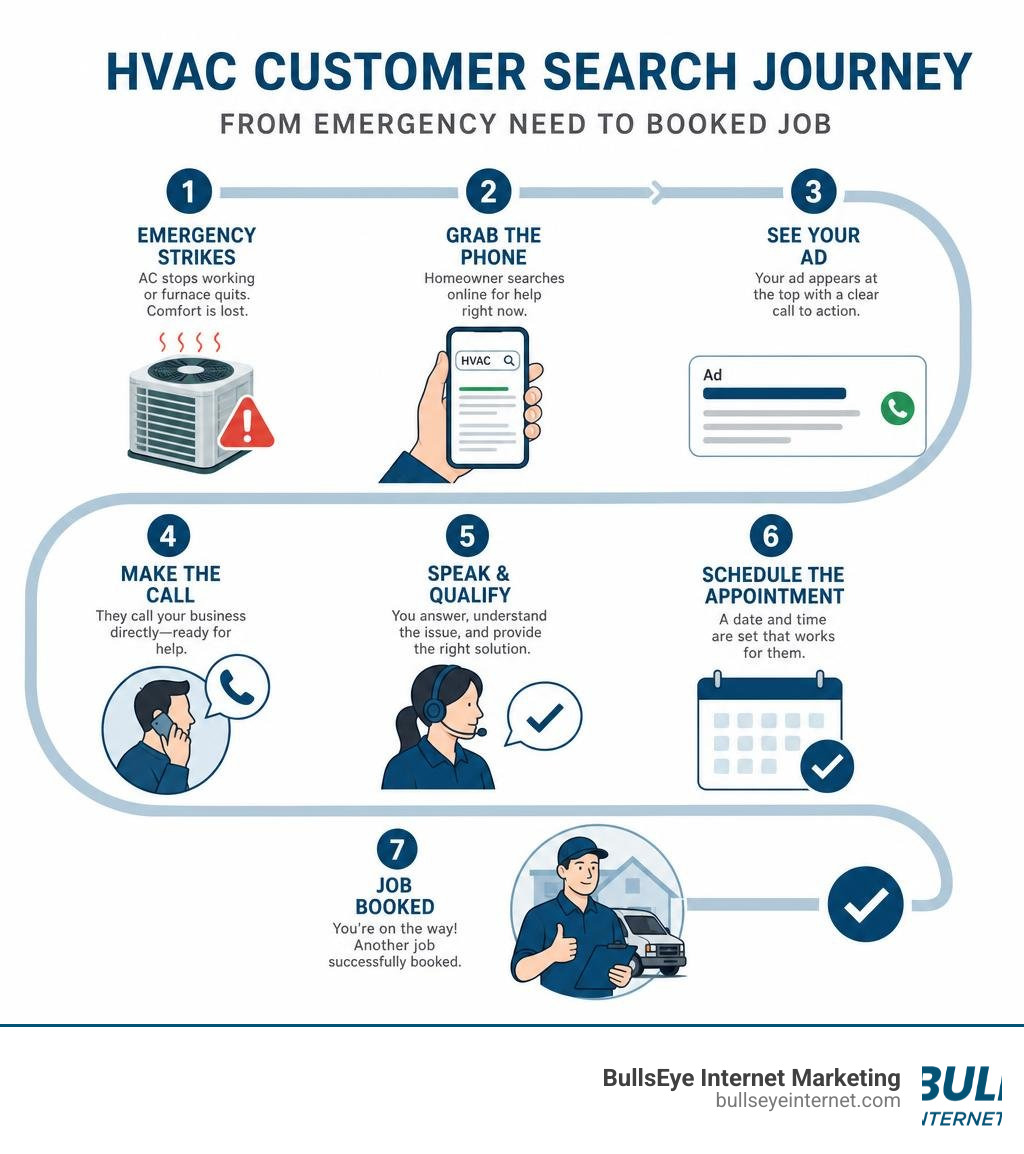
When a homeowner’s furnace dies at midnight in January, they don’t browse — they grab their phone, search Google, and call the first credible result they see. That’s your window. The question is whether your ads, landing pages, and phone systems are ready to capture it.
I’m Ronnie Katz, founder of BullsEye Internet Marketing, and since 2006 I’ve helped contractors and local service businesses build profitable Google Ads for HVAC and other competitive industries — from keyword strategy to conversion tracking to seasonal budget management. In this guide, I’ll walk you through exactly how to structure campaigns that generate real booked jobs, not just clicks.
Simple Google Ads for HVAC glossary:
The Core Pillars of Google Ads for HVAC

To build a high-performing system, we must first understand that Google Ads is not a single tool. It is an ecosystem of distinct campaign types, each designed to capture a different stage of the customer’s journey.
Many contractors make the mistake of throwing their entire budget into a single generic campaign. They bid on broad terms like “air conditioning” and send that traffic directly to their homepage. In a highly competitive market like South Florida—from Miami-Dade up through Broward and the Palm Beaches—this is a recipe for a very expensive lesson in budget depletion.
Instead, a successful campaign relies on three core pillars: Search Ads, Local Services Ads (LSAs), and automated campaigns like Performance Max (PMax). Balancing these three networks allows us to capture the immediate emergency calls while building a pipeline for high-ticket system replacements. To see how these paid channels fit into your overall growth plan, check out our Complete Guide To Hvac Marketing Strategies.
Choosing the Right Campaign Types for Google Ads for HVAC
Let’s break down the primary campaign types you should run:
- Google Search Ads (PPC): These are the traditional text-based ads that appear at the top and bottom of the search results page. They operate on a pay-per-click model. Search Ads give you total control over your ad copy, bidding strategies, and landing pages. This control is critical for targeting high-value replacement jobs where you need to explain financing options or highlight specific brand certifications.
- Local Services Ads (LSAs): Positioned at the very top of Google’s search results, LSAs operate on a pay-per-lead model. You only pay when a customer calls or messages you directly through the ad. Featuring the green “Google Guaranteed” badge, these ads instantly build trust with skeptical homeowners. If you want to dive deeper into maximizing this channel, read our specialized guide on Local Services Ads For Heating Air Conditioning Companies.
- Performance Max (PMax): PMax uses Google’s machine learning to serve ads across YouTube, Gmail, Display, Discover, and Search. While PMax can deliver a lower cost per lead ($72 average compared to $149 for non-branded search), it requires careful monitoring. Without strict guardrails, PMax can easily serve your ads to people watching DIY repair tutorials on YouTube rather than local homeowners needing immediate service.
Structuring High-Intent Keywords in Google Ads for HVAC
If you want to stop wasting money, you must distinguish between transactional keywords and informational keywords.
- Transactional Keywords: These are search terms used by people who have their wallets out and are ready to book. Examples include “emergency AC repair Miami,” “24/7 air conditioning service Fort Lauderdale,” or “heat pump replacement near me.” These keywords have high search intent and command higher costs per click (CPCs), but they convert into booked jobs at a much higher rate.
- Informational Keywords: These are used by research-gatherers or DIY enthusiasts. Examples include “how to fix a leaking AC” or “why is my furnace making a clicking noise.” Bidding on these terms will attract people who want to fix the issue themselves, wasting your ad spend on clicks that will never convert.
Additionally, we highly recommend utilizing long-tail keywords (search phrases containing three or more words). While they have lower search volume, they are highly specific, less competitive, and convert incredibly well. For instance, instead of bidding broadly on “AC installation,” target “ductless mini-split installation cost Palm Beach.” This captures a customer who knows exactly what they want and is actively researching pricing. For more insights on structuring your campaigns to capture these high-intent moments, explore The HVACR Guide to Google Ads in 2026 | ACHR News.
Eliminating Budget Waste with Negative Keywords and Geo-Targeting
In our experience auditing thousands of PPC campaigns, we find that the average unoptimized HVAC account wastes 25% to 30% of its budget on completely irrelevant clicks. In a high-CPC environment, that can translate to thousands of dollars lost every single month.
To prevent this bleed, we use two powerful defensive weapons: a robust negative keyword list and precise geo-targeting settings. For a comprehensive look at setting up these platform defenses, refer to our Google Ads Complete Guide.
Building a Bulletproof Negative Keyword List
Negative keywords tell Google exactly which search queries you do not want your ads to show up for. Every HVAC campaign must launch with a comprehensive negative keyword list that is updated weekly through search term audits. Your negative list should cover:
- DIY and Troubleshooting Terms: how to, fix, manual, diagram, schematic, parts, wholesale, compressor replacement DIY.
- Career and Employment Terms: jobs, hiring, salary, careers, resume, HVAC school, training, certification, EPA 608 test.
- Low-Intent and Price-Shopping Terms: cheap, free, used, rental, wholesale, Amazon, Home Depot.
- Irrelevant Services: If you don’t offer duct cleaning, commercial refrigeration, or chimney sweeps, add those terms as negatives immediately.
- Competitor Login Queries: Homeowners searching for “competitor name login” or “competitor customer portal” are looking to pay their bills or schedule maintenance with an existing provider. Do not pay for their click.
Precision Location Settings to Avoid Out-of-Area Clicks
If your physical shop is in Fort Lauderdale, you don’t want to pay for clicks from users in Orlando or Tampa. However, Google’s default location setting is “People in, regularly in, or who have shown interest in your targeted locations.” This means someone in New York planning a vacation to Miami could trigger your “AC repair” ad.
To fix this, change your location target settings to “Presence: People in or regularly in your targeted locations.”
Next, use radius targeting or specific zip code targeting to match your actual service area. If you only service Broward and Palm Beach counties, target those specific counties or set a 25-mile radius around your office. This ensures your budget is reserved exclusively for homeowners you can actually serve today.
Landing Page Optimization: Turning Clicks into Booked Jobs
Getting the click is only half the battle. If your ad points to a slow, confusing, or generic website, the user will hit the “back” button faster than a compressor can short-cycle.
Your landing page is the digital equivalent of your customer service representative. It needs to load instantly, answer the user’s question immediately, and make it incredibly easy to book a service call.
Mobile-First Strategies for Urgent Service Calls
Over 70% of HVAC searches happen on mobile devices, and during a heatwave or cold snap, that number climbs even higher. When a homeowner’s AC breaks down in the middle of a humid South Florida summer, they aren’t opening a laptop. They are searching on their phone while sweating in their living room.
Your landing pages must be designed mobile-first:
- Speed is King: Over half of mobile users will abandon a page if it takes longer than 3 seconds to load. Optimize your images, eliminate bulky scripts, and ensure your landing page loads lightning-fast.
- Sticky Click-to-Call Buttons: Keep a prominent, clickable phone number visible at the top of the screen at all times as the user scrolls. 90% of HVAC leads occur over the phone.
- Simple Booking Forms: For non-emergencies, offer a simple form with minimal fields (Name, Phone, Zip Code, Service Needed). Better yet, integrate direct scheduling tools like ServiceTitan or Housecall Pro so users can book a specific time slot without picking up the phone.
Trust Signals and Proof Points That Drive Conversions
Homeowners are naturally skeptical about inviting service technicians into their homes. Your landing page must build instant credibility above the fold.
- Authentic Team Photos: Ditch the stock photos of smiling models holding clipboards. Show your actual local technicians, branded service trucks, and your office staff. Authenticity builds trust.
- Certifications and Badges: Display recognizable industry credentials prominently, such as NATE certifications, EPA 608 compliance, and your state contractor license number.
- Social Proof: Feature recent, location-specific 5-star reviews. If your landing page is targeting Delray Beach, show reviews from happy customers in Delray Beach.
- Upfront Pricing and Financing: Display diagnostic fees transparently to filter out price shoppers. For high-ticket system replacements, highlight flexible financing options. According to industry data, offering clear financing options can improve replacement close rates from 38% to 49%.
Seasonal Bidding Strategies and Budget Management
The HVAC industry is highly seasonal. In South Florida, AC repair demand spikes dramatically during the summer months, while heating and heat pump maintenance take center stage during the brief winter dips.
To maximize your ROI, your Google Ads budget must scale alongside these weather-driven demand swings.
| Season | Primary Service Focus | Typical Search Volume Change | Target Bidding Strategy | Recommended Budget Allocation |
|---|---|---|---|---|
| Summer Peak | Emergency AC Repair, Rapid Replacement | +200% to +300% | Maximize Conversions / High Target CPA | 50% – 60% of Annual Budget |
| Winter Peak | Heating Repair, Heat Pump Services | +100% to +150% | Maximize Conversions | 20% – 25% of Annual Budget |
| Shoulder Seasons | IAQ, Maintenance, Tune-up Specials | Baseline | Maximize Clicks / Target CPA | 15% – 20% of Annual Budget |
Managing the Summer AC and Winter Heating Spikes
During peak summer heat waves, search volume for emergency AC repair can spike by over 260%. During these high-demand periods, you need to be aggressive.
We recommend implementing weather-driven bidding. When local temperatures are forecasted to hit record highs, preemptively increase your daily budgets and boost bids on high-intent emergency keywords. Homeowners with broken ACs in 95-degree weather will call the first credible business they see—meaning top-of-page visibility is worth the premium CPC.
Navigating the Shoulder Seasons with Maintenance Offers
During the mild spring and autumn “shoulder seasons,” emergency calls naturally drop. Many contractors make the mistake of pausing their ads entirely during these months. This is an expensive error, as pausing campaigns causes Google’s machine-learning algorithms to lose their historical optimization data.
Instead, pivot your strategy:
- Lower Budgets, Don’t Pause: Reduce your daily spend to 50% of your summer baseline to keep the campaign active and healthy.
- Promote Preventative Maintenance: Shift your ad copy to promote low-friction offers, such as a “$79 AC Tune-Up Special” or “Indoor Air Quality (IAQ) inspections.”
- Focus on Demand Generation: Use these quieter months to build up your scheduling book for system replacements before the summer rush begins.
Tracking Success: Conversion Metrics and Offline Feedback
Many HVAC companies run Google Ads for years without knowing which keywords actually generate revenue. They track “clicks” or “impressions,” but clicks don’t pay the bills—booked jobs do.
To run a truly profitable PPC system, you must implement precise conversion tracking from the click to the final invoice. For a deeper understanding of how to manage these metrics, refer to our Google Ads Management For Beginners A Complete Guide.
Key Performance Indicators to Measure ROI
To accurately evaluate your Google Ads performance, you should focus on four primary KPIs:
- Click-Through Rate (CTR): The percentage of people who click your ad after seeing it. A healthy HVAC search CTR is around 3.9% to 5%, though highly optimized local ads can easily exceed 8%.
- Conversion Rate (CVR): The percentage of ad clicks that result in a phone call or form submission. While the industry average sits at 7.1%, top-performing accounts achieve conversion rates of 12% to 15% by using dedicated landing pages.
- Cost Per Lead (CPL): The total ad spend divided by the number of leads generated. Your target CPL will vary by service line (e.g., $86 for maintenance vs. $155+ for system replacements).
- Return on Ad Spend (ROAS): The total revenue generated divided by your total ad spend. For instance, if you spend $1,000 on heating repair campaigns and generate $3,690 in revenue, your ROAS is 3.69x.
The Role of Offline Conversion Tracking and CRM Integration
The ultimate level of Google Ads optimization is Offline Conversion Tracking (OCT).
When a lead calls your office, they are logged in your CRM (like ServiceTitan or Housecall Pro). If that lead eventually buys a $10,000 replacement system, OCT automatically sends that revenue data back to your Google Ads account.
This feedback loop is incredibly powerful. Instead of telling Google’s smart bidding algorithms to simply find “more phone calls,” you are training the system to find “more high-ticket replacement buyers.” This shifts your optimization focus away from cheap, low-quality clicks and directly toward actual business profitability.
Frequently Asked Questions about HVAC PPC
What is a realistic cost per lead (CPL) for HVAC Google Ads in 2026?
In 2026, the blended average cost per lead for HVAC campaigns is $104. However, this number varies significantly depending on the campaign type. Branded search campaigns (targeting your own company name) deliver the lowest CPL at around $34. Performance Max campaigns average $72 per lead, while competitive, high-intent non-branded search campaigns (such as “AC installation near me”) average $149 per lead.
How do Local Services Ads (LSAs) compare to traditional Search Ads?
The primary difference is the pricing model. Traditional Search Ads operate on a pay-per-click (PPC) model, where you pay for every user who clicks your ad, regardless of whether they contact you. LSAs operate on a pay-per-lead (PPL) model, meaning you only pay when a customer calls or messages your business directly. LSAs sit at the absolute top of the search results and feature the Google Guaranteed badge, making them excellent for capturing rapid-response emergency repairs.
Should HVAC companies run branded search campaigns?
Absolutely. Bidding on your own business name is highly cost-efficient (averaging a low $34 CPL) and serves as a vital defensive strategy. If you do not run branded ads, your competitors can bid on your business name and steal your loyal customers right at the top of the search results page. Branded campaigns ensure you dominate your own search results and protect your hard-earned local reputation.
Conclusion
Cracking the HVAC PPC code isn’t about outspending the national franchises; it’s about outsmarting them with local relevance, tight campaign structures, and flawless execution. By separating your campaigns by service line, maintaining a disciplined negative keyword list, optimizing for mobile conversions, and tracking actual revenue, you can turn Google Ads into a highly predictable lead generation machine.
At BullsEye Internet Marketing, we specialize in helping home service contractors dominate their local markets. We do digital marketing differently: we offer no long-term contracts and enforce a strict exclusive territory policy — we only work with one HVAC contractor per geographic area to give you a true, undivided competitive advantage.
If you are ready to stop wasting budget on non-converting clicks and start booking high-value jobs, explore our Google Ads Services Agency Guide or contact us today to build your custom Google Ads strategy. Let’s get your phones ringing with the high-quality jobs you actually want.
