
How Google Ads Pricing Really Works
Google Ads pricing is not a fixed rate card. You set a budget and bid limits, then Google runs a real-time auction each time someone searches. Your actual cost depends on competition, keyword intent, ad quality, and how relevant your landing page is to the search.
For a practical starting point:
- Set a monthly test budget you can afford to measure, often $1,000 to $2,500 for a small business, or roughly $20 to $50 per day.
- Calculate your ceiling from results, not clicks: monthly ad budget = revenue goal divided by target ROAS.
- Start with focused, high-intent searches and track calls, leads, and sales before increasing spend.
Google may allow a campaign to spend up to twice its daily budget on a busy day, but monthly charges are capped at 30.4 times your average daily budget. Better ads and landing pages can also help you compete without simply bidding more.
I’m Ronnie Katz, founder and Principal CEO of BullsEye Internet Marketing. Since 2006, I have helped businesses make sense of Google Ads pricing, improve conversion paths, and turn paid-search budgets into more measurable calls and sales.
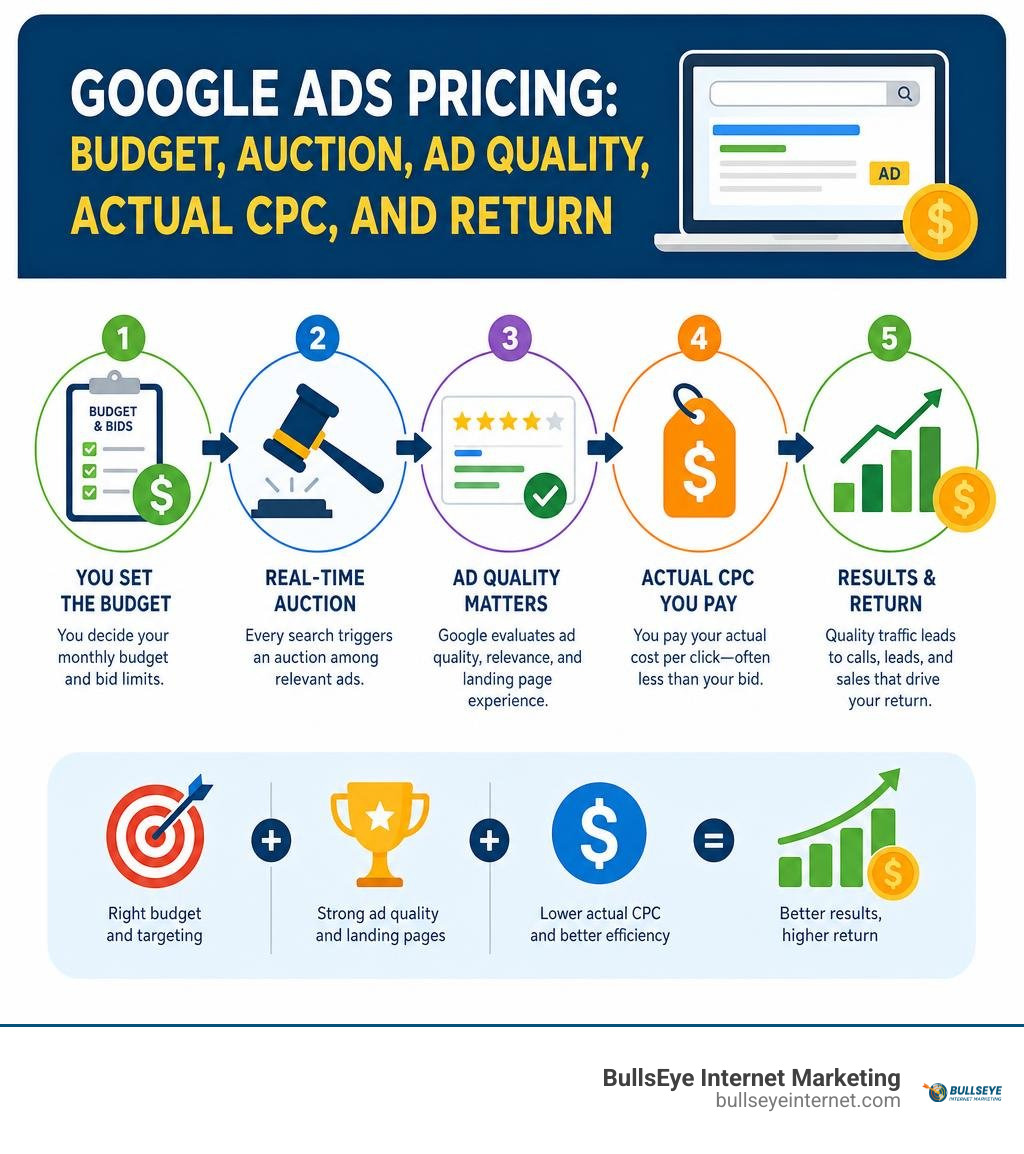
Basic google ads pricing vocab:
How Google Ads Pricing Works: The Ad Auction and Cost Breakdown
Google Ads does not function like a traditional billboard or print magazine where you pay a fixed upfront fee regardless of results. Instead, it operates on a dynamic pay-per-click (PPC) system where an automated auction executes in milliseconds every time a user types a search query.
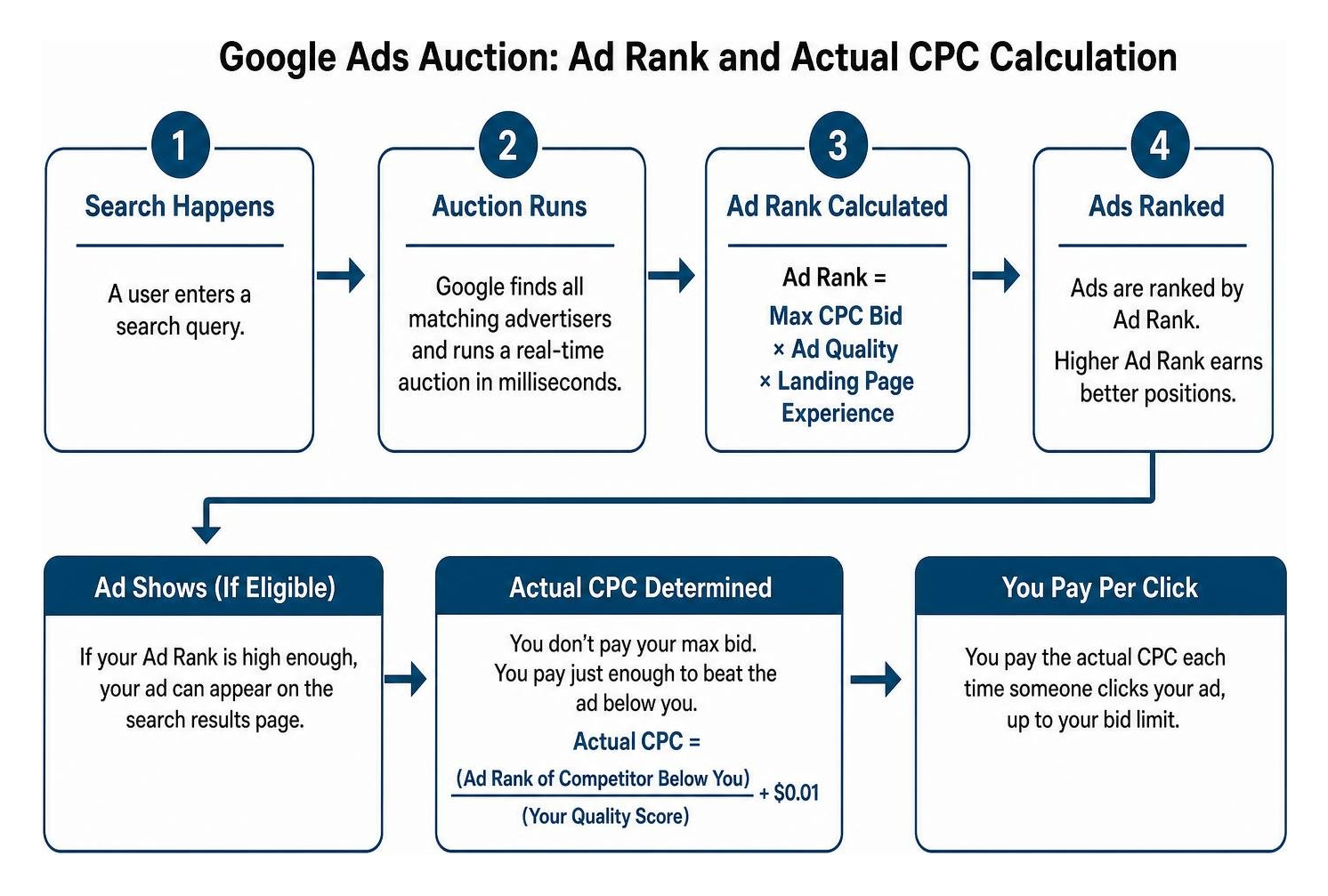
The Ad Auction, Ad Rank, and Actual CPC Calculation
When a user submits a search, Google identifies all matching advertisers and calculates an Ad Rank for each eligible ad. Ad Rank determines two fundamental outcomes: whether your ad appears on the search engine results page (SERP) and its exact position relative to competitors.
Ad Rank is calculated using a dynamic formula:
- Maximum CPC Bid: The highest amount you have specified you are willing to pay for a click.
- Quality Score: Google’s assessment of expected click-through rate (CTR), ad relevance, and landing page experience.
- Ad Rank Thresholds: The baseline reserve price required for an ad to show in a given position based on search topic, device, and user context.
- Competitiveness of the Auction: The gap between competing advertisers’ quality and bids.
- Ad Assets and Formats Impact: The expected lift from sitelinks, call buttons, and structured snippets.
Under Google’s modified second-price auction model, your actual cost-per-click (actual CPC) is rarely your maximum bid. Instead, you pay only the minimum amount necessary to clear the Ad Rank threshold and surpass the Ad Rank of the competitor immediately beneath you. For granular control over starting bids, reviewing guidelines for manual CPC bidding helps advertisers establish baseline caps before deploying automation. For a broader structural overview, consult our comprehensive Google Ads complete guide.
Quality Score, Landing Page Experience, and Bid Thresholds
Quality Score is graded on a scale of 1 to 10 for each keyword. It acts as a direct discount multiplier on your advertising expenses. Advertisers with higher Quality Scores enjoy lower actual CPCs and superior ad placement, even when bidding less than their direct competitors.
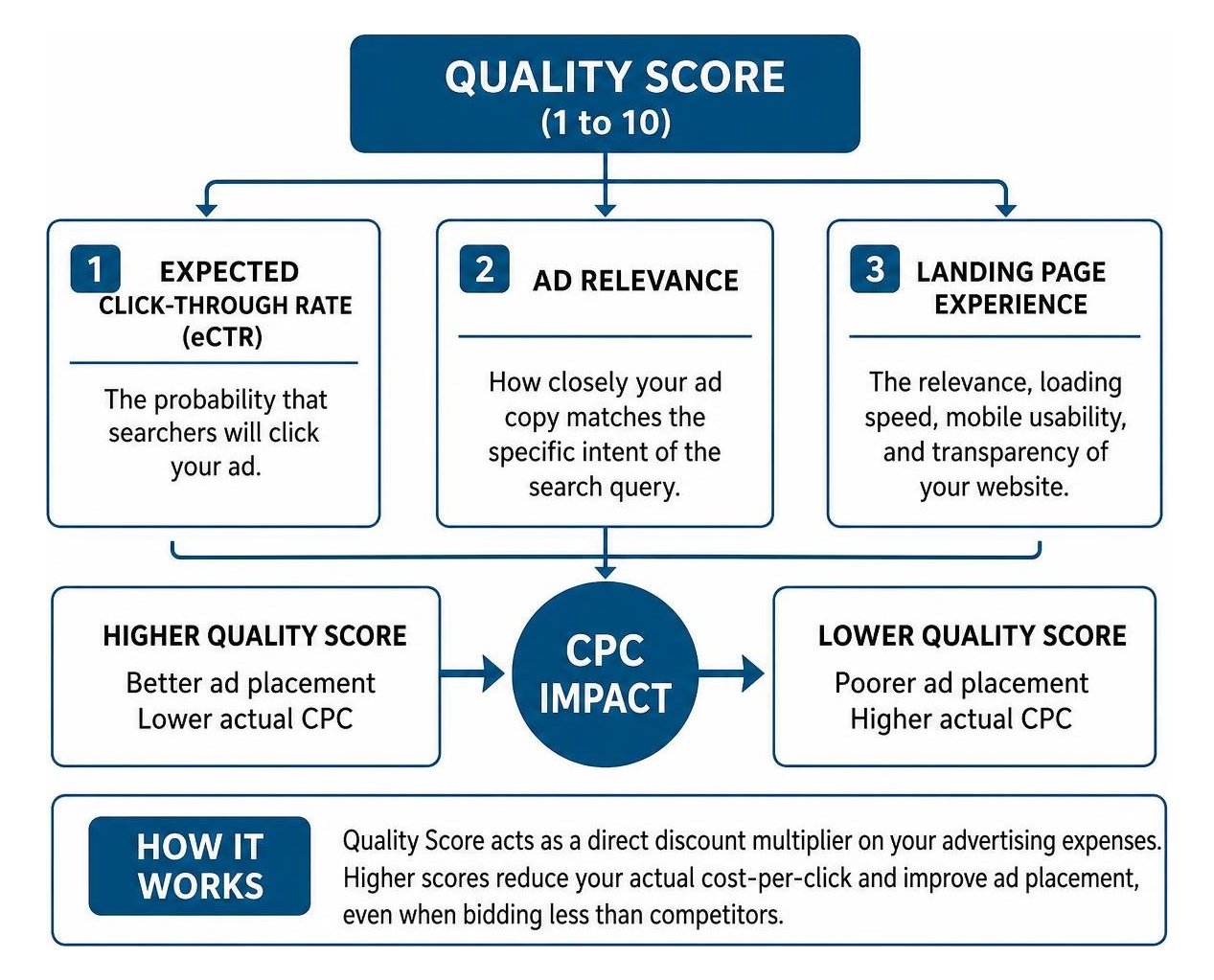
The three pillars of Quality Score include:
- Expected Click-Through Rate (eCTR): The probability that searchers will click your ad based on historical performance and ad positioning.
- Ad Relevance: How closely your ad copy matches the specific intent of the search query.
- Landing Page Experience: The relevance, loading speed, mobile usability, and transparency of your website.
A subpar landing page experience carries heavy financial penalties. Poor landing page performance inflates CPCs by an average of 47% while decreasing ad visibility by 23%. Furthermore, your landing pages must uphold strict compliance standards; deceptive claims or hidden checkout fees violate Google’s misrepresentation and dishonest pricing policies and can lead to account suspension after a standard 7-day warning period.
Industry Benchmarks and Factors Influencing Google Ads Pricing
Across all industries, the average cost per click in Google Ads in 2026 reached $5.42 on Search, with an overall average cost per lead (CPL) of $66.69. However, broad averages obscure drastic industry-specific variations driven by customer lifetime value and bidding competition.
- Attorneys & Legal Services: Average CPC of $9.87; average CPL of $131.63.
- Home & Home Improvement: Average CPC of $8.33.
- Dentists & Dental Services: Average CPC of $8.00.
- Personal Services: Average CPC of $7.17.
- Health & Fitness: Average CPC of $6.17.
- Arts & Entertainment: Average CPC of $1.63.
- Restaurants & Food: Average CPC of $2.05.
Local service providers can also leverage alternative pay-per-lead models. For localized service pricing mechanics, see our breakdown of Google Local Service Ads pricing.
Targeting broad keywords like “lawyer” or “plumber” invites fierce bidding wars. Conversely, targeting high-intent long-tail keywords—such as “emergency commercial pipe repair contractor”—reduces competition, drives down CPCs, and captures qualified prospects ready to make an immediate purchasing decision.
Google Ads Campaign Types and Average Cost Benchmarks
Google offers distinct campaign types across its advertising ecosystem, each carrying unique cost structures and performance dynamics.
Search, Shopping, Display, and Video Ad Formats
Pricing varies significantly across Google’s network based on visual format and user search intent:
| Campaign Type | Average CPC / CPV | Typical Conversion Rate | Primary Best Use Case |
|---|---|---|---|
| Search Ads | $2.96 – $5.42 | 3.5% – 7.0% | Capturing immediate, high-intent bottom-funnel searches |
| Shopping Ads | $0.66 | 2.0% – 4.5% | Direct product sales driven by Google Merchant Center feeds |
| Display Network | < $1.00 ($0.50 – $2.00) | 0.5% – 1.5% | Brand awareness, visual remarketing, and broad reach |
| YouTube Video | $3.56 per view action | 1.0% – 3.0% | Mid-funnel engagement and visual product storytelling |
| Performance Max | $1.00 – $4.00 (blended) | 3.0% – 6.0% | Cross-channel automated asset distribution |
To maximize Search real estate without increasing baseline click costs, advertisers frequently deploy interactive price assets. Setting up these formats correctly is straightforward when following Google pricing asset setup specifications. These interactive cards display pricing for up to 8 distinct products or services directly beneath your search text ad, with each asset click billed at your standard headline CPC.
Setting Minimum Budgets and the 30.4 Daily Overspend Rule
Google Ads does not enforce a mandatory platform minimum spend; campaigns can technically run on as little as $1.00 per day. However, a practical testing budget requires enough traffic to generate meaningful conversion data. Across analyzed Google accounts, spend distribution breaks down into clear tiers:
- 24% of accounts spend under $1,000 per month.
- 39% of accounts spend between $1,000 and $10,000 per month.
- 37% of accounts spend over $10,000 per month.
- The average account across all industries spends $3,127.38 per month.
When planning daily caps, keep Google’s billing rules in mind. Google uses a 30.4 multiplier (the average number of days in a calendar month) to calculate your monthly spending ceiling:
$$\text{Monthly Budget Cap} = \text{Average Daily Budget} \times 30.4$$
On days with unusually high search volume, Google’s overdelivery rule allows your campaign to spend up to 2x (200%) of your daily budget. However, you are never billed more than your monthly cap over a full billing cycle. Any overdelivery spend exceeding your 30.4 threshold is automatically credited back to your billing summary. For complete step-by-step setup details, review Google campaign budget setting instructions.
Strategic Bidding and Budget Calculation Models
Establishing a profitable Google Ads budget requires working backward from concrete commercial targets rather than guessing an arbitrary monthly dollar figure.

Selecting the Right Bidding Strategy for Your Goals
Choosing a bidding model depends on your monthly budget size, conversion history, and business objectives:
- Manual CPC: Best for new accounts with limited conversion data (fewer than 15–30 conversions per month). It provides complete control over keyword-level bid caps while establishing initial baselines.
- Maximize Conversions: Google’s algorithm automatically sets bids to harvest the highest volume of conversions within your designated daily budget.
- Target CPA (Cost Per Acquisition): Instructs Google’s Smart Bidding engine to generate leads or sales at or below a specific acquisition cost.
- Target ROAS (Return on Ad Spend): Optimizes bids dynamically for revenue value. Ideal for e-commerce stores with varied order values once consistent conversion tracking is established.
For an end-to-end framework on configuring and scaling bidding models, check our ultimate Google PPC management guide.
Working Backward from Target ROAS, CAC, and Lifetime Value
To build an accurate advertising budget, reverse-engineer your spend from your revenue targets and customer lifetime value (CLV):
Calculate Allowable Ad Spend from Revenue Goals: $$\text{Monthly Ad Budget} = \frac{\text{Monthly Revenue Target}}{\text{Target ROAS}}$$ Example: If your business targets $100,000 in monthly revenue at a 4x target ROAS (400%), your allowable ad budget is $25,000.
Determine Target Customer Acquisition Cost (CAC) via CLV: If an average customer spends $200 per order and purchases 3 times over their lifespan, your CLV is $600. Using a sustainable 3:1 CLV-to-CAC ratio, your allowable target CAC is $200.
Calculate Maximum Allowable CPC: $$\text{Max Tolerable CPC} = \text{Target CAC} \times \text{Landing Page Conversion Rate}$$ Example: With a target CAC of $200 and a 4% landing page conversion rate: $$\text{Max CPC} = \$200 \times 0.04 = \$8.00$$
A modest 1% improvement in landing page conversion rate (e.g., from 3% to 4%) can compress required ad spend by 20% to 30% while generating identical revenue output.
Tactics to Reduce Wasted Spend and Maximize Return
Unmonitored Google Ads campaigns can waste 20% to 40% of their total budget on unqualified clicks. Systematic budget hygiene protects your margins.
Negative Keywords, Exclusions, and Ad Scheduling
- Aggressive Negative Keyword Lists: Regularly review the Search Terms Report to identify and exclude irrelevant search intent (e.g., searches containing “free,” “jobs,” “salary,” “DIY,” or “login”).
- Audience Exclusions: Exclude existing customers from top-of-funnel acquisition campaigns to eliminate redundant spend, and suppress non-converting demographic brackets.
- Ad Scheduling (Dayparting): Restrict ad delivery to operating hours when your sales team can answer incoming calls immediately, or prioritize days that historical analytics show have higher conversion rates.
- Geographic Bid Adjustments: Exclude non-serviceable ZIP codes or adjust bids downward in underperforming regions.
Scaling Budgets and Recognizing Diminishing Returns
Scale your budget systematically rather than doubling spend overnight. Increase campaign budgets by 10% to 20% every 7 to 14 days only when specific efficiency criteria are met:
- Campaign ROAS remains consistently above target for 14+ consecutive days.
- Search Impression Share Lost to Budget exceeds 20%, indicating unsatisfied demand.
- Cost per acquisition (CPA) remains stable as impression volume expands.
Conversely, if CPA increases by more than 15% to 20% without a corresponding increase in lead or revenue volume, your bids may be hitting diminishing marginal returns. Evaluating account efficiency through professional PPC audit pricing reveals underlying waste before you attempt further budget expansion.
Hidden PPC Expenses and Data Fragmentation Challenges
Raw ad spend paid directly to Google is only one part of total advertising costs. Indirect costs and measurement discrepancies must be factored into your financial calculations.
Managing Hidden Costs and Agency Google Ads Pricing Models
Outside of direct media spend, businesses must account for creative asset development, landing page hosting, and professional campaign management. Standard agency fee structures include:
- Percentage of Ad Spend: Agencies charge a 15% to 20% management fee on top of raw ad spend.
- Flat Monthly Retainers: Predictable fees ranging from $2,500 to $7,000 monthly for SMBs and mid-market accounts.
- Enterprise Management Fees: Accounts spending over $100,000 monthly typically pay management fees between $8,000 and $15,000+ per month.
For an extensive review of management fee models and deliverables, consult the no-nonsense guide to Google Ads services pricing.
At BullsEye Internet Marketing, we operate with a straightforward philosophy: we work with no long-term contracts and maintain strict client exclusivity by partnering with only one business per industry within any geographic area. This structure aligns our agency directly with your growth and prevents competitive conflicts of interest.
Attribution Gaps and Unified Performance Data
Privacy changes—such as iOS App Tracking Transparency (ATT) where cross-app tracking opt-ins dropped below 25%—have introduced substantial attribution gaps. Many standard Google Ads accounts experience a 40% to 60% drop in directly reported conversion accuracy.
When ad data, CRM records, and offline sales live in disconnected software silos, businesses often under-allocate budget to upper-funnel search campaigns that drive offline phone calls or in-person visits. Implementing enhanced conversions, server-side tracking, and direct CRM integration ensures your budget decisions reflect true revenue rather than incomplete platform dashboards.
Frequently Asked Questions About Google Ads Costs
What is the minimum budget required to start Google Ads?
Google enforces no mandatory minimum spend, but starting with at least $1,000 to $2,500 per month ($20 to $50 per day) allows the platform to accumulate sufficient click and conversion data within 30 to 60 days to guide optimization.
Why does actual CPC differ from the maximum CPC bid?
Your maximum CPC bid represents the highest amount you are willing to pay, while your actual CPC is determined dynamically by Google’s auction. You only pay the minimum amount required to maintain your Ad Rank position above the competitor ranked beneath you, which is frequently less than your maximum bid.
How does Quality Score lower advertising expenses?
Quality Score serves as a bid discount. High ad relevance, strong expected click-through rates, and fast, transparent landing pages allow you to secure top search placements at lower CPCs than competitors with inferior Quality Scores who bid higher amounts.
Conclusion
Understanding Google Ads pricing requires recognizing that success is not determined by who spends the most money, but by who spends every advertising dollar with the greatest precision. By mastering auction mechanics, improving Quality Score, applying rigorous negative keyword controls, and calculating budgets from revenue metrics, your business can build an efficient, scalable customer acquisition engine.
If you are ready to eliminate wasted ad spend and generate qualified calls and sales, partner with our team for expert Google Ads management backed by dedicated market exclusivity and zero long-term contracts.
