
How AI Search Algorithms Make Search Results More Useful
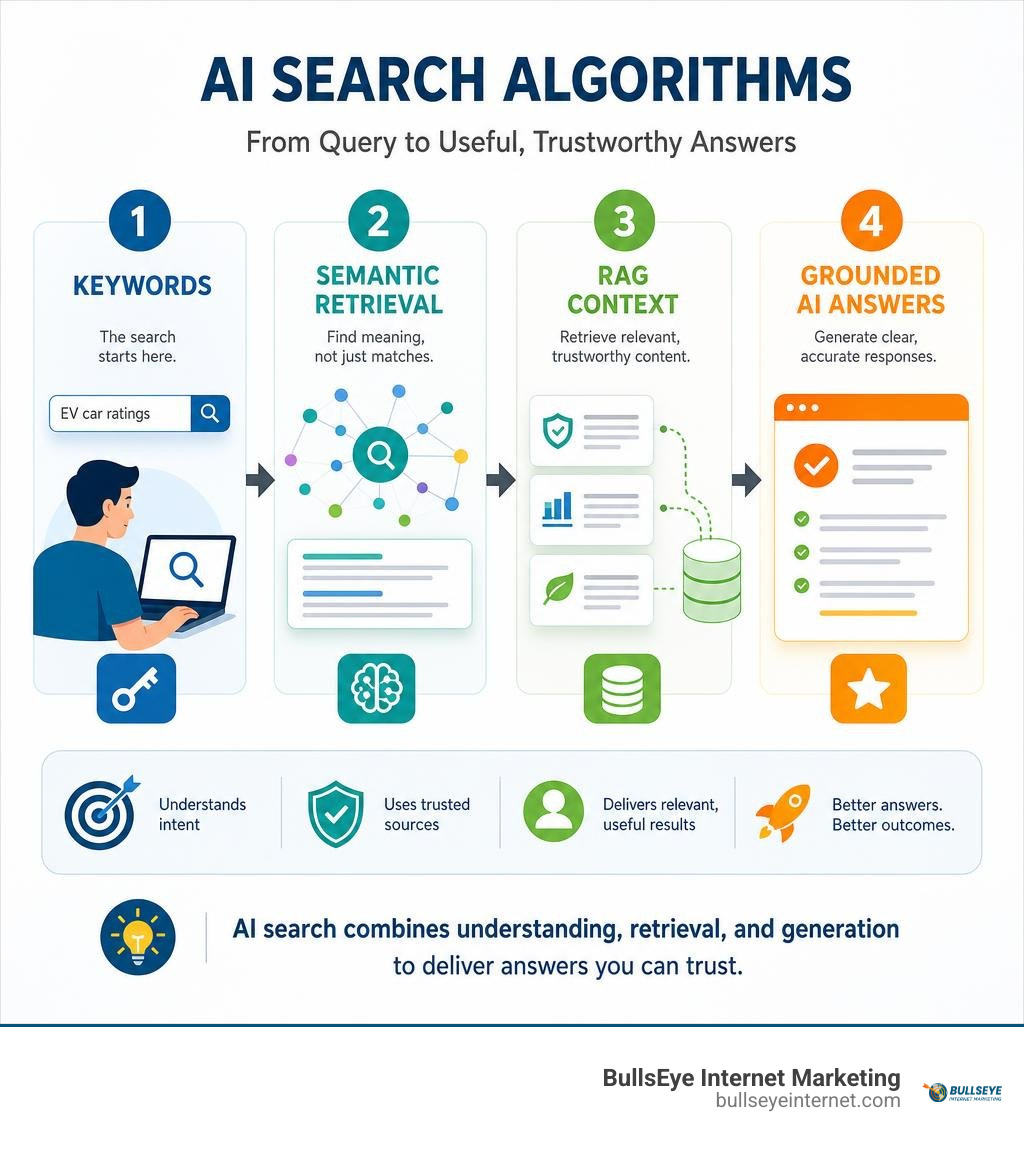
AI search algorithms help search engines find meaning, not just matching words. They combine keyword signals with natural language processing, machine learning, and semantic embeddings to understand a query’s context. Retrieval Augmented Generation (RAG) adds another layer: it retrieves relevant, trustworthy content first, then gives an AI system the context needed to produce a grounded answer.
For businesses, this shift matters because visibility is no longer only about ranking for a phrase. Your content must clearly answer the question, match the searcher’s likely goal, and cover the motivations behind that goal – such as price, safety, speed, trust, or environmental impact.
A search for “EV car ratings,” for example, may look informational. But the person searching may really be a parent comparing safety features, a budget-conscious buyer checking long-term costs, or an eco-focused shopper. Modern search systems can use query language and contextual signals to better distinguish among those needs.
RAG helps close that gap. Instead of relying only on what a language model learned during training, a RAG system retrieves relevant pages or passages at search time and uses them to inform its response. That can make results more specific, current, and useful when the retrieval sources are accurate and well structured.
I am Ronnie Katz, founder and Principal CEO of BullsEye Internet Marketing, with more than 20 years of experience helping businesses improve online visibility, traffic, and conversions. As AI search algorithms reshape SEO, PPC, AEO, and content strategy, I focus on practical, measurable ways to turn changing search behavior into more qualified calls and leads.
AI search algorithms word guide:
The Mechanics of Modern AI Search Algorithms and Neural Retrieval
The transition from string matching to conceptual understanding represents the most profound shift in information retrieval history. In earlier search frameworks, engines relied on lexical algorithms like BM25 to score documents based on term frequency and inverse document frequency. While effective for exact keyword matches, this approach failed whenever a user’s vocabulary diverged from the author’s phrasing.
Modern discovery engines employ dense retrieval powered by high-dimensional vector representations. Instead of cataloging isolated text strings, neural networks transform sentences, paragraphs, and multimedia into dense vectors residing in an embedding space. Vector databases calculate cosine similarity to identify documents that share underlying conceptual meaning, even when they do not share a single matching word.
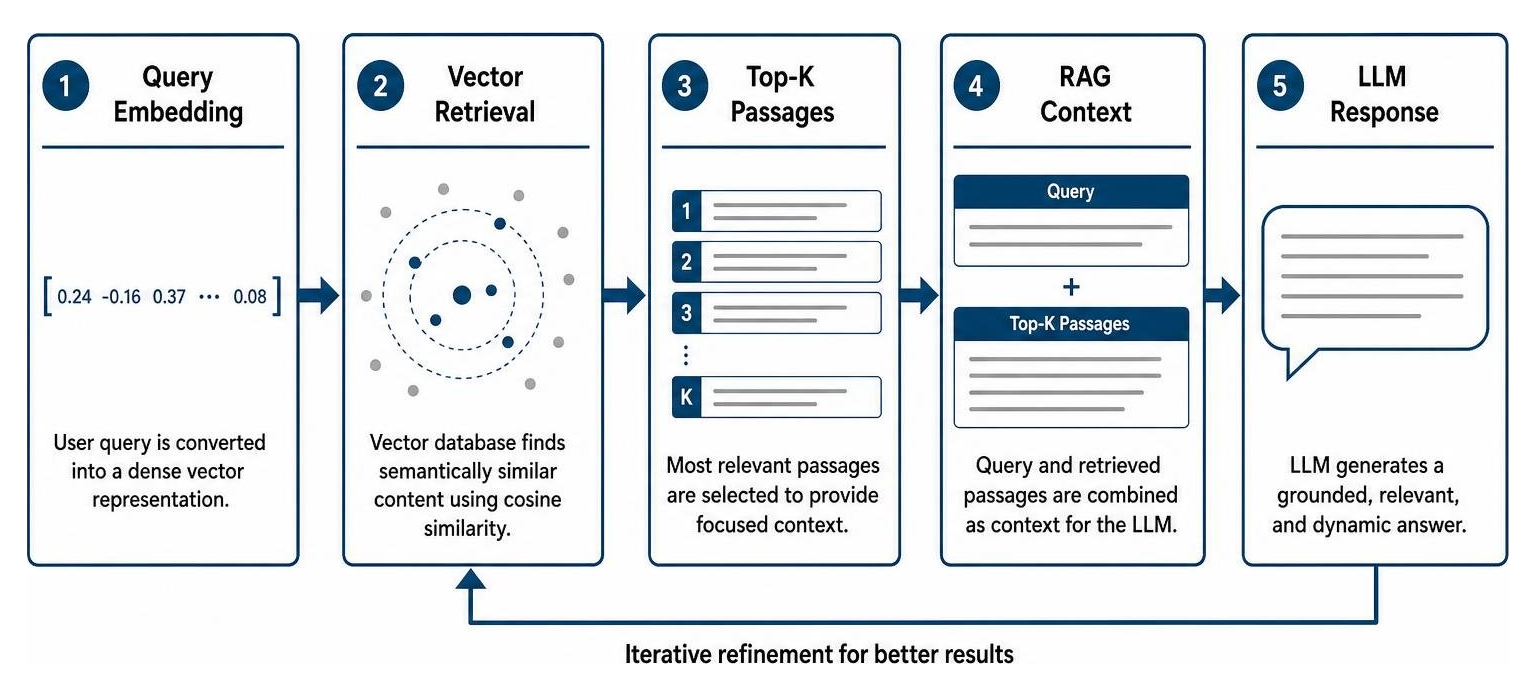
State-of-the-art architectures integrate hybrid search models that combine the precision of BM25 with the conceptual depth of dense vector retrieval. Furthermore, autonomous agents are transforming simple vector retrieval into dynamic problem-solving pipelines. Cutting-edge scientific research on agentic tree search demonstrates that applying lookahead tree search algorithms allows AI agents to explore multi-step web environments, backtrack upon encountering dead ends, and substantially boost task completion rates compared to standard sequential language models.
How AI Search Algorithms Decode User Intent and Query Motivation
Deciphering why someone types a phrase requires analyzing semantic nuances and implicit psychological drivers. Natural language processing (NLP) and transformer models like BERT (Bidirectional Encoder Representations from Transformers) evaluate words in context by processing bidirectional relationships across whole sentences.
When evaluating ranking criteria and AI search ranking factors, discovery systems analyze:
- Contextual modifiers that signal user urgency or price sensitivity
- Historical interaction trajectories across search sessions
- Situational variables including device type, browsing patterns, and geographic environment
- Semantic associations between adjacent concepts within knowledge graphs
By mapping queries across multi-layered motivation vectors, AI search engines distinguish between identical phrases that stem from radically different consumer needs.
From Lexical Matching to High-Dimensional Vector Search
High-dimensional vector indexing allows search engines to perform approximate nearest neighbor (ANN) search across billions of documents in milliseconds. Structures like Hierarchical Navigable Small World (HNSW) graphs enable algorithms to traverse dense clusters of semantic points rapidly.
To maintain visibility across these neural frameworks, organizations must implement sophisticated large language model SEO strategies. High-dimensional vector indexing ensures that content is grouped by conceptual authority rather than superficial keyword repetition, allowing discovery engines to ground generative summaries in verified, contextually rich documentation.
Bridging Intent Gaps: RAG Architecture, Heuristics, and Multi-Step Planning
Retrieval-Augmented Generation bridges static knowledge cutoffs and live information retrieval. Standard large language models are limited by their frozen training data, which can lead to hallucinations when answering niche or timely queries. RAG overcomes this by establishing a dynamic retrieval pipeline: when a user initiates a query, the system retrieves relevant document chunks from an indexed database, injects those passages into the model’s active context window, and synthesizes an accurate, grounded answer.
| Dimension | Traditional Lexical Search (BM25) | Generative Retrieval (RAG & Dense Vectors) |
|---|---|---|
| Matching Mechanism | Exact term matching and inverted index lookup | Semantic embeddings and nearest-neighbor vector similarity |
| Context Understanding | Keyword density and proximity metrics | Deep bidirectional attention and conceptual embeddings |
| Result Presentation | Ten blue links and static text snippets | Synthesized conversational summaries with source attribution |
| Query Flexibility | Fragile; requires precise keyword syntax | Resilient; understands colloquialisms, voice, and intent |
| Planning Capability | Single-step static scoring | Multi-step agentic planning, exploration, and verification |
Recent breakthroughs in scientific research on Pareto-optimal agentic planning reveal that decoupling search planners from generative answer engines yields superior QA accuracy while minimizing latency. By using reinforcement learning to optimize both retrieval utility and computational cost, these modular frameworks ensure that search engines retrieve only the most relevant context before generating answers.
Engineering Agentic Workflows with AI Search Algorithms
Modern search engines are evolving from passive retrieval filters into proactive reasoning engines. Rather than executing a single vector search, advanced search platforms employ Monte Carlo Tree Search (MCTS) and reinforcement learning to navigate complex problem spaces.
Pioneering scientific research on tree-based search in LLMs proves that embedding structured tree search directly into training loops allows models to overcome exploration bottlenecks, achieving higher accuracy with significantly fewer compute resources. To capture visibility within these multi-turn reasoning chains, brands must master contemporary generative SEO techniques that present structured data and authoritative solutions directly to autonomous evaluation agents.
Optimizing Heuristic Exploration and Knowledge Calibration
When heuristics are imperfect or query data is noisy, naive search algorithms can stall in suboptimal branches. Advanced heuristic search frameworks resolve this by integrating epistemic calibration and selective sampling into their candidate expansion loops.
Groundbreaking scientific research on epistemic A* exploration highlights how cluster scouting and path-aware sampling allocate exploration budgets to the most promising candidate nodes. By applying Upper Confidence Bounds for Trees (UCT) penalties and frontier selection, search systems navigate open candidate sets efficiently, ensuring that generative engines surface contextually sound results even when resolving complex, multi-layered queries.
Motivation-Driven Search Marketing and Ad Relevance at Scale

Understanding the “why” behind a search query provides an undeniable competitive advantage in paid and organic search. Search platforms increasingly reward content and advertisements that align directly with deep consumer motivations rather than generic search phrases. When campaigns align with user intent, click-through rates rise, cost-per-click drops, and overall campaign efficiency improves.
Investing in structured AI visibility optimization ensures that your brand assets are positioned across all intent pathways, capturing high-intent prospects across every stage of the decision-making cycle.
Transforming Traditional Search Intent into Deep Motivation Targeting
Traditional search marketing categorized intent into basic buckets: informational, navigational, transactional, and commercial. While helpful, these broad categories miss the psychological friction points that dictate conversion behavior.
Through deep semantic parsing and semantic SEO services, we can identify specific motivation clusters within an identical commercial keyword:
- Cost Minimization: Buyers looking for maximum ROI, discounts, or flexible pricing terms
- Risk Aversion: Shoppers seeking warranties, certifications, safety ratings, and social proof
- Convenience & Speed: Customers prioritizing immediate availability, rapid delivery, and frictionless checkout
- Eco-Conscious Values: Consumers evaluating sustainability metrics, carbon offsets, and ethical sourcing
By creating content variations and dynamic ad copy tailored to each motivation cluster, businesses eliminate intent gaps and turn broad interest into measurable sales.
Scaling Personalized Content and Campaign Efficiency
Scaling dynamic copy across dozens of motivation archetypes is now achievable through automated generative pipelines. Machine learning models analyze real-time context—such as query phrasing, location, device capabilities, and browsing patterns—to assemble personalized ad creatives and landing pages dynamically.
Deploying advanced generative AI lead generation pipelines allows businesses to maximize lead velocity while reducing wasted ad spend. When ads resonate directly with a searcher’s core motivation, engagement signals surge, driving higher Quality Scores and lowering incremental customer acquisition costs across the board.
Strategic Implementation, Ethics, and Governance in Generative Discovery
Deploying AI-driven discovery systems requires rigorous governance, security safeguards, and ethical oversight. Inferring user motivation must never compromise consumer privacy or violate regulatory frameworks.
To build sustainable, high-performing search systems, organizations should follow our structured LLM SEO best practices guide to balance discovery performance with institutional compliance:
- Ingest and Clean Proprietary Data: Ensure all corporate knowledge bases, product documentation, and FAQs are parsed into structured markdown chunks.
- Implement Dense Embedding and Vector Indexing: Use high-performance embedding models to convert domain assets into searchable vector clusters.
- Establish Hybrid Retrieval Layers: Combine BM25 lexical ranking with vector similarity to capture exact product codes as well as conversational questions.
- Deploy Context-Grounded RAG Pipelines: Limit generative responses strictly to retrieved, verified context passages to eliminate hallucinations.
- Calibrate Continuous Feedback Loops: Monitor user satisfaction scores, click-through paths, and conversion metrics to re-index content dynamically.
Navigating Algorithmic Transparency and Ethical Constraints
As AI systems infer motivation from contextual signals, businesses must prioritize consumer trust. Implementing techniques like differential privacy and federated learning allows algorithms to train on aggregated user interactions without exposing personally identifiable information.
Furthermore, search engines and marketing platforms must implement strict hallucination controls. Ensuring that AI outputs are traceable to underlying citations protects brand reputation and maintains long-term user confidence across AI-assisted channels.
Practical Steps for Building Motivation-Centric Search Experiences
To ensure search engines cite your brand when addressing user motivations, your digital footprint must provide structured answers to every dimension of a customer’s decision process.
Applying proven AI search best practices guarantees that your digital assets satisfy both classical search engine crawlers and modern generative discovery agents across the search ecosystem.
Frequently Asked Questions About AI Search Systems
How do AI search systems determine the underlying motivation behind a user query?
Modern search systems combine advanced natural language processing (NLP), transformer embeddings like BERT, and contextual signals to analyze query structure. By evaluating grammatical modifiers, past search sequences, geographic context, and device telemetry, machine learning models map queries against distinct psychological intents (such as convenience, price, safety, or luxury) rather than treating words as isolated terms.
What is the primary difference between traditional RAG and agentic tree search?
Traditional Retrieval-Augmented Generation (RAG) executes a single-step retrieval query: it converts a prompt into an embedding, fetches the most similar document chunks, and passes them to a language model for answer generation. Agentic tree search employs multi-step lookahead planning, exploration heuristics, and dynamic backtracking. It can issue multiple sub-queries, verify intermediate facts, evaluate conflicting evidence, and adjust its retrieval trajectory before providing a final response.
How does motivation-aligned search advertising lower campaign costs?
When ad copy and landing page messaging align directly with a searcher’s specific motivation (e.g., highlighting safety certifications to a risk-averse buyer), user engagement increases substantially. This produces higher click-through rates (CTR) and conversion rates. Search and ad platforms reward this relevance with higher Quality Scores, reducing the effective cost-per-click (CPC) and driving down customer acquisition costs.
Conclusion
Understanding the mechanics behind neural search, vector databases, and Retrieval-Augmented Generation is essential for any modern growth strategy. As search engines shift toward motivation-driven generative answers, businesses that rely solely on outdated keyword density will continue to lose market share to agile brands that satisfy the deeper “why” behind every search.
At BullsEye Internet Marketing, we help businesses navigate this transformation. We specialize in driving measurable phone calls and qualified sales through advanced Pay Per Lead, Google Business Profile Optimization, comprehensive SEO, PPC management, and conversion rate optimization. Our core differentiator is simple and built for your growth: we offer no long-term contracts and maintain an exclusive policy of working with only one client per industry per geographic area, providing you with an undeniable competitive advantage in your market.
Whether you are looking to dominate local search or scale your generative visibility nationwide, mastering Answer Engine Optimization is the key to securing sustainable digital market share. Ready to elevate your online performance? Connect with BullsEye Internet Marketing today to capture high-intent leads and accelerate your business growth.
