
What Are Search Engine Optimized Websites — and Why Do They Matter?
Search engine optimized websites are websites built and structured so that Google and other search engines can easily find, understand, and rank them — putting your business in front of people who are actively looking for what you offer.
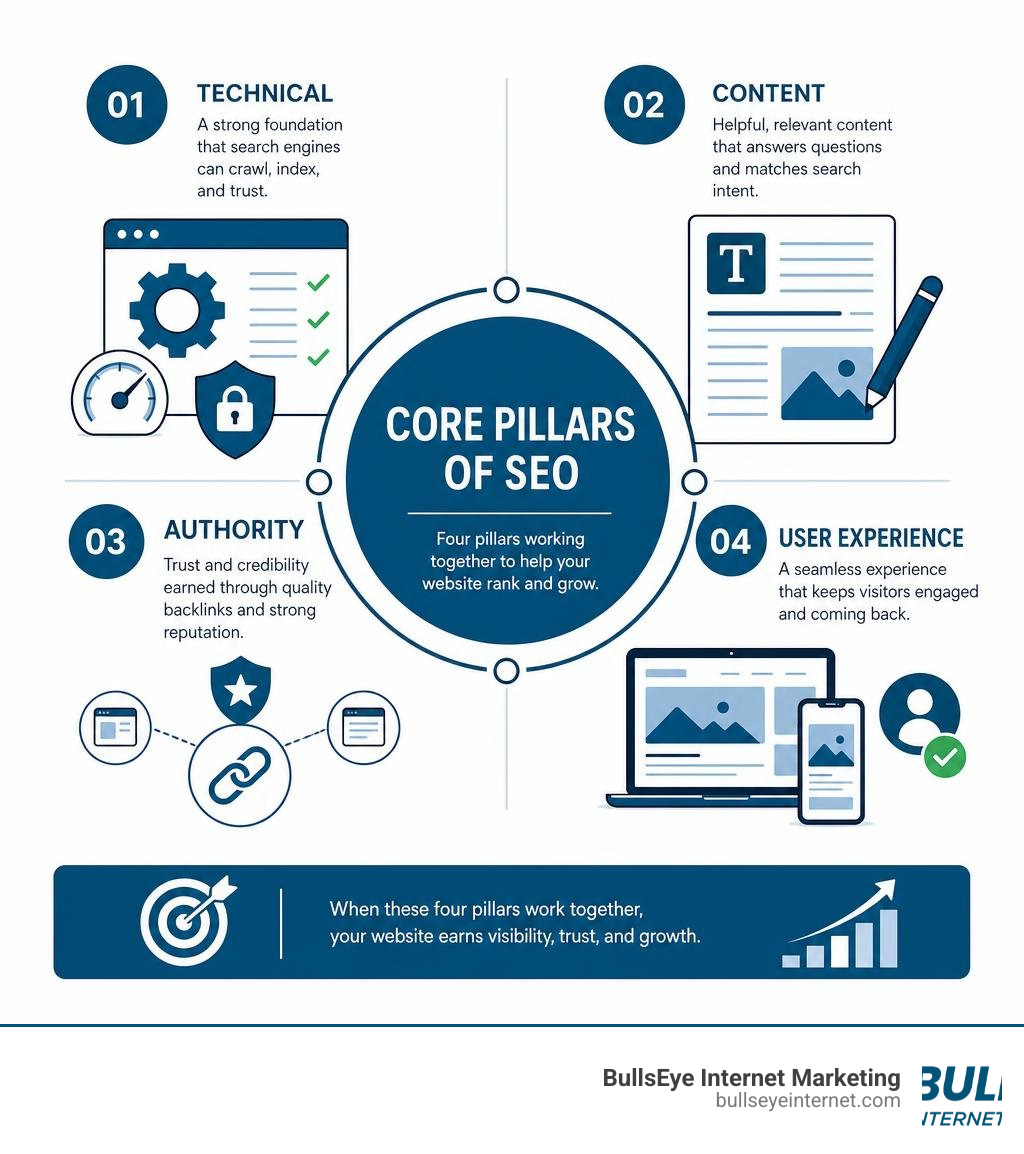
Here’s what makes a website search engine optimized:
- Technical foundation — fast load times, mobile-friendly design, HTTPS security, and clean code
- Crawlability — clear site structure, XML sitemaps, and proper robots.txt so search engines can index your pages
- Content quality — relevant, helpful content that matches what your audience is searching for
- On-page optimization — title tags, meta descriptions, headings, and keywords used correctly
- Authority — links from reputable websites that signal trust to search engines
- User experience — easy navigation, low bounce rates, and pages that load quickly on any device
If your website isn’t showing up on page one of Google, you’re likely missing customers to competitors who rank above you. Research shows that page one results capture 95% of all clicks — while everything on page two and beyond shares just 5%. With Google controlling roughly 92% of global search traffic, ranking well isn’t optional for businesses that want consistent, cost-effective leads.
But SEO isn’t just about rankings. A well-optimized site is faster, easier to use, and more trustworthy — which means more visitors convert into actual customers.
I’m Ronnie Katz, founder and Principal CEO of BullsEye Internet Marketing, and since 2006 I’ve helped businesses of all sizes build search engine optimized websites that drive real, measurable growth. In this guide, I’ll walk you through exactly how SEO works and what it takes to rank in today’s competitive landscape.
The Anatomy of Search Engine Optimized Websites
To understand how to build search engine optimized websites, we must first pull back the curtain on how search engines operate. Google isn’t a magical oracle; it is a highly sophisticated, fully automated software system. It relies on automated programs called crawlers (often referred to as bots or spiders) to explore the web constantly.
This process occurs in three distinct phases:
- Crawling: Crawlers discover new and updated pages by following links from pages they have already visited.
- Indexing: Once a page is discovered, Google analyzes its content, layout, images, and structure to understand what it is about. This information is stored in a massive database called the search index.
- Ranking: When a user types a query, Google’s algorithm searches the index to find the most relevant, high-quality answers. It evaluates hundreds of ranking factors to decide which pages appear at the top.

The Google algorithm is constantly evolving. To give you some context on how fast things change, Google made over 500 algorithm changes back in 2010—nearly 1.5 changes per day. Today, that number is even higher. To stay ahead, your site must align with the core principles of search engine algorithms. Learn more about these ranking factors in our guide to SEO Ranking Best Practices Factors Tips Tools to Improve Your Positions.
Why Public Sector and Government Entities Need Search Engine Optimized Websites
While commercial businesses use SEO to drive sales, public sector and government entities use it to provide vital public services. Strong SEO fosters transparency, enhances user experience, and connects citizens to critical resources.
In the United States, digital experience standards are legally mandated. The 21st Century Integrated Digital Experience Act (21st Century IDEA Act) and OMB Memo M-23-22 require federal websites to be searchable, accessible, and user-friendly.
When public websites are search engine optimized, the public can easily find answers to complex questions—such as how to renew a passport or check tax statuses—directly on the search engine results page (SERP). This effective search capability reduces user friction and significantly lowers reliance on contact centers or support channels, saving millions of dollars in taxpayer-funded administrative costs.
Technical Foundations of Search Engine Optimized Websites
Before you write a single word of content, your website’s technical foundation must be rock-solid. If search engines struggle to load or read your site, your rankings will suffer.
First, let’s talk about speed and user experience. Google measures these through Core Web Vitals, which focus on three main metrics:
- LCP (Largest Contentful Paint): How fast the main content of a page loads (aim for 2.5 seconds or less).
- CLS (Cumulative Layout Shift): How visually stable the page is (aim for a score of 0.1 or less so elements don’t jump around).
- INP (Interaction to Next Paint): How responsive the page is to user interactions like clicks (aim for 100 milliseconds or less).
To optimize these metrics, we recommend compressing images, minifying CSS and JavaScript files, and utilizing a reliable Content Delivery Network (CDN).
Second, security is a non-negotiable ranking factor. An SSL certificate encrypts data between your user and your server, turning your URL from HTTP into the secure HTTPS protocol. Google prioritizes secure sites to protect user privacy.
Finally, your site must be designed with mobile-first indexing in mind. Mobile-first indexing became the default for Google in 2019. This change was driven by user behavior: today, over 51.3% of all web pages are loaded by mobile devices. Google crawls and ranks your site based on how it looks and performs on a mobile screen, not a desktop. For a deeper dive into modern design standards, check out our resource on Web Design Best Practices 2025.
Crawlability, Site Structure, and Navigation
Think of your website as a library. If the books are piled randomly on the floor, no one can find what they need. A clean site architecture makes it easy for both human visitors and search engine crawlers to navigate your pages.
To help crawlers navigate your library, you need two essential files:
- XML Sitemaps: This is a structured roadmap of all the important pages on your website. Submitting your XML sitemap to Google Search Console ensures Google knows exactly which pages to crawl.
- robots.txt: This file acts as a gatekeeper. It tells crawlers which directories or pages they should not crawl, such as internal search result pages, admin areas, or duplicate print-friendly pages.
Your URL structure should also be clean and descriptive. Compare these two URLs:
bullseyeinternet.com/seo-services-florida/bullseyeinternet.com/cat/?id=98723
The first URL uses descriptive directories and keywords, making it immediately clear to both users and search engines what the page is about.
Additionally, we must address duplicate content. If you have multiple URLs with similar content, search engines won’t know which version to rank. To prevent this, use canonical tags (rel="canonical") to point search engines to the primary, authoritative version of the page. If you are unsure if your site has crawlability issues, scheduling a comprehensive SEO Audit is the best way to uncover hidden technical bottlenecks.
Organizing Navigation for Users and Crawlers
Great navigation bridges the gap between technical crawlability and user experience. When organizing your site’s navigation, keep these best practices in mind:
- Logical Hierarchy: Group topically similar pages into clear directories. For example, your services should sit under a main
/services/subfolder. - Descriptive Anchor Text: When linking internally, avoid generic phrases like “click here” or “read more.” Instead, use descriptive anchor text like “learn about our Modern WordPress Website Redesign Strategies for 2026.”
- Breadcrumbs: Breadcrumbs are small text paths at the top of a page (e.g., Home > Services > SEO). They help users track their location and provide search engines with clear internal linking paths.
Content Strategy, Keywords, and Semantic Optimization
At BullsEye Internet Marketing, we often say that while technical SEO gets you into the race, high-quality content is what actually wins it. Google’s primary goal is to provide users with the absolute best answer to their search queries.
To evaluate content quality, Google uses a framework called E-E-A-T:
- Experience: Does the content creator have first-hand experience with the topic?
- Expertise: Is the author a recognized expert in their field?
- Authoritativeness: Is the website a trusted source of information in its industry?
- Trustworthiness: Is the information accurate, secure, and transparent?
This means your content must be written for humans, not search engine bots. Keyword stuffing—the practice of repeating keywords unnaturally to manipulate rankings—will get your site flagged and penalized. Instead, focus on search intent. Ask yourself: what is the user trying to accomplish when they search for this term? Are they looking to buy, learn, or find a specific website?
To optimize your pages, map each page to a specific, high-intent keyword phrase. Use your target keyword naturally in the title tag, the meta description, the H1 heading, and within the first 100 words of your copy. Title tags should be kept under 70 characters and meta descriptions under 150 characters to ensure they display beautifully on search results pages. For advanced strategies, explore our Semantic SEO Services Complete Guide.
Optimizing Rich Media and Documents
Search engine optimization isn’t limited to plain text. To build truly search engine optimized websites, you must also optimize your images, videos, and downloadable documents.
- Image Alt Text: Search engines cannot “see” images the way humans do. Adding descriptive alt text (e.g.,
alt="West Palm Beach office building entrance") helps search engines index the image and makes your site accessible to screen readers. - Video SEO: If you host videos, include descriptive titles, tags, and transcripts. Transcripts provide crawlers with readable text to index.
- PDF Optimization: Many organizations host PDFs containing valuable information. To make PDFs search-friendly, compress the file size, use descriptive file names, and include links back to your main website within the document.
- Schema Markup: Schema markup (using JSON-LD) is a standardized code you add to your website to help search engines understand your content. It enables “rich results” on the SERP, such as star ratings, product prices, and FAQ dropdowns.
For businesses targeting multiple locations, structuring local pages correctly is vital. If you are managing pages that target different geographic areas, check out this SEO best practice for page that is the same for 50 US States to learn how to avoid duplicate content penalties while maximizing local visibility. To dominate your local Florida market, we recommend partnering with a specialist—explore our dedicated SEO Services Florida to see how we help local businesses grow.
White Hat vs. Black Hat SEO: Ethical Optimization
In search engine optimization, there are right ways and wrong ways to rank. These approaches are categorized as white hat, grey hat, and black hat SEO.
| SEO Technique | Description | Risk Level | Long-Term Value | Examples of Tactics |
|---|---|---|---|---|
| White Hat SEO | Aligning with search engine guidelines to provide genuine value to users. | None | Very High | Quality content, mobile optimization, natural link building |
| Grey Hat SEO | Using tactics that technically follow the letter of the law but push ethical boundaries. | Moderate | Variable | Expired domain redirection, heavy guest posting |
| Black Hat SEO | Deceptive practices designed to manipulate search algorithms and bypass guidelines. | Extremely High (Penalties/Bans) | Low / Negative | Keyword stuffing, link schemes, hidden text, cloaking |
Using black hat SEO techniques is highly risky. Google’s web spam detection systems are incredibly advanced. In 2006, Google famously removed BMW Germany from its index for using deceptive doorway pages, dropping their organic traffic to zero overnight.
If you participate in link schemes or buy links from spammy networks, your site will eventually face search engine penalties. Stick to white hat SEO to build sustainable, long-term organic traffic.
Sustaining Long-Term Authority and Promotion
To maintain your rankings over time, you must build domain authority. This is primarily achieved through link building—the process of getting other reputable, high-authority websites to link back to yours. Search engines view these backlinks as votes of confidence.
To build links ethically, focus on:
- Digital PR: Creating link-worthy resources, such as original research, data studies, or comprehensive guides.
- Brand Mentions: Reaching out to websites that mention your business but haven’t included a link, and asking them to make it clickable.
- Content Updates: Regularly updating your existing pages with fresh statistics and insights. Search engines view regularly updated content as an indicator of site relevancy.
For a deeper dive into modern link-building strategies, we highly recommend reading Backlinko: SEO, Content Marketing, & Link Building Strategies.
Adapting to the Future: AI Search and Accessibility
The SEO landscape is shifting rapidly as we head deeper into 2026. The rise of Large Language Models (LLMs) and AI-driven search tools—like ChatGPT Search and Google’s AI Overviews—has introduced new optimization disciplines:
- Generative Engine Optimization (GEO): Structuring your content so that AI engines can easily read, synthesize, and cite your website as a source.
- Answer Engine Optimization (AEO): Crafting concise, direct answers to common questions to ensure your brand is recommended by voice assistants and AI chatbots.
To secure LLM citations and AI recommendations, your website must present clear, structured facts, use bulleted summaries, and implement schema markup.
At the same time, website accessibility has become a major priority. In Florida and across the United States, there has been a significant rise in web accessibility lawsuits. Websites must comply with the Web Content Accessibility Guidelines (WCAG 2.1 Level AA) to stay legally compliant under the Americans with Disabilities Act (ADA).
The good news? Web accessibility requirements overlap significantly with SEO requirements. Screen readers use the exact same structural elements as search engine crawlers. By implementing clear heading hierarchies (H1 through H6), descriptive image alt text, and keyboard-friendly navigation, you protect your business legally while improving your search rankings. When your site is fast, secure, accessible, and easy to navigate, your Conversion Rate Optimization efforts will naturally succeed, turning more passive searchers into paying clients.
Frequently Asked Questions about SEO
How do search engines discover and index web pages?
Search engines discover web pages primarily through automated crawlers, such as Googlebot. These crawlers constantly browse the web by following links from existing pages. When they find a new page, they download its code and analyze the text, structure, and media. If the page meets quality standards, Google adds it to its massive search index—a database of all the web pages it knows about—making it eligible to appear in search results.
How does SEO improve user experience and reduce support costs?
SEO and user experience (UX) go hand-in-hand. To rank well, a website must load quickly, work beautifully on mobile devices, and have a clear, logical navigation structure. By eliminating user friction and organizing content intuitively, you make it easy for visitors to find the information they need on their own. This self-service model reduces the volume of repetitive inquiries hitting your support team, directly lowering contact center and operational costs.
What tools are essential for monitoring SEO performance?
To track your website’s search performance, you should set up Google Search Console and Google Analytics. Google Search Console is a free tool that shows you how Google views your site, which keywords are driving impressions and clicks, and whether there are any indexing or security errors. Google Analytics tracks user behavior once they arrive on your site, showing you bounce rates, traffic sources, and conversion rates. To identify hidden technical issues and build a prioritized action plan, we recommend scheduling a professional Strategic Site Audit.
Conclusion
Building search engine optimized websites is not a one-time project; it is an ongoing strategy that requires a strong technical foundation, high-quality content, and continuous optimization. When done right, SEO is the most cost-effective way to generate consistent, high-quality leads for your business.
At BullsEye Internet Marketing, we take a different approach to digital marketing. We specialize in generating direct calls and sales through Pay Per Lead, Google Business Profile Optimization, SEO, PPC, and conversion optimization.
Why choose us?
- No Long-Term Contracts: We earn your business month after month based on real, measurable results.
- Exclusive Geographic Advantage: We work with only one client per industry per geographic area, giving you an unmatched competitive edge over your local competitors.
Whether you are looking to dominate search results in Broward County, Miami Dade County, West Palm Beach, or across the United States, we are here to help. Ready to build a website that actually ranks and brings in clients? Explore our BullsEye Internet Marketing Web Design Services and schedule your strategy call with us today!
