
Why Analysing SEO Online Is the First Step to More Traffic and Leads
If you want to grow your business online, you need to analyse SEO online — and the good news is you can do it right now, without hiring an expensive consultant.
Here’s how to get started quickly:
- Enter your URL into a free SEO analysis tool (like Semrush, Seobility, or SEOptimer)
- Review your SEO score — above 80% is strong, 30–79% means room to improve, below 30% needs urgent attention
- Identify your top issues — look for red flags around page speed, missing meta tags, broken links, and crawl errors
- Follow the prioritized recommendations the tool gives you
- Fix issues and re-run the audit to track your progress
That’s the core process. The rest of this guide goes deeper — so you can do it like a pro.
Most business owners assume their website is “fine.” Then they run an audit and find dozens of hidden problems quietly killing their search rankings.
Search engines evaluate hundreds of factors when deciding where to rank your site — from page speed and mobile-friendliness to content quality and backlink profiles. If any of these are broken or missing, you’re leaving traffic (and revenue) on the table.
The encouraging part? Many of these issues are fixable once you know where to look.
I’m Ronnie Katz, founder of BullsEye Internet Marketing, and I’ve spent over 20 years helping businesses analyse SEO online to uncover exactly what’s holding their sites back. In that time, I’ve seen a simple audit completely transform a company’s inbound leads — and I’ll show you how to do the same.
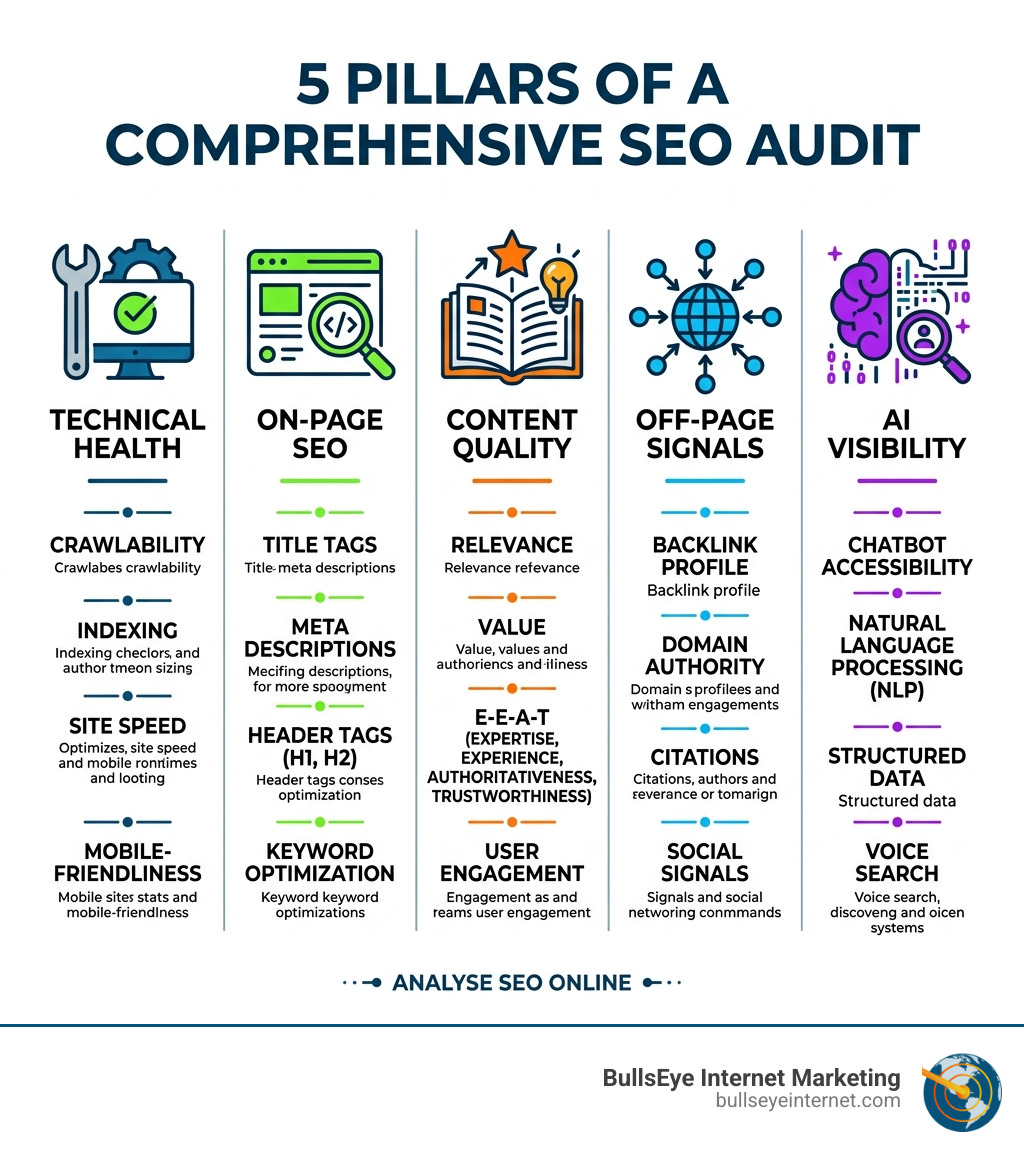
Know your analyse seo online terms:
The Strategic Importance of Website Audits
In the digital world, your website is your 24/7 salesperson. But if that salesperson is mumbling, tripping over their shoelaces, or standing in the wrong room, they aren’t going to close many deals. This is Why Every Business Needs a Comprehensive SEO Analysis for Growth.
When we analyse SEO online, we aren’t just looking for technical glitches; we are looking for opportunities to improve the user experience and conversion rates. Research shows that some businesses have actually doubled their inbound SEO leads simply by identifying and fixing the issues found during an automated audit.
Search engines like Google reward sites that are clean, fast, and authoritative. By performing regular checks, you ensure your site remains “healthy” in the eyes of the algorithm. Think of it as a digital check-up. Just as you wouldn’t ignore a “check engine” light in your car, you shouldn’t ignore a declining SEO score. Whether you are a small business in Miami or a growing enterprise serving all 50 US States, a strategic audit is the foundation of organic growth.

How to Analyse SEO Online: A Step-by-Step Technical Framework
To analyse SEO online effectively, you need a structured approach. You can’t just look at your homepage and guess. We recommend using a SEO Audit Complete Guide to ensure no stone is left unturned.
Most modern tools, like the SEO Analysis – Free tool by Alyze, provide a “Site Health Score.” This is a numerical representation of how well your site adheres to best practices. For instance, tools like Seobility use a specific threshold:
- 80% or higher: You have a strong SEO foundation.
- 30% to 79%: There is significant optimization potential.
- Below 30%: You are facing critical issues that likely prevent you from ranking at all.
An effective online analysis tool doesn’t just give you a score; it provides a prioritized list of tasks. We always tell our clients to focus on the “red flags” first—these are high-impact issues like server errors or blocked pages that stop search engines from seeing your content.
How to Analyse SEO Online for Technical Health
Technical SEO is the “engine” of your website. If the engine is broken, the paint job doesn’t matter. When you analyse SEO online, technical health should be your first priority. This includes:
- Crawlability and Indexing: Can search engine bots actually read your pages? If you’ve accidentally left a “noindex” tag on a main service page, it will never show up in results.
- Site Speed: This is critical. Statistics show that 53% of mobile users will abandon a site if it takes longer than 3 seconds to load.
- Core Web Vitals: These are specific speed and usability metrics Google uses to measure user experience. To pass with flying colors, we suggest you Don’t Just Pass, Ace It: The Ultimate Core Web Vitals Audit.
- Mobile-Friendliness: With the majority of searches happening on mobile devices, your site must look and function perfectly on a smartphone.
Evaluating On-Page and Content Factors
Once the engine is running, we look at the “fuel”—your content. On-page SEO is about making sure each individual page tells search engines exactly what it’s about.
Key elements to check include:
- Meta Titles and Descriptions: These are your “billboards” in the search results. They should be descriptive, include your primary keywords, and stay within character limits to avoid being cut off.
- Heading Hierarchy: Your H1, H2, and H3 tags should act like an outline for your page. A clear structure helps both readers and bots understand your main points.
- Image Alt-Text: Search engines can’t “see” images, so they rely on alt-text to understand what a picture represents. Plus, it’s vital for accessibility.
- Keyword Density: Are you using your target keywords enough? Or are you “stuffing” them in a way that feels unnatural?
For businesses operating across multiple regions, such as those in South Florida or across the country, it’s important to follow SEO best practice for page that is the same for 50 US States to avoid duplicate content penalties while still targeting local audiences.
The New Frontier: Answer Engine Optimization (AEO) and AI Visibility
The way people search is changing. We are no longer just typing keywords into a search bar; we are asking questions to AI chatbots like ChatGPT, Gemini, and Perplexity. In fact, 40% of searches now happen in AI engines. This is why you must analyse SEO online for “AI Visibility.”
This new field, often called Generative Engine Optimization (GEO), focuses on how often and how accurately your brand is mentioned by Large Language Models (LLMs). When we perform a LLM SEO Audit Best Practices check, we look at:
- Brand Mentions: Is the AI aware of your business?
- Citation Frequency: Does the AI link back to your site as a source of truth?
- Sentiment Analysis: Does the AI talk about your brand in a positive or negative light?
One user who optimized for these factors saw ChatGPT recommend their brand in 8 out of 10 relevant queries! To be “AI-ready,” your content needs to be structured, factual, and backed by strong authority signals. Traditional SEO gets you to the top of Google; AEO gets you into the conversation.
Choosing the Right Tools to Analyse SEO Online
There are hundreds of tools available to analyse SEO online, ranging from free browser extensions to high-end enterprise platforms. Choosing the right one depends on your goals and the size of your site.
| Feature | Free Tools (e.g., SEOptimer Free, Alyze) | Paid Tools (e.g., Semrush, SEO Site Checkup) |
|---|---|---|
| Check Frequency | Limited (e.g., 1–5 checks per day) | High/Unlimited (e.g., 50–200+ checks) |
| Technical Depth | Basic (meta tags, speed, headers) | Advanced (JS rendering, Core Web Vitals) |
| Reporting | Web-based view | White-label, branded PDF exports |
| Monitoring | Manual checks only | Automated daily tracking and alerts |
| AI Visibility | Rarely included | LLM tracking across multiple engines |
For agencies and professionals in places like Broward County or Miami-Dade, features like “White-label reporting” are a game-changer. Tools like SEOptimer can generate a professional PDF audit in just 20 seconds, which you can then brand with your own logo to present to clients.
Another technical feature to look for is “JavaScript rendering.” Many modern websites are built using complex frameworks that basic crawlers can’t read. Advanced tools simulate a real browser (like Googlebot does) to ensure they are seeing the full picture.
Using CMS Plugins to Analyse SEO Online in Real-Time
If you use WordPress, you have a massive advantage. You can analyse SEO online in real-time as you write your content. Over 3 million website owners use plugins like AIOSEO or Yoast to Improve Website SEO directly from their dashboard.
These plugins offer:
- Real-time Feedback: They give you a “red, yellow, or green” light for your content’s SEO health while you are still in the editor.
- Snippet Previews: You can see exactly how your page will look on Google (and mobile) before you hit publish.
- Schema Markup: This helps you add “structured data” to your site, making it easier for search engines (and AI engines) to understand your products, reviews, and FAQs.
Frequently Asked Questions about Online SEO Analysis
What is the difference between free and paid SEO tools?
The biggest differences are data limits and advanced features. Free tools are excellent for a quick “snapshot” of a single page. However, paid tools allow you to perform a full Strategic Site Audit across thousands of pages. Paid versions also offer automated monitoring, so you’ll get an email the moment a link breaks or your ranking drops.
How often should I perform an online SEO analysis?
For most small to medium businesses, a monthly audit is a great rhythm. However, if you have a large e-commerce site or are frequently adding new content, a weekly check is better. You should also run an analysis whenever Google announces a major algorithm update to see if your rankings were affected. For a deeper look at long-term planning, check out our Website Audit Services Guide 2025.
Can these tools help with competitor analysis?
Absolutely! This is one of the most powerful ways to use these tools. You can enter a competitor’s URL to see exactly what keywords they are ranking for, where their backlinks are coming from, and even see their PPC (paid search) strategies. Learning What Your Competitors Know That You Don’t: Insights From Competitive SEO Audits can help you find “keyword gaps”—terms they are ranking for that you’ve missed.
Turning SEO Insights into Calls with BullsEye Internet Marketing
Learning how to analyse SEO online is like being given a map to a hidden treasure. It reveals the exact obstacles standing between you and your customers. Whether you are fixing 47 technical issues to see a 34% traffic boost or optimizing your content for the new world of AI search, the data is your most valuable asset.
At BullsEye Internet Marketing, we specialize in turning these technical insights into actual phone calls and sales. We don’t believe in “set it and forget it” marketing. We offer a unique competitive advantage: we work with only one client per industry per geographic area, and we never lock you into long-term contracts. Our success is tied directly to yours.
If you’re ready to stop guessing and start growing, we’re here to help you navigate the complexities of SEO, PPC, and conversion optimization. From Palm Beach County to the Treasure Coast and across the entire United States, we’ve got your back.
Ready for a professional deep dive? Let’s start with a comprehensive SEO Audit today.
