
Why Google AdWords Advertising Remains Essential for Business Growth
Google AdWords advertising, now officially Google Ads after a 2018 rebrand, is the world’s leading online advertising platform. It allows businesses to display ads to potential customers at the exact moment they search for related products or services on Google.
Key Facts About Google Ads:
- What it is: A pay-per-click (PPC) platform where you bid on keywords to show ads in Google search results and its network.
- Reach: Taps into over 5.6 billion daily Google searches.
- Cost Model: You only pay when someone clicks your ad (PPC).
- Main Benefit: Targets customers with high search intent who are actively looking for your offerings.
- Name Change: In 2018, “AdWords” became “Google Ads” to reflect its expanded capabilities beyond search.
Why businesses use it: Of every $3 spent on online advertising, $1 goes to Google Ads. The platform helps drive sales, generate leads, and increase website traffic.
For businesses frustrated by high customer acquisition costs, Google Ads offers a way to reach ready-to-buy customers with full budget control. Unlike organic SEO, which takes time, Google Ads can place you at the top of search results immediately, even for competitive keywords.
The platform has evolved significantly since its 2000 launch, now including AI-powered tools, multiple campaign types (Search, Display, Video, Shopping, App, Performance Max), and sophisticated targeting options.
I’m Ronnie Katz, founder of BullsEye Internet Marketing. Since 2006, I’ve used my experience in PPC management to help businesses generate measurable ROI with Google Ads. Success on this powerful platform requires a deep understanding of its auction, Quality Score, and optimization processes.
Google adwords advertising further reading:
The Core Mechanics of Google AdWords Advertising
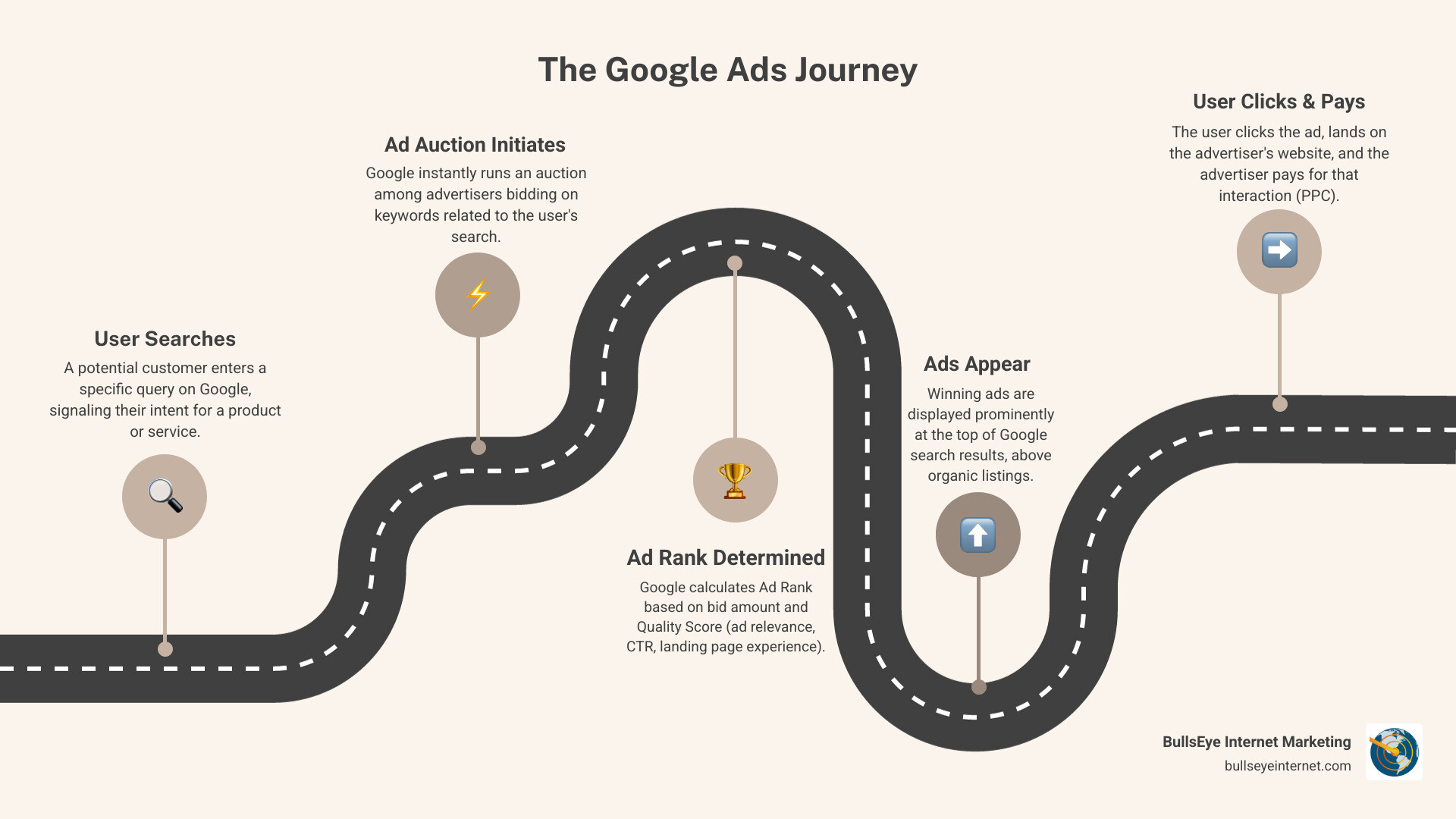
At its core, Google AdWords advertising runs on an auction system. When a user searches on Google, an instant auction determines which ads appear and in what order. This is Pay-Per-Click (PPC) advertising: you only pay when someone interacts with your ad (e.g., a click). This model is cost-effective because you pay for genuine interest, not just impressions.
Our goal with Google Ads is to get our clients’ businesses in front of people actively searching for what they offer. This means targeting customers with high search intent. Google Ads also supplements SEO efforts, allowing us to instantly appear for high-value keywords and compete effectively against larger players, even with smaller marketing budgets.

Understanding the Auction and Quality Score
The Google Ads auction isn’t just about the highest bid. Google also considers your ad’s “Quality Score.” This metric ensures users see relevant, high-quality ads. A higher Quality Score can lead to lower costs per click and better ad rankings—a win-win for advertisers.
Quality Score is rated from 1 to 10 and is based on three main factors:
- Expected Click-Through Rate (CTR): Google’s prediction of how likely your ad is to be clicked for a specific keyword.
- Ad Relevance: How closely your ad copy matches the user’s search intent.
- Landing Page Experience: The relevance, transparency, and usability of your landing page for users who click your ad. A fast, mobile-friendly page that matches the ad’s promise scores higher.
To dive deeper into this crucial metric, you can explore Google’s explanation of Quality Score.
Google Ads offers several bidding strategies to align with business goals:
- Cost-Per-Click (CPC): Pay each time someone clicks your ad. This is the most common model.
- Cost-Per-Mille (CPM): Pay per thousand impressions. This is often used for brand awareness campaigns.
- Cost-Per-Engagement (CPE): Pay when users engage with specific ad formats.
The Primary Benefits for Your Business
For businesses in competitive markets like Florida, Google AdWords advertising offers powerful benefits. Our clients, from contractors in Broward County to plumbers in Palm Beach County, see measurable results with strategic campaigns.
Here’s why Google Ads is a game-changer:
- Driving Sales: Puts your business directly in front of customers who are ready to buy.
- Lead Generation: Optimizes campaigns to generate qualified leads through calls, form submissions, or bookings.
- Website Traffic: Drives targeted traffic to your site, building brand awareness and future leads.
- Targeting High-Intent Audiences: Reaches people actively searching for solutions to their problems.
- Measurable Results: Every click, impression, and conversion is trackable, allowing for clear performance analysis and ROAS calculation.
- Budget Control: Offers complete flexibility with daily or monthly budgets, making it accessible for businesses of all sizes.
For those looking to maximize their investment and see real growth, exploring our specialized Google PPC Management Agency services can be a smart next step.
Exploring Google Ads Campaign Types
Google Ads offers various campaign types to match different marketing goals and brand strategies. Each is designed to connect with customers at different stages of their buying journey, ensuring your message resonates effectively.
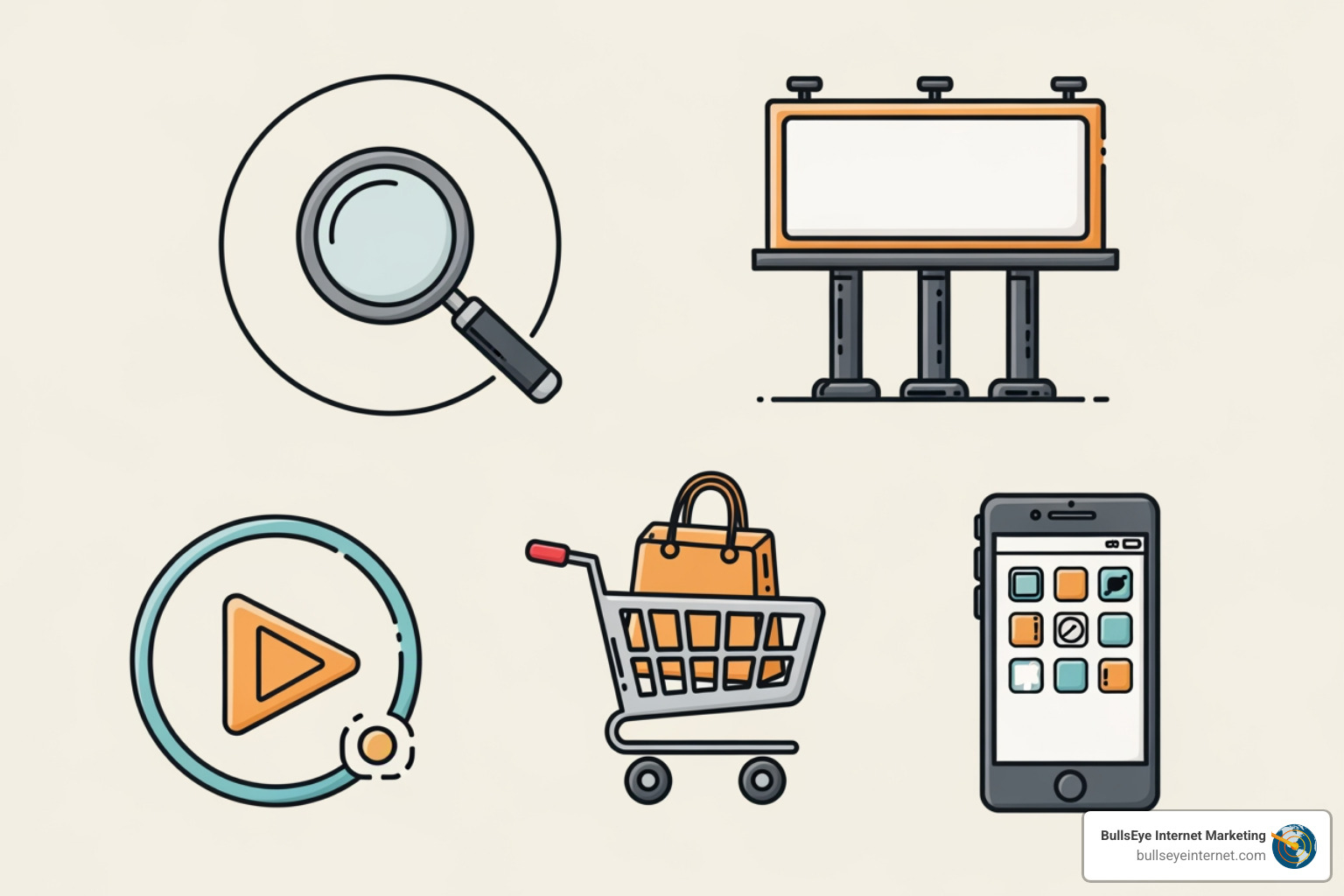
Here’s a list of the primary campaign types available:
- Search campaigns
- Performance Max Campaigns
- Display campaigns
- Demand Gen campaigns
- Shopping campaigns
- Video campaigns
- App campaigns
Search Campaigns
Search campaigns capture user intent with text-based ads that appear on Google search results pages when people look for something specific. We focus on bidding on high-value keywords that indicate strong commercial intent, like “emergency plumber Fort Lauderdale.” These campaigns excel at reaching people who are actively researching or ready to purchase, making them ideal for immediate lead and sales needs.
For our contractor clients, search ads are vital. When a homeowner in Miami Dade County searches for “roof repair Miami,” we want our client’s ad to be right there. You can learn more about how we help the trades with Google Ads for Contractors.
Search campaign formats include:
- Responsive Search Ads: The current standard, where you provide multiple headlines and descriptions, and Google’s AI tests combinations to find the most effective ad for each search.
- Dynamic Search Ads: Automatically generate headlines and landing pages based on your website’s content, ideal for large inventories.
Display, Video, and Shopping Campaigns
Beyond search campaigns that capture active demand, other types build brand awareness and reach customers across the internet.
- Display Campaigns: Show visually engaging ads across millions of websites, apps, and Google properties (like Gmail) to build brand awareness or retarget visitors based on interests and demographics.
- Video Campaigns: Run ads on YouTube to reach a massive audience of over 122 million daily active users. These are ideal for brand storytelling and can appear before, during, or after videos.
- Shopping Campaigns: A must for e-commerce, these ads showcase products with images, prices, and store names directly in Google search results, targeting consumers actively looking for specific items.
App, Performance Max, and Demand Gen Campaigns
Google continues to innovate with specialized, AI-driven campaign types to help businesses reach goals more efficiently.
- App Campaigns: Drive installs and re-engagement for your mobile app across Google’s entire network.
- Performance Max Campaigns: An AI-powered, goal-based campaign type that accesses all of Google’s inventory from a single campaign. It optimizes performance across all channels to find new customers and drive conversions. The ‘Ads Power Pair’ (Search + Performance Max) is a key strategy for maximizing reach.
- Demand Gen Campaigns: An AI-driven campaign focused on generating demand with visually rich ads across YouTube, Find, and Gmail for audiences likely to convert.
Building a Successful Campaign from Scratch
Setting up a successful Google AdWords advertising campaign requires a strategic approach. From keyword selection and ad copy to landing page design, every step needs careful consideration to achieve the best results.
Key Components for Successful Google AdWords Advertising
A winning Google Ads campaign hinges on several critical components working in harmony:
- Thorough Keyword Research: This is the foundation. We use tools like Google’s free Keyword Planner to find keywords based on audience pain points, search volume, and competition. We often prioritize specific long-tail keywords, which attract higher-intent searchers and can be less competitive.
- Strategic Keyword Match Types: Choosing the right match type (broad, phrase, exact) ensures ads appear for relevant searches while minimizing wasted spend.
- Negative Keywords: A crucial step is adding negative keywords to prevent ads from showing for irrelevant searches (e.g., a luxury car dealer adding “cheap” or “used”). This saves money and focuses on qualified leads.
- Compelling Ad Copy: Ads must grab attention, state a clear value proposition, and have a strong Call-to-Action (CTA). We use Responsive Search Ads, letting Google’s AI optimize combinations for the best performance. Ad extensions are also used to provide extra info like phone numbers and locations, which can significantly increase click-through rates.
- Ad Groups: We organize keywords and ads into tightly themed ad groups to ensure high relevance between the search query and the ad, which positively impacts Quality Score.
Creating High-Converting Landing Pages
A user clicking an ad for “plumbing services in Miami” should not land on a generic homepage. This is why dedicated, high-converting landing pages are essential.
- Message Consistency: The landing page content must directly align with the ad that brought the user there. If an ad promises “24/7 emergency plumbers,” the landing page must reinforce that message.
- Above the Fold Content: The content visible without scrolling is crucial. It must be compelling, with a strong headline, a relevant image, and a clear Call-to-Action.
- User Experience (UX): Landing pages must be clean, easy to steer, and mobile-friendly.
- Fast Loading Speed: Slow loading times lead to high bounce rates and lower Quality Scores.
While we can build landing pages on a client’s website, tools like Unbounce or LeadPages are excellent for creating and testing dedicated, highly optimized pages. For a deeper dive into our strategies, explore our Google Ads Services.
Measuring Success and Maximizing ROI
Launching a Google Ads campaign is just the start. The key to success is continuously measuring performance and optimizing for maximum Return on Investment (ROI). Without proper conversion tracking and analysis, you can’t improve your results.
Essential Metrics to Track
To understand the effectiveness of our Google AdWords advertising efforts, we track several key metrics:
- Return on Ad Spend (ROAS): Measures the revenue generated for every dollar spent on advertising. It’s calculated by dividing campaign revenue by its total cost. A ROAS of 3:1 is generally considered good.
- Click-Through Rate (CTR): The percentage of people who click your ad after seeing it (clicks ÷ impressions). A high CTR indicates relevant, compelling ads.
- Cost-Per-Click (CPC): The actual amount you pay for each click, influenced by your bid, Quality Score, and competition.
- Cost-Per-Conversion: The total campaign cost divided by the number of conversions. This shows how much it costs to acquire a lead or sale.
Robust conversion tracking is non-negotiable. Tracking actions like form submissions or phone calls is vital for understanding what’s working. Campaigns without good tracking often fail, which is why we take this data so seriously. For more insights, check out our Google AdWords Management Services Guide.
Optimizing for Better Performance
Optimization is an ongoing process of testing, analyzing, and adjusting.
- A/B Testing Ad Copy: We regularly test different headlines and descriptions to see which versions drive higher CTRs.
- Adjusting Bids: We dynamically adjust bids based on performance, competition, and conversion value.
- Refining Keyword Lists: We continuously review search term reports to add relevant keywords and block irrelevant searches with negative keywords.
- Improving Quality Score: By focusing on ad relevance, CTR, and landing page experience, we improve Quality Score, which leads to lower CPCs and better ad positions.
Many accounts are left unoptimized, with some untouched for over a month. This neglect is a missed opportunity to maximize ad spend and improve results.
Advanced Topics and The Future of Google Ads
The world of Google AdWords advertising is constantly evolving with new features and AI advancements. Staying ahead requires adapting strategies to these shifts.
Advanced Google AdWords Advertising Strategies
Google Ads also supports advanced marketing methodologies like Account-Based Marketing (ABM), which is particularly effective for B2B clients.
- Integrating with Account-Based Marketing (ABM): ABM is a strategy focused on marketing directly to specific, high-value businesses. Google Ads is a great tool for ABM, allowing for personalized campaigns that target specific accounts. We can use search ads to capture initial interest and then use display and video ads for follow-up.
- Targeting Specific Businesses: While direct company name targeting isn’t possible, we can use a combination of precise geographic targeting, custom intent audiences, and other advanced tactics to reach employees at target companies.
- Personalized Campaigns: We can craft highly personalized ad copy and landing page experiences for target accounts, which significantly increases engagement and conversion rates.
- Remarketing: If someone from a target company visits a client’s website but doesn’t convert, we use remarketing to show them custom ads across Google’s network, reminding them of the value proposition. Research shows ABM often yields higher returns than other marketing approaches.
AI-Powered Features and Common Controversies
Google’s commitment to AI is changing the advertising landscape with tools like the ‘Ads Power Pair’ (Search and Performance Max) and AI-powered ad creation. These advancements promise more efficient campaign management.
However, Google AdWords advertising has also faced challenges and criticisms:
- Trademark Bidding Issues: Policies around bidding on trademarked keywords have evolved but can still be a complex legal area for advertisers.
- Click Fraud Concerns: While Google’s systems are now robust, click fraud (malicious clicks from competitors or bots) remains a concern that requires monitoring.
- Misleading Ads and Disinformation: The platform has faced criticism over ad revenue funding disinformation and the appearance of misleading ads. Enforcing policies against such content at scale remains an ongoing challenge for Google.
These controversies underscore the importance of ethical advertising practices and diligent campaign management.
Frequently Asked Questions about Google Ads
How much does Google Ads cost?
With Google AdWords advertising, you have complete budget control. It operates on a pay-per-click (PPC) model, so you only pay when someone interacts with your ad. You set a daily or monthly budget, and Google will not exceed it.
The actual cost-per-click (CPC) varies based on:
- Industry: Competitive industries often have higher CPCs.
- Keywords: High-intent keywords cost more.
- Competition: More bidders on a keyword increase the price.
- Quality Score: A higher Quality Score can lower your CPC.
There’s no fixed cost; it’s an investment you tailor to your business goals.
How long does it take to see results from Google Ads?
A major benefit of Google AdWords advertising is speed. Once a campaign is live, you can generate clicks and traffic almost immediately—often within hours. This is a significant advantage over organic SEO, which can take months to show results.
However, achieving a positive ROI and consistent, profitable conversions takes time. Expect several weeks to a few months of continuous testing and refinement to:
- Collect enough data for informed decisions.
- A/B test ads and landing pages.
- Refine keyword lists.
- Adjust bidding strategies.
- Improve Quality Score.
Initial visibility is quick, but sustained profitability is a marathon, not a sprint.
Can I do Google Ads myself?
Yes, anyone can create a Google Ads account. Google provides tools for self-service management.
However, the platform is complex. Effectively managing Google AdWords advertising to achieve a strong ROI is a specialized skill. Without expertise, it’s easy to waste ad spend on irrelevant clicks, target the wrong audience, or miss key optimization opportunities.
This is where specialists like us at BullsEye Internet Marketing come in. Our expertise helps prevent wasted ad spend and accelerates results. We specialize in generating calls and sales, and our unique approach of offering no long-term contracts and working with only one client per industry per geographic area ensures a competitive advantage for our partners.
Unlock Google Ads Growth Potential with BullsEye Internet Marketing
Google AdWords advertising, now known as Google Ads, is undeniably one of the most powerful and effective digital marketing tools available today. It offers an unparalleled opportunity to reach high-intent customers precisely when they are searching for what your business provides. From driving immediate sales and generating quality leads to building brand awareness, Google Ads provides a versatile platform for growth.
However, as we’ve explored, using its full potential requires more than just launching a campaign. It demands a deep understanding of the auction process, meticulous keyword research, compelling ad creative, high-converting landing pages, and continuous optimization based on robust data analysis. It’s a strategic endeavor that, when executed correctly, can yield significant returns on investment.
At BullsEye Internet Marketing, we understand the intricacies of Google AdWords advertising. Our mission is to partner with businesses, like yours across Florida, to maximize your ROI and generate more calls and sales, ensuring you stand out in competitive markets. If you’re ready to take your digital advertising to the next level and truly connect with your ideal customers, consider partnering with an expert.
