
Why Phone Calls Are Gold for Dental Practices

Dentist pay per call is a performance marketing model where dental practices pay only for qualified inbound phone calls from potential patients, rather than for clicks or impressions that may never convert.
Quick Answer: What is Dentist Pay Per Call?
- What it is: A lead generation model where you pay $30-$60 per qualified call (typically 60+ seconds).
- How it works: Marketing providers drive calls to your practice through SEO, PPC, and other channels.
- Key benefit: Phone calls convert to paying patients 10x more frequently than other lead types.
- Best for: Practices wanting predictable costs and high-intent leads (80% of dental patients book their first appointment by phone).
- Average results: With a $1,500 budget, expect 20+ leads per month at under $57 per lead.
If you’re frustrated watching your marketing budget disappear into clicks that never ring your phone, you’re not alone. Most dental practices struggle with traditional advertising because they pay for exposure instead of results.
Pay per call flips that model. You only pay when someone interested enough to pick up the phone calls your practice. These aren’t cold form fills or casual browsers—they’re high-intent prospects ready to schedule an appointment. With an average call lasting 5 minutes and a 50% conversion rate in the dental industry, each call represents a real opportunity to grow your practice.
The model works because it aligns costs with outcomes. Instead of gambling on whether a click will convert, you’re investing in direct conversations. Marketing providers handle the top of the funnel—running ads and driving traffic—while you focus on converting callers into patients.
I’m Ronnie Katz, founder of BullsEye Internet Marketing. With over 20 years in online marketing, I’ve seen that practices willing to pay for performance rather than promises see the best returns. We’ve helped dental practices implement dentist pay per call campaigns that generate consistent patient appointments without the waste of traditional advertising.
Quick dentist pay per call terms:
The Fundamentals of Pay Per Call for Dentists
1. What is pay-per-call lead generation and how does it work for dental practices?
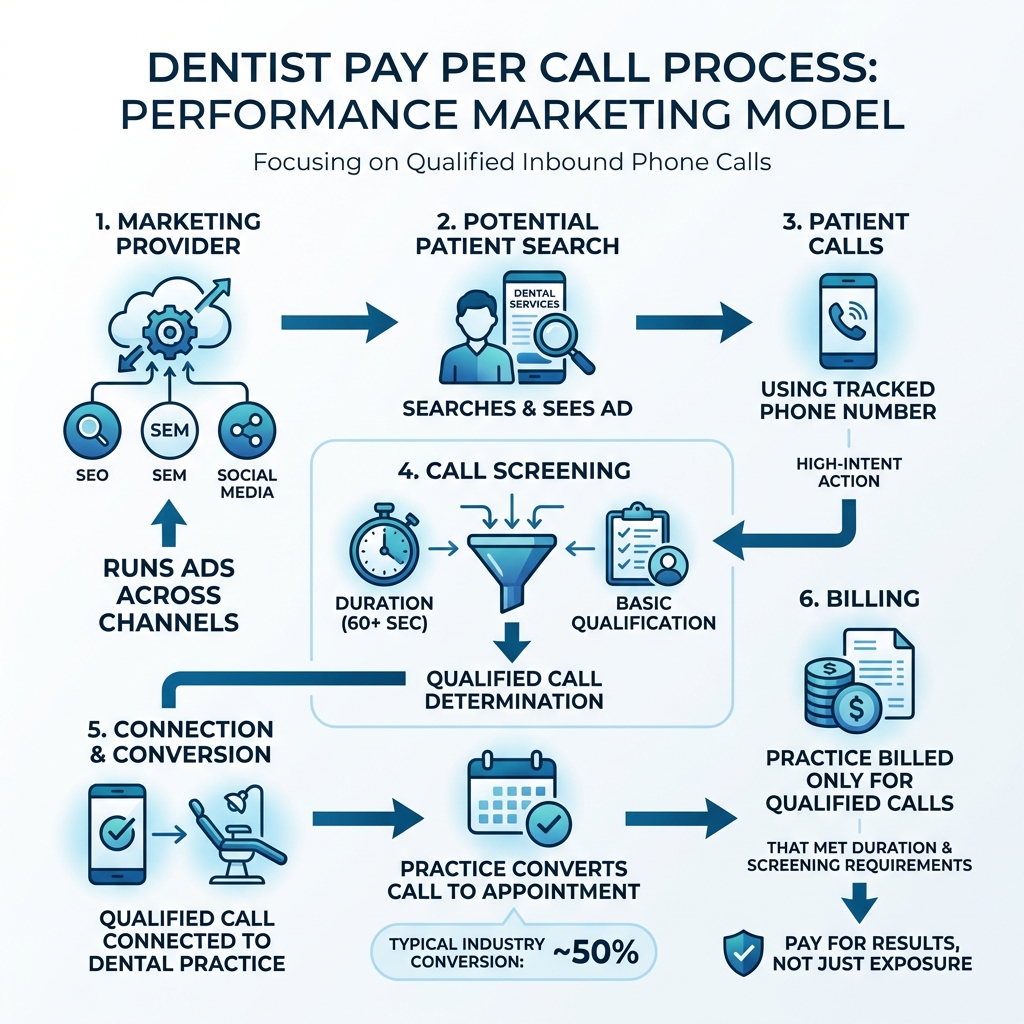
Pay-per-call lead generation is a performance marketing model where dental practices pay an advertiser for incoming phone calls from potential customers. Instead of paying for clicks or impressions, you pay only when a prospective patient calls your practice. This directly connects marketing spend to tangible interactions.
Here’s how it works for dental practices:
- Lead Generation: We use marketing channels like SEO, Google Local Services Ads, and social media to reach individuals actively searching for dental services in areas like Miami or Fort Lauderdale. Ads and listings feature a unique, trackable phone number.
- Patient Calls: A high-intent patient with an immediate need calls the number.
- Screening & Qualification: Before reaching you, the call is screened to ensure the caller meets your criteria (e.g., located in Broward County, seeking a specific service).
- Connection & Payment: Qualified calls are routed to your office. Your staff schedules the appointment, and you are only charged for that qualified call.
This model is highly effective for dentists, as 80% of patients schedule their first appointment by phone. Phone calls convert to paying customers 10x more frequently than other leads. It outsources the top of your marketing funnel, allowing your team to focus on patient care.
2. What are the benefits of using pay-per-call marketing for dentists compared to other lead generation methods?
The core benefit of dentist pay per call is simple: you pay for results, not just potential exposure. Here are the key advantages:
- Pay for Results, Not Clicks: With PPC, you pay for every click, regardless of outcome. With pay-per-call, you only pay for a qualified call, eliminating wasted ad spend.
- Higher Lead Quality and Intent: Callers are high-intent prospects with an immediate need. This is why phone calls convert 10x more frequently than web forms, with a typical 50% conversion rate to an appointment in the dental industry.
- Immediate Connection with Patients: A phone call provides an instant, direct line to a potential patient, allowing your staff to build rapport and schedule appointments in real-time.
- Easier ROI Tracking: Paying per qualified call makes it simple to track your return on investment. You know your exact cost per lead, which clarifies your cost per acquisition.
- Outsourcing Top-of-Funnel Marketing: Pay-per-call services handle the complex work of generating calls, freeing up your time to focus on patient care.
- Reduced Risk: With no long-term contracts and payment only for qualified leads, the financial risk is significantly reduced. Our success is tied to yours.
Here’s a quick comparison of Pay Per Call to other traditional lead generation methods:
| Feature | Pay Per Call (PPC) | Pay Per Click (PPC Ads) | Search Engine Optimization (SEO) |
|---|---|---|---|
| Cost Model | Per qualified phone call (e.g., $30-$60) | Per click on an ad (variable, can be high) | Monthly retainer or project fee (no direct lead cost) |
| Lead Intent | High (caller actively seeking service) | Medium (clicker may be browsing) | Medium-High (organic searcher often researching) |
| Conversion | Direct conversation, high appointment rate (50%) | Requires website visit, form fill, or further action | Requires website visit, form fill, or call |
| ROI Measurement | Clear (cost per call vs. patient value) | More complex (clicks to conversions) | Long-term, harder to attribute directly |
| Effort for Practice | Low (answer calls, schedule) | Medium (website optimization, form follow-up) | High (content creation, technical SEO) |
| Time to Results | Fast (calls can start immediately) | Fast (ads go live quickly) | Slow (months for rankings to improve) |
Implementing a Successful Dentist Pay Per Call Campaign
3. How can dental practices ensure they are getting qualified leads through pay-per-call campaigns?
Ensuring you receive qualified leads is paramount. We focus heavily on lead qualification to protect your staff’s valuable time.
Here’s how we ensure you get high-quality leads:
- Custom Qualification Criteria: We work with you to define a “qualified” lead. For a general dentist in Miami, this might be a new patient seeking a check-up. For a specialist, it could be someone needing a specific cosmetic procedure.
- Call Duration Requirements: We set a minimum call duration (typically 60 seconds) for a call to be billable. If a call is shorter or clearly not a real inquiry, you aren’t charged.
- Pre-screening Callers: We can use live agents or automated Interactive Voice Response (IVR) systems to ask callers pre-qualifying questions, such as “Are you a new patient?” This filters out irrelevant calls before they reach your office.
- Geographic Targeting: We target calls to your specific service areas, ensuring callers are located within your practice’s zip codes or a reasonable radius. This prevents calls from patients who are too far away.
- Filtering by Insurance or Payment: If your practice has specific insurance or payment policies, we can incorporate these into the screening process to reduce calls from non-aligned patients.
By implementing these methods, we deliver calls from genuinely interested and viable potential patients.
4. What factors influence the cost of pay-per-call leads for dentists, and how can practices determine a reasonable budget?
The cost of dentist pay per call leads varies, but understanding the factors helps you set a reasonable budget. Our rates typically range from $30 to $60 per call.
Here’s what influences the cost:
- Geographic Location & Competition: More competitive markets (like Miami) may have a higher cost per call than smaller towns.
- Lead Quality & Vetting: More stringent qualification criteria (e.g., specific insurance, new patients only) can impact the cost, as these leads are more valuable.
- Call Duration Requirements: A longer required duration (e.g., 60 vs. 30 seconds) ensures higher quality but may increase the cost per billable call.
- Service Type: Calls for high-value services like emergency or cosmetic dentistry may command a higher price.
Determining a Reasonable Budget:
To set a smart budget, start by calculating the lifetime value (LTV) of a patient. Don’t just look at the first visit; consider the revenue a patient generates over several years. If a new patient brings in $500 in their first year and stays for 5 years, their LTV could be $2,500. Knowing this helps you determine how much you can spend to acquire a new patient while remaining profitable.
A competitive bid in the dental industry is typically around $30 for a 60-second call. With a $1,500 budget, our clients often see 20+ leads per month at a cost-per-lead under $57.
Once you understand your patient LTV, you can work backward to set a budget and project how many calls you need to hit your growth targets.
5. What are the key features to look for in a pay-per-call provider for dental practices?
Choosing the right dentist pay per call provider is crucial. Here are the key features to look for:
- Real-time Call Tracking Dashboard: A dashboard gives you full transparency to monitor calls and campaign performance.
- Call Recording and Transcription: This is invaluable for quality control and staff training, helping you verify call qualification and improve your team’s handling of inquiries.
- Quality Assurance and Compliance: A reputable provider will have strict processes to ensure leads are legitimate and meet all healthcare compliance regulations.
- Transparent Pricing and Billing: Look for clear, upfront pricing without hidden fees.
- Dedicated Support: You’re partnering with an agency. Excellent support means you have a contact to help optimize your campaigns.
- Advanced Lead Qualification: Features like IVR systems and geographic targeting are essential to ensure you receive truly qualified calls.
- No Long-Term Contracts: Providers offering month-to-month agreements are confident in their service and give you flexibility.
- Exclusivity: We only work with one client per industry per geographic area, giving you a competitive advantage.
- Proven Track Record: Look for a provider with deep experience in pay-per-call for the dental industry. We’ve been doing this for over 20 years.
Integrating Pay Per Call and Maximizing ROI
6. How does pay-per-call marketing fit into a broader dental marketing strategy, and what other tactics should practices consider?
While dentist pay per call is a powerful tool, it works best within a holistic marketing strategy. It brings in new patients, while other tactics ensure they stay and refer others.
Here’s how pay-per-call fits and other tactics to consider:
- Online Reputation Management: This is non-negotiable. Since 84% of people say reviews are important in their healthcare decisions, a strong online presence on Google, Yelp, and Healthgrades is crucial. Positive reviews build trust and encourage callers to book an appointment. For a deeper dive into how patients use reviews, see resources like online review statistics.
- Local SEO (Search Engine Optimization): While pay-per-call gets your phone ringing, local SEO ensures your practice appears in local search results when patients search for a “dentist near me.” This includes optimizing your Google Business Profile and ensuring your business information is consistent online.
- Consistent Business Listings: Your practice’s Name, Address, and Phone Number (NAP) must be identical across all online platforms. Inconsistencies confuse search engines and potential patients.
- Patient Retention Strategies: Acquiring a patient is half the battle. Implement systems for excellent patient experience, personalized follow-ups, and feedback requests. Happy patients become loyal, referring patients.
- Appointment Reminders: Reduce no-shows with multi-channel reminders (phone, text, email). A patient generated by pay-per-call is a valuable lead; make sure they show up.
- Website Optimization: A professional, user-friendly website acts as a digital brochure where patients can learn more about your practice after their call.
By combining high-intent leads from dentist pay per call with a strong foundational marketing strategy, your practice can achieve sustainable growth.
7. How can dental practices measure the ROI of their pay-per-call campaigns?
Measuring the Return on Investment (ROI) for dentist pay per call campaigns is one of its greatest strengths, offering best clarity.
Here’s how to measure ROI:

- Track Calls to Appointments: The first step is tracking which qualified calls convert into scheduled appointments. Our systems provide all the necessary data on call origin and duration.
- Calculate Cost Per Acquisition (CPA): This is a key metric, calculated by dividing your total campaign cost by the number of new patients acquired. For example, spending $1,000 to acquire 20 new patients gives you a $50 CPA.
- Compare CPA to Patient Lifetime Value (LTV): As discussed, understanding a patient’s long-term value is critical. If your average patient LTV is $2,500 and your CPA is $50, you’re generating a massive return on your investment.
- Use Call Tracking Software: Our sophisticated software provides detailed analytics, including peak call times and geographic data, which helps optimize campaigns and improve your front office’s performance.
- Monitor Conversion Rates: We track the conversion rate from qualified calls to booked appointments (typically around 50% for dental). Monitoring this helps evaluate both lead quality and your team’s effectiveness.
- Maintain a Feedback Loop: Regular communication between your practice and our team is vital. Your feedback on call quality allows us to continuously refine targeting and maximize your ROI.
By focusing on these measurable outcomes, we ensure your dentist pay per call investment is a powerful engine for practice growth.
Advanced Strategies and Common Pitfalls
8. What are common challenges or mistakes dental practices make when using pay-per-call marketing, and how can they be avoided?
Even with its advantages, dentist pay per call requires preparation to avoid common pitfalls. Here are frequent mistakes and how to prevent them:
- Poor Call Handling: The most qualified lead can be lost by a rushed or untrained front desk. Invest in training your team to be friendly, empathetic, and skilled at converting inquiries into appointments. Use call recordings for coaching.
- Inadequate Staff Training: Ensure your staff understands the value of these high-intent calls and is trained to convey your practice’s value, handle objections, and confirm appointments effectively.
- Not Tracking Results Internally: While we provide tracking, your internal system is also crucial. Implement a process to ask every new patient, “How did you hear about us?” and record the answer in your practice management software.
- Focusing on Cost Per Call, Not ROI: A cheap call that doesn’t convert is a false economy. Always evaluate the quality of calls and their conversion rate. A slightly higher cost for a much higher conversion rate is more profitable.
- Neglecting Patient Follow-Up: A booked appointment isn’t a guarantee. Use automated reminders via text, email, and phone to reduce no-shows and foster patient loyalty.
- Inconsistent Online Presence: Patients often check your practice online after calling. Maintain a stellar online reputation with positive reviews and ensure your business information is consistent and professional across all platforms.
By proactively addressing these areas, your practice can maximize the effectiveness of its dentist pay per call campaigns.
9. How does AI-powered call screening or other technology improve the effectiveness of pay-per-call for dentists?
Technology, especially AI, is revolutionizing dentist pay per call by making campaigns more efficient and effective. It acts as a smart assistant, vetting every call before it reaches your front desk.
Here’s how AI improves pay-per-call:
- Automated Call Screening: AI instantly filters out telemarketers and wrong numbers by analyzing caller intent, saving your staff from answering irrelevant calls.
- Precise Geographic Matching: AI systems can instantly verify a caller’s location, ensuring calls are only routed from patients within your service area, from Jupiter to Homestead.
- Filtering by Practice Preferences: AI can filter calls based on your specific needs, such as insurance acceptance, language preference (e.g., routing Spanish-speaking callers to the right staff), or interest in specific services.
- Saving Staff Time: By automating the filtering process, AI reduces the burden on your front office, allowing them to focus on high-intent callers and existing patients.
- Increasing Good Patient Fit: Granular filtering increases the chance that a connected caller is a great fit for your practice, leading to higher conversion rates and more satisfied long-term patients.
- Improved Analytics: AI contributes to richer call data, providing insights into caller demographics and conversion patterns that help us continually optimize campaigns.
With over 70,000 calls per month available nationwide for dental services, AI is crucial for ensuring your practice receives only the most relevant, high-quality leads.
10. What are the typical payout structures and duration requirements for dentist pay-per-call offers?
Understanding the payout structures and duration requirements is key to dentist pay per call. We ensure these terms are transparent and aligned with delivering value.
Here’s a typical breakdown:
- Payout Model: The most common model is a “per qualified call” payment. You pay a set fee, typically ranging from $30 to $60, only for calls that meet predefined criteria. The rate can vary based on market competition and the specificity of your filters.
- Call Duration: This is a crucial metric. A call must last a minimum time, often 60 seconds, to be billable. A competitive bid is around $30 for a 60-second call. If a call is shorter or is clearly unqualified (e.g., a telemarketer), you are not charged.
- Billable Call Definition: Beyond duration, a billable call is defined by other criteria, such as being a new patient, located in your service area, and seeking a service you provide.
- Flexibility and Fairness: Reputable providers offer a clear process for disputing calls you believe were unqualified. We also don’t use long-term contracts, as we believe in earning your business every month through performance.
These structures ensure you only pay for genuine opportunities to acquire new patients, aligning our success directly with yours.
Grow Your Practice with High-Intent Patient Calls
At BullsEye Internet Marketing, we understand the challenges of attracting new patients in competitive Florida markets, from Miami to Martin County. We deliver tangible results, not just promises.
Our dentist pay per call service is designed to provide your practice with a consistent stream of high-intent patient calls, eliminating the guesswork of traditional advertising. We offer exclusive leads—working with only one client per industry per geographic area—to give you a distinct competitive advantage.
With no long-term contracts, transparent performance marketing, and a relentless focus on your ROI, we make it easy for your practice to thrive. We handle the lead generation so your team can focus on what they do best: providing exceptional dental care and turning callers into loyal patients.
Ready to fill your appointment book with pre-qualified, high-intent patients?
Learn more about our pay-per-call agency for Google Local Services Ads and find how we can help your dental practice grow.
