
Why Digital Marketing for Law Firms Is No Longer Optional
Digital marketing for law firms is the strategic use of online channels—like search engines, social media, and websites—to attract, engage, and convert potential clients. In today’s legal landscape, it’s essential for survival and growth.
Key components of effective digital marketing for law firms include:
- Search Engine Optimization (SEO) – Ranking higher in Google for terms like “divorce lawyer near me”
- Pay-Per-Click (PPC) Advertising – Immediate visibility through Google Ads
- Local SEO – Appearing in Google’s Map Pack where 44% of all clicks happen
- Content Marketing – Blogs and resources that establish your expertise
- Social Media & Email – Building relationships and staying top-of-mind
- Website Optimization – Converting visitors into consultations
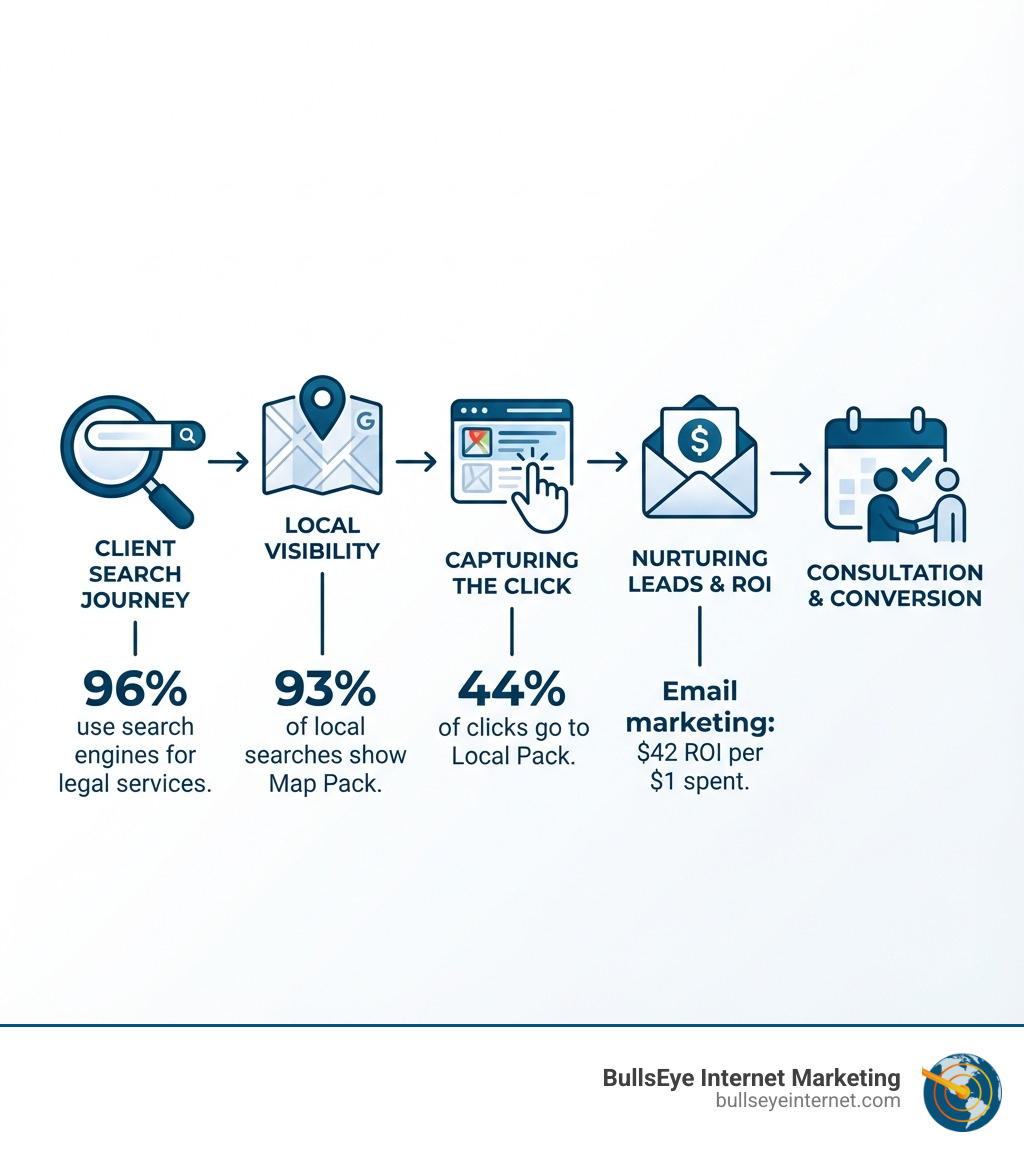
The numbers tell the story: 96% of consumers use search engines when seeking legal services, and a third of all potential clients start their attorney search online. Yet many law firms still rely primarily on referrals, missing massive opportunities for growth.
The legal marketing landscape has shifted. Traditional methods like print ads have given way to Google searches and online reviews. Clients now research attorneys extensively online before making contact.
It’s about being found when a potential client needs you most. If you’re not ranking in search results, you’re invisible to high-intent prospects searching for help at all hours.
The good news? Digital marketing for law firms is measurable, targetable, and cost-effective. Unlike traditional advertising, digital channels provide clear data on what’s working. You can track how many people found your website, called your office, or scheduled consultations—and adjust your strategy accordingly.
I’m Ronnie Katz, founder of BullsEye Internet Marketing. Since 2006, I’ve helped law firms leverage digital marketing for law practices to generate exclusive leads. In this guide, I’ll share the exact strategies that work in today’s competitive legal market.
The Foundation: Building Your Law Firm’s Digital Strategy
Your law firm’s website is the cornerstone of your digital strategy. It’s your 24/7 storefront where potential clients form their first impression and decide whether to contact you. A professional, user-friendly website is critical for building brand reputation and trust.
Digital marketing offers cost-effective client acquisition, with content marketing delivering a 62% lower cost per lead than traditional methods. It also allows for hyper-targeting to reach ideal clients in specific areas, from Miami-Dade to Broward County.

Why Digital Marketing is Essential for Lawyers
The legal landscape has undergone a seismic shift. Today, 96% of consumers use a search engine when seeking legal services, and around 90% of those searches happen on Google. If your firm doesn’t have a robust online presence, you’re invisible to most potential clients.
Digital marketing for law practices is essential for several reasons:
- Changing Client Trends: Most clients now start their attorney search online. Without an online presence, you’re overlooked.
- Competitive Edge: With over 1.3 million lawyers in the U.S., digital marketing helps you differentiate your firm and attract the right clients.
- Sustainable Growth: It builds a long-term, sustainable pipeline of leads through assets like optimized content.
- Increased Visibility: It ensures your firm appears prominently where clients are actively searching for legal help.
- Measurable Results: Unlike traditional methods, digital marketing is highly measurable, allowing for data-driven adjustments to maximize effectiveness.
Defining Your Goals and Target Audience
Before diving into tactics, it’s crucial to define your “why” and “who.”
- Set SMART Goals: Define clear, measurable goals like increasing website traffic by 20% or generating 10 new consultations per month for a specific practice area. These goals will guide your strategy.
- Identify Your Ideal Client: Create detailed client personas (e.g., “Sarah, 38, recently separated”) to understand their pain points and online behavior. This allows for custom messaging on the most effective channels.
- Focus on Key Practice Areas: Specializing your marketing efforts (e.g., LinkedIn for an employment lawyer) allows for highly targeted campaigns that resonate with specific clients.
- Craft a Compelling Value Proposition: Clearly communicate what makes your firm unique—be it aggressive advocacy or deep niche expertise. Your value proposition should be evident in your website copy and headlines.
The Critical Role of Website Design and User Experience
Your website is often the first interaction a potential client has with your firm. It needs to make a strong, positive impression.
- First Impressions Matter: A modern, professional website builds instant credibility. An outdated site can undermine your reputation.
- Mobile-Responsive Design: With over 58% of internet traffic from mobile, your site must be optimized for all devices to ensure a perfect user experience.
- Prioritize User Experience (UX): A frustrating website deters clients. We focus on clear navigation, readable content, and intuitive layouts.
- Use Clear Calls-to-Action (CTAs): Prominently display CTAs like “Schedule a Free Consultation” or “Call Now” to guide visitors to the next step.
- Ensure Fast Loading Speed: A slow website is a turn-off and hurts Google rankings. A fast site is crucial for user experience and engagement.
- Build Trust with Attorney Bios: People hire lawyers, not firms. Detailed, personal bios with professional photos build rapport and trust, which is vital in the legal profession.
Core Strategies in Digital Marketing for Law Firms
Once your website is a solid foundation, we can build upon it with a suite of digital marketing strategies. Think of it like a well-oiled machine, where each component plays a crucial role in attracting and converting clients.

Content Marketing: Establishing Authority and Trust
Content marketing involves creating valuable content to attract clients, demonstrate expertise, and build trust.
- Blogging: Regularly posting content that answers client questions (e.g., “What to Do After a Car Accident in Miami”) establishes your firm as an authority.
- Answering Client Questions: Creating an FAQ section can answer common queries and potentially land your site in Google’s featured snippets for prime visibility.
- Case Studies: Sharing anonymized success stories builds credibility by focusing on the positive impact you’ve had for clients.
- Whitepapers: For complex topics like corporate law, whitepapers position your firm as a thought leader.
- Cost-Efficiency: Content marketing offers a 62% lower cost per lead than traditional methods and provides long-term value by attracting organic traffic.
Social Media and Email Marketing: Nurturing Relationships
These channels are about building and maintaining relationships, not just broadcasting messages.
- Choose the Right Platforms:
- LinkedIn: Ideal for B2B practices like corporate law and reaching professionals.
- Facebook: Great for B2C practices like family and personal injury law, allowing for community engagement.
- Twitter: Useful for engaging in legal news and industry discussions.
- Showcase Firm Culture: Humanize your firm by sharing team events or community involvement to seem more approachable.
- Share Testimonials: Positive reviews on social media act as powerful social proof.
- Nurture Leads with Email: Email is a highly effective tool for nurturing leads and engaging with current and former clients.
- Send Newsletters: Regular newsletters with legal updates or firm news keep you top-of-mind and build loyalty.
- High ROI: Email marketing generates an average return of $42 for every $1 spent, making it an essential tool.
Video Marketing: Engaging Potential Clients
Video is a powerful marketing tool used by 91% of businesses, with a significant impact on search rankings and conversions.
- Explainer Videos: Simplify complex legal concepts with short, engaging videos.
- Attorney Introductions: Help potential clients “meet” you before they call, building crucial rapport and trust.
- Video Testimonials: These are more impactful than written ones, conveying genuine emotion.
- SEO and Conversion Benefits: Websites with video are 53 times more likely to rank on Google’s first page. Video can also boost landing page conversions by 80% and message retention to 95%.
Creating an Integrated Digital Marketing Strategy for Law Firms
The most successful digital marketing for law strategies integrate multiple channels into a cohesive plan.
- Combine Channels for Maximum Impact: An integrated approach ensures all channels (SEO, content, PPC, social media) work together, amplifying your overall impact.
- Maintain Consistent Messaging: Consistent branding, tone, and messaging across all platforms reinforce your brand identity and build recognition.
- Steps to Create an Integrated Plan: Start by defining your audience and goals. Then, build a strong website and create valuable content. Implement SEO, PPC, social media, email, and video marketing. Finally, continuously monitor, measure, and adjust your strategy based on performance data.
- Use a Funnel-Based Approach: Use different channels for different stages of the client journey. For example, SEO builds awareness, PPC captures high-intent leads, and email nurtures them toward a consultation. This holistic approach optimizes every touchpoint.
Mastering Search: The Power of SEO and PPC for Lawyers
When it comes to attracting new clients, showing up prominently in search results is non-negotiable. Whether it’s through organic listings or paid advertisements, dominating search is key to a thriving digital marketing for law strategy.
Search Engine Optimization (SEO): Your Long-Term Growth Engine
SEO is the practice of increasing traffic to your website through organic search results. It’s a long-term growth engine that builds sustainable visibility and credibility.
- Drive Organic Traffic: Ranking high in Google for relevant keywords attracts high-intent visitors actively searching for legal services.
- Google’s Ranking Factors: Google’s algorithm uses over 200 factors, with content quality, backlinks, and user experience being key.
- The Importance of E-A-T: Google emphasizes Expertise, Authoritativeness, and Trustworthiness (E-A-T) for legal content. This requires content to be accurate, well-sourced, and written by qualified professionals.
- “Your Money or Your Life” (YMYL) Content: Google classifies legal content as YMYL, holding it to a higher standard and making E-A-T critical for SEO success.
- The Value of Ranking: Being on Google’s first page is crucial, as few users go to the second. Top-ranking pages get significantly more clicks, making them highly visible.
- More Info: To dive deeper into how we can help you increase your online presence, check out our guide on increasing your online presence with Local SEO.
Local SEO: Winning Clients in Your Area
For firms targeting specific geographic areas like Broward County or Miami, Local SEO is paramount. It ensures you appear in searches like “lawyer near me.”
- Google Business Profile (GBP) Optimization: Your GBP is the most critical local SEO component. We optimize it with accurate information, photos, and updates for maximum visibility.
- Manage Online Reviews: Reviews are a massive trust signal. We help you proactively encourage and manage client reviews on your GBP, as 93% of customers read them before making a decision.
- Build Local Citations: Consistent Name, Address, and Phone number (NAP) across online directories strengthens your local SEO.
- The Google Local Pack: This coveted map section appears at the top of 93% of local searches and drives 44% of all clicks. Ranking here can dramatically increase views and clicks.
- Local SEO Tools: We use tools like Local Falcon and CallRail to track local rankings and ensure you’re reaching clients in your target area.
- Further Reading: Learn more about Local Ads for Lawyers and how they can boost your local presence.
Pay-Per-Click (PPC) Advertising: Generating Immediate Leads
While SEO is a long-term play, Pay-Per-Click (PPC) advertising offers immediate visibility and is a powerful lead generation tool.
- Google Ads for Law Firms: PPC campaigns on Google Ads place your firm at the top of search results, capturing high-intent leads who need immediate help.
- Target High-Intent Keywords: Though competitive, we strategically target keywords like “personal injury lawyer Miami” using geographic filters and ad scheduling to control costs and reach the right audience.
- Control Your Budget: With PPC, you set a budget and only pay when someone clicks, allowing for precise spending control.
- Higher Conversion Rates: Law firms see a 7% higher conversion rate with PPC than other industries, indicating that the high-quality leads often justify the cost.
- Part of an Integrated Plan: PPC works best as part of a larger marketing plan, complementing your SEO and content efforts to build trust.
- Comprehensive Guide: For an in-depth look at this powerful strategy, read our Lawyer PPC Advertising Ultimate Guide.
Measuring Success and Navigating the Legal Landscape
Effective digital marketing for law requires data-driven decisions, a clear Return on Investment (ROI), and adherence to strict ethical standards.
How to Measure Your Digital Marketing ROI
Measuring ROI is crucial for understanding what’s working and optimizing your spend.
- Key Performance Indicators (KPIs): We track essential KPIs like organic traffic, keyword rankings, website conversions (calls and form fills), and local search visibility.
- Cost Per Acquisition (CPA): This metric tracks the cost to acquire one new client, which we manage to ensure a healthy profit margin for your firm.
- Client Lifetime Value (CLV): Understanding the total revenue a client generates helps put CPA into perspective. A high CLV can justify a higher CPA and still yield a strong ROI.
- Calculating ROI: A common benchmark is a 5:1 revenue-to-cost ratio. While a 1000% return is possible, a 500% ROI is a more common and healthy target.
- Analytics Tools: We use tools like Google Analytics, Google Search Console, CallRail, and Local Falcon to track metrics and manage your campaigns effectively, because “what gets measured, gets managed.”
Ethical Considerations in Digital Marketing for Law
The legal profession has unique ethical guidelines for marketing that must be strictly followed.
- ABA and State Bar Rules: We ensure all strategies comply with ABA and state bar advertising rules.
- No Guarantees: Marketing cannot guarantee case outcomes or use unsubstantiated superlatives like “best” unless objectively verifiable.
- Client Confidentiality: Never share sensitive client or case information in marketing materials.
- Data Privacy: We comply with data privacy laws like the CAN-SPAM Act, ensuring secure data storage and providing opt-out options for all communications.
When to Hire a Digital Marketing Agency
As a legal professional, your time is better spent on practicing law. Managing digital marketing in-house requires substantial time, expertise, and resources.
- Focus on Your Practice: Digital marketing is complex and constantly changing. Hiring an agency allows you to focus on lawyering while experts handle your marketing.
- Scale Your Growth: An agency can efficiently scale your marketing strategies as your firm grows.
- Access to Advanced Tools: We invest in cutting-edge tools and stay current on the latest trends, like AI search optimization, to benefit your firm.
- BullsEye Internet Marketing’s Benefits: We offer a unique advantage with industry exclusivity (we only work with one firm per practice area in a market), no long-term contracts, and a singular focus on generating results for law firms.
Frequently Asked Questions about Digital Marketing for Law Firms
Which digital marketing strategy is most effective for generating leads?
SEO and PPC are the most effective for generating both long-term and immediate leads. SEO builds a sustainable pipeline of organic traffic, helping your firm organically rise to the top of search results. PPC, including Google Local Services Ads for Lawyers, targets clients actively seeking legal help, often resulting in high conversion rates because they are searching with high commercial intent. Combining both strategies creates a powerful lead generation engine.
How much should a law firm spend on digital marketing?
A common benchmark is to allocate 7-8% of your gross revenue to internet marketing efforts. The focus should always be on achieving a positive Return on Investment (ROI), where the value of new cases significantly outweighs the marketing spend. If clients are paying $3000 on average per case, you should not spend more than $3000 getting one client through your digital marketing strategy. A revenue:cost ratio of 5:1 is generally thought to be acceptable for marketing spend. Your budget depends on your practice area, competition, and growth goals.
Can a small law firm compete with larger firms online?
Yes, absolutely! Digital marketing for law firms levels the playing field. By focusing on a specific niche, dominating local SEO (especially in your particular city or county, whether it’s Doral, Kendall, or West Palm Beach), and creating highly valuable content, small firms can effectively compete with and even outrank larger competitors for specific search terms. The emphasis on E-A-T (Expertise, Authoritativeness, Trustworthiness) by Google also benefits specialized smaller firms who can demonstrate deep knowledge in their area.
Drive Digital Growth for Law Firms: BullsEye Internet Marketing
The digital age has irrevocably changed how law firms attract and retain clients. Relying solely on traditional methods is no longer a viable strategy for sustainable growth. By embracing a comprehensive digital marketing for law strategy, your firm can open up immense potential, reaching prospective clients exactly when they need your expertise.
We’ve explored the foundational elements of a strong online presence, from a user-friendly website to the power of content, social media, and video. We’ve digd into the intricacies of SEO and PPC, highlighting their roles in driving both long-term organic growth and immediate lead generation. And we’ve discussed the crucial aspects of measuring ROI and navigating the ethical landscape unique to the legal profession.
The power of an integrated approach, where all your digital channels work in harmony, cannot be overstated. It’s about creating a consistent, compelling brand narrative that builds trust and authority across every online touchpoint. Take control of your online presence and position your firm for unparalleled success in the years to come.
To get started with a strategy that generates exclusive leads in your area, learn more about our approach to Google Local Services Ads for Lawyers.
