
Why Topical Authority Building Is Your Biggest SEO Opportunity Right Now
Topical authority building is the process of becoming the most trusted, comprehensive resource on a specific subject in your industry — so search engines and AI systems consistently choose your site over competitors.
Here’s how to do it in plain terms:
- Pick a focused topic that aligns with your business and has real search demand
- Map every subtopic and question your audience asks about that subject
- Create a content cluster — a pillar page plus supporting articles covering each subtopic
- Link everything together with strategic internal links
- Refresh content regularly to maintain freshness and relevance
- Track your progress using organic traffic, keyword rankings, and AI citation rate
If you’re a business owner tired of watching competitors dominate search results while your marketing budget burns, you already know something isn’t working. The old playbook — chase high-volume keywords, buy a few backlinks, publish occasional blog posts — doesn’t cut it anymore.
Google’s algorithm has shifted. So have AI tools like ChatGPT, Perplexity, and Google’s own AI Overviews. They don’t just look for keywords. They look for depth. They ask: does this website genuinely understand this topic?
The good news? You don’t need a massive budget or thousands of backlinks to win. A focused site with 30–40 deeply interconnected articles on a specific subject can outrank household names. Research shows sites with high topical authority rank in the top 3 positions for 67% of their target keywords — and gain organic traffic up to 57% faster than topically scattered competitors.
This isn’t theory. It’s a structural advantage you can build systematically.
I’m Ronnie Katz, founder of BullsEye Internet Marketing, and with over 20 years of hands-on experience helping businesses grow online, topical authority building has become one of the most powerful strategies I use to drive sustainable, long-term organic growth for our clients. In this guide, I’ll walk you through exactly how to build it — step by step.
Topical authority building word list:
What is Topical Authority and Why It Matters in 2026
To understand why topical authority building is so crucial in June 2026, we have to look at how search engines have evolved. Historically, Google ranked websites based on simple keyword matching and the sheer volume of external backlinks pointing to a page. If you had the money to buy or build thousands of backlinks, you won’t just win; you’d dominate.
But search engines got smarter. Google’s transition to semantic search began in earnest with the Hummingbird update in 2013, which shifted the engine’s focus from individual keywords to understanding the intent and contextual relationships behind queries. This laid the groundwork for Google’s Knowledge Graph, an advanced database mapping real-world entities (people, places, concepts) and their relationships.
Today, Google’s Helpful Content System (which was integrated into the core ranking systems in 2024 and refined through 2025 and 2026) actively penalizes websites that publish shallow, scattered content. Instead, it rewards sites that demonstrate comprehensive domain-level expertise on a specific subject.
When a user searches for a query, Google doesn’t just want to serve a single page that mentions that keyword. It wants to serve a page from a website that has proven, through a deep and interconnected library of content, that it is a trusted authority on the broader topic. This shift is thoroughly analyzed in our Semantic SEO Services Complete Guide.
Furthermore, as search engines increasingly rely on AI Overviews to answer queries directly on the search results page, having a structured, topically complete website is no longer optional. AI models synthesize information from across the web. They look for consensus, accuracy, and depth. If your site only covers a topic superficially, you won’t even make it into the AI’s citation pool. For a deeper look into how search engines evaluate this, read the guide on Topical Authority: Build Trust & Dominate Search Rankings.
Topical Authority vs. Domain Authority
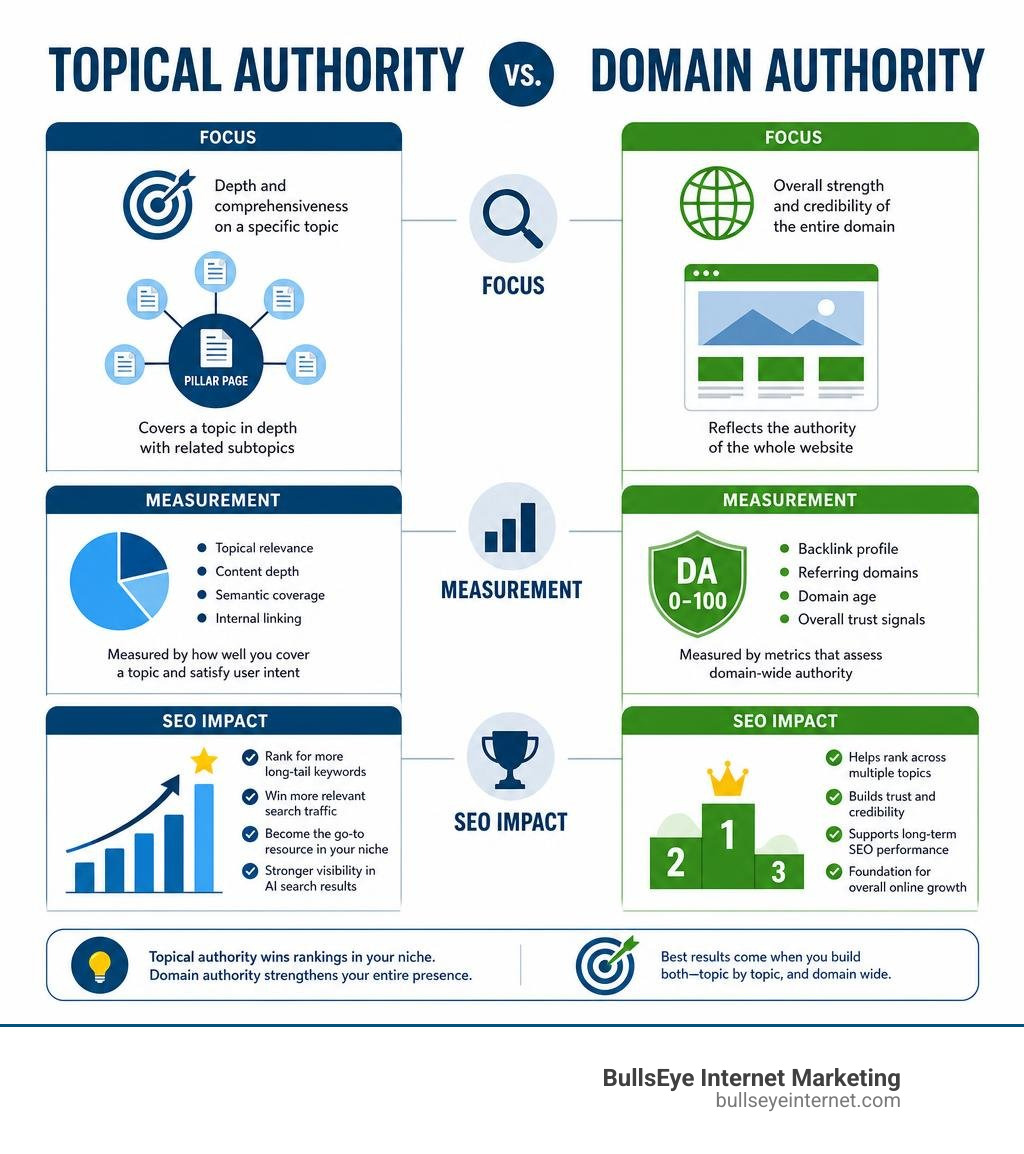
A common point of confusion for business owners is the difference between Topical Authority and Domain Authority (DA).
Domain Authority is a third-party metric (created by SEO tool providers like Moz and Ahrefs) that measures the overall strength and trust of a website’s backlink profile across the entire web. It is a generalist metric.
Topical Authority, on the other hand, is an algorithmic reality. It measures the depth of your expertise in a specific niche. A website can have a very low Domain Authority but have incredibly high topical authority for a specific, narrow subject. This is why a local plumbing site in Fort Lauderdale or a niche digital agency in West Palm Beach can easily outrank massive national directories or Wikipedia for highly specific, high-intent keywords.
| Feature | Topical Authority | Domain Authority |
|---|---|---|
| Primary Focus | Depth of expertise on a specific subject | Overall strength and trust of the website |
| How It’s Evaluated | Content comprehensiveness, semantic relationships, and internal linking | Backlink profile strength, site age, and linking domains |
| Strategy Goal | Cover 80%+ of subtopics within a niche | Acquire high-quality external backlinks |
| User Impact | Highly satisfying, expert-level answers | General trust and brand recognition |
| Rankings Impact | Allows low-DA sites to outrank massive competitors | Helps rank for broad, highly competitive terms |
The Impact on AI Search and LLMs
The search landscape of 2026 is heavily shaped by Generative Engine Optimization (GEO). Users are no longer just clicking on blue links; they are asking complex questions to Large Language Models (LLMs) like ChatGPT, Gemini, and Perplexity, which synthesize answers on the fly.
To be cited as the “Footnote of Truth” in these generative answers, your website must have undeniable topical authority. LLMs prefer consistent depth and entity alignment. They cross-reference claims across multiple pages of a website to verify factual accuracy before surfacing it as a recommended source.
If your site features a single, standalone blog post about a topic, the LLM has no context to verify your expertise. However, if you have a robust, interlinked topic cluster, the AI’s semantic mapping systems can easily trace your credentials and cite your content. In fact, websites with clear topic cluster structures receive 3.2x more AI citations than topically shallow competitors.
To learn how to position your business for these AI-driven systems, check out our LLM SEO Best Practices Guide and read more about building a defensive moat in Topical Authority SEO: Your Moat Against AI Search (Guide) – Keyword Insights.
The Core Framework of Topical Authority Building
Building topical authority is more like semantic engineering than traditional blogging. You are not just writing articles; you are building a structured knowledge library.
To do this successfully, your content strategy must focus on three core principles:
- Content Depth: Covering a topic so thoroughly that a user has no need to return to the search results to find a follow-up answer.
- Information Gain: Adding unique insights, original data, or experience to the conversation, rather than simply rehashing what already exists on the web.
- Semantic Connectivity: Organizing your content in a way that search engines can easily understand how each piece of information relates to the other.
To understand the full technical scope of this process, refer to the How to Build Topical Authority – Complete SEO Guide 2026 – Sunil Pratap Singh.
The Role of Content Clusters in Topical Authority Building
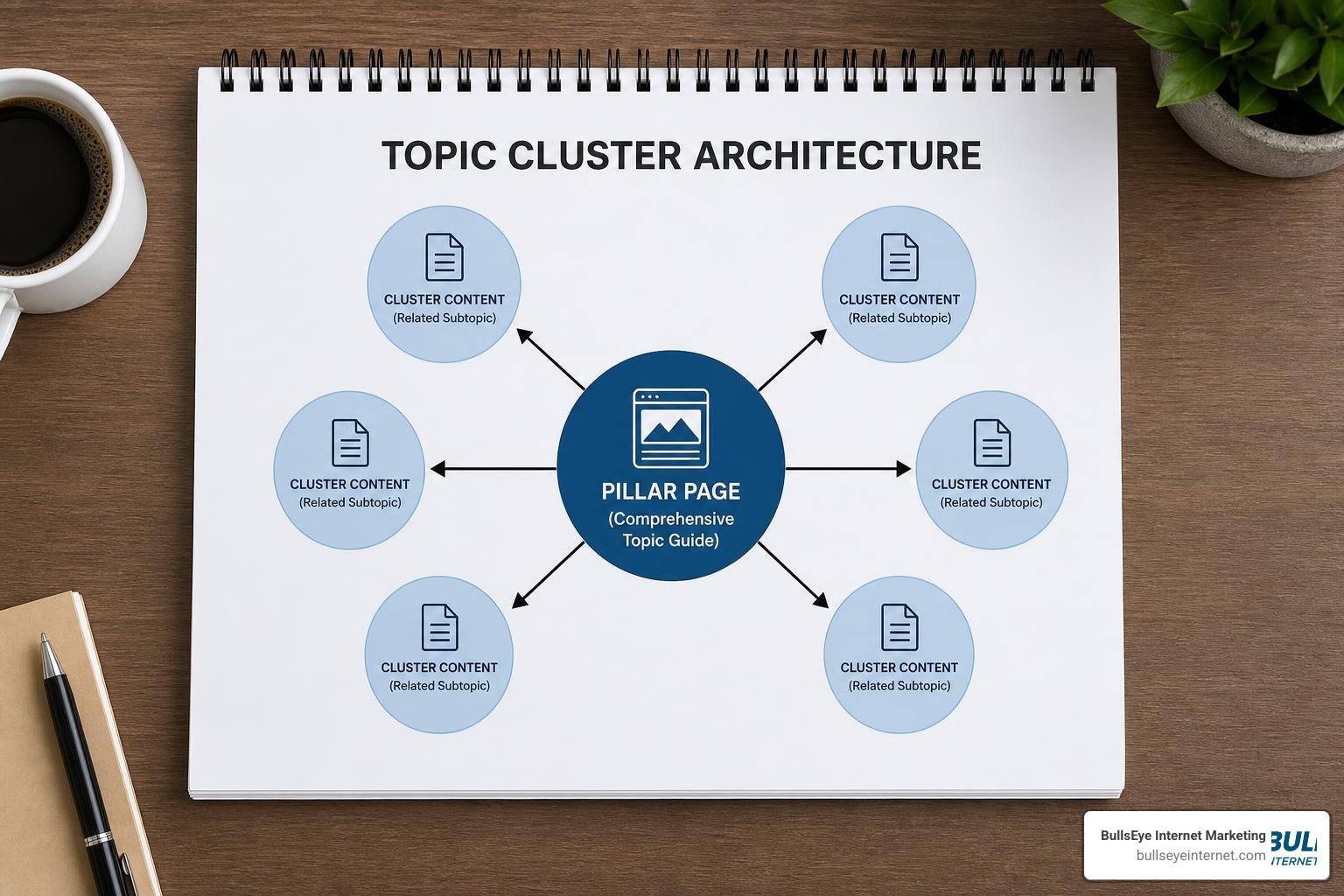
The fundamental structural unit of topical authority is the topic cluster (also known as the hub-and-spoke model).
A topic cluster consists of:
- The Pillar Page: A comprehensive, high-level guide that covers a broad topic in depth (typically 2,500 to 4,000 words).
- The Spoke Pages (Cluster Content): Highly focused, supporting articles that dive deep into specific subtopics, questions, or niche angles related to the pillar (typically 1,500 to 2,500 words).
- Strategic Internal Linking: Bidirectional links that connect every spoke page back to the pillar, and link the pillar to every spoke.
This structure acts as a signal booster for search engine crawlers. When Google crawls a spoke page and follows a link back to the pillar, and then to another sibling spoke page, it immediately recognizes the semantic relationship. It understands that your site isn’t just publishing random articles—it is systematically mapping out an entire subject area. For businesses targeting local markets, such as in Miami-Dade or Broward County, this model is highly effective when paired with localized content strategies, as detailed in our guide on Content Marketing for Local SEO.
Entity-Based Content Strategy and Schema Markup
In 2026, search engine optimization is entity-first. Google does not just index strings of text; it indexes things (entities) and the connections between them.
To align your content with Google’s Knowledge Graph, you must implement an entity-based content strategy. This means identifying the core concepts, people, and tools associated with your niche and creating content that clearly defines your brand’s relationship to those entities.
One of the most effective ways to do this is through advanced Schema markup:
- Person & Organization Schema: Clearly define who wrote the content, their professional credentials, and their social profiles.
- sameAs Markup: Use the
sameAsattribute in your schema to link your authors to authoritative external entities, such as Wikipedia, Wikidata, or highly trusted LinkedIn profiles. This directly feeds Google’s E-E-A-T (Experience, Expertise, Authoritativeness, Trustworthiness) evaluation systems. - Article & FAQ Schema: Structure your pages so that search crawlers and AI agents can easily parse your main arguments and direct answers to common questions.
By combining structured data with entity-rich content, you speak the search engine’s native language. For a complete breakdown of this optimization process, read our guide on how to Speak the AI’s Language: Optimizing Content for Large Language Models.
Step-by-Step Strategy for Topical Authority Building

Now that you understand the theory, let’s look at the practical, step-by-step blueprint for executing a successful topical authority building campaign. For a deeper look at this process, you can read What Is Topical Authority in SEO & How to Build It.
Step 1: Map Your Topical Territory
Before you write a single word, you must define the boundaries of your niche. If your topic is too broad, you will spread your resources too thin and fail to build meaningful authority. If it is too narrow, you won’t have enough search volume to drive real business growth.
- Define Your Seed Keyword: This should represent a core service or product your business offers (e.g., “commercial HVAC repair” if you are a contractor in Boca Raton).
- Mine Audience Questions: Use tools like AlsoAsked, Answer the Public, or Google’s “People Also Ask” (PAA) boxes to find the exact questions your customers are asking.
- Conduct Competitor Gap Analysis: Look at the top-ranking sites in your niche. What subtopics are they missing? Where is their coverage thin? Map out these gaps—they are your easiest ranking opportunities.
Step 2: Execute High-Quality Content with Information Gain
Google’s Helpful Content System is designed to weed out what we call “consensus content”—articles that simply rewrite the top 3 search results using AI. To stand out, every piece of content you publish must offer Information Gain.
- Include Original Research or Data: Conduct surveys of your clients or publish proprietary industry statistics.
- Conduct Expert Interviews: Add quotes and insights from real professionals in your field to provide unique perspectives.
- Share Real Case Studies: Walk readers through a real problem your business solved, complete with metrics, challenges, and step-by-step solutions.
This approach not only satisfies human readers but also signals genuine expertise to AI crawlers. For actionable tips on creating high-value content efficiently, read our guide on Write Smarter Not Harder: LLM Content Creation Strategies.
Step 3: Implement Strategic Internal Linking
Internal links are the highways that distribute authority across your website. When a single page on your site earns a high-quality external backlink, that “link juice” should flow seamlessly to your other pages through your internal links.
- Use Contextual, Entity-Rich Anchor Text: Avoid generic anchor text like “click here” or “read more.” Instead, use descriptive, keyword-aware anchors (e.g., “learn more about our [South Florida commercial HVAC maintenance plans]”).
- Maintain Bidirectional Linking: Ensure your supporting spoke pages link back to the parent pillar page, and the pillar page links out to each spoke.
- Keep Clusters Tight: Do not link unrelated topic clusters together. Keep your internal links focused within the specific cluster to avoid confusing search engine crawlers.
Step 4: Maintain Content Freshness and Velocity
Topical authority is not a “one-and-done” project. It requires consistent momentum.
Leaving outdated content on your website is like leaving moldy bread in your pantry—it stinks up the place and scares away the search engine crawlers. Google and AI search systems heavily favor content that has been updated recently (often looking for updates within the past 30 days for highly dynamic topics).
- Establish a Consistent Publishing Cadence: Aim to publish 4 to 6 high-quality articles per month within your target cluster until you hit a threshold of 25 to 30 interlinked pages.
- Conduct Quarterly Audits: Use Google Search Console to identify decaying content (pages that have lost traffic or rankings over the last 6 months).
- Execute Historical Optimization: Regularly refresh old articles with updated statistics, new subtopics, and fresh internal links to maintain their search visibility.
How to Measure and Track Your Topical Authority
Because topical authority is an emergent algorithmic property rather than a single numerical score displayed in an SEO tool, tracking it requires looking at a combination of proxy metrics.
Key Metrics for Topical Authority Building
To understand if your topical authority building efforts are working, monitor these five key performance indicators:
- Topic Share of Voice: The percentage of organic search visibility your domain holds for a defined group of topically related keywords compared to your competitors.
- Content Coverage Ratio: The percentage of subtopics, questions, and entity relationships mapped in your initial topical territory that you have fully covered with high-quality content. Aim for at least 80% coverage to see significant ranking lift.
- Ranking Breadth (Non-Targeted Keyword Rankings): A clear sign of strong topical authority is when your site starts ranking for hundreds of long-tail keywords that you didn’t explicitly target in your copy. If your ratio of non-targeted to targeted keyword rankings is above 3:1, your topical authority is strong.
- New Page Indexing Speed: On a topically weak site, a new article can take weeks to be indexed and rank. On a site with high topical authority, new pages are often indexed within hours and immediately rank on the first few pages of search results.
- AI Citation Rate: How often your brand and website are cited as references in AI search results like ChatGPT, Perplexity, and Google AI Overviews.
To learn more about tracking your visibility in generative search environments, refer to our AI Search Optimization Complete Guide.
Frequently Asked Questions About Topical Authority
How long does it take to build topical authority?
For a focused niche where you publish a cohesive cluster of 25 to 30 deeply interlinked articles, you can expect to see initial ranking improvements within 3 to 6 months. Achieving complete topical dominance and outranking major national competitors typically takes 9 to 12 months of consistent publishing and optimization.
Can a small website with low Domain Authority compete?
Absolutely. This is the primary benefit of topical authority building. While a massive generalist site like Forbes or Amazon has a high Domain Authority, they cover thousands of topics superficially. A highly focused, 40-page specialist site that covers a single, narrow topic exhaustively will consistently outrank generalist giants for niche-specific queries.
Do I need backlinks if I have strong topical authority?
While topical authority is incredibly powerful, it is not a complete replacement for link building. Instead, think of them as complementary strategies. Building a comprehensive topic cluster first makes your site highly “link-worthy,” encouraging other authoritative sites to link to your content naturally. These high-quality backlinks then distribute their authority across your entire site through your strategic internal linking structure.
Conclusion
At BullsEye Internet Marketing, we have spent more than two decades helping businesses in Florida and across the United States cut through the noise and dominate their digital spaces. Our unique approach to digital marketing centers on a powerful competitive advantage: we work with only one client per industry per geographic area, and we offer no long-term contracts.
Whether you are looking to capture high-value leads in Miami-Dade, Broward, Palm Beach, or beyond, we build custom SEO and GEO strategies that turn your website into an undisputed authority.
Ready to stop renting traffic through expensive ads and start owning your niche? Let’s talk. Explore our comprehensive services in Answer Engine Optimization: AEO, GEO, LLM SEO and find out how we can help your business win the search frontier of 2026.
