
Why Elder Law Advertising Is a Different Game — and How to Win It
Elder law advertising is one of the most misunderstood areas of legal marketing — and that gap is costing attorneys real clients every day.
Here’s the quick answer if you need it now:
What elder law advertising involves:
- Targeting two audiences at once — adult children (the searchers) and seniors (the clients)
- Using channels like local SEO, Google Ads, workshops, and referral networks
- Messaging that addresses both planned services (estate planning, Medicaid) and crisis situations (nursing home placement, guardianship)
- Following strict bar advertising rules on disclaimers, testimonials, and solicitation
The stakes are high. The global elder law services market was valued at $15.2 billion in 2023 and is projected to reach $24.8 billion by 2032. More than 40 million Americans are currently 65 or older — and that number keeps climbing.
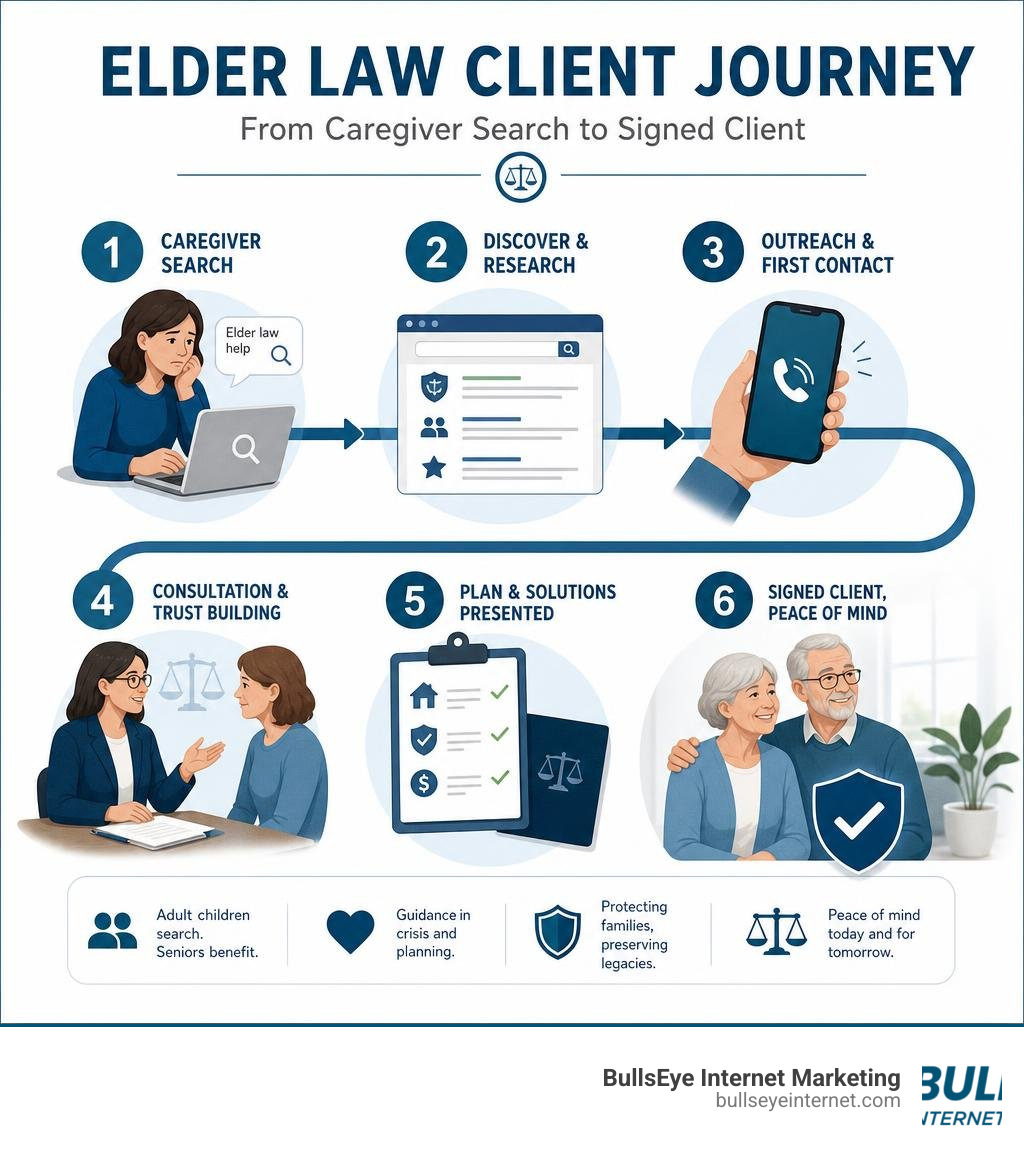
But here’s what most elder law attorneys miss: the person with the legal problem is rarely the one searching for help.
Over 70% of initial contacts for elder law services come from adult children — typically a 50-something daughter or son scrambling for answers after a parent’s fall, diagnosis, or hospital discharge. One source captures it perfectly: a 52-year-old daughter calling after her father fell, facing a $9,000-per-month nursing home bill with no plan in place.
Generic legal marketing doesn’t account for that dynamic. Elder law advertising has to.
I’m Ronnie Katz, founder of BullsEye Internet Marketing, and since 2006 I’ve helped law firms cut waste, lower acquisition costs, and build marketing systems that actually generate calls — including in the competitive space of elder law advertising. In this guide, I’ll walk you through exactly what works, what doesn’t, and what to do first.
Elder law advertising terms to know:
Understanding the Elder Law Market and the Dual-Audience Approach
Most legal marketing campaigns are built around a single user persona: the person who has a legal problem and is looking for a solution. In personal injury, the injured person searches. In criminal defense, the accused (or their immediate spouse) searches.
But in elder law, you are marketing to a Trust Triangle: the aging parent (the client), the adult child (the decision-maker and searcher), and the professional referral source (the validator). If your marketing only speaks to one of these sides, the triangle collapses.
The economic opportunity here is staggering. We are currently in the middle of the “Great Wealth Transfer,” where Baby Boomers are expected to pass down over $30 trillion to Millennials and Gen Xers. This means the adult children searching for your services are highly motivated to protect their parents’ hard-earned assets.
To win these cases, your firm must master How to Market a Law Practice by executing a dual-audience strategy. Let’s look at how to break this down using a Modern Legal Marketing Guide framework.
Reaching the Caregiver and Adult Child
The adult child (average age: 50) is typically your primary digital target. They are often sandwiched between raising their own kids and caring for aging parents. When they search for help, they are usually in a state of high stress or outright crisis.
Common emotional triggers for the adult child include:
- A parent receiving a diagnosis of dementia or Alzheimer’s.
- An unexpected hospital discharge notice with a recommendation for skilled nursing care.
- A Medicaid denial letter that threatens to deplete the family’s life savings.
Their search behavior reflects this urgency. They aren’t searching for abstract legal terms like “testamentary capacity.” Instead, at 11:30 PM, they are typing queries like: “mom needs nursing home can’t afford” or “how to protect parents’ house from Medicaid.”
According to a Caring.com study, when adult children fill out lead forms on behalf of their parents, the conversion rate is 3.5 times higher than when seniors inquire for themselves. Your copy, landing pages, and Attorney marketing solutions must speak directly to this caregiver’s pain points. They want to hear: “We can help you protect your parent’s assets and guide you through this overwhelming process.”
Appealing Directly to Seniors and Older Adults
While the adult child does the heavy lifting online, the senior (average age: 74) is still the actual client who must sign the retainer. They are motivated by a desire for control, dignity, and a wish to avoid being a burden to their families.
When seniors research legal help, they look for deep trust signals. They are highly skeptical of flashy, aggressive, or alarmist marketing. To appeal to them:
- Speak their language: Replace confusing legal jargon with clear, comforting explanations. Instead of “probate avoidance strategies,” talk about “keeping things simple for your family.”
- Focus on accessible design: Ensure your website features high-contrast fonts, clean navigation, and large, readable text.
- Showcase authority: Highlight credentials such as membership in the National Academy of Elder Law Attorneys Home NAELA or local bar associations.
High-Impact Channels for Elder Law Advertising
Relying on a single marketing channel is a recipe for empty consultation calendars. To build a highly visible elder law practice, you must implement a multi-channel digital strategy that captures both active searchers and those researching long-term planning options.

Using a variety of digital channels ensures that whether a family is planning five years in advance or facing an immediate nursing home admission, your firm is the first one they see. Let’s look at the three most effective channels for elder law firms.
Local SEO and Google Business Profile Optimization
For elder law, geography is everything. Families want an attorney who understands the local probate courts, regional nursing homes, and state-specific Medicaid rules.
If your firm is located in South Florida, for example, your local SEO must be incredibly precise. A family in Miami-Dade County facing a crisis will search for highly localized terms. You must optimize your Google Business Profile (GBP) to rank in the “Map Pack” for keywords like “Medicaid planning attorney Miami” or “guardianship lawyer Fort Lauderdale.”
To dominate local search:
- Claim and complete your GBP: Fill out every section, including your exact practice areas, business hours, and a detailed business description.
- Gather local reviews: Aim for at least 20+ high-quality Google reviews with an average rating above 4.5 stars. Respond to every review professionally.
- Build local directories: Ensure your name, address, and phone number (NAP) are identical across local directories and legal databases, such as Best Elder Law Lawyers in Broward County, FL – Justia, Miami-Dade County Elder Law Legal Aid & Pro Bono Services – Justia, Best Elder Law Lawyers in Palm Beach County, FL – Justia, and Best Elder Law Lawyers in Martin County, FL – Justia.
For a complete breakdown of how to structure your website to rank organically for these high-value terms, check out our Digital Marketing for Law: Complete Guide.
Google Ads and PPC Campaigns
While SEO is a long-term play, Google Ads (Pay-Per-Click) is the fastest way to generate immediate phone calls from families in crisis. When a parent is about to be discharged from a hospital to a skilled nursing facility, the family doesn’t have months to wait for your organic rankings to improve. They need help today.
To run a highly profitable PPC campaign, you must understand the distinction between traditional Google Search Ads and Google Local Services Ads (LSAs).
- Google Local Services Ads (LSAs): These sit at the absolute top of the search results page, even above traditional paid ads. They operate on a pay-per-lead model (typically costing $40 to $90 per qualified lead) rather than a pay-per-click model. Because they display the “Google Screened” badge and show your star rating, they convert at an incredibly high rate.
- Google Search Ads: These allow you to target high-intent keywords like “crisis Medicaid planning lawyer” or “how to apply for nursing home Medicaid in Florida.” Click costs (CPCs) for elder law keywords typically range from $30 to $95 depending on competition.
To maximize your budget, never send PPC traffic to your homepage. Instead, build dedicated landing pages that address the specific search query. For example, if someone clicks an ad for “Medicaid asset protection,” the landing page should focus entirely on protecting assets, featuring a clear call-to-action (CTA) to schedule a consultation.
Learn more about managing these campaigns in our guides on PPC Advertising for Law Firms, Lawyer PPC Advertising: Ultimate Guide, and Pay Per Click Advertising for Lawyers Guide.
Budgeting and Cost Expectations for Elder Law Advertising
How much does it actually cost to acquire an elder law client? Because elder law cases often have high matter values — ranging from $1,000 for basic estate planning to $5,000–$15,000+ for comprehensive Medicaid asset protection and crisis planning — the return on investment (ROI) is exceptionally strong.
Generally, established elder law firms allocate 15% to 17% of their gross revenue to marketing, while firms in aggressive growth phases may invest 25% to 30%.
Here is a realistic look at typical advertising costs by channel:
| Advertising Channel | Average Cost Per Lead (CPL) | Average Cost Per Signed Client (CAC) | Recommended Monthly Budget |
|---|---|---|---|
| Google Local Services Ads | $40 – $90 | $200 – $400 | $1,500 – $2,500 |
| Google Search PPC | $80 – $200 | $300 – $800 | $2,000 – $4,000 |
| Local SEO & GBP | Organic (Time/Agency Fee) | $150 – $350 | $1,500 – $3,000 |
| Facebook Ads / Webinars | $20 – $50 (per attendee) | $150 – $400 | $1,000 – $2,000 |
To learn more about maximizing your ad spend, read our Detailed Guide to Google Ads for Lawyers and explore Why Every Lawyer Should Invest in Google Local Ads.
Balancing Planning vs. Crisis-Driven Services
One of the biggest mistakes elder law firms make is running a single, generic ad campaign for all their services. “Elder law” is not a single service; it is divided into two entirely different markets that require completely separate messaging, ad campaigns, and landing pages.
Proactive Estate and Medicaid Planning
Proactive planning is for healthy seniors and their families who want to prepare for the future. The primary goal here is to protect assets from being completely consumed by future long-term care costs while planning around Medicaid’s strict five-year look-back period.
- The Searcher’s Mindset: Calm, forward-thinking, and research-oriented. They are looking for information and education.
- Effective Marketing Channels: Educational workshops, webinars, organic content marketing, and Facebook ads targeting seniors aged 55–70.
- The Message: “Plan ahead to protect your home and savings. Don’t let long-term care costs wipe out your hard-earned legacy.”
For proactive planning, offering a free downloadable guide or an invitation to a local “Lunch & Learn” seminar works incredibly well to build top-of-funnel leads that you can nurture over time.
Reactive Crisis and Guardianship Services
Crisis planning occurs when a senior is already in a nursing home or about to enter one, and the family is told they must pay out-of-pocket because they do not qualify for Medicaid. This also includes emergency guardianship situations where a parent has suddenly lost capacity without a Power of Attorney in place.
- The Searcher’s Mindset: Panicked, highly stressed, and looking for immediate representation. They do not want to read an eBook; they need to speak to an attorney now.
- Effective Marketing Channels: Google Search Ads, Google Local Services Ads, and direct referral networks.
- The Message: “Is your loved one facing an immediate nursing home stay? We can help qualify them for Medicaid and protect their assets, even at the last minute.”
Firms like Elder Law & Medicaid Planning | Miami-Dade & Broward focus heavily on showing families that it is “never too late” to plan, which is highly effective copy for crisis-driven searches.
Compliance, Ethics, and Referral Networks
Because elder law involves vulnerable populations, your advertising must adhere to strict ethical standards. Simultaneously, because digital ads are only one piece of the puzzle, you must build offline referral networks to sustain long-term growth.

Combining highly compliant digital advertising with a robust, professional referral network creates a reliable stream of cases that keeps your firm profitable year-round.
Ethical Compliance in Elder Law Advertising
Attorneys practicing in Florida must be exceptionally careful. The Florida Bar has some of the strictest advertising rules in the nation. Under the Advertising Handbook, 2025 Edition Approved 12/10/25, there are several critical rules you must follow:
- No Deceptive or Misleading Claims: You cannot promise or guarantee a specific outcome (e.g., “We guarantee 100% asset protection”).
- Testimonial Disclaimers: If you display client reviews or testimonials on your website or in your ads, they must represent actual clients, and you must include a clear disclaimer stating that prior results do not guarantee a similar outcome.
- Bona Fide Office Disclosure: Any advertisement must clearly disclose the city, town, or county of one or more bona fide office locations where the advertising attorney actually practices.
- No Prohibited Solicitation: Cold calling or sending unsolicited direct messages to prospective clients in crisis is strictly prohibited.
Always cross-reference your marketing materials with the official Florida Elder Law resources and local bar guidelines to ensure total compliance. For a broader overview of how to stay safe while marketing online, read our guide on Lawyer Advertising Rules & Solutions for Modern Firms.
Building Strategic Referral Partnerships
While digital advertising is incredibly powerful for capturing direct-to-consumer cases, some of your highest-quality, lowest-cost cases will come from professional referral networks.
To build a powerful referral engine, identify the professionals who interact with your target audience before they need an attorney:
- Hospital Discharge Planners & Social Workers: They are on the front lines when a senior is transitioning from a hospital stay to a skilled nursing facility.
- Nursing Home Administrators & Admissions Directors: They frequently encounter families who want to admit a parent but cannot afford the private pay rate and do not know how to navigate Medicaid.
- Financial Advisors & CPAs: They manage the assets of seniors and are often the first to realize a client needs robust estate and long-term care planning.
Don’t just ask them for business. Instead, position yourself as an educator. Offer to conduct free educational seminars for their staff on how to spot Medicaid planning opportunities or when a guardianship is necessary.
Frequently Asked Questions
What is the average cost per lead for elder law advertising?
The average cost per lead (CPL) varies depending on the channel. Google Local Services Ads generally offer the lowest CPL, ranging from $40 to $90 per qualified phone call. Traditional Google Search Ads typically cost between $80 and $200 per lead due to high keyword competition. To explore alternative lead generation strategies, check out our guide on Pay Per Lead for Lawyers.
How do we track the ROI of our elder law marketing campaigns?
To accurately track your ROI, you must implement a robust call-tracking system (like CallRail) and integrate it with your CRM (like Clio or Filevine). This allows you to track exactly which keyword, ad, or organic search led to a phone call, which calls turned into consultations, and which consultations ultimately signed a retainer.
Why do generic legal marketing strategies fail for elder law?
Generic legal marketing assumes that the person searching is the client. In elder law, you are dealing with a highly emotional dual-audience (the adult child and the senior), complex state-specific Medicaid rules, and a mix of proactive planning and high-stress crisis situations. If your marketing doesn’t speak to the specific emotional and practical triggers of the caregiver, it will fail.
Achieving Sustainable Growth with BullsEye Internet Marketing
Elder law advertising is not about screaming the loudest or having the flashiest ads. It is about building a system of trust, authority, and empathy that reaches both stressed-out adult children and seniors looking to protect their legacy.
By combining highly targeted Google Ads for immediate crisis cases, local SEO to dominate your South Florida market, and compliant, educational messaging, you can build a highly profitable practice that consistently attracts qualified clients.
At BullsEye Internet Marketing, we specialize in helping elder law firms cut through the noise. Our unique model sets us apart: we work with only one client per industry per geographic area, giving you an exclusive competitive advantage, and we never lock you into long-term contracts.
If you are ready to stop waiting for referrals and start generating highly qualified cases, we are here to help. For more details on building a winning legal campaign, read our Essential Guide to Advertising for Lawyers. If you also offer adjacent services, you might find our guide on Marketing for Insurance Agents: Don’t Let Your Leads Lapse highly valuable.
Ready to grow your firm? Contact BullsEye Internet Marketing today to claim your exclusive territory and launch your high-performance elder law campaign.
