
Your Buyers Are Asking AI—Is Your Business the Answer?
What is AEO strategy? Here’s the short answer:
Answer Engine Optimization (AEO) is the practice of optimizing your content so AI-powered tools like ChatGPT, Gemini, Perplexity, and Google’s AI Overviews cite your brand when buyers ask questions related to your products or services.
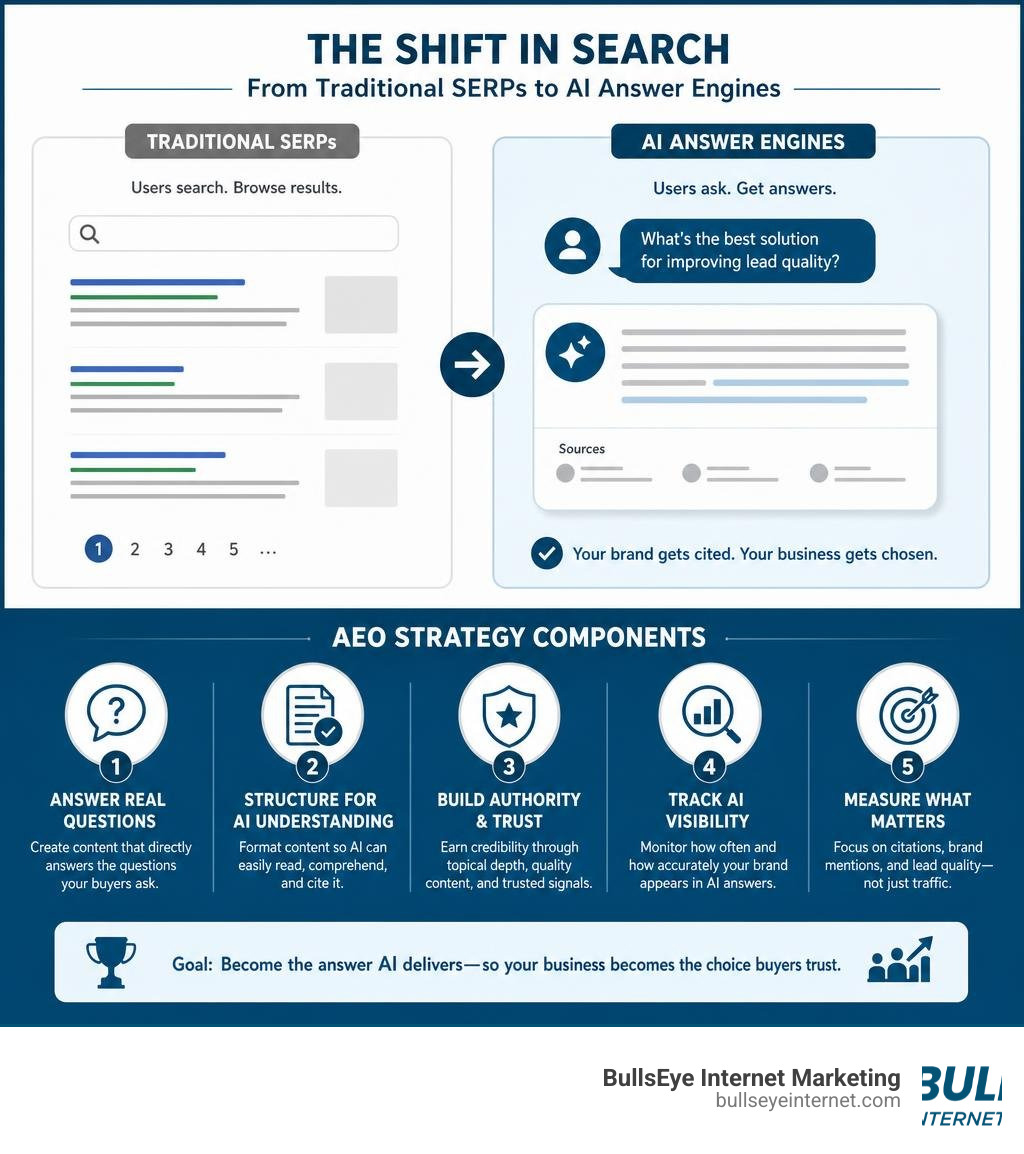
Unlike traditional SEO—which chases rankings and clicks—AEO is about becoming the answer that AI delivers directly to your potential customers.
The key elements of an AEO strategy include:
- Writing content that directly answers real questions your buyers ask
- Structuring that content so AI can easily read, understand, and cite it
- Building topical authority and trust signals across your website and beyond
- Tracking how often and how accurately your brand appears in AI-generated answers
- Measuring success through citations, brand mentions, and lead quality—not just traffic
Search behavior is changing fast. The average Google query is about 3 words. The average ChatGPT prompt? Closer to 60. Your buyers aren’t just Googling anymore—they’re having full conversations with AI tools to research vendors, compare solutions, and make purchase decisions. And 42% of CRM software buyers now use AI search as part of their evaluation process.
Here’s the problem: if your brand isn’t mentioned in those AI answers, you’re effectively invisible to a growing share of your market. Around 26% of brands have zero mentions in AI Overviews at all. Meanwhile, 62% of marketers are already seeing declining clicks from traditional search.
The window to get ahead of this shift is open right now—but it won’t stay open long.
I’m Ronnie Katz, founder and Principal CEO of BullsEye Internet Marketing, and with over 20 years of experience helping businesses grow their online visibility, I’ve watched search evolve through every major shift—and what is AEO strategy represents the most significant change I’ve seen since Google introduced PageRank. In this guide, I’ll walk you through exactly what it is, why it matters, and how to build one that drives real leads and revenue for your business.
What is AEO strategy definitions:
What is AEO Strategy and How Does It Differ From SEO?
To understand how to win in this new landscape, we first have to look at how we got here. For decades, traditional Search Engine Optimization (SEO) was the undisputed king of digital marketing. The goal was straightforward: optimize your website, build backlinks, rank in the top 10 blue links on search engine results pages (SERPs), and watch the clicks roll in.
Then came the Large Language Model (LLM) boom.
Today, platforms like ChatGPT, Claude, Gemini, and Perplexity don’t just point users to a list of websites; they synthesize information from across the web to draft a custom, conversational, AI-powered answer.
This is where Answer Engine Optimization (AEO) comes in. While SEO focuses on driving qualified traffic to your site via rankings, AEO focuses on maximizing your brand’s visibility, mentions, and citations within those AI-synthesized responses.
| Feature | Traditional SEO | Answer Engine Optimization (AEO) |
|---|---|---|
| Primary Goal | Rank high in SERPs to drive website clicks | Get cited and recommended in AI-generated answers |
| User Interaction | Short, keyword-based search queries | Long, conversational, contextual prompts |
| Success Metrics | Organic traffic, keyword rankings, impressions | Brand mentions, citation share, LLM visibility |
| Content Focus | Comprehensive pages targeting search volume | Direct, structured answers to specific questions |
| Target Platforms | Google, Bing | ChatGPT, Claude, Gemini, Perplexity, AI Overviews |
Think of AEO as a specialized, highly structured layer of your overall search strategy. If you want to dive deeper into the mechanics of how these platforms function, you can learn more about answer engine marketing to see how AI engines process your data.
Why AEO is Crucial for B2B Marketers in 2026
If you are a B2B marketer operating in 2026, the shift to AI search is no longer a futuristic prediction—it is your current reality. The modern B2B buyer journey has shifted. Instead of starting their research by clicking through five different blog posts, buyers are going to ChatGPT or Perplexity and typing: “Compare the top three CRM platforms for mid-sized healthcare companies in Florida, focusing on compliance and ease of implementation.”

This behavior is widespread. Recent industry statistics show that 42% of CRM software buyers now use AI search as part of their evaluation process.
Additionally, 70% of marketers believe AEO will significantly impact their organization’s digital strategy within the next one to three years. However, only 20% have actually begun implementing a dedicated strategy. This creates a massive first-mover advantage for businesses that act now. If you are wondering how your business can begin adapting, you can learn how to approach your AEO strategy to understand the fundamentals of content structure, or read The Ultimate Guide to Generative Engine Optimization and AI Search Visibility for a deeper strategic overview.
Understanding the Shift to Conversational Search
The core driver behind AEO is a fundamental change in search query behavior. In the past, search was constrained by keywords. Users typed fragmented phrases because that was what search engines understood.
Now, natural language processing allows for highly conversational, multi-sentence queries. The average Google search query is roughly 3.4 words. When users use Google’s AI-assisted search modes, that average jumps to 10.4 words. On ChatGPT, the average prompt is a staggering 60 words.
These longer, context-heavy queries mean that search intent is highly specific. AI engines look for content that matches this exact context rather than broad matching keywords. To learn more about this transition, check out AEO vs SEO: Transforming Digital Strategy for AI Answers 2025, which highlights how conversational search is transforming digital touchpoints.
The Cost of Inaction in the AI Era
Staying on the sidelines while AI search grows is a recipe for digital invisibility. Already, 62% of marketers have reported a decline in organic clicks and web traffic from traditional search engines. This is the “zero-click search” phenomenon in action: when an AI engine answers a user’s question directly, the user has no reason to click through to your website.
If your brand isn’t actively optimized for these engines, your citation frequency drops to zero. And here is a wake-up call: only 8% of ChatGPT citations feature URLs that also appear in Google’s top 10 organic results. You cannot rely on your traditional SEO rankings to save you in AI search. To protect your brand’s digital footprint, you must understand the rules of Large Language Model SEO and optimize specifically for how AI reads the web.
Key Components of an Effective AEO Strategy
To build an AEO strategy that actually works, you have to make your website highly “retrievable” for AI scrapers and crawlers. This means optimizing both your technical backend and your content structure.
The foundation of technical AEO is structured data and schema markup. While schema markup has never been a direct ranking factor for traditional Google SEO, it is absolutely vital for AEO. Schema provides context. It tells the AI crawler exactly what a piece of data represents—whether it is a product price, an author’s credential, a business location in Broward County, or a step-by-step guide.
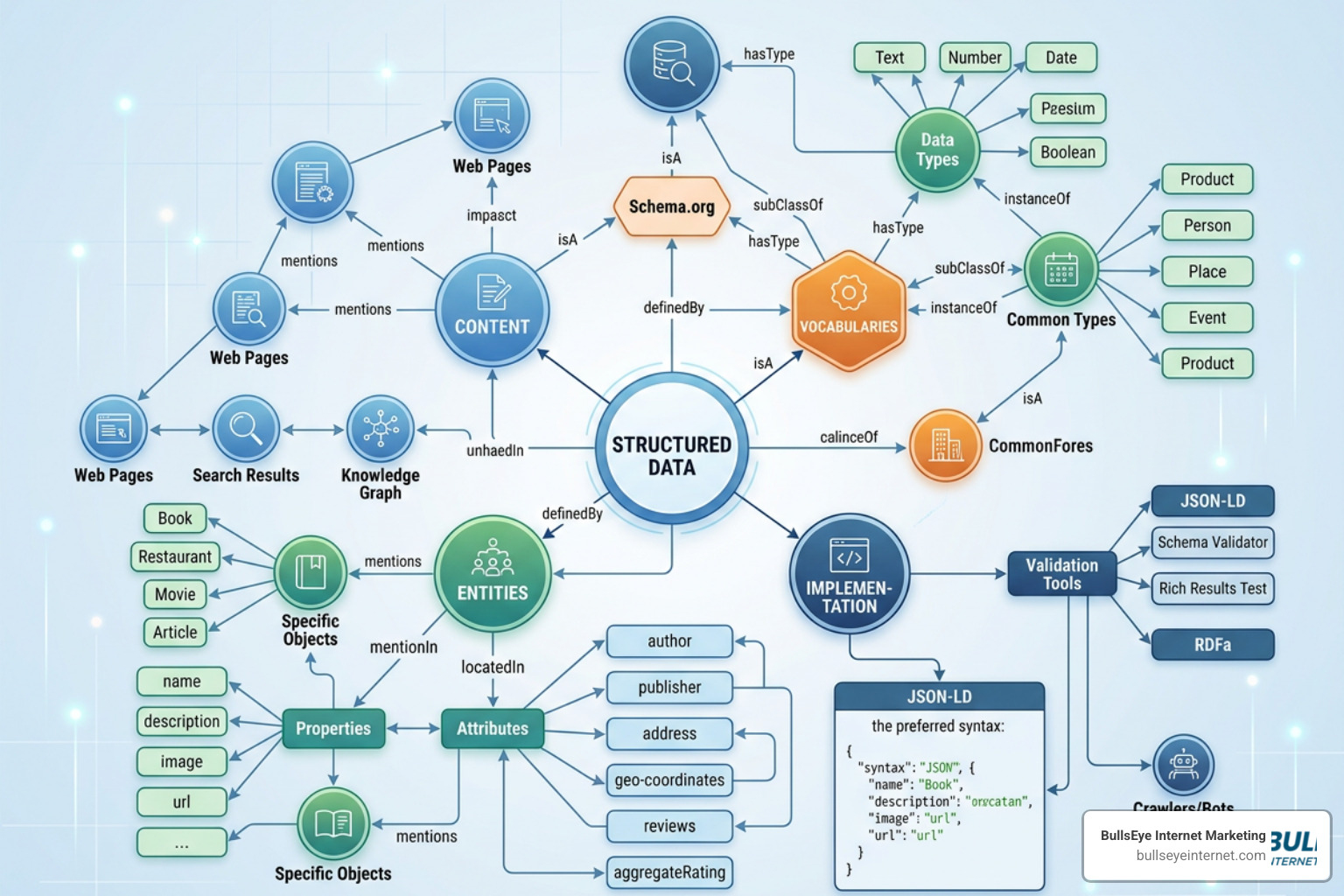
Beyond schema, you must build deep topical authority through content clusters. AI models do not evaluate pages in a vacuum; they look at your entire site to see if you are a credible source on a topic. If you want to get cited, you need to speak the AI’s language: optimizing content for Large Language Models is the best way to structure your site’s architecture for LLM scrapers.
How to Build a Knowledge Pack for What is AEO Strategy
An essential step in AEO is establishing a “Knowledge Pack” for your brand. This is a highly organized, single source of truth containing first-party data about your business, products, and services.
AI models are trained to look for corroboration. If your website says one thing, but your social profiles, local directories, and press releases say another, the AI will view your brand as untrustworthy. To construct this properly, you can follow the structured frameworks outlined in How to create an AEO strategy (2026) and learn how to write with LLMs in mind using Write Smarter, Not Harder: LLM Content Creation Strategies.
Your Knowledge Pack should include:
- Clear, unambiguous entity definitions (who you are, what you do, who you serve)
- Consistent NAP (Name, Address, Phone) data, particularly if you serve specific regions like South Florida (from Miami-Dade to Palm Beach County)
- Verified first-party data, original research, and proprietary statistics that cannot be found anywhere else
Optimizing Content Formats for AI Citations
AI engines love content that is easy to parse, summarize, and extract. To increase your chances of being cited, structure your content using these formats:
- Direct Q&A Formatting: Lead your sections with natural language questions (using H2 or H3 tags) and provide a direct, concise answer in the first 40 to 60 words.
- Scannable Tables and Lists: Use bullet points and formatted tables to display comparative data. AI crawlers can easily extract these to display in chat responses.
- Self-Contained Sections: Ensure each section of your page makes sense on its own. AI scrapers often pull single paragraphs rather than reading your entire page.
For a complete breakdown of these formatting rules, review our guide on AI Search Best Practices.
Measuring the Success of Your AEO Efforts
How do you know if your AEO strategy is actually working? You can’t just log into Google Search Console and look at your average position anymore. Measuring AEO requires a new set of KPIs.
To get an accurate picture of your performance, you must track:
- AI Visibility Score: The percentage of times your brand is mentioned when users run prompts related to your target keywords.
- Citation Frequency: How often AI engines link back to your website as a source.
- Sentiment Analysis: Whether the AI refers to your brand in a positive, neutral, or negative light.
- Branded Search Volume: An increase in users searching for your brand by name on Google is a strong leading indicator that they saw you mentioned in an AI chat.
To learn how to set up these tracking systems, follow our guide on LLM SEO Audit Best Practices.
Tracking Brand Visibility in LLMs
Because LLMs do not provide standard analytics dashboards, tracking requires manual or automated “output audits.” This involves simulating buyer prompts across ChatGPT, Claude, Gemini, and Perplexity, and analyzing the results.
Are you being recommended? Are your competitors being cited instead? Understanding these patterns is key to adjusting your content. For more details on what influences these engines, read about AI Search Ranking Factors.
Connecting AEO to Pipeline and Revenue
At BullsEye Internet Marketing, we don’t care about vanity metrics—we care about calls, sales, and revenue. Fortunately, the business impact of AEO is clear.
Data shows that high-intent leads from AI search grew 4x within the first six months of implementing an AEO strategy, while overall pipeline from AI-sourced leads grew 3x. Even better, the average deal size from AI search is 2.7x larger than those coming from traditional Google search. Why? Because buyers using AI search are further along in the buying journey and are asking highly specific, high-intent questions.
For example, HubSpot’s AEO beta customers drove 20% more traffic from AI than customers not using AEO tools. HubSpot’s own internal AEO strategy produced an incredible 1,850% increase in qualified leads. To see how you can capture this high-value traffic, explore our Generative Engine Optimization Service.
Advanced Frameworks for AI Search Optimization
To win at AEO in highly competitive markets like Miami, Fort Lauderdale, or West Palm Beach, you need to go beyond basic on-page edits. You need an advanced, multi-channel approach.
AI models do not just crawl your website; they crawl the entire web. They read Reddit threads, LinkedIn posts, local business directories, press releases, and review sites. If your brand is only mentioned on your own website, AI engines are unlikely to trust you. “If no one else corroborates you, AI won’t either.”
To build true citation strength, you must map your brand mentions across the entire digital ecosystem:
Step-by-Step Execution of What is AEO Strategy
Here is our agency’s proven framework for executing a successful AEO strategy:
- Build Your Knowledge Pack: Gather all first-party data, customer testimonials, and case studies.
- Document Your ICP (Ideal Customer Profile): Define exactly who your buyer is, down to their industry, company size, and specific pain points.
- Simulate Buyer Prompts: Generate a list of 200+ realistic, long-form prompts your ICP would ask an AI engine.
- Audit and Analyze: Run those prompts through an AEO tool to see where your brand stands.
- Optimize and Distribute: Update your website content to directly answer those prompts, and distribute those answers across high-authority third-party platforms.
For Florida-based businesses looking to establish dominance in local AI search, we highly recommend reading Becoming the Answer: Answer Engine Optimization for Your Florida Business and checking out what LLM SEO Experts Share Their Advice for Florida Businesses.
Integrating AEO with Generative Engine Optimization (GEO)
While AEO focuses on formatting your content to answer specific questions, Generative Engine Optimization (GEO) focuses on building the overall authority, digital PR, and third-party validation needed to make AI engines trust your brand.
By combining AEO (formatting and structure) with GEO (authority and PR), you create a powerful, dual-layered strategy that ensures you are both found and cited. You can learn more about this integration by reading Generative Engine Optimization Services 101.
Frequently Asked Questions about AEO
Does AEO replace traditional SEO?
No. AEO does not replace traditional SEO; it enhances and future-proofs it. Think of them as complementary strategies. Traditional SEO keeps your site technically healthy, builds domain authority, and captures users who still prefer standard search. AEO ensures you capture the rapidly growing segment of users who rely on AI summaries. For a complete look at how these strategies work together, read our AI Search Optimization Complete Guide.
What types of content are most likely to be cited by AI?
AI engines prioritize highly authoritative, structured, and factual content. This includes:
- Original research, surveys, and proprietary data
- Detailed FAQ pages structured with Schema markup
- Comprehensive step-by-step guides and comparative tables
- Case studies with clear, measurable outcomes
To see real-world examples of how to get your brand selected, watch From SEO to AEO: How to get your brand chosen by AI.
How long does it take to see results from AEO?
Because AI engines rely on crawling and training cycles, the timeline can vary. Optimizing your site for Google’s AI Overviews can show results in as little as 3 to 4 weeks, as Google crawls the web constantly. However, appearing in the core training data of offline models like Claude or ChatGPT can take several months, depending on their update cycles. To understand how to accelerate this process, check out our AI SEO Consulting Ultimate Guide.
Future-Proof Your Strategy with BullsEye Internet Marketing
The search landscape is undergoing its most radical transformation in decades. Clicks are declining, conversational queries are rising, and your buyers are actively using AI to make purchasing decisions. If your business isn’t optimized for answer engines, you are leaving massive amounts of pipeline on the table.
At BullsEye Internet Marketing, we help businesses across the United States—with a special focus on our local Florida communities in Miami-Dade, Broward, and Palm Beach counties—navigate this shift. Our unique model means we offer no long-term contracts and we work with only one client per industry per geographic area, giving you an exclusive, highly aggressive competitive advantage in both traditional and AI search.
Are you ready to stop chasing blue links and start becoming the definitive answer? Let us build a custom, high-impact strategy for your brand. Explore our complete guide on Answer Engine Optimization: AEO, GEO, LLM SEO and contact us today to secure your territory.
