
Introduction
A specialized ChatGPT ads agency helps businesses reach high-intent buyers by managing sponsored placements within dynamic AI dialogues. Choosing the best agency partner requires evaluating core capabilities: semantic intent cluster mapping to target specific buying prompts, prompt-aligned conversational copy optimization that integrates naturally into answers, dynamic bid management across conversational auctions, and closed-loop attribution that connects chat interactions directly to CRM revenue.
Conversational search is fundamentally changing how people discover products and services. Instead of typing rigid keywords into a traditional engine and clicking through dozens of links, users now hold in-depth conversations with AI platforms to compare enterprise software, research local service providers, or evaluate financial tools.
This behavioral shift has unlocked ad inventory inside the answer stream itself. In the 2026 digital marketing landscape, conversational AI platforms process millions of daily queries where users explicitly state pain points, budgets, and timelines. Partnering with the right agency ensures your brand appears at the exact moment a purchase decision is being framed.
Understanding Conversational Advertising in ChatGPT
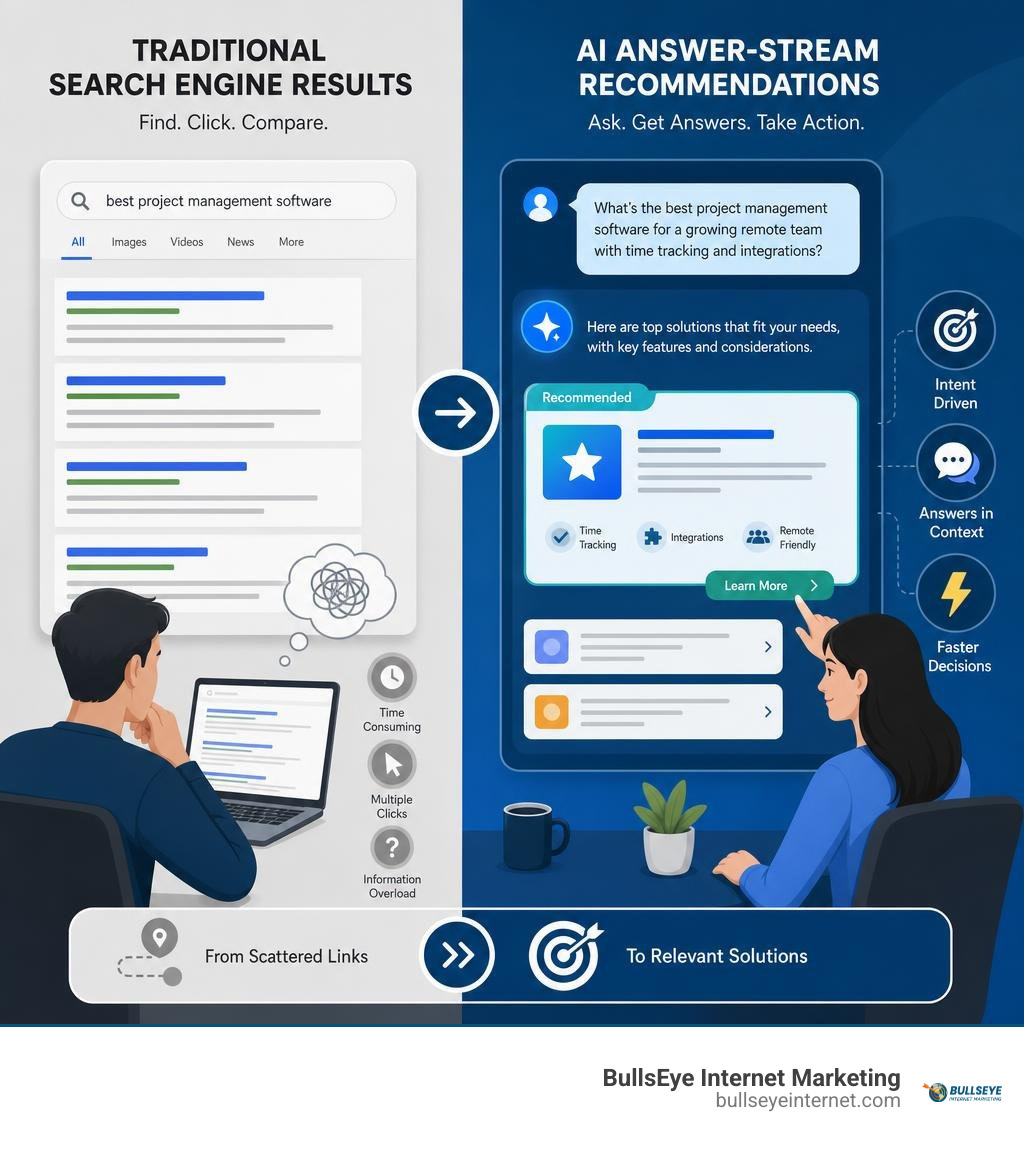
Conversational advertising integrates sponsored answers and contextual brand recommendations directly into dynamic AI dialogue. When a user asks an AI assistant for guidance—such as finding the best billing automation platform for a healthcare practice or identifying a qualified local contractor—the platform identifies high-intent queries and introduces relevant, non-intrusive ad units.
To learn more about how discovery platforms are evolving, review our ai search marketing agency guide.
Unlike traditional banner placements that distract users from their primary task, conversational placements act as organic extensions of the dialogue. Rather than screaming for attention, they offer context-aware recommendations that help the user complete their research. This format bypasses the widespread blind-scrolling behavior seen across legacy platforms, where users instinctively skip past sponsored banners and generic top-of-page search ads.
How Conversational Placements Differ from Search and Social Ads
Traditional Search Engine Results Pages (SERPs) rely heavily on isolated keyword triggers. If someone searches for “best enterprise CRM,” the platform delivers four sponsored links at the top, regardless of whether the user wants a technical comparison, pricing sheet, or implementation guide. Social media ads operate on an interruption model, guessing a user’s interests based on passive browsing data and slipping sponsored content into an entertainment feed.
In contrast, in-dialogue recommendations are powered by deep semantic intent. Conversational ads analyze the entire thread context—the user’s industry, prior questions, stated budget constraints, and specific technical requirements.
Recent research on user behavior highlights significant differences:
- Higher User Trust: Native contextual suggestions achieve up to 4.5x higher trust than standard display banners, as users perceive the recommendation as relevant assistance rather than unsolicited promotion.
- Overcoming Ad Fatigue: While an estimated 80% of users blind-scroll past standard search ads, native answer placements engage prospects who are actively seeking direct advice.
- Intent Clusters: Instead of bidding solely on individual keywords, advertisers target expansive intent clusters—groups of semantically related prompts that represent genuine buying scenarios.
To understand how early experiments formed the foundation for this ad model, explore the background on testing ads in ChatGPT.
The 2026 Rollout and the First-Mover Advantage
OpenAI began rolling out its initial ad placements across the United States in early 2026, marking a new chapter for performance marketers. The initial ad inventory on OpenAI Ads focuses on high-intent query streams, providing a distinct first-mover advantage for businesses that enter the auction early.

When new digital advertising channels emerge, early participants typically enjoy significantly lower cost-per-click (CPC) and cost-per-acquisition (CPA) rates before the broader market creates aggressive bidding competition. Beyond lower media costs, early advertisers gather critical first-mover intent data. By mapping out which user prompts convert into qualified leads today, brands can optimize their conversational copy, refine their offer messaging, and establish strong market visibility while inventory competition remains favorable.
Key Capabilities to Expect from a ChatGPT Ads Agency
Managing conversational ad inventory requires a very different skill set than traditional pay-per-click marketing. Because conversational ads depend on dynamic dialogue rather than static headlines, partnering with a specialized ai search agency ensures your campaigns are structured around intent mapping, advanced prompt engineering, and conversational message matching.
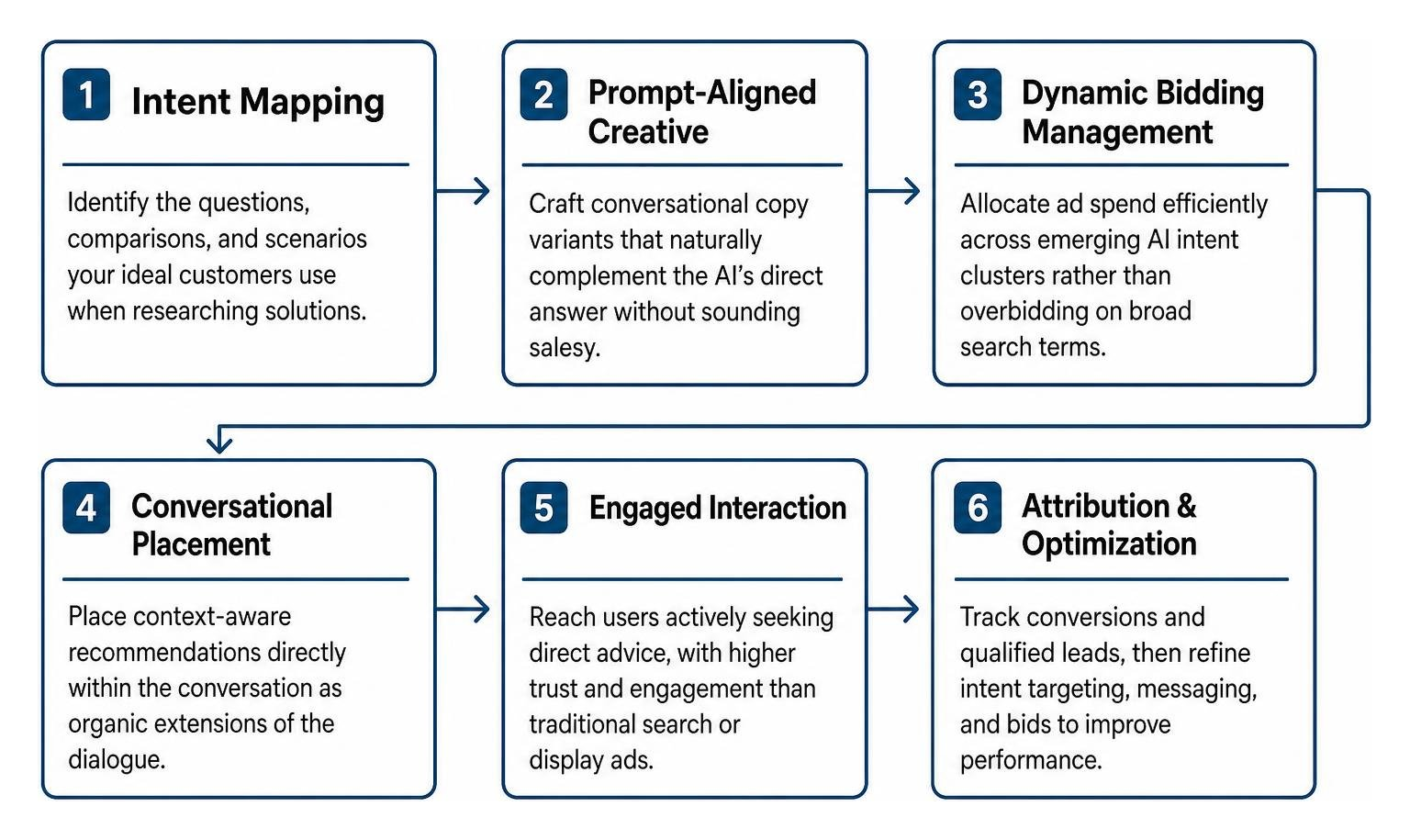
A competent agency manages several technical and strategic capabilities:
- Conversational Intent Mapping: Identifying the precise questions, comparisons, and scenarios your ideal customers use when researching solutions.
- Prompt-Aligned Creative Engineering: Crafting conversational copy variants that naturally complement the AI’s direct answer without sounding salesy.
- Dynamic Bidding Management: Allocating ad spend efficiently across emerging AI intent clusters rather than overbidding on broad search terms.
- Security & Privacy Standards: Ensuring all data collection and attribution pipelines comply with strict data privacy guidelines, including SOC 2 and GDPR frameworks.
Why Work with a Specialized ChatGPT Ads Agency?
Conversational queries have subtle semantic nuances that standard search platforms ignore. A user asking “Can you explain how SOC 2 compliance software works for a 50-person startup, and recommend two easy-to-implement tools?” has provided detailed firmographic and intent data. A generalist agency might simply trigger a generic brand ad, whereas a conversational advertising specialist crafts a context-matched recommendation that directly addresses the 50-person startup use case.
Furthermore, running conversational campaigns requires adhering to proven ai search best practices to prevent ad fatigue. If an ad appears too pushy, unhelpful, or disconnected from the conversation, users reject it instantly. Specialized agencies design ad structures that act as natural next steps, guiding prospects into consultative conversion funnels.
Core Deliverables of an Enterprise ChatGPT Ads Agency
When vetting an agency partner to manage your conversational ad campaigns, ensure their scope of work includes these core deliverables:
- Answer Gap Auditing: Analyzing your target market to discover which user prompts are currently unserved by direct competitor recommendations.
- Conversational Copy Development: Producing modular, helpful ad assets tailored for conversational recommendation engines.
- Lead Generation Pipeline Integration: Connecting conversational ad responses directly to high-converting landing pages, booking funnels, or generative ai lead generation systems.
- Continuous Prompt & Variant Testing: Routinely testing how different value propositions, consultative offers, and informational assets perform across diverse prompt variations.
- Multi-Touch Conversational Attribution: Tracking how dialogue-based touchpoints contribute to pipeline generation, closed deals, and overall return on ad spend (ROAS).
Evaluating Campaign Strategy, Creative Optimization, and Attribution
To generate reliable returns from conversational AI advertising, your campaign strategy must align creative messaging with user intent while maintaining accurate attribution tracking.

For a complete framework on optimizing your digital footprint across modern AI channels, read our comprehensive ai search optimization guide 2026.
Creative Optimization for Conversational AI Streams
In a conversational environment, aggressive sales pitches fall flat. Effective ad creative serves as a “helpful next step.” If a prospect is asking the AI for a step-by-step breakdown of how to switch corporate payroll providers, an effective ad does not simply say “Buy Our Payroll Software Today!” Instead, it offers a seamless progression: “Download the 2026 Payroll Migration Checklist and get a custom onboarding quote from our dedicated specialists.”
This consultative, prompt-aligned creative approach produces measurable performance benefits:
- Enhanced Brand Recall: Conversational campaigns designed around helpfulness achieve up to 92% brand recall among engaged users.
- Lower Customer Acquisition Costs: Seamlessly answering the user’s implicit question can drive significant CAC reductions compared to cold social feeds.
- Optimized Answer Share: Consistent testing ensures your business secures top share-of-voice across the most profitable conversational query clusters in your vertical.
Measuring Conversational Attribution and Real Business Impact
Tracking conversational advertising success requires moving past basic vanity metrics. High click-through rates (CTR) mean very little if those interactions do not translate into verified pipeline value.
When evaluating campaign performance, your reporting should focus on direct business indicators:
- Cost Per Lead (CPL) and Cost Per Acquisition (CPA): Measuring the exact expenditure required to generate a qualified consultation request, demo booking, or completed transaction.
- Conversion Rate Lift: Tracking how conversational placements improve overall funnel efficiency compared to standard search traffic.
- Impact on Search Visibility: Analyzing how increased conversational brand awareness influences broader discoverability factors covered in our breakdown of ai search ranking factors.
- Closed-Loop Revenue Reporting: Integrating your CRM with the ad platform to attribute finalized customer contracts and revenue directly back to the original conversational prompt cluster.
Budgeting, Market Eligibility, and Industry Fit
Before launching campaigns on conversational platforms, businesses must evaluate their operational readiness, market eligibility, and internal resources.
| Feature / Consideration | In-House Management | Specialized Conversational Agency |
|---|---|---|
| Setup & Account Onboarding | Steep learning curve with new AI platforms | Immediate deployment via proven processes |
| Intent Mapping Expertise | Limited to existing search keyword tools | Advanced intent cluster & prompt modeling |
| Creative Adaptation | Often recycles standard search/social copy | Modular, conversational-first copy development |
| Testing Velocity | Manual, slow prompt variation iterations | Continuous multi-variant prompt experimentation |
| Attribution Setup | Often reliant on basic last-click tracking | Full multi-touch attribution & CRM pipeline integration |
| Resource Efficiency | Requires hiring or retraining dedicated staff | Instant access to seasoned AI ad strategists |
To understand how conversational advertising integrates with broader digital optimization strategies, check out our ai search optimization complete guide.
Pricing Structures, Minimum Ad Spend, and Geographic Constraints
Pricing for conversational advertising typically follows an auction-based model influenced by intent value, competition, and placement relevance. Most agencies utilize transparent management fee structures combined with a percentage of total ad spend.
When planning your deployment, keep these operational parameters in mind:
- Geographic Availability: As of late 2026, ad serving is active primarily for United States businesses targeting domestic traffic, with international rollouts expanding incrementally. Advertisers must hold an active US business entity to participate in initial inventory auctions.
- Testing Budgets: A healthy testing budget allows the ad platform’s delivery algorithms to explore various intent clusters and build statistically significant conversion data.
- Managing Bidding Volatility: Because conversational ad auctions are expanding quickly, proactive bid management is essential to keep CPAs stable as more advertisers enter the marketplace.
Best-Fit Industries for Conversational Ads
While conversational advertising continues to expand across diverse sectors, high-consideration purchases and consultative services see the strongest returns.
Industries experiencing exceptional performance include:
- B2B SaaS and Enterprise Software: Prospective buyers routinely use conversational AI to research integrations, evaluate workflows, and compare complex software architectures.
- Professional, Legal, and Financial Consulting: High-intent users seeking wealth management advice, corporate legal guidance, or tax planning welcome recommendations for established firms.
- High-Value Consumer Services & Home Contracting: Homeowners researching major renovations, solar installations, or specialized repairs frequently rely on conversational AI for cost estimates and local recommendations.
- Higher Education and Professional Certifications: Individuals researching career transitions and advanced degree options actively engage with contextual program suggestions.
Frequently Asked Questions About ChatGPT Advertising
How much do ChatGPT ads cost to launch and maintain?
Conversational advertising costs are auction-driven, operating on dynamic CPM (cost per thousand impressions) and CPC models determined by user intent intensity and vertical competition. Initial testing budgets typically range from a few thousand dollars per month upward, depending on your target industry and market size. Ongoing maintenance costs involve media spend alongside agency management retainers that cover continuous prompt testing, intent mapping, copy updates, and closed-loop attribution reporting.
Can businesses outside the United States advertise on ChatGPT?
The advertising rollout launched first in the United States, requiring a domestic business presence to participate in primary auctions. While global expansion plans are underway to open ad inventory to international markets throughout upcoming phases, non-US brands must currently operate through eligible US entities or focus on broader organic AI discoverability strategies until regional rollouts are completed.
How do conversational AI ads integrate with existing paid search strategies?
Conversational ads serve as a high-intent complement to traditional pay-per-click campaigns, not an outright replacement. While traditional PPC captures direct keyword searches on search engines, conversational advertising captures consultative, research-heavy inquiries that happen inside AI chat interfaces. Aligning both channels allows businesses to synchronize messaging, target unclaimed search intent, and redistribute budgets toward the highest-performing touchpoints across the entire customer journey.
Conclusion: Partnering for Success in the AI Advertising Era
The emergence of conversational advertising represents the most significant shift in digital media since the arrival of mobile search. As millions of consumers and business professionals replace traditional search engines with conversational dialogue, capturing high-intent discovery moments within the answer stream becomes essential for sustainable growth.
At BullsEye Internet Marketing, we have helped businesses scale visibility, phone calls, and revenue across the United States for over two decades. Whether managing high-return PPC pay-per-click management campaigns, optimizing local map presence, or navigating the new frontier of AI search, we believe in real business results over vanity metrics.
Our unique approach provides two critical competitive advantages:
- No Long-Term Contracts: We earn your business every month through transparent reporting, active optimization, and measurable returns.
- Market Exclusivity: We strictly work with only one client per industry per geographic area, ensuring our strategic focus is dedicated entirely to your market dominance.
The conversational search landscape is moving quickly. Contact BullsEye Internet Marketing today to audit your current search presence, identify your conversational intent opportunities, and secure an early advantage in your industry.
