
Why AI Search Engine Marketing Matters for Your Brand
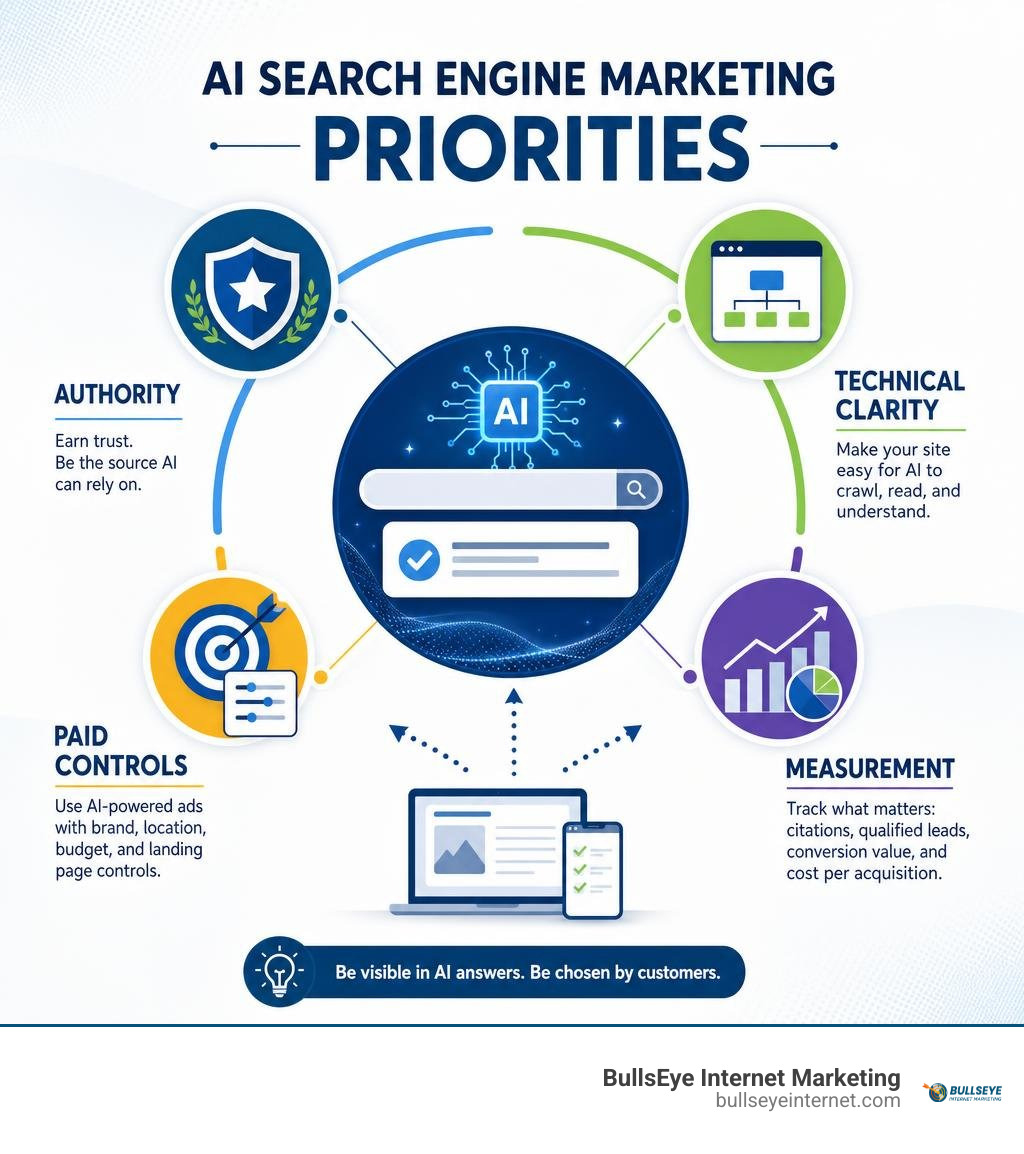
AI Search Engine Marketing helps your brand appear when people ask AI tools and search engines for answers, comparisons, recommendations, and products. It combines proven SEO and paid-search work with generative engine optimization (GEO), so your content is easier for AI systems to understand, trust, cite, and connect to the right customer need.
For most businesses, the practical priorities are simple:
- Publish original, expert-led pages that answer real customer questions clearly.
- Make your website easy to crawl with clean structure, semantic HTML, accurate business data, and useful product or service details.
- Test AI-powered paid campaigns carefully, while using brand, location, budget, and landing-page controls.
- Track more than rankings and clicks, including AI citations, qualified leads, conversion value, and cost per acquisition.
Search is becoming more conversational. Instead of typing a short phrase, a buyer may ask for a specific solution, budget, location, and deadline in one prompt. AI answers can satisfy that need without a website visit, too. One February 2026 study found that results with Google’s AI Overviews were associated with a 58% lower average clickthrough rate. That makes visibility, authority, and conversion readiness more important than traffic volume alone.
I’m Ronnie Katz, founder and Principal CEO of BullsEye Internet Marketing. With more than 20 years in online marketing, I help businesses use AI Search Engine Marketing, SEO, paid search, local visibility, AEO, and GEO to generate measurable calls, leads, and sales.
Easy AI Search Engine Marketing glossary:
The Evolution of Search: Understanding AI Search Engine Marketing in 2026
The search industry has crossed a major threshold. Every single minute, Google processes roughly 5.9 million searches. That adds up to 354 million queries per hour, 8.5 billion per day, and a staggering 3 trillion searches every year. Yet the way people find information has permanently fractured. In 2024, Google’s global search market share dipped below 90% for the first time in nearly a decade, and it has stayed there ever since. By the end of Q4 2025, conversational tools like ChatGPT commanded an estimated 17% of digital query volume compared to traditional search at 78%.
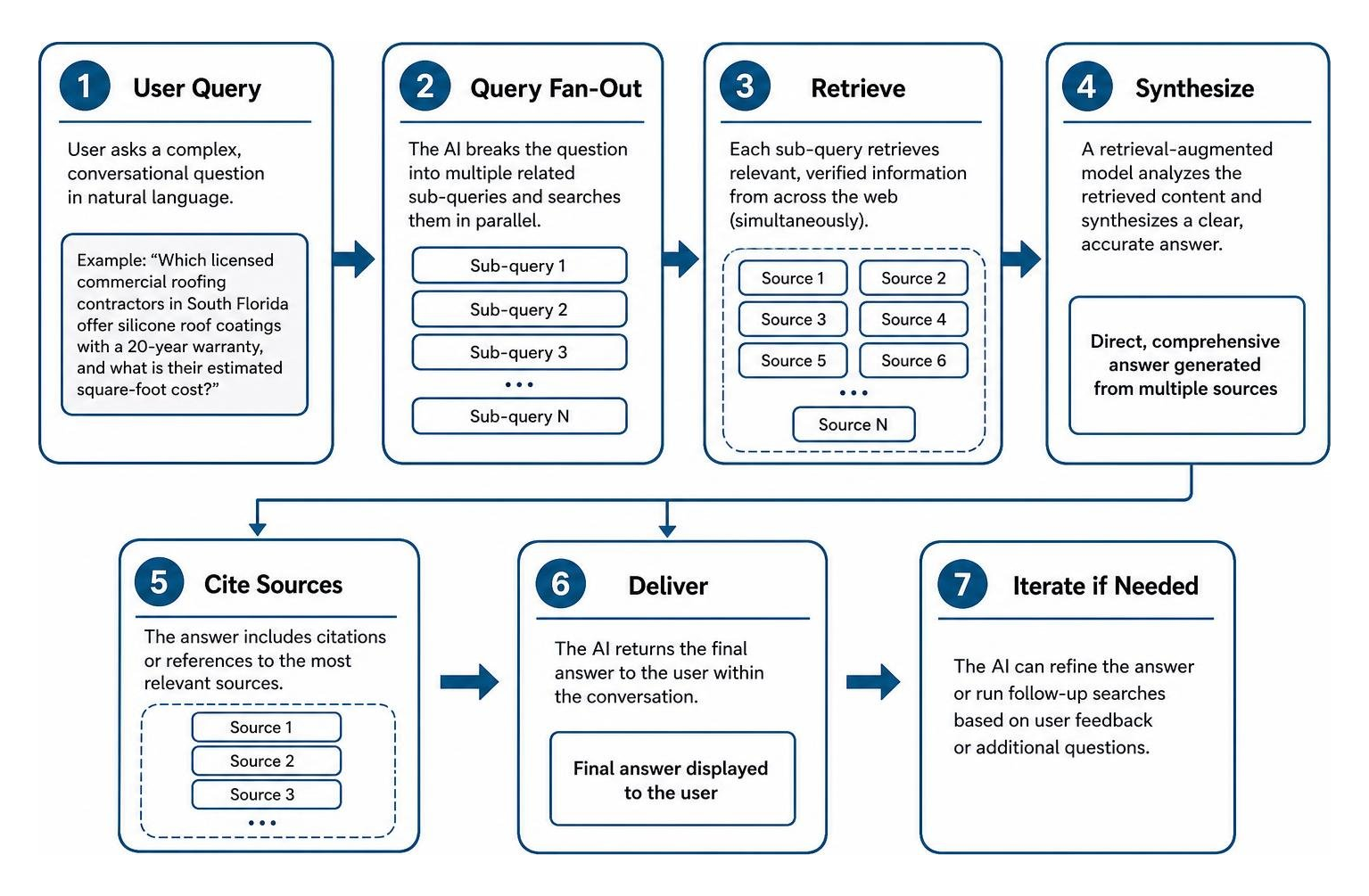
This transformation is driven by advanced neural architectures using Retrieval-Augmented Generation (RAG) and query fan-out mechanisms. When a user submits an inquiry, the search system does not just match keywords against a static index. Instead, RAG models retrieve relevant, verified documents across the web and synthesize custom, direct answers. Simultaneously, query fan-out allows the underlying artificial intelligence to break a complex prompt into multiple parallel sub-queries, gathering comprehensive context across hundreds of sources in milliseconds.
As highlighted by McKinsey insights on the new front door to search, conversational search environments are replacing standard navigation patterns. Winning in this space requires modern businesses to execute next-generation SEO strategies that emphasize semantic relevance, structured clarity, and verifiable authority.
How Conversational Search and Zero-Click Queries Reshape AI Search Engine Marketing
Search queries are longer and more nuanced than ever before. In the United States alone, the average query length expanded by 14% between Q1 and Q2 this year. Users no longer type disjointed keywords like “Miami commercial roofer pricing”; instead, they ask complex natural-language prompts like, “Which licensed commercial roofing contractors in South Florida offer silicone roof coatings with a 20-year warranty, and what is their estimated square-foot cost?”

This conversational evolution directly accelerates zero-click behavior. When search engines generate synthesized answers at the top of the screen via AI Overviews, users often get everything they need without clicking through to an external site. An April 2025 study found that search results containing an AI Overview were associated with a 34.5% lower average click-through rate (CTR), and by February 2026, follow-up industry research showed that gap widening to a 58% reduction.
To thrive despite shrinking raw click volume, brands must understand the underlying mechanics of what is AEO (Answer Engine Optimization). When your business is cited as the primary source inside the synthesized answer, the traffic that does click through carries exceptionally high purchase intent.
Autonomous Search Agents and the Rise of the Agentic Web
We are now moving rapidly from conversational interfaces to autonomous execution. Agentic AI refers to intelligent systems that do not merely retrieve facts; they complete multi-step tasks across the web on behalf of users. An agent can research business options, compare localized pricing, read real customer reviews, and complete a multi-stage transaction without the user manually loading a single webpage.
Preparing your digital infrastructure for autonomous search bots requires machine readability. You must structure your online presence so that AI agents can effortlessly parse your service offerings, operating locations, and pricing rules. For a detailed breakdown of these foundational technical structures, explore A Comprehensive Guide to AI Visibility SEO LLM Optimization Strategies.
Core Differences Between Traditional SEM and Generative Engine Optimization
Traditional Search Engine Marketing (SEM) focuses heavily on capturing keyword volume, matching bid terms, and earning high placements on standard 10-blue-link Search Engine Result Pages (SERPs). Generative Engine Optimization (GEO) flips the focus from page rank to model presence, citation frequency, and algorithmic synthesis.
| Strategic Dimension | Traditional Search Engine Marketing (SEM) | Generative Engine Optimization (GEO) |
|---|---|---|
| Primary Objective | Rank high on standard SERPs and win direct website clicks | Earn citations and high visibility within AI-synthesized responses |
| Targeting Focus | Fixed, exact, phrase, or broad-match keywords | Natural-language entities, semantic relationships, and conversational context |
| User Interaction | Fragmented, keyword-based search queries | Multi-turn conversational prompts, follow-up questions, and voice interactions |
| Content Evaluation | Keyword density, on-page tags, and backlink counts | Demonstrable E-E-A-T, factual verification, and third-party consensus |
| Success Metrics | Impressions, Click-Through Rate (CTR), and Average Position | Answer share of voice, citation frequency, and post-synthesis conversions |
Adapting to this model means moving beyond simple keyword placement to implement advanced generative SEO techniques that satisfy RAG systems.
Paid Search Automation: From Dynamic Search Ads to AI Max Campaigns
Paid advertising is undergoing an identical shift. The industry is bidding farewell to legacy campaign setups as Google upgrades Dynamic Search Ads to AI Max. AI Max is a real-time optimization layer that bridges broad-intent search term matching, automatic creative text customization, and dynamic final URL expansion.
Advertisers utilizing the complete AI Max suite—combining search term matching, text customization, and URL expansion—capture an average of 7% more conversions or conversion value at a similar CPA/ROAS compared to search term matching alone. Early testing also shows that campaigns with AI Max enabled achieve at least an 8% lift in total conversions compared to manual campaign controls. Mastering these algorithmic features is central to running modern paid search management in 2026.
Conversational Ad Formats in AI Mode and Copilot Ecosystems
Artificial intelligence is also transforming how paid placements are displayed within conversational chat tabs. In ecosystems like Microsoft Copilot and Google Gemini AI Mode, search engines pull assets dynamically to match user prompts. In fact, ads embedded directly within Copilot experiences generate a 101% higher engagement rate compared to traditional search ads, and user journeys within Copilot yield a 53% increase in completed purchases within 30 minutes of interaction.
In Google’s AI Mode, the platform remixes Responsive Search Ad (RSA) assets on the fly. Rather than serving a static headline, the engine acts like a dynamic DJ, pulling modular prices, current-year freshness references (such as 2026), and specific product attributes into bespoke combinations tailored to the conversational context. To leverage these opportunities, explore the full documentation on how AI Max for Search campaigns works in Google Ads Help and the Microsoft Advertising AI Max guide.
Strategic Content and Technical Optimization for AI Answer Engines
To earn valuable citations in AI-generated answers, websites must provide non-commodity, original value that machine learning algorithms can easily verify.

- Establish Non-Commodity Entity Authority: Generative engines easily summarize basic, repetitive web copy. To stand out, provide unique business data, proprietary case studies, first-hand reviews, and distinct professional viewpoints that reflect true Experience, Expertise, Authoritativeness, and Trustworthiness (E-E-A-T).
- Implement Structured Schema Architecture: Clear semantic HTML, robust FAQ schemas, Organization markups, and local business data provide direct hooks for RAG engines to ingest your content without ambiguity.
- Cultivate Third-Party Citation Consensus: AI answer engines look across the broader web to verify facts. Consistent company name, address, phone number (NAP) data, active directory listings, and genuine reviews across verified platforms build the digital consensus necessary for top-tier visibility.
For businesses seeking hands-on strategic implementation, our team delivers customized generative engine optimization services to build and execute these authority-driven frameworks.
Balancing Paid Automation and AI Search Engine Marketing Workflows
While AI-powered campaign tools offer incredible scale, total reliance on automation without human supervision is dangerous. Today, 95% of marketing professionals use generative or agentic AI monthly, and 33% rely on it daily. However, 100% of surveyed marketers acknowledge that generative AI introduces brand safety and misinformation risks.
Automated headline generators can occasionally misunderstand nuanced service offerings or invent claims. You must protect your brand by creating strict negative keyword lists, defining brand-exclusion parameters, and auditing dynamically remixed copy to ensure compliance and local accuracy. Integrating automated bidding with rigorous human management is key to providing comprehensive search engine marketing solutions.
Tracking Generative Visibility, Citations, and Answer Share
You cannot optimize what you do not measure. Evaluating your performance in 2026 requires looking beyond classic keyword positions:
- Generative AI Performance Reports: Monitor the dedicated AI reporting tabs inside Google Search Console to track impression volume and click engagement from AI Overviews and AI Mode.
- Citation Frequency & Brand Mentions: Track how often your brand is cited as an authoritative source in answers across ChatGPT, Perplexity, and Copilot.
- Answer Share of Voice (SOV): Measure your presence within synthesized answers for commercial and local prompts across your target service areas.
- Downstream Lead Quality: Evaluate conversion rates and lead-to-close metrics from AI-referred visits, which frequently close faster due to high pre-qualification during conversational search.
For deeper insights on how algorithmic systems score content, review our analysis of AI search ranking factors and measurement.
How to Evaluate and Select the Best GEO and AI Search Partner
Selecting an agency partner in this new landscape requires careful evaluation. Many service providers struggle to keep pace with these shifts: an April 2025 study revealed that 68% of marketing professionals had received no formal AI training from their organizations, and 62% identified a lack of education and training as their biggest barrier to adopting AI effectively.
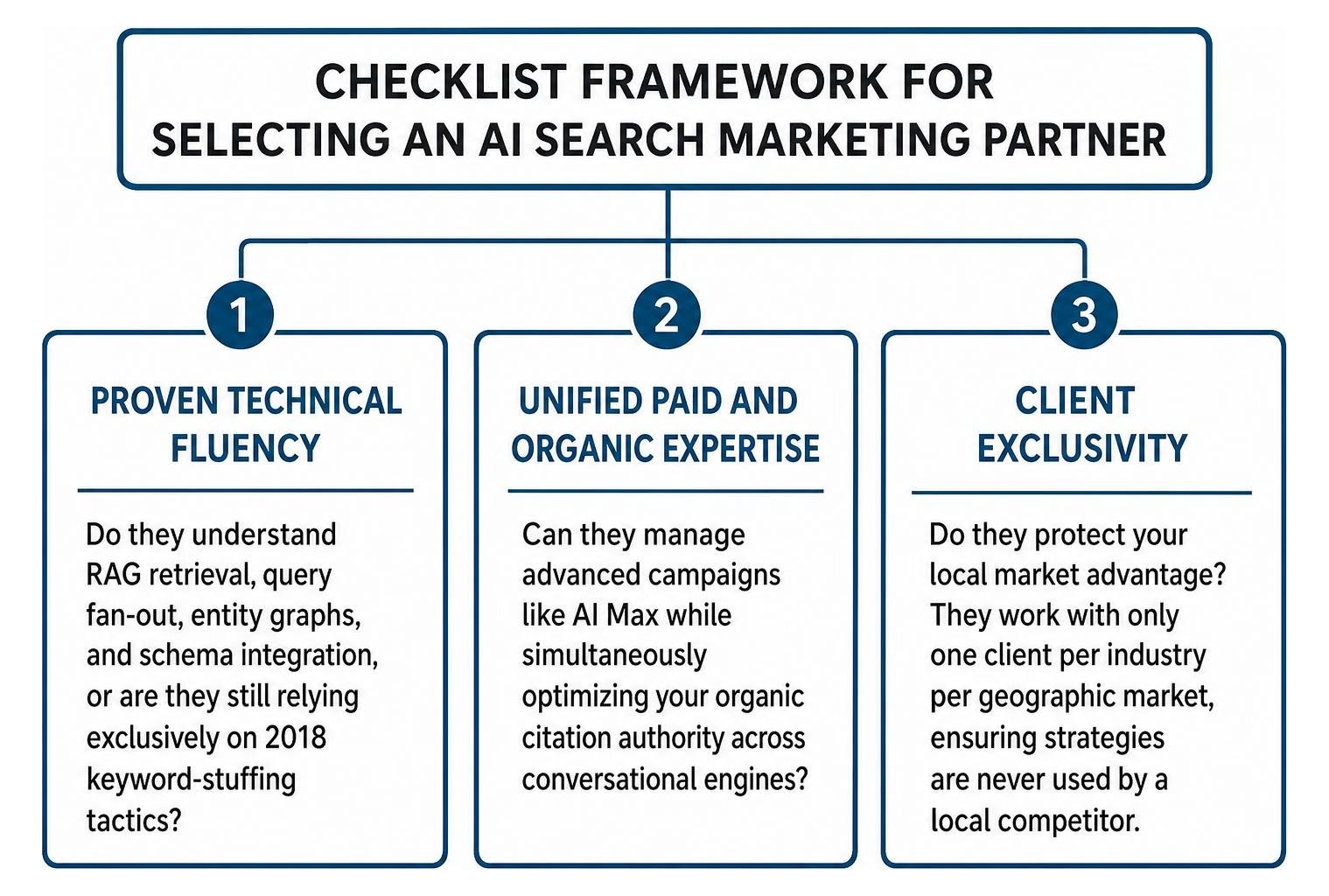
When vetting a partner, use this evaluation checklist:
- Proven Technical Fluency: Do they understand RAG retrieval, query fan-out, entity graphs, and schema integration, or are they still relying exclusively on 2018 keyword-stuffing tactics?
- Unified Paid and Organic Expertise: Can they manage advanced campaigns like AI Max while simultaneously optimizing your organic citation authority across conversational engines?
- Client Exclusivity: Do they protect your local market advantage? At BullsEye Internet Marketing, we work with only one client per industry per geographic market, guaranteeing that our proprietary strategies are never used against you by a local competitor.
- No Long-Term Contracts: Transparent agencies earn your business every month based on performance, lead volume, and clear return on investment.
To learn more about vetting qualified providers, read our comprehensive AI search marketing agency selection guide.
Frequently Asked Questions About AI Search Engine Marketing
What is the difference between traditional SEO and Generative Engine Optimization?
Traditional SEO focuses on earning high organic placements on standard search result pages to capture website visits. Generative Engine Optimization (GEO) focuses on optimizing content so AI engines (like Google Gemini, ChatGPT, and Perplexity) select and cite your business within synthesized answers, driving highly qualified leads even in zero-click environments.
How do AI Overviews impact organic website traffic and click-through rates?
AI Overviews provide synthesized answers at the top of the search results, reducing overall organic click-through rates by 34.5% to 58% on informational queries. However, users who click through after reading an AI answer exhibit substantially higher purchase intent, making citation visibility essential for capturing ready-to-buy customers.
What technical website changes are needed to support autonomous AI agents?
To ensure autonomous AI search agents can read and navigate your site, maintain semantic HTML structures, install schema markup (such as LocalBusiness, Product, and FAQ), provide clear API access where appropriate, and keep technical documentation updated to ensure seamless machine readability.
Conclusion: Future-Proofing Your Search Visibility in the Generative Era
The rise of generative AI search engines, conversational prompts, and automated search agents has reshaped the online marketing landscape. Businesses that rely strictly on outdated keyword tactics risk becoming invisible as zero-click queries and synthesized AI answers expand.
At BullsEye Internet Marketing, we deliver full-funnel search strategies that combine high-intent Pay Per Lead models, advanced Google Business Profile optimization, cutting-edge SEO, conversion optimization, and AI Max campaign management. We operate with a strict market exclusivity policy—partnering with only one client per industry per geographic area across Florida and all 50 U.S. states—backed by a no long-term contract commitment.
Are you ready to secure your brand’s presence across modern conversational engines? Take the next step and partner with an expert in answer engine optimization and LLM SEO today.
