
Why Google Ads for Businesses Is One of the Smartest Growth Moves You Can Make
Google Ads for businesses is an online advertising platform that lets you show your ads to people who are actively searching for what you sell — right at the moment they’re ready to buy.
Here’s a quick look at what it offers:
| What It Does | Why It Matters |
|---|---|
| Shows ads on Google Search, YouTube, Maps, and more | Massive reach across channels your customers already use |
| Charges you only when someone clicks | You pay for real interest, not just exposure |
| Lets you set and adjust your own budget | Full control, no surprise costs |
| Uses AI to find high-intent buyers | Smarter targeting without extra work |
| Tracks conversions and ROI in real time | You know exactly what’s working |
Google processes over 8.5 billion searches every day. That’s 8.5 billion moments where someone is looking for a product, a service, or a solution. The businesses that show up in those moments win customers. The ones that don’t, lose them to competitors.
Yet many business owners try Google Ads, burn through their budget, and walk away convinced it doesn’t work. It does work — but only when it’s set up and managed the right way.
This guide will walk you through exactly how to make Google Ads work for your business — from choosing the right campaign type to measuring real ROI.
I’m Ronnie Katz, founder and Principal CEO of BullsEye Internet Marketing, and I’ve spent over 20 years helping businesses grow online, including managing Google Ads for businesses across dozens of competitive industries since 2006. In this guide, I’ll share what actually moves the needle — no jargon, no fluff.
Basic Google Ads for businesses terms:
Understanding Google Ads for Businesses: How the Platform Works
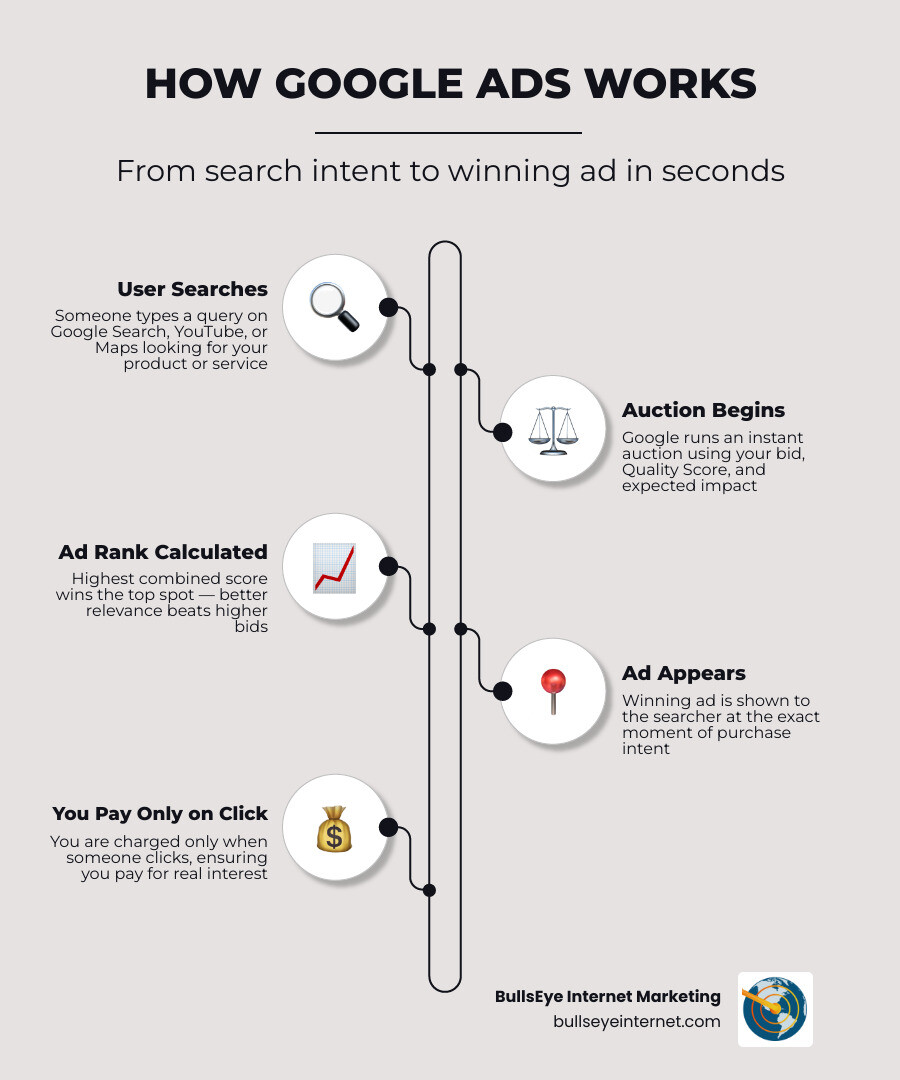
To make Google Ads for businesses truly profitable, we first need to pull back the curtain on how the system decides which ads to show. It isn’t just about who has the biggest wallet; it’s about who provides the best answer to the user’s question.
Google operates primarily through two massive networks:
- The Search Network: These are the text ads you see at the top of Google search results. This is high-intent territory. If someone searches for “plumber in Fort Lauderdale,” they have a problem that needs fixing now.
- The Display Network: This includes millions of websites, apps, and videos (like YouTube) where your visual ads can appear. This is great for building awareness and staying top-of-mind.
Every time a search happens, an Ad Auction occurs in milliseconds. Google looks at your bid (the maximum you’re willing to pay for a click) and your Quality Score. Your Quality Score is a rating of the quality and relevance of both your keywords and your ads.
The combination of your bid and Quality Score determines your Ad Rank. This is why a small business with a smaller budget but highly relevant ads can often outrank a huge corporation with sloppy campaigns. For a deeper dive into these mechanics, check out this Detailed Guide to Google AdWords Advertising Basics. If you are ready to jump in, you can also learn How to Set Up and Run your First Google Ads Campaign – Google Ads.
The Role of AI and Machine Learning
By May 2026, AI has become the heartbeat of Google Ads for businesses. Google uses machine learning to analyze billions of “real-time signals”—things like the user’s location, the time of day, the device they are using, and their previous browsing behavior—to predict buyer intent.
The most prominent example of this is Performance Max. This campaign type uses AI to automatically find your best-performing ad combinations and show them across Search, YouTube, Display, Discover, and Maps. It’s designed to multiply your results by putting the right message in front of the right person at the exact moment they are most likely to convert. We specialize in helping you know about Google Ads management for high intent audiences so you can leverage these AI tools effectively.
Key Benefits and Potential Drawbacks
Is Google Ads for businesses right for everyone? Let’s look at the trade-offs.
The Benefits:
- Immediate Traffic: Unlike SEO, which can take months to build, Google Ads can start sending qualified leads to your website the same day you launch.
- Massive Reach: You can reach customers across the entire Google ecosystem.
- Cost Control: You set a daily budget and can pause or adjust it at any time. Statistics show that businesses make an average of $8 in revenue for every $1 spent on Google Ads.
The Drawbacks:
- Learning Curve: The platform is incredibly powerful but complex. It’s easy to waste money if you don’t know what you’re doing.
- Competition: In popular industries (like legal or home services in South Florida), the cost-per-click can be high.
- Constant Monitoring: It is not a “set it and forget it” system. It requires regular optimization to stay profitable.
If you’re wondering if it’s worth the effort, we have a guide on Does Google Ads Really Work? Your Guide to Marketing with Google that breaks down the reality for different business types.
Choosing the Right Campaign Types for Your Goals
One of the first decisions we help our clients make is choosing the right campaign type. Your choice should align perfectly with your business goals.
- Search Ads: The gold standard for lead generation. Perfect for capturing “high-intent” users looking for specific services.
- Shopping Ads: Essential for e-commerce. These show a photo of your product, the price, and your store name directly in the search results.
- Video Ads: Run on YouTube to build brand awareness or drive action with engaging storytelling.
- App Promotion: Designed specifically to get more people to download and use your mobile app.
To see the full menu of options, you can explore What Types of Ads Are Available on Google? or view Google’s official list of Campaigns for every business goal.
Maximizing Reach with Google Ads for Businesses
For local businesses in areas like West Palm Beach, Boca Raton, or Miami, reach isn’t just about numbers; it’s about proximity.
Google Maps ads are a game-changer for local shops and restaurants. When someone searches for “Italian restaurant near me,” appearing at the top of the map pack is incredibly valuable.
For service-based businesses like plumbers, electricians, or HVAC techs, Local Services Ads (LSAs) are a must. These ads appear at the very top of Google and come with a “Google Guaranteed” badge, which builds instant trust. We’ve seen massive success using Google Ads for Contractors to turn local searches into high-quality phone calls.
Performance Max and Multi-Channel Integration
As mentioned earlier, Performance Max is Google’s “all-in-one” solution. Instead of managing separate campaigns for Search and Display, you provide Google with “asset groups”—headlines, descriptions, images, and videos.
The AI then mixes and matches these assets to find the winning combination for each individual user across all Google platforms. It uses automated bidding to ensure you are getting the most conversions for your budget. You can learn more about how to Reach Customers Across YouTube & Search – Google Ads using this unified approach.
Strategic Setup: Budgeting, Bidding, and Targeting
Getting the technical setup right is the difference between a campaign that prints money and one that just drains your bank account.
Bidding Strategies Comparison
| Strategy | Full Name | Best For… |
|---|---|---|
| CPC | Cost-Per-Click | Driving traffic to your website |
| CPM | Cost-Per-Thousand Impressions | Brand awareness and visibility |
| CPA | Cost-Per-Acquisition | Maximizing conversions at a specific cost goal |
| ROAS | Return on Ad Spend | E-commerce businesses focused on profit margins |
Keyword Research and Match Types
Keywords are the bridge between what a customer wants and what you offer. We use tools like Google Keyword Planner to find the terms your customers actually use. But it’s not just about the keywords; it’s about the match types:
- Broad Match: Reaches the most people but can be less relevant.
- Phrase Match: Reaches people searching for your keyword and its close variations.
- Exact Match: The most restrictive and targeted, showing ads only when the search matches your keyword exactly.
Equally important are Negative Keywords. These are terms you don’t want to show up for. For example, if you are a luxury car dealer, you might add “used” or “cheap” as negative keywords to avoid wasting money on clicks from people who aren’t your target audience. For a full breakdown of these strategies, see our Google Ads Complete Guide.
Optimizing ROI in Google Ads for Businesses
How do you know if your ads are working? You have to track everything. Conversion tracking allows us to see exactly which keyword and which ad led to a phone call, a form submission, or a sale.
We also look closely at:
- CTR (Click-Through Rate): The percentage of people who see your ad and click it. A high CTR usually means your ad is highly relevant.
- ROAS (Return on Ad Spend): The total revenue generated divided by the total ad spend.
- Ad Extensions: These are additional snippets of information like your phone number, location, or links to specific pages on your site. They make your ad bigger and more useful. Read about the impact of ad extensions on paid search performance to see why they are non-negotiable.
Advanced Targeting and Audience Insights
Google allows us to get incredibly specific with who sees your ads. We can target by demographics (age, gender, household income) or location (targeting specific zip codes in Broward or Miami-Dade County).
One of the most powerful tools is Remarketing. Have you ever visited a website and then seen ads for that business everywhere you go for the next week? That’s remarketing. it allows you to stay in front of people who have already shown interest in your business but haven’t converted yet. You can find more about Targeting the Right Audience for Business Growth on our main PPC page.
Avoiding Common Pitfalls and Measuring Success

Even with the best intentions, it’s easy to make mistakes. One of the biggest is ad spend waste. This often happens when businesses use “Smart Campaigns” without enough oversight, leading to ads showing up for irrelevant searches.
Another common pitfall is ignoring landing page relevance. If your ad promises “24/7 Emergency Plumbing” but your website takes them to a generic homepage that doesn’t mention emergency services, the user will leave immediately. Google will also penalize you with a lower Quality Score.
To stay ahead, we rely on:
- A/B Testing: Constantly testing two different versions of an ad to see which one performs better.
- Google Analytics 4 (GA4): Integrating your ads with GA4 gives you a “full-funnel” view of how users behave after they click.
Before you start, make sure you read What Every Business Owner Should Know Before Running a Google Ads Campaign.
Best Practices for Ad Copy and Creative
Your ad copy needs to be persuasive and clear. Google has strict character limits (30 characters for headlines, 90 for descriptions), so every word counts.
- Use a strong CTA (Call to Action): Tell them exactly what to do next. “Call Now,” “Get a Free Quote,” or “Shop the Sale.”
- Highlight your USP: Why should they choose you over the three other ads on the page? Do you have 5-star reviews? Do you offer a 100% satisfaction guarantee?
- Be relevant: Ensure your headline matches the keyword the user searched for.
For inspiration, Google often shares 50 states, 50 stories, highlighting how small businesses across the country use creative advertising to win big.
Comparing Google Ads to Other Marketing Channels
Many of our clients ask: “Should I do Google Ads or Facebook Ads?”
The answer is usually “both,” but they serve different purposes.
- Google Ads is about Search Intent. You are reaching people who are actively looking for a solution.
- Facebook Ads is about Passive Browsing. You are reaching people based on their interests and demographics while they are scrolling through their feed.
Think of it this way: Google is the “Yellow Pages” (where people go when they need something), and Facebook is the “Billboard on the highway” (where people see things they might be interested in). Combining them creates a powerful full-funnel digital strategy.
Frequently Asked Questions about Google Ads
What is a good conversion rate for Google Ads?
The average conversion rate across all industries is roughly 3.75% on the search network. However, this varies wildly by industry. For high-urgency services like plumbing or locksmiths, we often see much higher rates. You can see more specific data in our Google Ads for Plumbers Complete Guide.
How much should a small business spend on Google Ads?
There is no one-size-fits-all answer, but a common starting point is a daily budget calculated as: (Monthly Budget / 30.4). For most small businesses in South Florida, we recommend a starting budget that allows for at least 10-20 clicks per day so the AI has enough data to learn. You can learn more about Strategic Budgeting for Google Ads Success on our services page.
How can businesses measure the ROI of their campaigns?
ROI is measured by setting up conversion tracking for every valuable action: phone calls, form fills, and actual sales. By comparing the cost of those leads to the revenue they generate, you get your true Return on Ad Spend.
Google Ads Growth Strategies by BullsEye Internet Marketing
Google Ads for businesses is arguably the most powerful tool ever created for small business growth. It levels the playing field, allowing local businesses in Miami, Fort Lauderdale, and West Palm Beach to compete with national brands by being smarter and more relevant.
At BullsEye Internet Marketing, we do things differently. We don’t believe in locking you into long-term contracts; we believe in earning your business every single month through results. We also offer a unique competitive advantage: we only work with one client per industry per geographic area. If we’re working with you, we aren’t working with your competitor down the street.
Whether you need help with Google Ads, SEO, or a complete Pay Per Lead strategy, we are here to help you turn those clicks into loyal customers.
Ready to see what Google Ads can do for your business? Let’s talk.
