
Why Traditional Lead Generation is Failing You (And What’s Replacing It)
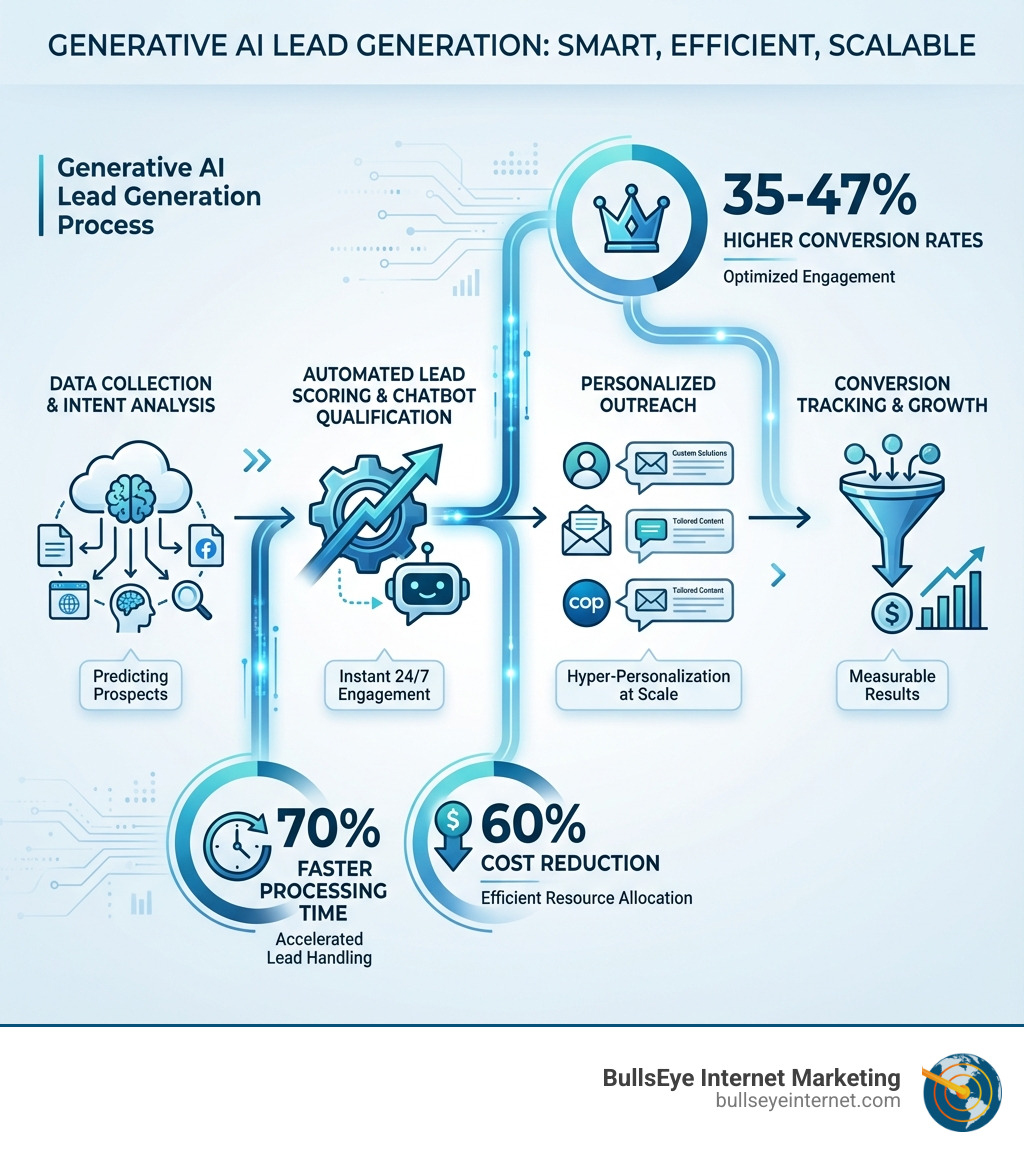
Generative AI lead generation is changing how businesses find and convert customers by using artificial intelligence to automate prospecting, personalize outreach, and qualify leads with unprecedented speed and accuracy. Here’s what you need to know:
Key Benefits:
- Higher conversion rates – Companies report 35-47% improvement in conversion rates
- Dramatic cost reduction – Up to 60% lower lead generation costs
- Real-time engagement – AI chatbots and SDRs respond instantly, 24/7
- Better lead quality – Predictive scoring identifies your best prospects automatically
- Massive efficiency gains – AI reduces lead processing time by 70%
Core Strategies:
- Automated lead scoring using predictive intelligence
- Intent data activation to identify buying signals
- AI chatbots and SDRs for instant qualification
- Hyper-personalized outreach at scale
- AI-powered content creation for nurturing campaigns
If you’re frustrated by skyrocketing acquisition costs and plummeting conversion rates, you’re not alone. Traditional lead generation is broken.
The numbers tell a stark story: 65% of organizations now use generative AI in their operations, and businesses leveraging AI for lead generation get twice as many leads compared to those using traditional methods. Meanwhile, companies that reach out to a lead within one hour are 7 times more likely to qualify that lead. Wait 24 hours? Your chances drop by 98%.
The digital landscape has fundamentally changed. Buyers do more research independently, bounce between channels, and expect instant, personalized responses. Cold calling and generic email blasts hit diminishing returns while your competitors adopt AI systems that work around the clock.
Here’s what’s different now: AI doesn’t just automate tasks—it makes your entire lead generation process smarter. It analyzes massive datasets to predict which prospects will convert. It personalizes outreach at scale. It qualifies leads in real-time. And it does this while cutting your costs by up to 60%.
This isn’t about replacing your sales team. It’s about giving them superpowers.
The gap between companies using AI and those stuck with manual processes is widening fast. Data-driven B2B businesses deploying generative AI are 1.7 times more likely to increase market share. Two-thirds of executives using AI report advantages over their peers in brand value, customer loyalty, and profitability.
I’m Ronnie Katz, founder and Principal CEO of BullsEye Internet Marketing, and I’ve been helping businesses leverage cutting-edge online marketing techniques since 2006. Over the past two decades, I’ve watched countless marketing revolutions, but Generative AI lead generation represents the most significant shift in how businesses can actually get their phones ringing with qualified prospects.
The Paradigm Shift: Why AI is Revolutionizing Lead Generation
Traditional lead generation, with its manual processes and broad outreach, simply can’t keep up with today’s digital environment. Buyers are more informed and expect immediate, relevant interactions. This is where Generative AI lead generation truly shines, offering a transformative approach that redefines efficiency and effectiveness.
Let’s look at how AI stacks up against traditional methods:
| Feature | Traditional Lead Generation | AI-Driven Lead Generation |
|---|---|---|
| Processes | Manual, labor-intensive | Automated, streamlined, data-driven |
| Outreach | Broad, generic | Hyper-targeted, personalized, contextual |
| Engagement Speed | Slow, delayed responses | Real-time, instant engagement, 24/7 availability |
| Cost Efficiency | High cost per lead | Significantly reduced costs (up to 60% lower), optimized resource allocation |
| Data Utilization | Limited, reactive | Predictive analytics, comprehensive data analysis, proactive insights |
What is Generative AI Lead Generation and Why is it Crucial Now?
Generative AI lead generation refers to the application of artificial intelligence models capable of generating new content, insights, or interactions to identify, attract, and convert potential customers. Unlike traditional AI that primarily analyzes existing data, generative AI can create. This means it can write personalized emails, design ad copy, generate sales scripts, and even simulate human conversations.
Why is this crucial now, especially for businesses across the U.S., including our vibrant markets in Florida? Well, the market pressure is immense. Traditional tactics like cold calling and broad email blasts are yielding diminishing returns. As we’ve seen, 61% of marketers find lead generation the most difficult part of their job. The urgency stems from the “short life of online sales leads.” According to Harvard Business Review, companies that reach out to a lead within one hour of their initial inquiry are nearly 7 times more likely to qualify the lead. If you wait just one additional hour, that likelihood drops dramatically. Delay by 24 hours or more, and the chance of qualifying the lead drops by over 98%. This speed-to-lead is a critical factor AI can address.
By embracing generative AI, we can achieve increased lead quality and higher conversion rates. Businesses using AI for lead generation get twice as many leads compared to traditional methods, and companies using AI for lead qualification have seen conversion rates improve by up to 47%. This is why understanding and implementing solutions for More info about AI is no longer optional, it’s essential for staying competitive.
The Core Benefits of Integrating AI into Your Strategy
Integrating AI into our lead generation strategy isn’t just about buzzwords; it’s about tangible improvements that impact our bottom line.

Here are the core benefits we can expect:
- Improved Efficiency: AI can reduce lead processing time by 70% while improving accuracy. It automates repetitive tasks like data entry, CRM updates, and initial lead qualification, freeing up our sales and marketing teams to focus on strategy and building relationships. This means less time spent on mundane tasks and more on closing deals.
- Improved Lead Quality: AI lead scoring models can increase leads by up to 50% and help us target promising leads, cutting lead generation costs by up to 60%. Sales teams using AI report improved lead prioritization 98% of the time, ensuring we focus our efforts on prospects most likely to convert. AI helps identify high-potential leads by analyzing various data sources, including online activity, demographic information, and buying behavior.
- Hyper-Personalization at Scale: Generative AI enables us to craft highly personalized messages, content, and outreach strategies for each prospect. This level of personalization, custom to individual needs and preferences, drives engagement. Organizations that use AI personalization achieve five to eight times the return on marketing spend.
- Scalability Without Complexity: Imagine being able to handle a massive influx of leads without hiring more staff. AI empowers us to scale our outreach and qualification efforts, ensuring no lead falls through the cracks, even during peak demand. This capability is particularly valuable for businesses looking to expand their reach across Florida and beyond.
- Cost Reduction: By targeting more promising leads and automating expensive, time-consuming tasks, AI can cut lead generation costs by up to 60%. This efficiency directly translates to a healthier budget and better ROI.
- Increased Market Share: Data-driven B2B businesses deploying generative AI are 1.7 times more likely to increase market share than those who don’t. This isn’t just about doing more business; it’s about strategically outmaneuvering the competition.
- Better Customer Need Anticipation: Companies using AI are 4 times more likely to anticipate customer needs better than their peers. This foresight allows us to be proactive, offering solutions before customers even realize they need them, fostering stronger, longer-lasting relationships.
The Core Strategies for Generative AI Lead Generation
Now that we understand the “why,” let’s dive into the “how.” Generative AI lead generation isn’t a single tool but a suite of integrated strategies designed to revolutionize our approach.

Automated Lead Scoring and Intent Data Activation
One of the most powerful applications of generative AI is its ability to refine our understanding of leads.
- Predictive Intelligence and Prioritization: AI-powered lead scoring analyzes vast amounts of customer data to predict which prospects are most likely to convert. This eliminates guesswork, allowing us to prioritize high-value prospects. Companies using AI lead scoring report 35% higher conversion rates on average and see up to 60% lower processing costs per lead. This means our sales teams can focus their precious time on the most promising opportunities, instead of chasing cold leads.
- Analyzing Online Activity and Identifying Buying Signals: AI can analyze various data sources—website visits, content downloads, social media interactions, and more—to identify explicit and implicit buying signals. This is intent data activation in action. For example, if a prospect in Miami-Dade County is repeatedly visiting our “Pay Per Lead” service page, AI can flag them as high intent. According to Gartner, AI lead-scoring models can reduce the time spent on lead qualification by up to 30%. This allows us to engage prospects at precisely the right moment, when their interest is piqued. To understand more about how these AI models work, explore More info about ChatGPT and similar technologies.
AI Chatbots and AI SDRs for Inbound Engagement
Imagine a tireless, knowledgeable team member who can engage with prospects 24/7, without breaks or complaints. That’s the power of AI chatbots and AI Sales Development Representatives (SDRs).
- 24/7 Availability and Real-time Qualification: Our customers across Florida, from the busy streets of Miami to the serene beaches of Palm Beach County, operate on their own schedules. AI chatbots provide instant responses, engaging website visitors and social media users around the clock. This is vital, as 82% of consumers would rather interact with AI chatbots than wait for a live representative. These chatbots can pre-qualify leads by asking targeted questions about budget, needs, and timeline, ensuring that only genuinely interested prospects are passed on to our human team.
- Instant Lead Routing and Automated Meeting Booking: Once a lead is qualified, AI can instantly route them to the appropriate sales representative and even book meetings automatically. This eliminates delays and ensures that high-intent leads receive immediate attention.
- Answering Common Questions and Boosting Revenue: Chatbots can handle a large volume of routine inquiries, providing quick and accurate answers to frequently asked questions. This improves the customer experience and can even boost revenue by 7-25%. By managing initial interactions efficiently, AI SDRs free up our human sales team to focus on complex conversations and closing deals, ultimately improving our customer experience and accelerating our sales cycle.
Hyper-Personalized Outreach and Content Creation
Generic messages are a fast track to the spam folder. With Generative AI lead generation, we can create outreach that resonates deeply with each individual.
- Automated Content Generation and Custom Sales Copy: Generative AI models can create highly persuasive sales copy, product descriptions, proposals, and even entire blog posts custom to specific customer segments or industries. This means we can produce a vast amount of high-quality, relevant content quickly and efficiently, fueling our inbound marketing efforts. For example, AI can generate a unique email sequence for a prospect in Broward County interested in Google Business Profile Optimization, highlighting specific benefits relevant to their local market.
- Personalized Email Campaigns and Social Media Engagement: AI allows us to craft hyper-personalized emails and social media messages at scale. By analyzing prospect data—their industry, role, recent activity, and stated interests—AI can generate messages that feel handcrafted. This includes personalized LinkedIn connection messages, follow-up emails, and even comments on social media posts, fostering genuine engagement.
- Nurturing Leads with Relevant Content: AI can identify which content pieces (e.g., case studies, whitepapers, blog posts) are most relevant to a lead’s stage in the buyer journey and automatically deliver them. This intelligent nurturing keeps prospects engaged and moves them closer to conversion. The result? Organizations that use AI personalization achieve five to eight times the return on marketing spend. For a deeper dive into the power of intelligent content generation, explore resources like More info about InstructGPT.
Implementing and Measuring Your AI System
Successfully integrating Generative AI lead generation requires careful planning and a commitment to data-driven optimization. It’s not a “set it and forget it” solution; it’s an evolving system that needs our attention.
How to Effectively Implement Generative AI in Your Processes
Implementing AI might sound daunting, but by breaking it down into manageable steps, we can smoothly integrate these powerful tools into our existing workflows.
- Defining Goals: Before anything else, we need to clearly define what we want our AI lead generation system to achieve. Are we aiming for a 30% increase in qualified leads in Palm Beach County, or a 20% reduction in lead acquisition costs across South Florida? Specific, measurable KPIs are crucial for success. Vague goals like “more leads” won’t cut it.
- Choosing the Right Tools: The market for AI lead generation tools is booming. We need to select tools that align with our goals, integrate seamlessly with our current systems (like our CRM), offer scalability, and are user-friendly. We focus on solutions that augment our team’s capabilities rather than creating more complexity.
- Ensuring Data Quality and Enrichment: This is perhaps the most critical step. AI is only as good as the data it’s fed. Poor data quality causes 60% of AI failures. We must prioritize data validation, cleansing, and enrichment to build a reliable foundation. AI tools can help here by automatically enriching lead profiles with missing information like job titles, company size, and funding details.
- Integrating with CRM and Existing Tech Stack: For a holistic view of our customers and seamless workflows, our AI tools must integrate with our CRM (e.g., Salesforce, HubSpot) and other marketing/sales platforms. Studies show that revenue can grow up to 40% more when AI blends with CRM systems. This integration ensures that lead data flows smoothly, enabling cross-departmental collaboration and accurate tracking.
- Starting with a Pilot Program: Instead of a full-scale rollout, we recommend starting with a pilot program. This allows us to test AI tools and strategies on a smaller scale, gather feedback, identify potential issues, and refine our approach before wider implementation. This iterative process minimizes risk and maximizes our chances of success.
- Training Your Sales and Marketing Teams: AI is an augmentation, not a replacement. Our teams need to understand how to use these new tools, interpret AI-generated insights, and adapt their workflows. Comprehensive training and ongoing support are essential for successful adoption and change management. If AI is providing lead scores, our team needs to know what those scores mean and how to act on them.
How to Measure the Success of Your Generative AI Lead Generation Efforts
Measuring success ensures we are on the right track and provides insights for continuous optimization. We track key performance indicators (KPIs) to evaluate the effectiveness of our Generative AI lead generation initiatives.
Here are the key metrics we focus on:
- Lead Quality Score Improvement: This measures how much the quality of our incoming leads has improved after implementing AI. Are we attracting prospects who are a better fit for our services, like those seeking Pay Per Lead solutions in Florida?
- Conversion Rate by Source and AI Engagement: We analyze conversion rates at every stage of the funnel, attributing conversions to specific AI-driven touchpoints (e.g., AI chatbot interaction, personalized email sequence). This helps us understand which AI strategies are most effective.
- Reduced Cost Per Acquisition (CPA): This metric directly measures the financial efficiency of our AI efforts. A lower CPA indicates that AI is helping us acquire quality leads more cost-effectively.
- Shortened Sales Cycle Length: By improving lead quality, speeding up qualification, and enhancing personalization, AI can significantly reduce the time it takes to move a prospect from initial contact to a closed deal.
- Full-Funnel Tracking with AI-Powered Reporting: AI tools provide comprehensive analytics, allowing us to track leads across the entire customer journey. This includes insights into response rates, engagement levels, pipeline velocity, and ultimately, revenue generated. AI-powered reports can even help our marketing team increase productivity, as seen with Function Growth achieving a 30% increase in productivity with AI reports.
Navigating Challenges and Future Trends in AI Sales
While the benefits of Generative AI lead generation are clear, it’s important to know the challenges and future trends in this rapidly evolving field.
Key Challenges and Considerations When Adopting AI
Adopting generative AI comes with challenges:
- Data Quality and Availability: As we’ve emphasized, clean, accurate, and comprehensive data is the lifeblood of effective AI. Ensuring data quality can be an ongoing challenge, requiring consistent effort and investment in data governance.
- High Initial Costs: While AI promises significant long-term ROI, there can be substantial upfront costs associated with acquiring AI platforms, integrating them, and potentially training teams. Businesses need to plan for this investment.
- Technical Integration Complexity: Integrating new AI tools with existing CRM systems, marketing automation platforms, and other tech stacks can be complex. This often requires careful planning and potentially specialized technical expertise.
- Ensuring Human Oversight: AI is a powerful assistant, but it’s not infallible. We must maintain human oversight to validate AI logic, interpret signals, and refine workflows. AI outputs should be treated as decision-support tools, not decision-makers.
- Managing Organizational Change: Introducing AI transforms traditional roles and workflows. Resistance to change, skill gaps, and the need for new processes can be significant challenges. Effective change management, including clear communication and training, is crucial.
- Ethical Considerations: Data privacy, potential biases in AI algorithms, and the responsible use of AI-generated content are important ethical considerations. We must ensure our AI practices are transparent, fair, and compliant with regulations like GDPR and CCPA, especially when dealing with customer data across different U.S. states and our Florida locations. For more insights into the broader landscape of AI, visit More info about OpenAI.
The Future of Sales: Predictions for Generative AI
The future of sales, particularly B2B sales, is ready for radical change thanks to generative AI. This isn’t just about incremental improvements; it’s about entirely new paradigms.
- Autonomous AI Agents: We’re moving towards a future where AI agents can autonomously handle multi-step lead generation tasks, from identifying prospects and initiating contact to nurturing leads and even setting appointments. These agents will act as virtual co-workers, collaborating with human sellers and managing routine inquiries.
- Voice and Visual AI Integration: Expect more sophisticated integration of voice and visual AI, enabling more natural and intuitive interactions. Imagine AI analyzing a prospect’s video call for sentiment or providing real-time coaching to a sales rep based on vocal cues.
- Buyer-Side AI Assistants: As AI becomes more ubiquitous, buyers themselves will increasingly use AI assistants to research products, compare vendors, and even negotiate. This means our Generative AI lead generation strategies will need to adapt to engage not just human buyers, but their AI counterparts too.
- Deeper Personalization: AI will continue to refine personalization, moving beyond basic demographic data to anticipate complex needs and preferences with uncanny accuracy. This will allow for truly hyper-relevant engagement at every touchpoint.
- Organizational Restructuring for an “AI-First” Approach: Companies will increasingly adopt an “AI-first” mindset, embedding AI into the core of their operations. This will lead to new roles, redefined workflows, and a greater emphasis on human-AI collaboration, where human creativity and emotional intelligence complement AI’s analytical power. McKinsey’s research on The future of generative AI in B2B sales digs deeper into these transformative shifts.
Frequently Asked Questions about AI Lead Generation
We often get questions about integrating AI into lead generation. Here are some of the most common ones:
Is AI-powered lead generation cost-effective?
Absolutely, in the long run! While there might be an initial investment in AI platforms and integration, the return on investment (ROI) is significant. AI helps us by:
- Reduced Manual Effort: Automating tasks that typically consume countless hours, like data entry, lead qualification, and personalized outreach, frees up our team’s time and reduces operational costs.
- Lower Cost Per Lead: By targeting promising leads more effectively and optimizing campaigns, AI can cut lead generation costs by up to 60%. We’re not wasting resources on unqualified prospects.
- Increased Efficiency and Scalability: AI enables us to process more leads and scale our outreach efforts without needing to increase headcount. This means we can grow our pipeline efficiently, whether we’re targeting a specific city like Miami or expanding across all 50 U.S. states.
The ROI comes from improved lead quality, higher conversion rates, and the ability to do more with less.
Do I need technical expertise to use AI lead generation tools?
Generally, no! Most modern AI lead generation platforms are designed with business users in mind.
- User-Friendly Platforms: Many tools feature intuitive interfaces, drag-and-drop functionalities, and pre-built templates, making them accessible even without coding knowledge.
- Designed for Business Users: The focus is on solving marketing and sales challenges, not on complex technical implementation. We can leverage AI’s power without becoming data scientists ourselves.
- Focus on Strategy, Not Coding: Our energy can be directed towards refining our lead generation strategy, understanding our audience, and interpreting AI insights, rather than getting bogged down in technical details.
While technical expertise can be valuable for advanced integrations or custom solutions, it’s typically not a prerequisite for getting started and seeing significant results.
How does AI compare to traditional lead generation methods?
AI-powered lead generation offers several distinct advantages over traditional methods:
- Efficiency and Speed: AI operates 24/7, responding to leads instantly and processing data at speeds impossible for humans. This ensures we never miss a hot lead, especially crucial given the “short life” of online inquiries.
- Accuracy and Data Analysis: AI can analyze vast datasets to identify patterns and predict behaviors with far greater accuracy than manual analysis. This leads to better lead scoring and more precise targeting.
- Scalability: AI allows us to scale our lead generation efforts exponentially without a proportional increase in resources. We can handle thousands of leads with personalized attention, something that’s impractical with traditional methods.
- Personalization Capabilities: AI generates hyper-personalized content and outreach, making each interaction highly relevant to the individual prospect. Traditional methods often rely on broad, generic messaging.
- Handling Long Sales Cycles: For complex B2B sales, where cycles can stretch for months, AI can consistently nurture leads, provide timely information, and maintain engagement, ensuring leads don’t go cold.
AI doesn’t just do things faster; it does them smarter, leading to a more effective, efficient, and ultimately more profitable lead generation strategy.
Conclusion
The landscape of lead generation has fundamentally shifted, and Generative AI lead generation is at the forefront of this revolution. We’ve seen how AI transforms every stage of the process, from identifying high-value prospects and personalizing outreach to qualifying leads in real-time and significantly reducing costs. This isn’t about replacing human potential but augmenting it, giving our sales and marketing teams superpowers to focus on what they do best: building relationships and closing deals.
For businesses across the U.S., including our focus areas in Florida, embracing generative AI is no longer a luxury but a strategic imperative. It offers a clear competitive advantage, enabling us to achieve higher conversion rates, lower acquisition costs, and deeper customer engagement. The future is now, and we’re here to help you steer it.
At BullsEye Internet Marketing, we specialize in generating calls and sales through Pay Per Lead, Google Business Profile Optimization, SEO, PPC, and conversion optimization. With no long-term contracts and a commitment to working with only one client per industry per geographic area, we ensure your competitive advantage. Find how we can help you thrive in this new era of digital marketing by Mastering the new era of search with Answer Engine Optimization.
