
The Shift from Search Rankings to AI Citations — Why It Changes Everything
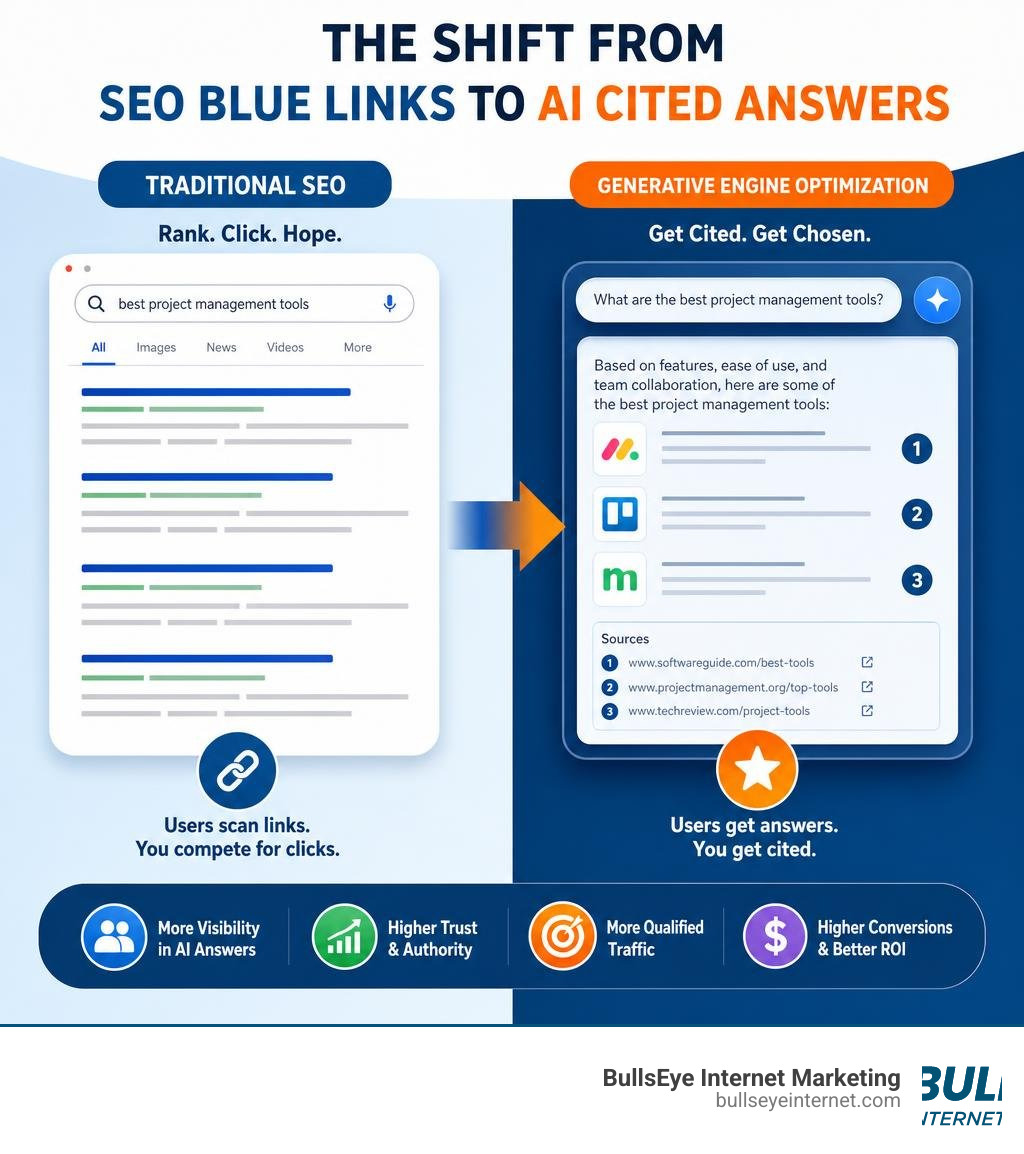
Generative Engine Optimization Services are how brands get cited — not just ranked — inside AI-generated answers on platforms like ChatGPT, Google AI Overviews, Gemini, and Perplexity.
If you’re a business owner wondering whether this matters for you, here’s the short answer:
What Generative Engine Optimization Services include:
- AI Visibility Audit — analyze how AI models currently see your brand
- Entity Authority Building — optimize your presence in knowledge graphs and structured databases
- Content Architecture — restructure content so AI can extract and cite it
- Schema Markup Implementation — help AI crawlers understand your pages
- Digital PR and Citation Building — earn mentions in sources AI models trust
- AI Citation Monitoring — track where and how often your brand appears in AI answers
Search behavior is changing fast. Nearly 65% of users now engage with zero-click search or conversational AI tools. By 2027, an estimated 40% of all search queries will bypass traditional results entirely — going straight to AI-generated answers.
That means your customers may never see a list of blue links at all. They ask an AI. The AI picks a source. If that source isn’t you, it’s your competitor.
The businesses showing up in those AI answers are seeing real results. Companies implementing GEO strategies have reported an 800% year-over-year increase in website traffic from large language models — and AI-sourced traffic converts at rates 12.8x higher than traditional search traffic.
This isn’t a future trend. It’s happening right now.
I’m Ronnie Katz, founder of BullsEye Internet Marketing, and I’ve been helping businesses grow their online visibility since 2006 — and Generative Engine Optimization Services are now a core part of what we do for clients in competitive markets. In this guide, I’ll walk you through exactly how GEO works, what it takes to implement it, and how to choose the right approach for your business.
Explore more about Generative Engine Optimization Services:
The Evolution of Search: Generative Engine Optimization Services
To understand where search is going in 2026, we have to look at how we got here. For decades, search engine optimization (SEO) was about one thing: ranking ten blue links on a Google results page. If you were in the top three spots, you won the game.
Then came Answer Engine Optimization (AEO), which optimized content for voice assistants and featured snippets (also known as “position zero”).
Today, we are in the era of Generative Engine Optimization (GEO). Instead of pulling up a list of websites for you to click through, generative AI search engines synthesize information from across the web, write a custom response, and cite their sources using inline footnotes.
| Feature | Traditional SEO | Answer Engine Optimization (AEO) | Generative Engine Optimization (GEO) |
|---|---|---|---|
| Primary Goal | Rank high in classic blue-link search results | Win voice search and featured snippets (Position Zero) | Earn citations and recommendations inside AI answers |
| Target Platforms | Google, Bing, Yahoo | Google Assistant, Siri, Alexa, Featured Snippets | ChatGPT, Perplexity, Gemini, Google AI Overviews, Claude |
| Content Focus | Keyword density, search volume, meta tags | Question-and-answer format, direct definitions | Passage citability, entity authority, structured facts |
| Core Metrics | Organic rankings, organic click-through rate (CTR) | Snippet ownership, voice assistant share | Citation frequency, AI share of voice, brand sentiment |
| Avg. Conversion Rate | ~2.1% | 5% – 8% | ~27% |
As you can see, GEO is the next logical step in the evolution of digital visibility. While traditional SEO drives traffic to your site, GEO establishes your brand as the authoritative source before a user even decides to click.
To dive deeper into this shift, you can explore the Yolando – Generative Engine Optimization Platform for Growth Marketers resources, which highlight how modern workflows are moving away from keyword tracking and toward conversational intent mapping. You can also Learn more about AEO to see how voice-friendly, Q&A-style content laid the groundwork for modern generative search.
How GEO Differs from Traditional SEO and AEO
Traditional SEO relies heavily on algorithmic ranking factors like keyword placement, backlink profiles, and domain authority. While those still matter, generative engines use a completely different reasoning paradigm.
Large Language Models (LLMs) do not just index words; they understand entities (people, places, concepts, and brands) and the relationships between them. Therefore, GEO focuses heavily on:
- Passage-Level Citability: AI models don’t cite entire websites; they extract and cite specific, highly factual paragraphs.
- Citation Signals: AI models look for clear data points, direct quotes, and verified statistics that they can use to back up their claims.
- Entity Authority: The AI must recognize your brand as a trusted authority on a specific topic within its internal knowledge graph.
If you want to understand how to align your existing digital assets with these new parameters, read our Guide to AI search optimization.
Why Brands Need Generative Engine Optimization Services in 2026
If you are running a business in South Florida—whether you are a service provider in Fort Lauderdale, a medical practice in Miami, or a real estate agency in West Palm Beach—your customers are changing how they find you.
Nearly 65% of all searches are now zero-click, meaning users get their answers directly on the search engine results page or inside a conversational app without clicking a single link. Furthermore, 40% of Gen Z users now prefer searching on conversational AI platforms over Google.
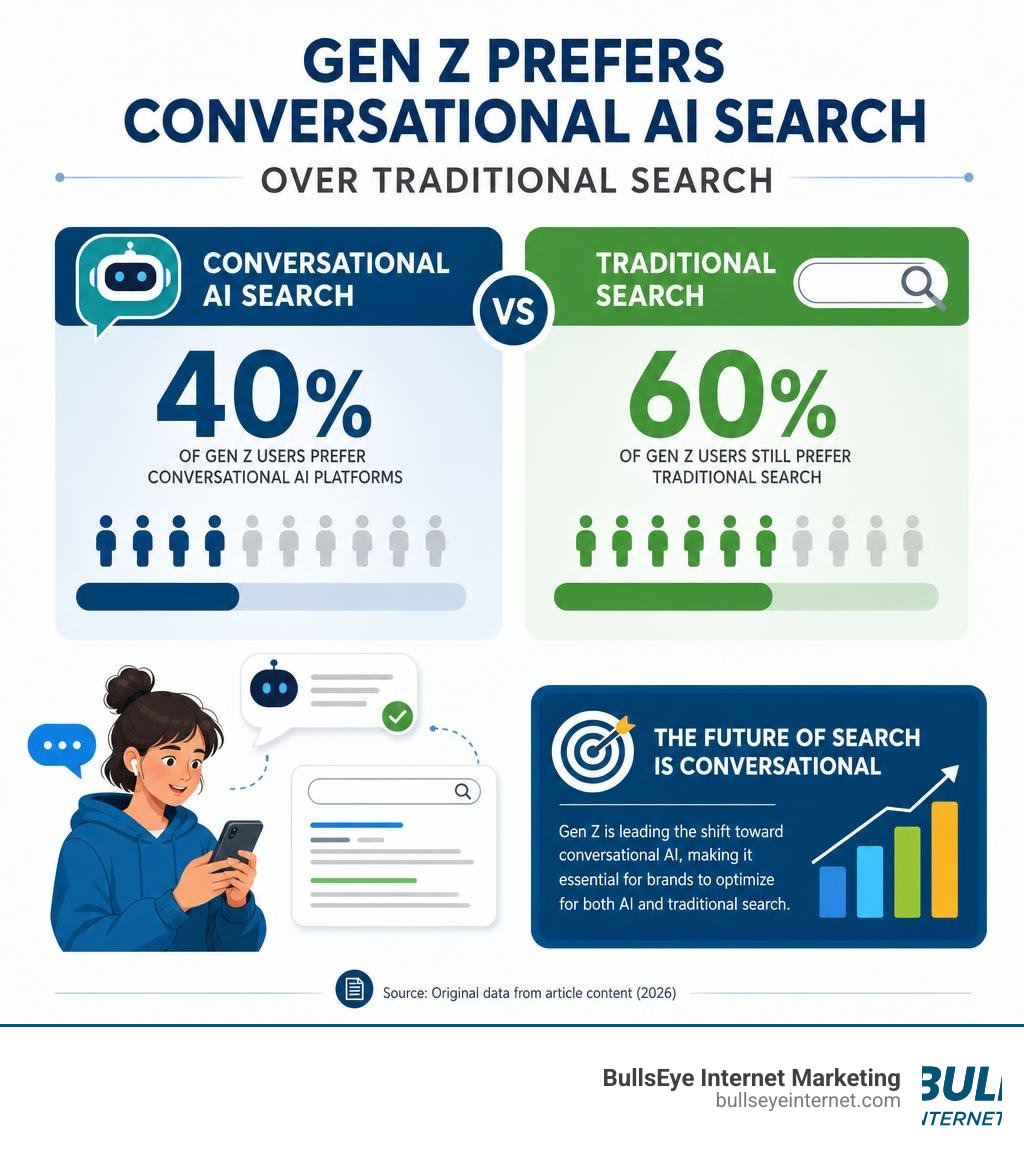
But here is the catch: Google still handles almost 14 billion searches per day (which is roughly 373 times more than ChatGPT). This means you cannot simply abandon traditional search to focus on AI, nor can you ignore AI to focus solely on traditional rankings. You need a dual-optimization strategy.
The foundational Academic research on GEO—originally published in the late-2023 Princeton paper GEO: Generative Engine Optimization—proved that using specific optimization techniques can increase a brand’s visibility in AI answers by up to 40%. The research also revealed that different search engines have unique citation biases:
- ChatGPT pulls heavily from established reference sites, with roughly 48% of its citations linking back to Wikipedia.
- Google AI Overviews relies heavily on community discussions and video, citing Reddit (21%) and YouTube (19%) at high rates.
- Perplexity prioritizes real-time data, drawing heavily from Reddit (46%) and structured review directories like Yelp and TripAdvisor (10%).
Core Tactics and Technical Foundations of GEO
Implementing Generative Engine Optimization Services requires a blend of technical preparation, content restructuring, and authority building.

To get started, we recommend looking at our comprehensive LLM SEO best practices to build a solid foundation. Let’s break down the three core pillars of successful GEO.
Technical LLM Readiness and Schema Markup
Before an AI can cite your website, its crawlers must be able to access and interpret your content. This starts with your robots.txt file. You need to explicitly allow access to AI-specific crawlers like GPTBot (OpenAI), OAI-SearchBot, ClaudeBot (Anthropic), Google-Extended (Gemini), and PerplexityBot.
Additionally, forward-thinking brands in 2026 are deploying llms.txt and llms-full.txt files. Think of these as plain-text sitemaps designed specifically for AI models, providing clean, markdown-formatted summaries of your most important pages.
On the code side, Schema.org structured data is non-negotiable. AI models rely on schema to understand the exact context of your pages. We implement a comprehensive schema framework for our clients, including:
- Organization Schema: Tells the AI exactly who you are, what you do, and where you are located.
- FAQPage Schema: Formats your content in clean Q&A pairs that AI engines can easily extract.
- Product and Review Schema: Feeds real-time pricing, availability, and customer sentiment directly into AI shopping experiences.
For a deep dive into the technical side of these setups, explore our guide on Technical LLM optimization techniques.
Content Architecture and Passage-Level Citability
AI engines do not read websites the way humans do. They scan for clear, structured, and factual passages. To make your content highly citable, you should adopt a definition-first architecture:
- The Direct Answer: Start your articles or service pages with a concise, 2-3 sentence direct definition or answer to the target query.
- Supporting Data: Back up your claims immediately with named statistics, direct quotes from industry experts, and dated claims (e.g., “According to a June 2026 study…”).
- Structured Subheadings: Use a clean H2 and H3 hierarchy with bulleted lists and tables to make the data easy for crawlers to parse.
When you write in this highly structured, authoritative style, you make it incredibly easy for an LLM to lift your paragraph and use it as a cited footnote. Learn more about writing for machines and humans alike in our guide to LLM content creation strategies.
Entity Authority and Digital PR
You can have the most beautifully formatted page on the internet, but if the AI doesn’t trust your brand, it won’t cite you. Trust is established by building Entity Authority.
AI models look at the broader web to verify your claims. They pull from knowledge graphs like Wikidata and Wikipedia, as well as high-authority digital PR placements. If your business is mentioned alongside industry-specific keywords in reputable local publications across Broward, Miami-Dade, or Palm Beach County, the AI connects those dots and recognizes your brand as a trusted local entity.
To build a robust digital footprint that AI models can’t ignore, check out our guide on How to build entity authority.
Measuring Success: Metrics, Timeline, and ROI
Measuring the impact of GEO is very different from tracking traditional keyword rankings. Because AI engines often synthesize answers without generating a click, we must look at a new set of data points.

For a complete overview of auditing your AI footprint, review our LLM SEO audit best practices.
Key GEO Metrics to Track
When we run campaigns for our clients, we look at four main metrics:
- Citation Frequency (or Citation Rate): How often your website is listed as a footnote or source in response to target prompts.
- AI Share of Voice (SoV): The percentage of times your brand is recommended or mentioned compared to your direct competitors for a specific group of queries.
- Brand Sentiment: Whether the AI describes your brand in a positive, neutral, or negative light when summarizing reviews.
- Referral Traffic and Assisted Conversions: Tracking the direct clicks coming from AI engines (like
chatgpt.comorperplexity.ai) and measuring how those visitors convert on your site.
To understand how these metrics correlate with actual search visibility, read our resource on How to measure AI search visibility.
Timeline and ROI Expectations
Because AI search databases are updated frequently, GEO can actually yield results much faster than traditional SEO.
- Weeks 2 to 4: Well-established brands often see their first new citations appear in search-enabled AI models.
- Months 3 to 6: This is the typical timeline to establish a strong, compounding presence across ChatGPT, Gemini, and Google AI Overviews.
The return on investment for GEO is incredibly high because of the search intent. A user asking an AI “What is the best commercial HVAC repair service in Fort Lauderdale?” is very close to making a purchase decision.
In fact, typical AI-sourced traffic converts at rates 12.8x higher than traditional search, with enterprise clients seeing AI-generated citations influence up to 32% of their sales-qualified leads. To learn more about turning AI search visibility into actual phone calls and closed deals, read about Generative AI lead generation.
How to Evaluate GEO Tools and Agencies
Because GEO is a relatively new discipline, the market is flooded with software and service providers. It is critical to know what to look for so you don’t end up buying rebranded, outdated SEO services.
When vetting agencies, you can consult the Top GEO agencies on Clutch to see verified reviews and industry rankings.
Selecting the Best Generative Engine Optimization Services for Your Business
Whether you choose to use software in-house or partner with an agency, look for these essential capabilities:
- AI Crawler Analytics: The ability to verify if your site is being crawled by GPTBot, ClaudeBot, and others.
- Multi-Model Tracking: Monitoring your brand’s visibility across ChatGPT, Gemini, Perplexity, and Google AI Overviews simultaneously.
- Persona-Driven Prompts: Testing how AI responds to conversational, long-tail questions that real buyers actually ask, rather than just single keywords.
- Ongoing Competitive Intelligence: Tracking your competitors’ share of voice inside AI answers so you can exploit gaps in their coverage.
For a complete framework on how to choose the right partner, consult our LLM SEO agency guide.
Future Trends: The Search Landscape Through 2027
As we look toward 2027, several major trends are shaping the future of conversational search:
- Query Fanouts: Answer engines are becoming highly sophisticated. If a user inputs a broad prompt like “Which business bank account is best for startups?”, the AI will autonomously run multiple sub-queries behind the scenes to gather real-time data before compiling its final, cited answer.
- AI Shopping Experiences: Platforms are integrating direct shopping capabilities. If your product schema, specifications, and FAQs aren’t optimized, your products won’t be pulled into conversational product comparisons.
- Multimodal Search: More users are searching using images, voice, and video. AI models will increasingly cite video timestamps (especially from YouTube) and image sources.
To stay ahead of these rapid shifts, read up on Next-gen SEO trends or check out Industry insights on LinkedIn to see what top industry experts are saying about the evolution of conversational search.
Frequently Asked Questions about GEO
How long does it take to see results from GEO?
For established brands with existing digital authority, initial citations can appear within 2 to 4 weeks. For newer brands or highly competitive niches, it typically takes 3 to 6 months of consistent entity building and content optimization to establish a strong, compounding presence across major AI platforms.
Do I still need traditional SEO if I invest in GEO?
Absolutely. Traditional SEO and GEO are highly complementary strategies. Google still drives over 90% of global web traffic, and generative engines pull their real-time data directly from top-ranking organic search results. A strong traditional SEO foundation is a prerequisite for earning high-quality AI citations.
How do AI engines decide which brands to cite?
AI engines prioritize sources that demonstrate high factual accuracy, clear entity authority, and clean technical formatting. They look for structured data (like schema markup), clear passage-level answers, verified statistics, and strong off-page trust signals (such as high-quality backlinks and digital PR mentions).
Conclusion
The search landscape is changing, but the goal remains the same: putting your business in front of ready-to-buy customers at the exact moment they are looking for you.
At BullsEye Internet Marketing, we don’t believe in vanity metrics or locking you into long-term contracts. We specialize in generating real phone calls and sales through highly targeted digital marketing campaigns.
To give our clients a true competitive advantage, we work with only one client per industry per geographic area. Whether you are in Miami, Fort Lauderdale, Boynton Beach, Delray Beach, West Palm Beach, or anywhere else in South Florida, we make sure you own the local search market—both on traditional Google search and in the conversational AI answers of tomorrow.
Ready to protect your search equity and claim your share of voice in ChatGPT, Gemini, and Google AI Overviews? Get started with our comprehensive AEO and GEO services today.
